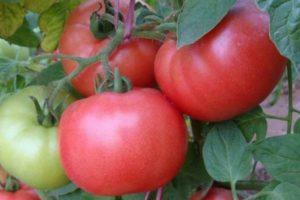
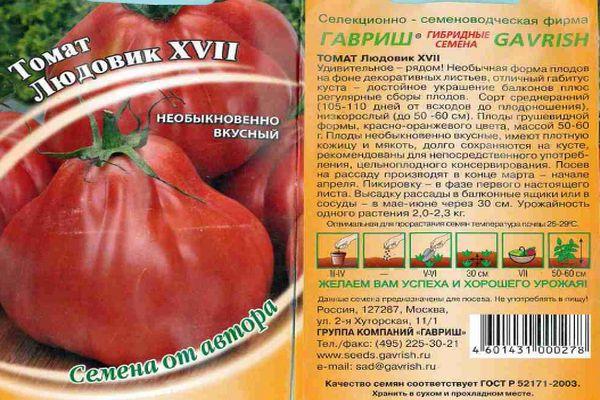
The Louis 17 tomato, whose description indicates it can be grown both outdoors and under cover, is included in the State Register of Breeding Achievements. These tomatoes are distinguished by their pear-shaped form, excellent flavor, and medium ripening time.
Advantages of the variety
The determinate tomato Louis 17 develops a bush with a strong stem 50-60 cm tall during the growing season. Its characteristics make it suitable for cultivation in open ground and greenhouses.
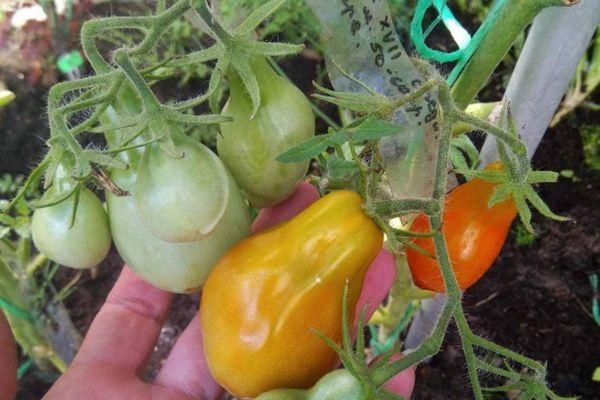
The leaves are small and deep green. The first flower stalk appears at the 8th or 9th leaf, and subsequent clusters of branched inflorescences are spaced 1-2 leaves apart. The tomato stalk is articulated.
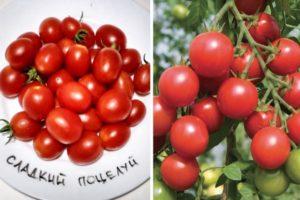
This mid-season variety begins bearing fruit 105-110 days after sprouting. Ripe tomatoes are bright red with orange hues. The shape of the fruit resembles a pear.
Description of fruits:
- The weight of tomatoes reaches 70-80 g.
- When cut horizontally, 2-3 chambers with seeds are observed.
- When grown under film covers, the yield is 6-7 kg per 1 m².
- The tomatoes have dense flesh and a classic taste.
- The fruits are stored well and can be transported over long distances.
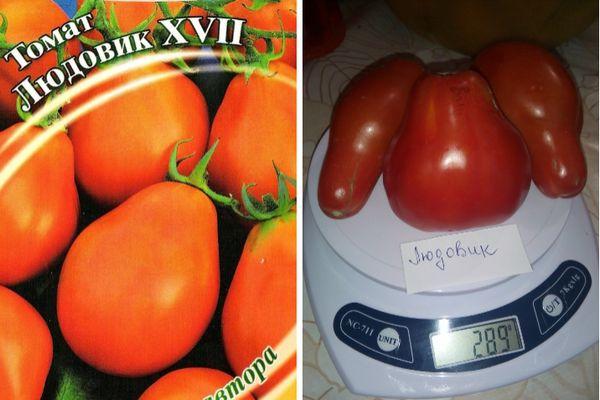
Vegetable growers' reviews attest to the variety's consistent yield, distinctive shape, and excellent taste. In cooking, these tomatoes are used fresh, in salads, and for canning.
Agricultural technology of cultivation
The tomato cultivation process begins with sowing seeds for seedlings 60 days before the expected planting date. The seeds are placed 1 cm deep in containers with prepared soil mixture and watered with warm water.
To ensure uniform sprouting and the formation of strong seedlings, it's important to ensure the correct temperature. Fluorescent lamps are used to compensate for the lack of light needed for seedling development. They extend daylight hours to 16 hours.
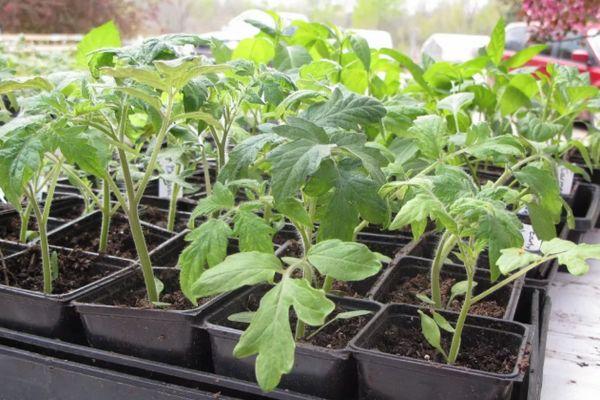
When the second true leaf is forming, the plant is pricked out. Planted in a separate container, the plant develops a strong root system and a powerful stem.
To ensure the crop's endurance and improve immunity, seedlings are hardened for 7-10 days before planting in the ground. On the first day, the seedlings are taken out for 15-30 minutes, gradually increasing the time to 8 hours.
Plant 7-9 bushes per square meter. Plant care includes fertilizing with mineral and organic fertilizers. Complex preparations that provide the plants with the necessary nutrients are recommended for application after replanting, during flowering, and during ripening.
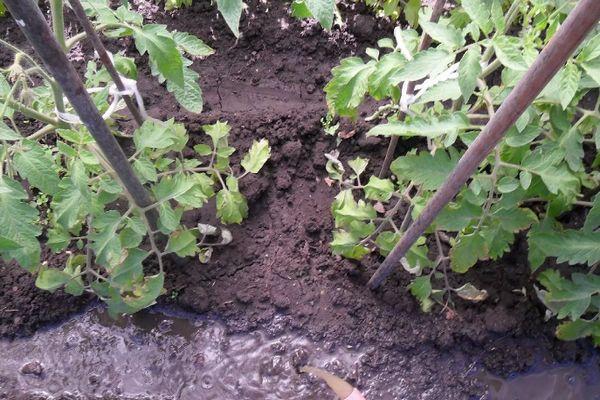
To stimulate root development and maintain moisture and air balance, hilling and loosening are used. Timely weed removal reduces the risk of biological pests.
Water the bushes after sunset, applying warm water at the roots. To ensure drip irrigation and prevent weed growth, mulch the soil with fiber.
Using straw and leaves as mulch enriches the soil with organic components essential for tomato development. Adherence to proper agricultural practices ensures high crop productivity.
The key to a bountiful harvest is proper tomato management. Bush formation begins when the seedlings are young, during the period when lateral shoots are forming in the leaf axils.
Side shoots are removed by hand to ensure the plant uses the nutrients for fruit formation and flower stalks. The first removal of side shoots is done two weeks after planting the seedlings in their permanent location. Subsequent procedures are repeated periodically, every 10-12 days.
This variety's distinctive feature is the formation of clusters after the main shoot ceases growing. To prolong the fruiting period, the growing point is transferred to a lateral shoot. It is recommended to combine the initial shoot removal with tying to a support to remove all excess shoots before flowering.
Tomatoes require sunny locations. To ensure proper plant development, carefully prepare the soil, enriching it with organic fertilizers.
Related posts:
 When and how to properly transplant tomato seedlings, the best days in 2025
 How to propagate and grow peas, cultivation technology, and care in open ground
 Methods for planting and propagating cherries at home
 The best grape varieties for growing in the Urals, planting and care rules in summer
 Description of varieties of sowing peas and cultivation, to which family they belong
 The best eggplant varieties for growing in a polycarbonate greenhouse: planting and care
 Causes and treatment of cherry diseases, methods of pest control
 How to properly plant peas in a greenhouse and open ground