
The Trans Novinka tomato belongs to a group of mid-season varieties. It doesn't require staking or shaping. Trans Novinka is registered in the State Register of Russia for the Nizhnevolzhsky District. The berries are used in salads and canned for winter.
Some technical data
The characteristics and description of the variety are as follows:
- The plant produces its first harvest 100-110 days after planting the seedlings in permanent soil.
- The height of a tomato bush ranges from 0.5 to 1.0 m. Small leaves, colored in light shades of green, grow on the stem.
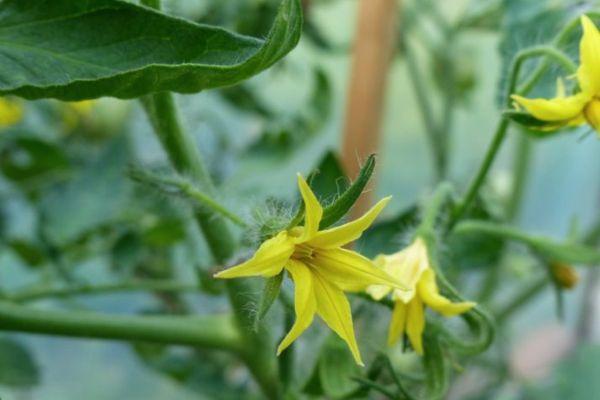
- The plant has simple inflorescences, the first of which appears above the 7th or 8th leaf, and all subsequent ones grow through 2 leaves.
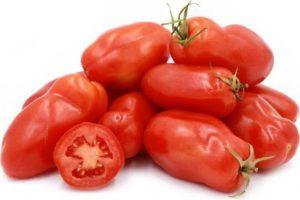
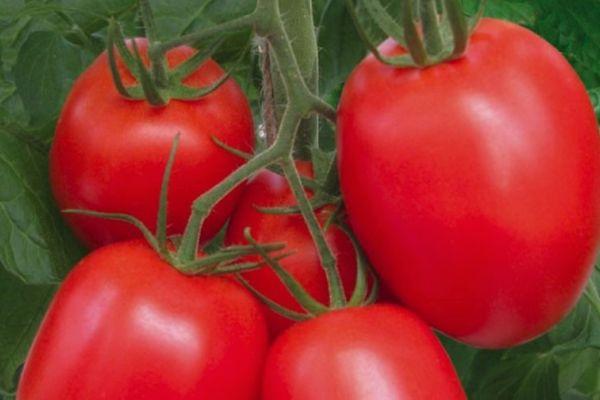
- The fruits are medium-sized. They are cylindrical, elongated toward the bottom, and have a pointed tip. They weigh between 80 and 100 grams. Ripe berries are red. They have a sweet taste. There is no green spot near the stalk.
- Tomatoes have firm flesh and thick skin, so they don't crack during pickling. When storing in jars, they are cut into wedges.
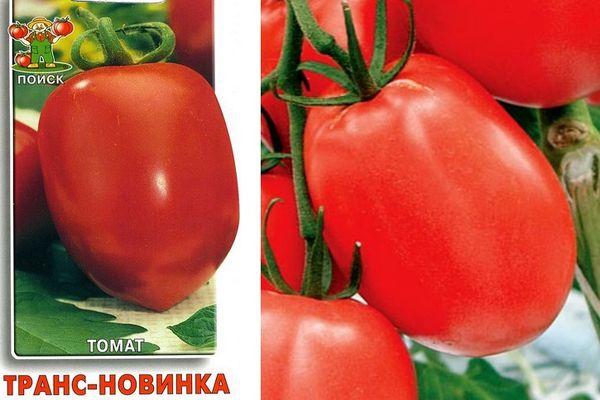
Feedback from farmers who have planted this tomato variety indicates that, in commercial production, the variety yielded 200 tons per hectare. Trans Novinka has moderate immunity to diseases such as fusarium wilt, Egyptian broomrape, tobacco mosaic virus, and blossom-end rot.
Gardeners who have grown this variety claim that the fruit can be stored in a cool place for up to 30 days. The berries can be transported over any distance, as they can withstand the mechanical stresses encountered during transport. Trans Novinka is well suited for mechanical harvesting and has a stable yield. Farmers in private gardens have been able to harvest 8-9 kg of berries from each bush.
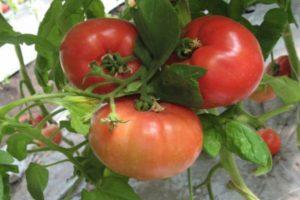

Trans new product grows well in open areas in the southern regions of Russia. growing tomatoes in the central zone or Siberia a greenhouse or hotbed will be required.
Growing seedlings yourself
The seeds are treated with a potassium permanganate solution and then placed in peat pots. The seeds are planted 15-20 mm deep and watered with warm water. This process is most often performed in mid-March.
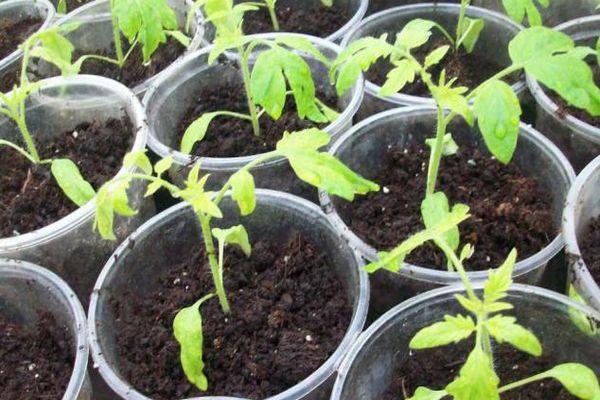
After 10 days, the first shoots appear. They are fed with organic or complex fertilizers. The container with the shoots is moved under electric lamps or placed in a bright spot. After one or two leaves appear on the plants, they are pricked out.
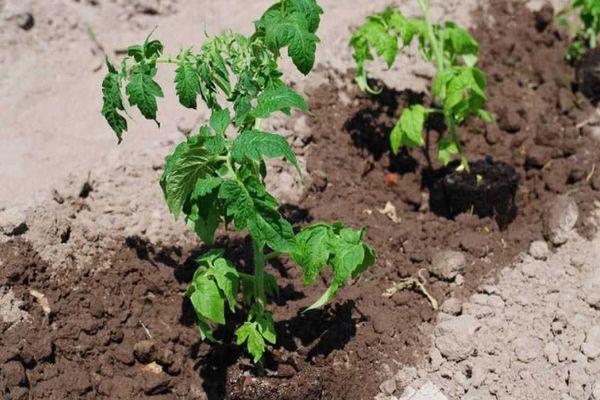
The seedlings are transplanted to their permanent soil in mid-May. To do this, the beds are loosened and organic or nitrogen fertilizers are added to the soil. The bushes are planted in a 0.7 x 0.6 m pattern.
The planting area must be well-lit. Trans Novinka requires warmth to produce a stable harvest. This is more important than soil moisture.
If the bushes are planted in a greenhouse, the farmer must monitor the humidity in the room. It should not exceed 60-65% in the first weeks after transplanting the seedlings. Subsequently, it is recommended to maintain humidity around 60%, otherwise the plants will have poor pollination and may become diseased. Trans Novinka grows best in loamy soil, which contains humus and nutrients.
Caring for bushes before harvesting
It's recommended to fertilize tomato plants 3-4 times during the growing season. Initially, the bushes are fed with nitrogen and organic fertilizers when transplanting. This helps the tomato plants gain green mass. Then, when the plants begin to bloom, they are given potassium and nitrogen mixtures. After this, the bushes can be fed with potassium and phosphorus during the period of full bloom. When the first fruits appear on the branches, the bushes are fed with complex fertilizers containing nitrogen, phosphorus, and potassium.
Water the tomato plants with warm water that has been left to stand in the sun. Water 1-2 times a week. This procedure is carried out before sunrise, early in the morning. If the gardener is unable to water at the appointed time, the procedure is postponed until late evening. Care must be taken to prevent moisture from coming into contact with the plant leaves, as this can cause sunburn.
Loosening and mulching the soil helps prevent some fungal diseases. Weeding protects tomatoes from insect infestations that feed on weeds.
To protect against diseases, it is recommended to treat the bushes with products such as Fitosporin. This preventative measure will prevent fungi and bacteria from damaging the tomato plants. Alternatively, you can use traditional methods such as treating the plants with copper sulfate.
When various garden pests, such as Colorado potato beetles, mites, aphids, or other insects, appear on tomato leaves and stems, they are destroyed with poisonous substances, soapy water, or herbal decoctions and infusions.
Related posts:
 Characteristics of the Trans Rio tomato and cultivation techniques
 Description of the Novinka Pridnestrovie tomato, growing seedlings and yield
 The best eggplant varieties for growing in a polycarbonate greenhouse: planting and care
 Description of the best varieties of black tomatoes for open ground and greenhouses
 Description and cultivation of the Elizabeth strawberry variety, planting and care
 Why tomato seedling leaves may wilt and curl, and what to do about it
 Description and characteristics of the Chocolate tomato variety, cultivation technology
 Description of the hybrid tomato Vladimir f1, growing seedlings and caring for bushes