
Blossom-end rot of tomatoes is a non-infectious disease that affects both greenhouse and open-field plants. When blossom-end rot occurs, yields are reduced so significantly that gardeners consider it more dangerous than late blight or early blight.
Why does blossom end rot occur?
For a long time among the reasons tomato diseasesParasitic fungi and bacteria were considered in peppers and other nightshade crops. When late blight, Alternaria, and other saprotrophic fungi were detected on affected fruits, blossom-end rot was attributed to infection by these pathogens. But the situation turned out to be much simpler.
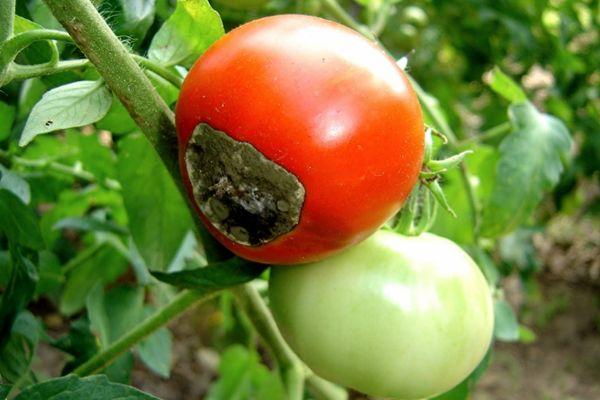
Currently, the main cause of blossom-end rot in tomatoes is considered to be calcium deficiency at the top of the fruit. In practice, this means that the tomato fruit is not receiving enough calcium salts, which are essential for the growth and division of the cells that make up the flesh and skin of the tomato. The top of the fruit is the part of the fruit furthest from the stalk. It suffers the most from a general deficiency of the nutrient. This is why blossom-end rot affects all the fruits on a bunch, causing the gardener to lose a large portion of the harvest.
Calcium deficiency can occur for several reasons, which in this case are considered risk factors for the development of the disease:
- Insufficient moisture. This simply prevents the micronutrient from being absorbed from the soil in sufficient quantities.
- Salinity or increased acidity of the soil on the site. This occurs due to excess and stagnant moisture in low-lying areas, close groundwater tables, and poor drainage. At the same time, the soil itself contains little calcium.
- Root system damage. When caring for plants, the root system can be damaged unnoticed by loosening the soil, removing weeds, or by carelessly applying granular mineral fertilizers or fresh organic matter. In any case, the root system's ability to absorb nutrients from the soil is reduced, resulting in moisture and mineral deficiencies.
- Stressful situations. These include watering with cold water in hot weather (roots temporarily lose their ability to absorb water), sudden temperature changes in the greenhouse (drafts), and changing weather conditions in the open ground (hail, cold snaps after a hot period).
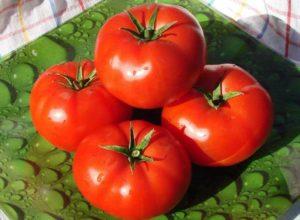
Gardeners who collect exotic varieties face another specific risk: growing extremely elongated tomatoes (Havana, Banana, Pink Flamingo) and giant beefsteak tomatoes. In these cases, blossom-end rot can be a natural consequence of the fruit's size.
Signs of blossom-end rot
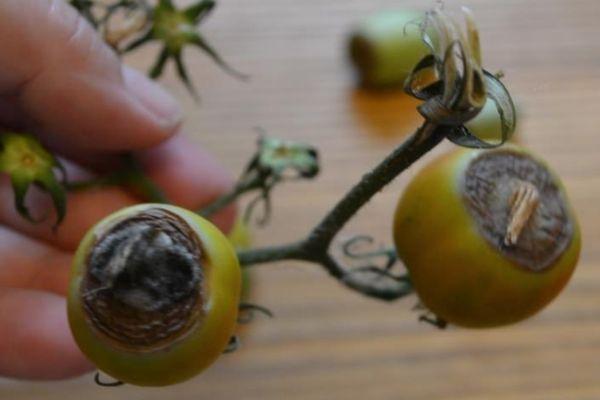
By identifying the onset of the disease early, you can try to combat it and save at least part of the harvest. Blossom-end rot affects tomato fruits, starting at the flower-head attachment. For most varieties, this area is out of sight, so if risk factors exist, it's important to regularly inspect the tomatoes by carefully lifting the bunch.
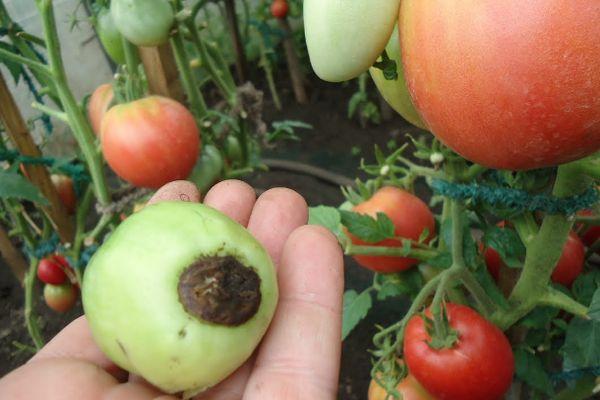
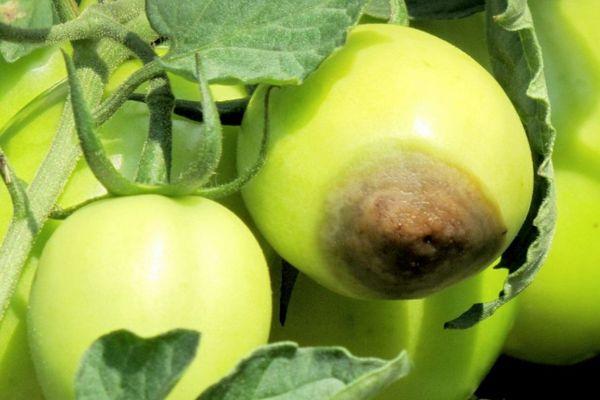
At the very onset of the disease, a watery, barely noticeable spot appears on the top of the fruit. Over time, the skin above it becomes dry and brownish. The surface appears slightly sunken inward in round tomatoes, while in "nose" varieties, the protrusion at the top is absent.
The amount of external damage to the skin may be relatively small, but more significant changes occur underneath the shell:
- various fungi and bacteria settle on the affected part of the skin and penetrate into the fruit;
- the tomato flesh darkens and then rots;
- As fungal hyphae (late blight, downy mildew, and others) penetrate the seed chambers, the seeds are also affected.
The fruit on which blossom-end rot develops begins to ripen earlier than its neighbors.
How to treat blossom-end rot on tomatoes?
If the disease has just begun to appear and has affected only 1-2 fruits per cluster, the situation can be corrected by providing the plants with adequate moisture during dry and hot summers. It is recommended to water tomatoes both indoors and outdoors so that the soil dries out to a depth of only 2-3 cm.
To reduce evaporation and overheating, mulch the soil under bushes with wood shavings, sawdust, straw, or other materials. If the soil has a normal balance of nutrients, this measure may be sufficient to restore the plants' health.
If the disease is caused by a disturbance in the mineral composition of the soil, action must be taken in two directions at once:
- eliminate calcium deficiency in a short time to save the current season's harvest;
- Ensure that the necessary fertilizers are applied during autumn digging to prevent blossom-end rot next year.
Take a look Also
To properly and effectively combat the disease, it is necessary to use chemicals and fertilizers containing substances necessary for plants.
How to treat tomatoes?
Brexil Ca (15% calcium and 5% boron) is suitable for rapid treatment of affected plants and the prevention of blossom-end rot. It is used as a foliar fertilizer. A solution is prepared by mixing 10 g of the product with 10 liters of water. Tomato plants affected by blossom-end rot are sprayed once every two weeks.
Treatment with an ash solution also helps, as it reduces acidity and ensures the supply of calcium, phosphorus, potassium, and other important elements to the soil:
- sift ash from burning wood or plant debris;
- take 300 g of the resulting powder (2 cups) and pour boiling water (1 l);
- Leave the mixture to cool (about 30 minutes) and mix with 10 liters of irrigation water;
- Apply 1 liter of fertilizer to each tomato bush, watering it at the roots.
You can also carry out foliar feeding by spraying tomato bushes with ash water mixed with laundry soap (50-60 g per 10 l).
Control measures for blossom-end rot may include:
- Apply calcium nitrate at a rate of 1 liter of working solution per plant. The solution is prepared using 7-10 g of the product per 10 liters of water.
- Mix calcium chloride with water in a 1:1 ratio and use the solution for feeding or spraying once every 2 weeks.
- Washing soda (sodium carbonate) contains some soluble calcium. Apply as a solution at a rate of 1.5 tablespoons of powder per 10 liters of water (0.5-1 liter per plant).
- Ground chalk (construction or poultry feed) is diluted in irrigation water at a rate of 100 g per 1 liter. The mixture is then used to water the soil under tomato plants if blossom-end rot has appeared.
Other methods are used to prevent the disease.
How to prevent rot?
Prevention of the disease should be carried out taking into account the characteristics of your site:
- In a garden with dense, heavy soil prone to acidification, liming is necessary. For this, use dolomite and bone meal, ground chalk, and slaked lime, applying the substances at a rate of approximately 1 kg per 1 m² during autumn tillage. Liming can also be done in the spring.
- A swampy area needs to be well drained, and if this is not possible, create raised beds filled with light-textured soil with the addition of lime-containing substances.
- In a greenhouse, blossom-end rot is often caused by a lack of water. If the soil in the tomato bed is dry and loose, like sand, it should be slightly heavier with sod or garden soil. To reduce acidity, add chalk or dolomite flour, and to reduce evaporation, mulch the soil after planting.
If you balance the soil composition and water the plantings on time and in sufficient quantities, blossom-end rot of tomatoes will not appear in the garden. It is not caused by infectious factors, so it can be prevented by providing good care for the plants.
Related posts:
 What is the best way to feed tomato seedlings to make them plump?
 What fertilizers and when to use for feeding tomatoes in a greenhouse
 What is the best way to mulch tomatoes in open ground and greenhouses?
 The best eggplant varieties for growing in a polycarbonate greenhouse: planting and care
 How to prepare tomato seeds for planting seedlings
 Description of tomato diseases and their treatment, how to process them
 Description of the best varieties of black tomatoes for open ground and greenhouses
 The best and most productive tomato varieties for greenhouse cultivation in the Urals, with descriptions
I'm so glad you have some helpful tips. This is the second year my beautiful tomatoes have been showing blossom-end rot, and I can't figure it out... Thank you again for the clear post.
Thank you very much, dear Galina, for your kind review. We are happy to work hard for you and our other readers.
I only have one variety affected by blossom-end rot. The same thing happened last year to tomatoes of this variety! I sowed them with last year's seeds (store-bought). I learned from an article that it can be transmitted through seeds!
Thanks for the tip! I got some calcium chloride out of the cupboard and watched the first video I saw…it was spot on! Now I'm off to spray! Today I picked a lot of tomatoes with blossom-end rot, and only on one variety*** with very juicy leaves.