
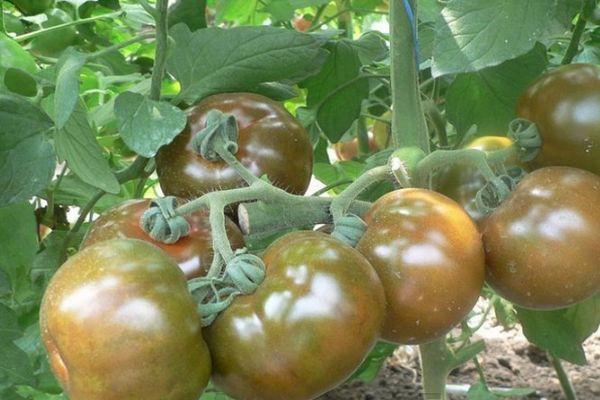
The Ashkelon f1 tomato belongs to the first-generation hybrid group. It can be grown in the southern regions of Russia, as well as in the vast central and northern regions. The fruits of this variety are considered the most delicious of all dark-colored tomatoes. Ashkelon tomatoes can be transported over long distances. They are eaten fresh, as the tomato's thin skin does not tolerate heat treatment during canning. Heat can cause the skin to crack or become completely deformed.
Characteristics and description of the variety
The characteristics and description of the Ashkelon variety are as follows:
- The first harvest can be obtained 100-105 days after sowing the seedlings.
- Hybrid bushes grow up to 160-170 cm in height. It is recommended to tie the bushes to sturdy supports. The plants develop a large number of leaves.
- The first ovary appears above the 8th leaf, and the next ones develop every 3 leaves.
- The hybrid is resistant to diseases such as verticillium wilt, tobacco mosaic virus, fusarium wilt, microbial damage, and yellow leaf curl.
- According to farmers' reviews, the Ashkelon hybrid tolerates drought well and is cold-resistant. Tomatoes of this variety are highly resistant to fruit rot. Garden pests rarely attack the hybrid.
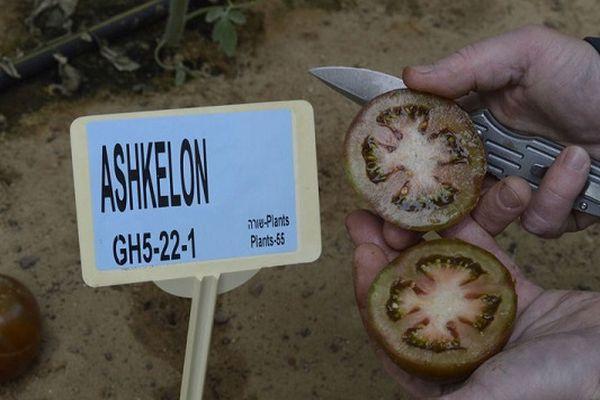
- Description of the Ashkelon variety: The tomatoes are round in shape and dark brown in color. The skin is smooth, and the flesh is quite firm.
- The weight of the fruits ranges from 0.2 to 0.25 kg.
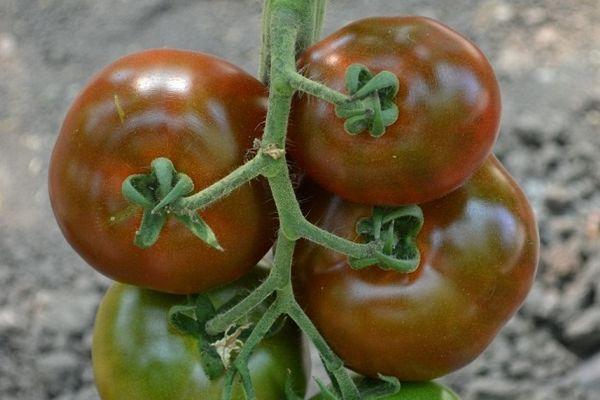
Reviews from farmers growing this hybrid indicate that the average yield is 10-18 kg of fruit per square meter of garden bed. Retailers readily purchase Ashkelon from farmers because of its attractive appearance and good transportability.
How to grow tomatoes in your garden
Hybrid seeds are purchased from seed farms or specialized agricultural stores. The seeds are treated with a potassium permanganate solution or aloe vera juice. They are then sown in containers pre-fertilized with organic fertilizer.

The optimal time for sowing seeds for seedlings is mid-March. Before sowing, it is recommended to harden the seedlings for 14 days. This will increase their immunity and ability to withstand adverse weather conditions.
After the sprouts have sprouted and 1-2 leaves have appeared on them, the seedlings are picked. Before transplanting seedlings into permanent soil, it is recommended to feed them with mineral fertilizers 2 or 3 times.
The seedlings are transferred to a greenhouse in mid-May. If Ashkelon is to be grown outdoors, the transplanting process to permanent soil occurs in the first ten days of June. By this time, the seedlings will already have 6-8 leaves. The plants must receive ample sunlight. Failure to do so will cause the fruit to lose its color and flavor.
To increase yield, it is recommended to train the bushes into a single stem and regularly remove side shoots. To prevent the plants from dying, fertilize them 2-3 times (before and after ovary formation, and then fruiting) with complex mineral fertilizers. Regular weeding is also recommended.
Water with warm water early in the morning, 2-3 times a week. To eliminate insect larvae from the roots and ensure free oxygen access to the root system, regularly loosen the soil under each bush.
If, despite the resistance of the tomato variety described to attacks by garden pests, they manage to multiply on the bushes, it is recommended to eliminate the threat by treating the tomato leaves with chemicals.
Related posts:
 What varieties of tomatoes are best to plant in a polycarbonate greenhouse?
 Description and characteristics of the 30 best hazelnut varieties, cultivation
 Description and characteristics of the most productive varieties and hybrids of corn
 80 Best Eggplant Varieties for Different Regions with Descriptions and Characteristics
 TOP 30 best varieties of cold-resistant cucumbers with descriptions and characteristics
 Description of the best tomato varieties for greenhouses in the Kirov region
 Description of the best Dutch tomato varieties for greenhouses and open ground
 TOP 40 best late-season cucumber varieties for open ground with descriptions
