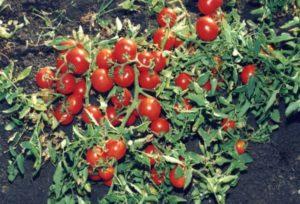
The Titan tomato was developed 30 years ago by breeders in the Krasnodar Territory and is included in the State Register with recommendations for outdoor cultivation. Its small bushes are distinguished by their abundant production of versatile fruits.
Advantages of the variety
The Titan tomato was developed in the early 1980s and was bred by Russian agrobiologists. The variety is included in the State Register with recommendations for cultivation in open ground conditions.

The characteristics and description of the variety indicate a standard determinate type of plant. This means that the bush's development is complete after a certain number of clusters have formed. A cluster of tomatoes always remains at the top of such a plant.
During the growing season, a sturdy bush 40-50 cm tall develops. The plant has a strong central stem and large leaves. The bush produces a moderate number of shoots that do not require removal.
The first flower cluster appears at the level of the 5th to 7th leaf, with subsequent flower stalks forming at intervals of every two leaves. The variety's description indicates late ripening, with the bushes beginning to bear fruit 120 to 135 days after germination.
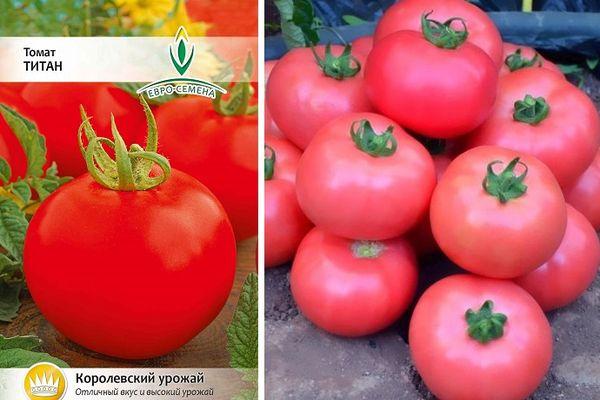
The Titan variety yields 3-4 kg per plant. Fruit weight reaches 80-150 g. The fruits are prone to cracking when ripe. The tomatoes are round, with a smooth surface, and turn red when ripe.
Titan tomatoes are distinguished by their fleshy pulp, thick skin, and excellent flavor. They withstand long-distance transportation well. In cooking, these tomatoes are used fresh, in sauces, and for canning.
A horizontal cut reveals chambers containing a small number of seeds. The Titan tomato is susceptible to late blight, macrosporiosis, and septoria, and is also prone to stolbur, a disease that causes the stem to harden and damage the fruit.

The variety tolerates moisture deficiency well, thanks to its adaptation to cultivation in the conditions of southern regions.

Tomato with improved properties
To improve the quality of the Titan variety, work has been carried out in recent decades to breed tomatoes with improved properties. The new tomatoes are free of the previous shortcomings.
The improvements resulted in a new variety called Pink Titan. The basic characteristics remain similar to the original Titan tomato, but the ripening period has been shortened. From the first shoots to fruiting, standard determinate bushes take 100-115 days.

Compared to the original variety, Pink Titan is distinguished by increased yield (almost 3 times), resistance to nightshade diseases and unfavorable climatic conditions.
Reviews from vegetable growers indicate that by following agricultural practices, a high yield can be achieved per bush.
Agricultural technology for growing tomatoes
Seedlings should be grown 65-70 days before the expected planting date. Before planting, treat the seeds with aloe juice and a growth stimulant.
Make 1-cm-deep furrows in a container with prepared soil and sow the seeds. After watering with warm water using a spray bottle, cover the container with plastic wrap until the seedlings emerge.

The development of healthy seedlings depends on lighting conditions, so seedlings should be placed in a sunny location. Fluorescent lamps are used to increase daylight hours.
It is recommended to periodically feed the seedlings with a complex fertilizer. When one or two true leaves have formed, transplant them into individual containers filled with substrate.
Peat pots can be used for planting, making it easy to transfer seedlings into the ground. Using these types of containers helps protect the root system from damage and facilitates the plant's adaptation to new growing conditions.
When planting in a permanent location, consider crop rotation. The best predecessors for tomatoes are zucchini, cucumbers, carrots, and cauliflower.

 The planting scheme provides for the placement of 5-6 bushes per 1 m².
A distinctive feature of the Titan tomato variety is the low position of the first flower cluster and its growth cessation after 4-5 flower stalks have formed. Therefore, given the biological properties of the determinate variety for inflorescence formation on the main shoot, the growing point is moved to a lateral stem. This significantly increases yield and extends the fruiting period.
Vegetable growers recommend removing excess shoots before the first cluster blooms.
Agricultural care guidelines for tomatoes call for moderate watering. Plants are watered with warm water at the roots as the surface soil dries.
Mulching is used to ensure even moisture distribution and prevent weed growth. Non-woven black fiber is used for this purpose. Hilling the bushes ensures proper root development. Periodic loosening of the soil helps regulate moisture balance and ensures air access to the root system.

The use of organic materials (hay, straw, leaves, wood shavings) is necessary for additional nutrition of the crop. During the growing season, mineral and organic fertilizers are required. During the active growth stage, fertilizers containing potassium and phosphorus are required. Tomato cultivation requires preventative measures against fungal diseases.
Anyone who has planted Titan tomatoes can attest to the fact that growing them requires a titanic effort. It's important to consider that tomatoes don't adapt to cold temperatures and are susceptible to biological pests.
Related posts:
 Description and characteristics of the Titan Pink tomato variety
 Composition and instructions for use of the fungicide Titan, application rates and analogues
 Description of the best tomato varieties for open ground in the central zone
 Description and characteristics of the best seeds of pea varieties and types
 The best grape varieties for growing in the Urals, planting and care rules in summer
 How to propagate and grow peas, cultivation technology, and care in open ground
 80 Best Eggplant Varieties for Different Regions with Descriptions and Characteristics
 The ripening time of grape vines by variety, how to speed up the process, and what to treat the plant with