
- How do peonies overwinter?
- When to start preparing for cold weather by region
- In the Leningrad region
- In Siberia
- In the Urals
- In the Moscow region
- What you need to know for successful overwintering of flowers
- When and how to prune flowers
- Addition of nutrients
- Prevention of diseases and pests
- The nuances of autumn care for different types of peonies
- ITO hybrids
- Grassy
- Tree-like
- How and with what to cover peonies for the winter?
- The danger of freezing and cooling of plants
Peonies are spectacular perennials that adorn the gardens of many Russian gardeners. These flowers are considered native to China, from where they spread throughout the world. They are low-maintenance, but regular watering, fertilizing, and disease and pest prevention are key. Peonies are perennials, growing in the same location for up to 30 years, so preparing them for winter requires special attention.
How do peonies overwinter?
Peonies are among the most frost-hardy plants, requiring no bulky shelter. The key is to complete all recommended gardening procedures before the onset of cold weather. Autumn activities and preparation for winter vary depending on the growing region. The variety also influences the plant's ability to tolerate low temperatures.
When to start preparing for cold weather by region
Each region has its own unique climate. These factors directly influence the timing of preparations. If you miss the recommended time, the peonies will freeze over the winter and won't bloom abundantly with the first warm days.
In the Leningrad region
The Leningrad Region's climate is unpredictable. The first frosts can occur as early as early November, so experienced gardeners recommend completing all gardening work no later than the end of October.

In Siberia
Since winter arrives early in Siberia, all preparatory work for peonies begins in September. It's important to complete this work before the first significant cold snap, which typically occurs in early October. Furthermore, if the peony variety isn't sufficiently frost-hardy, it should be covered with additional materials, and this should only be done in dry weather. It's crucial to follow these deadlines, otherwise the flowers won't survive the cold season.
In the Urals
In the Ural region, the necessary agricultural procedures are carried out from mid-September to mid-October.
In the Moscow region
It's recommended to complete all necessary work to prepare peonies for winter two weeks before the onset of sustained cold weather. This work begins in late September and continues until the end of October.


What you need to know for successful overwintering of flowers
To ensure your peonies survive the cold season and delight you with spectacular buds, it's important to learn the rules for preparing flowers for winter. Neglecting any step can result in your favorite variety failing to survive the frosts.
When and how to prune flowers
The procedure is quite laborious, but extremely necessary. If pruning is not carried out correctly, the peonies will die in winter, and the gardener will lose a favorite variety. Pruning branches and leaves begins after the flowering period ends, typically in late August or early September.
When pruning plants, follow these rules:
- Don't rush this procedure. Completing all the work before mid-September will weaken the shrubs. Furthermore, such early pruning disrupts natural photosynthesis in the flowers, making it impossible to fully prepare the plants for the cold weather.
- It is recommended to wait until the first frost, then the physiological processes in the peonies stop, and the procedure does not harm them.
- You should not rely on the appearance of the bushes and begin the procedure ahead of time, even if the plant is wilting for some reason.

Pruning done on time is the key to successful overwintering, but pruning done too early means the plant will not survive even the warmest winter.
The work is carried out according to the following algorithm:
- Prepare sharp pruning shears and gloves to protect your hands during pruning. All work should be done without force—avoid bending or breaking branches.
- All remaining branches and stems after the procedure must be immediately collected and disposed of off-site. Diseased shoots should be cut off first. If the remains are placed in a compost heap, infection from even a single leaf will quickly spread throughout the area and infect other plants.
- When pruning, be careful not to remove all shoots down to ground level; small stumps should be left above ground. Peony roots are fragile and delicate, and if accidentally damaged, the plant will die during the cold season.
- If the stems above the growth buds are no more than 5 cm long, they are not cut.
- After the procedure, all cuts and the soil around the bushes are sprinkled with wood ash for disinfection. It also repels insect pests.
Addition of nutrients
Fertilizing promotes abundant flower bud formation in the spring. Peonies respond favorably to phosphorus-potassium fertilizers. These nutrients ensure vigorous plant growth and abundant flowering.


There are various ways to use components such as potassium and phosphorus. If you decide to use the liquid form, prepare your own solution. To do this, prepare one tablet of each and dissolve them in a bucket of lukewarm water. Mix thoroughly and water the peony bushes generously.
When applying fertilizers dry, it's more convenient to use them in powder form. Sprinkle the soil around the plants with the nutrients, then water.
Prevention of diseases and pests
The best prevention of diseases and pests is to remove pruned branches and leaves from the site. After pruning, the stumps and soil around the peonies are sprayed with fungicides. Insect control is carried out using any insecticide, such as Maxim, Fufanon, or Actellic. To prevent pests from overwintering in the tree's trunk circle, the soil is dug over.

The nuances of autumn care for different types of peonies
Depending on the variety of peony, the rules for preparing plants for the winter period differ slightly.
ITO hybrids
Despite the cold tolerance of ITO hybrids, they still require insulation from frost. Most Russian gardeners grow mid- and late-blooming peonies in their garden plots; early-blooming hybrids are much less common. These robust perennial bushes are graced not only by their buds during flowering, but also by their foliage, which changes from green to vibrant multicolored hues in autumn. This foliage becomes the only decoration of the autumn garden and remains on the bushes almost until the first snow falls.
ITO hybrids are pruned later than other varieties, with attention paid to the fact that some renewal buds are located on the roots, while others are located on the stems, close to ground level. Therefore, pruning is not done close to the ground, leaving small stumps.
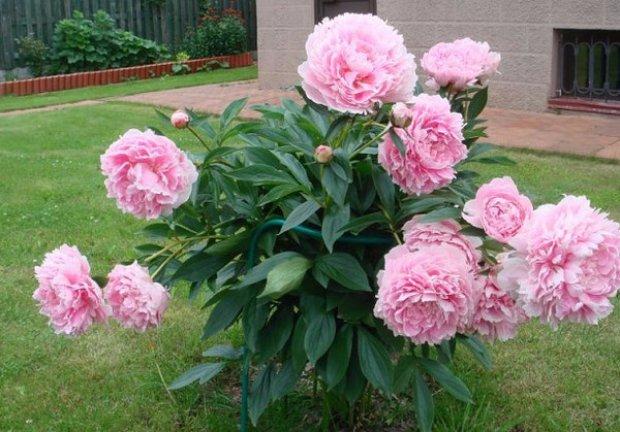
Hybrid peonies only need to be covered as a safety net if the winter is light on snow. Compost or peat moss, with a small amount of wood ash, is used as a mulch layer. The mulch should cover the entire diameter of the root system.
Grassy
Herbaceous varieties are covered as soon as the weather becomes consistently cold. Humus, peat, or wood shavings are used for this purpose. If a frosty winter with strong winds is predicted, spruce branches or spunbond are laid on top of the mulch layer. When snow falls, a snowdrift is piled on top of this structure.

Tree-like
Throughout the European part of the country, tree peonies do not require additional protection. This is only necessary in regions with frosty winters. However, if peony bushes are young or weakened, they must be covered, regardless of the growing region.

When working, remember that peonies of this variety have fragile branches that cannot be bent to the ground. They are divided into bundles and tied together. The soil around the trunk is mulched with peat to a depth of 15-20 cm. The younger the bush, the thicker the layer will be. Cover the top of the peony with spruce branches, and then with any non-woven material.
If there is enough snow in winter, it is piled on top of the shelter as an additional insulating layer.
How and with what to cover peonies for the winter?
Different materials are used to cover peony bushes:
- non-woven material;
- lutrasil;
- spunbond;
- spruce branches;
- non-acidic peat;
- humus;
- wood sawdust.
Peonies should be covered only after all gardening procedures—pruning, fertilizing, and preventative treatments—have been completed. This should only be done on a dry, non-rainy day. If peonies are covered during precipitation, they will rot under the cover and die at the first frost. Only dig up the plants in the fall if they are to be replanted.
The danger of freezing and cooling of plants
If peonies aren't properly prepared for winter, their roots and buds will freeze. This can lead to a slow recovery in the spring, and flowering may not occur at all. Furthermore, prolonged exposure to cold can slow growth and development.
Related posts:
 Descriptions and characteristics of all varieties of peonies, varieties and names of the best
 Timing of planting and care of peonies in open ground, growing rules
 TOP 20 Itoh Peony Varieties and Their Characteristics, Planting and Care Guidelines
 The best time for transplanting peonies, schemes and technology of implementation
 Top 11 Coral Peony Varieties and How to Grow Them
 Planting and caring for tree peonies: the best varieties and growing mistakes
 Description and characteristics of the Sarah Bernhardt peony variety, planting and care instructions
 Description of the hybrid peony variety Bartzella, planting and care instructions