
- Selection and description of English roses
- Application in landscape design
- The most beautiful varieties and types
- James L. Austin
- Vanessa Bell
- The Mayflower
- Golden Celebration
- Lady of Shalott
- Dame Judi Dench
- William Shakespeare
- Graham Thomas
- Abraham Derby
- Benjamin Britten
- How to plant on a plot
- Caring for English roses
- Watering mode
- Fertilizing bushes
- Loosening the soil
- Pruning and shaping
- Preventive and curative treatments
- Preparing for winter
- Reproduction
- By cuttings
- Layering
- Difficulties encountered during cultivation
D. Austin roses are increasingly appearing in gardens. They are prized for their beautiful appearance and delicate fragrance. Austin roses bloom intermittently throughout the season. They are easy to grow, frost-resistant, and have a strong immune system. Below is information about the most beautiful varieties of English roses, planting and care instructions, and propagation.
Selection and description of English roses
The cultivar was developed by English farmer David Austin. In the 1950s, while in France, he encountered ancient roses. David's dream was to improve them. Through breeding, he developed a group of tall roses with large, fragrant buds. A distinctive feature of the Austin roses is their flower shape. Each variety has a unique floral fragrance. David Austin roses have the following characteristic features:
- bush height – from 1 to 3 meters;
- flowering – long-lasting, repeated;
- bud shape – cup-shaped, rosette-shaped, pompom-shaped;
- flowers are collected in inflorescences;
- The buds are large and fragrant.
English roses have good immunity and are rarely susceptible to diseases and pest infestations.
Please note! Austin roses have a strong fragrance, most pronounced in the morning and evening. The most fragrant English rose is Jude the Obscure.
Application in landscape design
D. Austin roses look beautiful as solitaires against a backdrop of green grass. They are also used in rose gardens and mixed borders. Low-growing bushes are planted along garden paths. English roses can be used to separate work and relaxation areas. Climbing varieties of this plant decorate gazebos, arches, and pergolas.
The most beautiful varieties and types
Experts have developed numerous varieties of English roses. David Austin's son and grandson continued the breeding work. The best rose varieties are as follows.
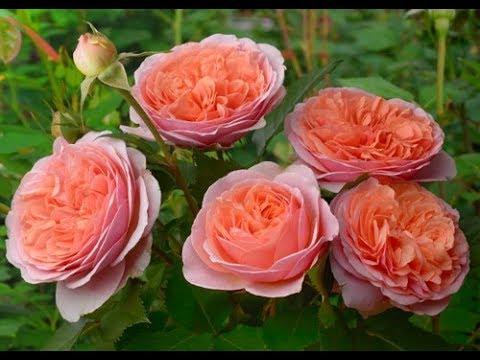
James L. Austin
Austinka, bred in 2017, is named after the breeder's son. The bushes grow upright. The shoots are covered with numerous large purple-pink flowers. The bushes exude a fruity aroma. The rose is resistant to most diseases.
Take a look Also
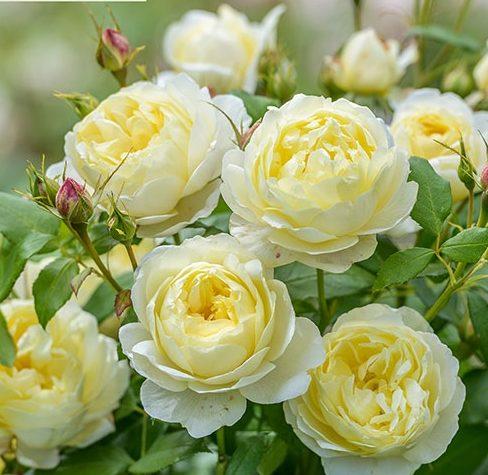
Vanessa Bell
The variety is named after the renowned British artist. The bushes grow to a height of approximately 120 centimeters and spread up to 75 centimeters in width. Three to five buds form on the stem. They are a delicate lemon color. The buds bloom almost continuously throughout the season. The bushes exude the aroma of lemon, honey, and green tea.
The Mayflower
This rose was bred in 2001. The bushes grow to about 1 meter in height and width. It blooms almost nonstop from May until the first frost. The buds are pink. The foliage is light green in spring, becoming dark and matte in autumn. The flowers are scented with rose oil.
Golden Celebration
Golden Celebration's stems reach a height of 1.5 meters. They droop slightly to the ground under the weight of their flowers. The buds range in color from soft yellow to peach. The flowers open in early summer. Then, after a short break, there are repeated waves of blooming.
Lady of Shalott
This is one of the hardy, frost-resistant varieties. The bushes reach a height of 120 centimeters. The shoots droop slightly. The flowers are cup-shaped and densely double. The center of the bud is salmon pink. The edges of the petals are tinted golden-orange. Austinka exudes the aroma of apples and cloves.
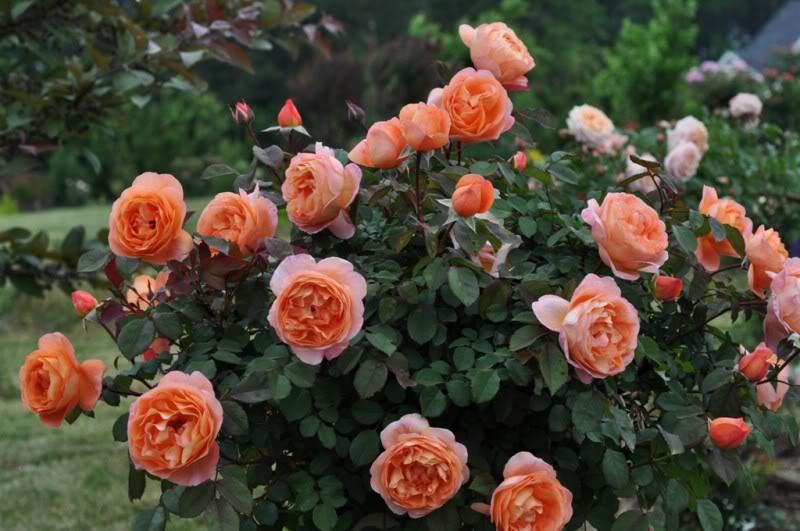
Dame Judi Dench
The plant's vigorous shoots reach a height of 1.2 meters. The bushes are 90 centimeters wide. The buds are apricot-colored and exude a cucumber aroma. Flowers form throughout the season. The plant has excellent disease resistance.
William Shakespeare
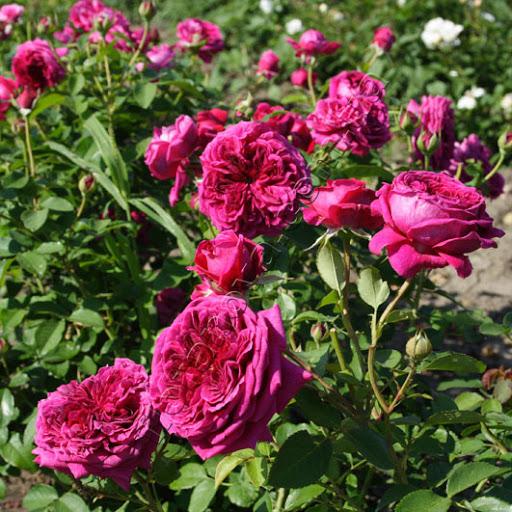
Considered the finest English red rose, the bush is upright. The stems are covered with purple flowers. When they open, the buds are cupped. When open, they flatten. In 2000, an improved variety, William Shakespeare 2000, was developed. It is more resistant to various diseases.
Graham Thomas
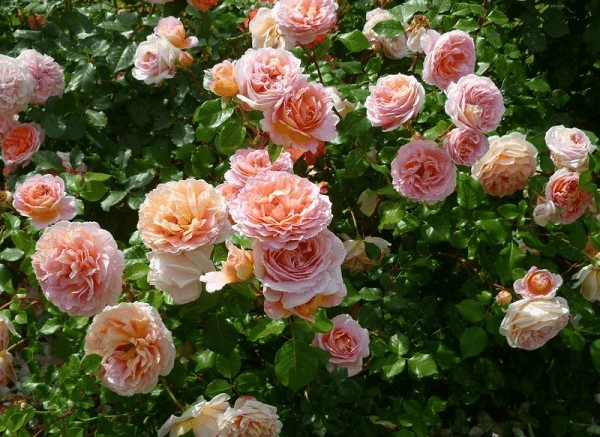
The shoots are long and arching, reaching a height of 1.5-3 meters. The buds are cupped and double. There are up to 75 petals. The color ranges from peach to orange. Exposure to strong sunlight can cause the petals to fade. The buds bloom profusely in early summer. After the first flush, moderate flowering occurs until frost.
Abraham Derby
The bushes reach a height of 100-150 centimeters. The taller the shoots, the more they droop under the weight of the inflorescences. The fragrance is fruity, with a hint of strawberry. The cup-shaped buds are copper-apricot in color. Under the hot rays of the sun, they turn a soft pink. The flowers are borne singly or in clusters of up to three.
Benjamin Britten
This variety is named after the English composer and conductor. It grows up to 110 centimeters. The flowers are densely double and raspberry-colored. The bushes exude a fruity aroma with hints of pear. This English rose can be used as a container plant.
How to plant on a plot
Plant the rose in a well-lit area. In colder regions, this procedure is carried out in the spring. This allows the roses time to adapt before the onset of frost. In warmer regions, Austin roses can be planted in September. Fall planting has the advantage of allowing the gardener to see the flowers growing on the bush.
The distance between rose bushes depends on the rose variety. Holes are dug 50x50 centimeters and filled with nutrient-rich soil. The day before planting, the seedling is placed in a rooting mixture.
Caring for English roses
Caring for the plant involves timely watering, periodic fertilizing, and loosening the soil. Faded flower buds and stems are pruned. To prevent diseases and pests, the bushes are treated with special preparations.
Watering mode
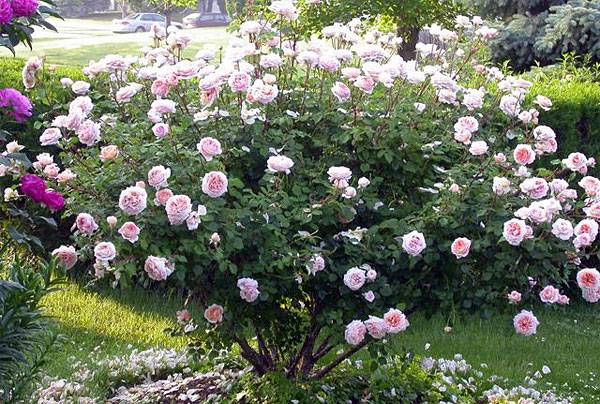
The soil around the bushes is watered generously, but not frequently. The top layer of soil should be allowed to dry out. Excessive moisture can cause fungal diseases in Austin roses. Depending on the size of the plant, 5-15 liters of water are needed per plant.
Fertilizing bushes
English roses begin fertilizing the year after planting. Nitrogen applied in early spring promotes rapid growth. A phosphorus-potassium mixture is used during budding. Potassium is applied after flowering.
Loosening the soil
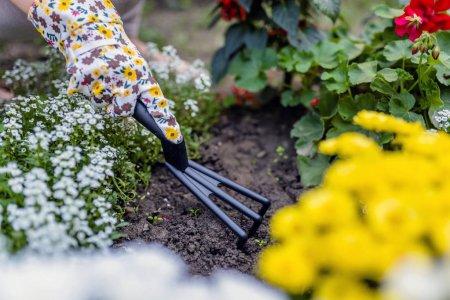
After watering, the soil around English roses is loosened. This procedure allows air and moisture to penetrate the root system. Loosening also removes weeds growing around the bushes. These weeds interfere with plant development and can harbor pests and pathogens.
Pruning and shaping
Roses are pruned in the spring. If the gardener wants to grow small bushes, they should remove half the shoots. If taller plants are desired, the cut is made by a third of the stem length. Climbing Austin roses require pruning by one-third of the branches.
Important! Bush shaping must be performed using sharp, disinfected tools.
Preventive and curative treatments
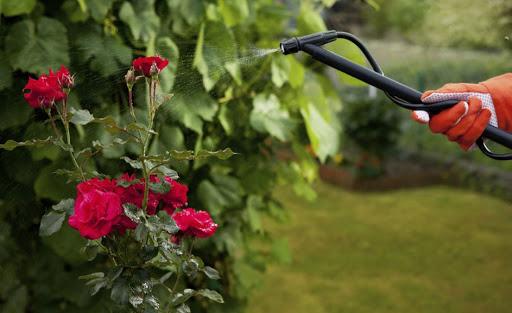
To prevent diseases and pests, bushes are treated with special preparations. Fungicides are used against fungal diseases. Insecticides are used to prevent and rid roses of insects. Removing plant debris from around the trunks of plants helps prevent pests.
Preparing for winter
In warmer climates, it's a good idea to sprinkle a layer of mulch around the plants in late autumn. In colder climates, install a frame over the bushes and cover it with non-woven material. This procedure is carried out after temperatures have dropped to -5°C for several days. If you water the bushes in mid-autumn, they will survive frosts better.
Reproduction
English roses are easily propagated by cuttings or layering.
By cuttings
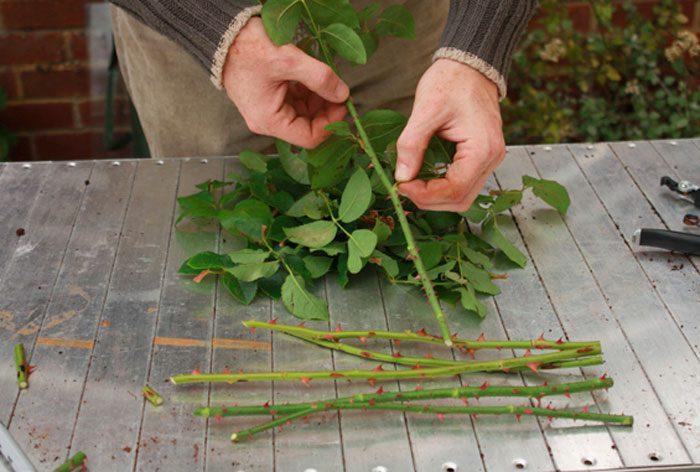
To propagate the plant using this method, take 20-centimeter-long cuttings. The lower leaves are trimmed off, leaving the upper ones. The shoots are planted in the ground at a distance of 15 centimeters and covered with a jar. In late autumn, the bed is covered with agrofibre. The bushes are transplanted to their permanent location a year later.
Layering
This method is used to propagate climbing roses. The shoots are cut and placed into pre-dug furrows. They are secured with staples, watered, and covered with soil. The cuttings require careful care: watering, loosening the soil, and removing weeds. Repotting is done every year.
Difficulties encountered during cultivation
Gardeners sometimes encounter certain challenges when growing English roses. The main difficulties are:
- The bushes are falling apart. Large flowers form on young shoots, causing the branches to droop. To prevent this, supports are installed around the bushes.
- The crop isn't blooming. One of the main reasons is that the bushes are overfed with nitrogen. Plants only need this nutrient in early spring. Then they use up phosphorus and potassium.
- The roses have been affected by a fungal disease. A possible cause is that the bushes are planted too close together, allowing moisture and air to stagnate between them. Frequent watering can also cause the disease.
- In the spring, the plant looks stunted. This may be because the bushes were covered with plastic. This doesn't allow air to pass through, which can lead to plant death.
- Repeat flowering is not occurring. Buds that are beginning to dry out, along with part of the shoot, should be removed. Otherwise, dormant lateral buds will not awaken.
Growing English roses is easy. With proper gardening practices, gardeners will enjoy beautiful, fragrant blooms all season long.
Related posts:
 Top 7 varieties of shrub roses, their planting and care in open ground for beginners
 Top 50 best new rose varieties of 2025 with descriptions and characteristics
 Growing Climbing Roses and the Top 10 Varieties, Planting, and Care in the Open Ground
 Description of the Cordana rose, planting and care at home
 Planting and caring for park roses in open ground, growing rules
 Top 16 Best Hybrid Tea Rose Varieties: Planting and Care in the Open Ground
 Top 12 Floribunda Rose Varieties: Planting and Care in the Open Ground
 Top 16 Peony Rose Varieties, Planting and Caring for Them in the Open Ground