
- The need for shelter
- Selecting dates depending on regional characteristics
- Middle zone
- Southern regions
- Ural
- Siberia
- Preparatory activities in autumn
- Removing from the trellis
- Trimming
- Cleaning up cuttings and plant matter
- Treatment with special agents
- Abundant watering
- Protection from rodents
- Disinfection of covering material
- How to cover properly
- Dry method
- Half-cover
- Complete cover
- Hilling
- Wet method
- With snow
- Earth
- Covering materials
- roofing felt
- Slate or plywood
- Boxes
- Film
- Wooden shields
- Agrofibre
- Spring opening
- Preparing grape seedlings for winter
- Tips and recommendations
What's the proper way to cover grapes for the winter? The method of covering depends on the climate and variety. In southern regions, grapes are simply hilled up high to prevent the roots from freezing. Grapevines growing in Siberia require more thorough insulation before the onset of frost. The vines are removed from the trellis, laid in a dug trench, and covered with covering material. Before covering, some preparatory work is carried out.
The need for shelter
Grapes are considered heat-loving plants that don't tolerate frosty winters well. Severe frosts can destroy the vine's roots and buds. In the spring, a frozen plant may only have half its buds open. Weakened by a heavy harvest, grapes may die completely in a harsh winter. All varietal crops require insulation before wintering.
First, cover the roots. Add a thick layer of soil to the base of the bush. The roots can be mulched with peat, humus, or coarse sand. Insulate the root system as soon as the temperature drops to -5-7 degrees Celsius. Roots can freeze at temperatures as low as -5-7 degrees Celsius.
A little later, the vines are insulated. If this is not done, the grape buds will freeze and die. The vines must be removed from the trellis and bent to the ground; only then can they be properly covered. If the vine is left on the trellis, wrapped in burlap or plastic, it will still freeze.
The vines are insulated before the temperature drops to -10 degrees Celsius. During light frosts, the plant can remain uncovered and be allowed to acclimate to the cold.
Selecting dates depending on regional characteristics
Besides frost, grapes have another enemy: thaws. If you cover the vines too early, they will rot if the daytime temperature rises. Vineyards are grown in various regions, not only in the south but even in Siberia. Climates vary widely, so plants need to be covered when the air temperature drops to -6-9 degrees Celsius. When constructing a cover, remember that it must be not only warm but also dry.
Middle zone
In this region, vineyards require insulation from mid-November to mid-March. It's best to cover the vines after the first frost, when the soil has frozen slightly. In the central zone, vineyards are less susceptible to frost than to sudden thaws, damping off due to prolonged dampness, or icing of the vines under poor-quality cover.
To protect grapes from frost and water, you need to create a periodically ventilated shelter that will not let moisture through, will not retain condensation, but will protect the vines from low temperatures.
Southern regions
In warm climates, grapes can be left on trellises all winter, wrapped in insulating material. More soil should be added to the base of the vine. Varieties that are particularly sensitive to frost can be removed from their supports and laid on the ground, then covered with a covering material. The vines are insulated at the end of November.
Ural
The vineyard is removed from its supports and laid on the ground in November, when temperatures drop to -5-8 degrees Celsius. In this region, winter temperatures often drop to -30 degrees Celsius. Winter cover must be high-quality, with several layers.
Siberia
The most unsuitable region for growing grapes. Vines are insulated as early as early November. In Siberia, grapes are always removed from their supports and placed in trenches. These pits are not dug specifically for wintering the vines; the grapes are planted directly in the trenches. When frost sets in, the vines are removed from their supports and placed in the pits, covered with insulation.

Preparatory activities in autumn
Once the first frost arrives, the grapes can be left uncovered. The plant needs time to acclimate to the cold. Light frosts are beneficial for grapes, helping them harden off. Hardened vines can withstand severe frosts more easily. A bush that is covered too early may die.
If the temperature drops to -5°C (-4°F), the root system should be insulated first. The entire vine can be covered a little later. It's important to insulate the grapes before the temperature drops below -10°C (-5°F).
Removing from the trellis
After the harvest and the leaves have fallen, the vines can be removed from the trellis. It's best to do this when the temperature outside is below -5°C (-5°F). The grapes must be picked very carefully, being careful not to damage the delicate branches. Before removing the vines from the trellis, prepare the plant for winter.
Trimming
To prepare grapes for winter, pruning is necessary. This is done in October, before November. However, experienced gardeners do not recommend pruning branches before winter. After all, it's unclear how the plant will survive the winter. The more buds remain, the higher the likelihood that some of them will bloom in the spring.
Cleaning up cuttings and plant matter
Before covering the grapes, remove all leaves and cuttings from around the vine. They can harbor dangerous infections. If there are any remaining leaves on the vines, they should also be removed. Over the winter, any remaining leaves will wither and rot.
Treatment with special agents
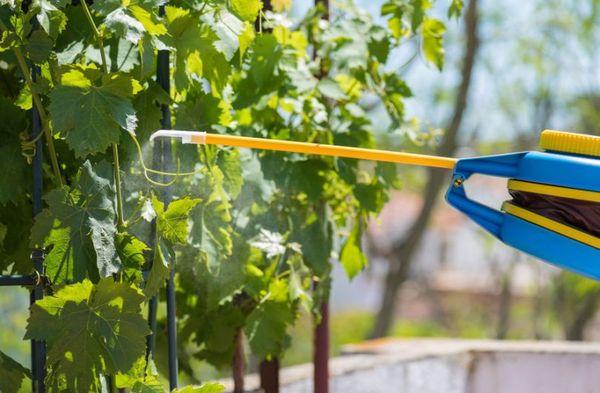
Before wintering, grapevines should be treated with a solution of copper or iron sulfate. This treatment will help the plant survive the winter without becoming diseased. If the plant frequently gets sick in the summer, you can treat it with sulfur-based preparations or fungicides such as DNOC or Nitrofen before wintering.
Abundant watering
Before covering the bush, it needs to be watered generously. Pour 8-10 buckets of water under the roots. You can also feed the grapes with a complex fertilizer. This care will help the plant survive the winter better.
Protection from rodents
Mice can access and damage vines lying on the ground. Spruce or pine branches, as well as traps and bait with poisoned food, can help control rodents. Mouse repellents can be scattered on the ground and under grapevines.
Disinfection of covering material
Before covering the vines, the covering material should be thoroughly dried, discarded, and disinfected, for example, with potassium permanganate or copper sulfate. If the grapes are covered with boards, inspect them for rot. You can sprinkle the covering material with dried wormwood or tansy. These plants will help prevent diseases.
How to cover properly
There are several ways to cover grapes for the winter. They differ in the type of covering material and the technology used. When choosing a particular insulation method, climate conditions are taken into account. The plant's vulnerability to frost depends on the age of the vine and the variety. The older the grapes, the better they tolerate winter.
Dry method
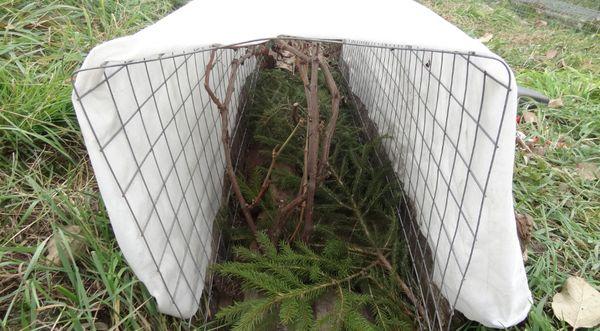
With the dry method, the vines are kept away from water. Experienced gardeners advise covering the vines so that they don't come into contact with the soil. Direct contact with the soil can lead to mold and rot.
Before laying the grapes on the ground, you can place roofing felt, boards, or wooden slats under the plant. These will prevent the vines from touching the soil. The bush is held to the ground with a metal hook.
Half-cover
This method of insulating grapes is used in regions where winters are not very cold. The lower part of the vine is covered with soil, and the vine itself is insulated with some material, such as film, burlap, or agrofibre. The vines are removed from the trellis and laid on dry leaves, wooden slats, or spruce branches.
The vines are insulated from above with a covering material stretched over iron arches to form a tunnel. It's not the material itself that protects the plant, but the warm air inside the structure.
Complete cover
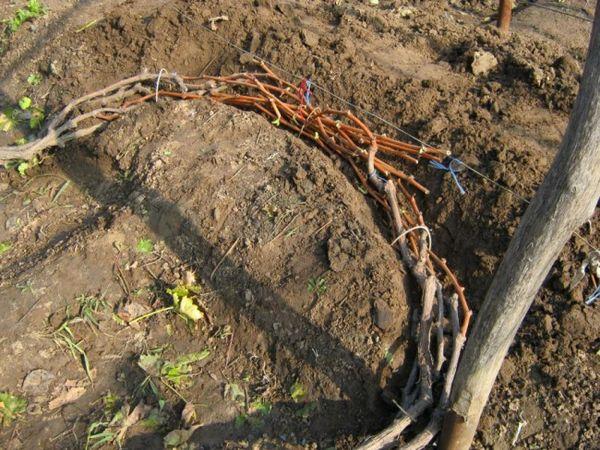
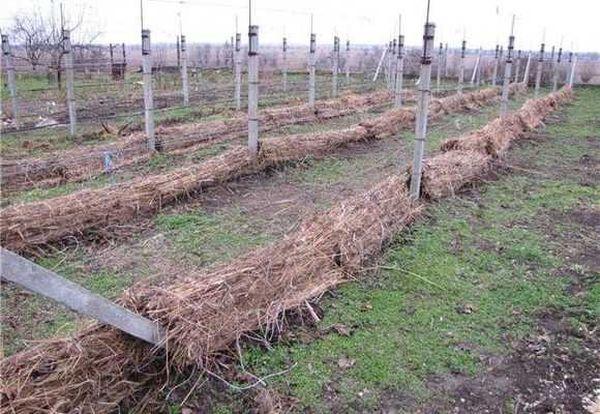
This method is most often used to cover grapes growing in northern latitudes. The vines are removed from the trellis, all the branches are pressed together, and laid on the ground or in a trench. The grapes are then covered with a covering material. Additionally, soil is piled on top of the covering, or boards or slate are installed.
Hilling
Hilling as the only method of insulating a plant is used only in the south. A thick layer of soil, 30-50 centimeters deep, is added to the base of the bush. The diameter of the hilling is 50-70 centimeters. The soil will protect the roots from freezing, although the vines themselves and the buds will remain vulnerable to frost.
Wet method
With the wet method, the vine is covered with soil or snow. This covering material doesn't protect the bush from moisture, but it will help it survive frost.
With snow
There's nothing better in a frosty winter than a pile of snow on top of the plants. The snow cover will prevent the vines from freezing. When it starts snowing, grab a shovel and pile more snow on the vines lying on the ground. Before using the snow cover, insulate the vineyard with soil or covering material.
Earth
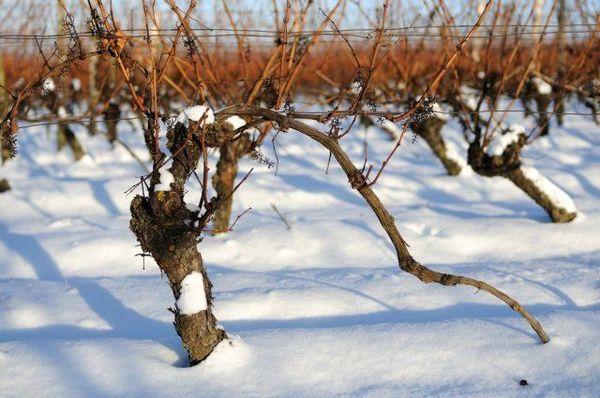
Soil is the cheapest material you can use to cover grapes. Depending on the variety and climate, the soil layer can be 10-50 centimeters thick. If the soil is sandy, the insulating layer should be even thicker.
For covering, use the soil found between the rows. Avoid taking soil from the base of the bush—the roots should not be exposed, otherwise they will freeze and the plant will die.
The downside of this method is that during thaws and high humidity, the vines below ground become moldy, and the buds begin to rot. To protect the plant from water damage, place oilcloth or slate sheets over the earthen cover.
Covering materials
Grapes are covered using materials readily available in every home. Boards, slate, or roofing felt can be laid over a soil or plastic cover. This material provides excellent protection from severe frosts.
roofing felt
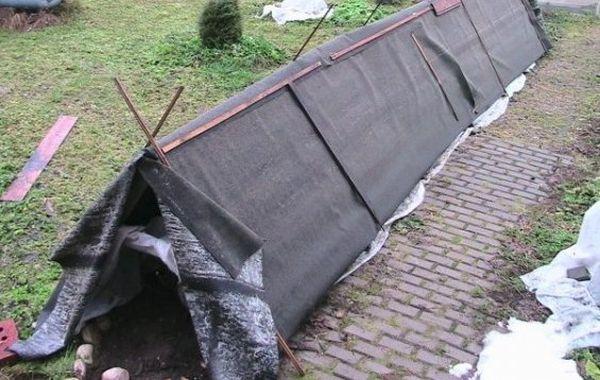
To thoroughly protect vines from frost, use roofing felt. This material is moisture-resistant, retains heat, is inexpensive, and lightweight. You can cover plants with roofing felt in 2-3 layers. However, this material quickly deteriorates when exposed to low temperatures, wind, and water.
Slate or plywood
Slate is a heavy and hard material. It's used to cover trenches or reinforce the walls of pits. Sheets can be stacked to form a "house" to protect grapes from frost. Slate doesn't heat up in the sun and doesn't absorb moisture.
Plywood sheets are most often used as flooring. The plywood is laid on the ground, and the vines, removed from the trellis, are placed on top. Plywood sheets become wet and swell in the rain. If used to cover grapes, a layer of oilcloth or roofing felt should be placed over the top.
Boxes
Cardboard boxes, used for packaging goods or as containers, can be used as covering material. Cardboard offers poor frost protection, but it absorbs moisture well. It can be placed between the vines and the plastic film.
The disadvantage of this material is that it becomes saturated with moisture, tears and quickly becomes unusable.
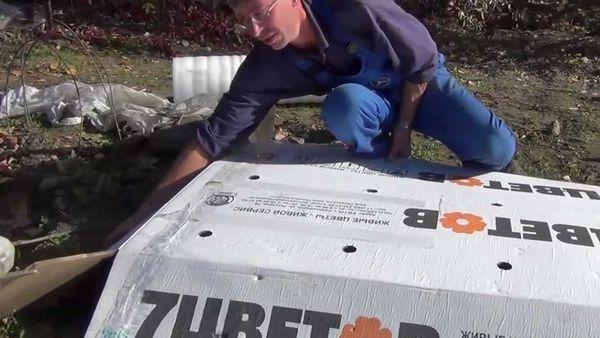
Film
This material is most often used to cover vines. The film is inexpensive and waterproof. Its downside is that it doesn't protect against frost. Another drawback is that during a thaw, the film creates a greenhouse effect, which can cause the plant to begin growing. A subsequent frost will destroy the awakened buds. However, opaque, white, reflective film retains heat better and prevents the plant from overheating during a thaw.
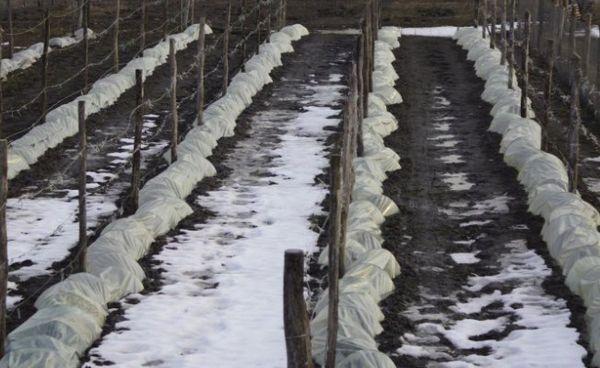
Typically, a tunnel is created over the vines laid on the ground using plastic film stretched over metal arches. It's important that the branches don't touch this material, otherwise they will become frost-damaged. The film can be stretched in two layers, with another row of arches placed higher above the tunnel. It's a good idea to lift the ends of the film during thaws to allow the plant to ventilate and prevent rotting.
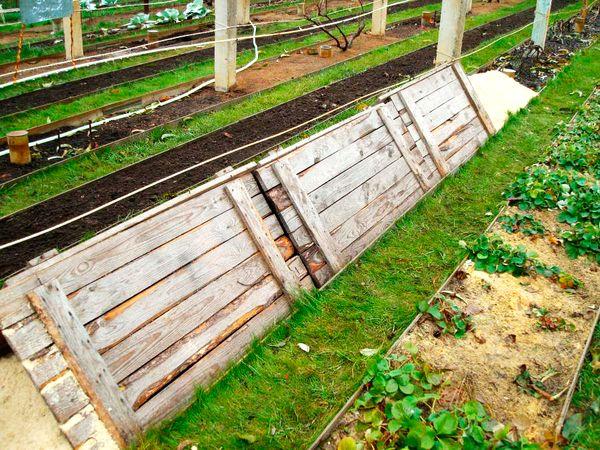
Wooden shields
This material effectively protects grapes from severe frost. The vines are removed from the trellis and laid in a trench, then covered with a wooden shield. Lightweight boards can be used to protect vines lying on the ground from frost, covered with agrofibre or film.
Agrofibre
A covering material made of polypropylene, also known as spunbond, it has a woven structure. Agrofibre is permeable to moisture and air, and does not accumulate condensation on the inner surface.
It can only be used as the sole covering material in regions with mild winters. In cold climates, agrofibre is used to cover the vines hidden in a trench, then the tunnel is insulated with one or more other materials.
Spring opening
The vines are fully uncovered in the spring, when the snow melts and the air temperature rises above freezing. The covering is removed in April-March, but not all at once, but gradually. First, the plants are aired out in sunny weather. Then they are uncovered during the day, and then covered again at night.
Once the threat of night frosts has passed, the grapes can be fully uncovered. The vines are uncovered when the nighttime air temperature reaches 5 degrees Celsius.
Preparing grape seedlings for winter
Young grapevines require more substantial insulation. Before frost sets in, the bush is covered with a thick layer of soil. The entire plant can be covered with soil mixed with spruce needles.
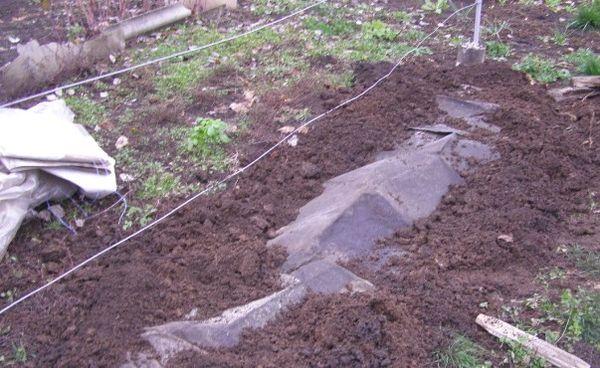
A small seedling is sometimes covered with a bottomless plastic bottle with holes for gas exchange, then covered with dry leaves and roofing felt on top.
The grown young plant is carefully removed from the trellis, the branches are pressed down, and wrapped several times with agrofibre. The vine should be completely covered. Then it is bent to the ground and covered with soil or a thick layer of dry leaves. A plastic sheet can be placed on top of the cover to prevent it from getting wet.
Tips and recommendations
Experienced gardeners and viticulturists recommend planting only zoned varieties in their plots. These grapes have already been tested, and the vines are well-adapted to the local climate, so they are more likely to survive the winter.
When covering a vineyard for the winter, it is important to remember that old plants tolerate frost better than young seedlings. During the first year of life, grapevines need to be thoroughly insulated. You can cover them with a 35-centimeter layer of soil. One-year-old seedlings respond well to a soil cover.
Experienced winegrowers advise careful removal of insulation. Grapes should be uncovered after the frost has passed, but before the buds have begun to swell. If the covering is removed too early, spring frosts can damage the vines.
If you delay opening the buds, the buds will begin to grow, but when you lift the vines from the ground and tie them to a trellis, the newly hatched leaves will fall off. Spraying with a weak solution of ferrous sulfate can help delay bud break.
Related posts:
 Description of 30 grape varieties for Siberia, planting and care for beginners
 How to grow grapes in the Moscow region in open ground without a greenhouse
 Description of the Julian grape variety, planting and care instructions
 Description of the Krasotka grape variety, planting and care technology
 Description of 30 varieties and types of Muscat grapes, planting, cultivation and care
 The ripening time of grape vines by variety, how to speed up the process, and what to treat the plant with
 Description and characteristics of the Codryanka grape variety, ripening period and care
 Beginner's Guide to Growing Grapes in Open Ground in Central Russia