
- How to pick berries from a tall tree
- An easy way is to use special machines for collection
- We make fixtures for manual assembly
- From a plastic tube
- From a plastic bottle
- From a fishing net
- From a tin can
- We use ladders
- Design requirements
- Installation and device
- Choosing a container for collecting cherries
- The steeplejack method
- Safety rules
- Necessary tools
- Safety belt
- Hooks for pulling up branches
- Bucket
- Thinning the top
- How to optimally prune a branch with juicy cherries
- How to properly store harvested crops
During harvest time, the fruit on the treetops can be a real challenge for gardeners. Various approaches include shaking them off, climbing ladders, and pulling up branches. Some even leave the out-of-reach fruit for birds to eat. But experienced gardeners know simple ways to safely pick cherries from tall trees using homemade devices or a lifting belt.
How to pick berries from a tall tree
- Owners of large gardens use specialized equipment—combines—to pick berries. While gardeners rarely manage to get their hands on an autoclave, they often rely on ladders and hand-held fruit pickers.
Equipment is available at both brick-and-mortar and online gardening stores. However, simple devices are easy to make yourself. All that's left to do is wait for the harvest.
An easy way is to use special machines for collection
Berry harvesters are used to harvest berries on plantations. These machines allow for rapid processing of the trees.
Types of combine harvesters:
- A mechanical arm. The device grips the trunk like a glove or a clamp and shakes out the cherries. The mechanically amplified vibration reaches the top branches, and even berries inaccessible to manual picking fall.
- A harvester with an arched frame. The machine is equipped with an "arm," a frame with brushes, and a conveyor belt. As it moves between rows, the machine shakes the trees. Cherries fall onto the frame and are carried by brushes onto the conveyor. The moving belt carries the berries into a storage bin.
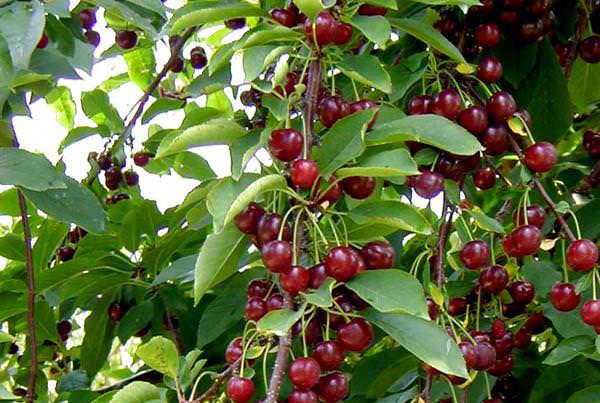
Automation helps prevent industrial injuries. The harvest from large orchards is used for sale and juice production. Cherries must reach retail shelves with their marketable appearance, flavor, and aroma intact. To ensure the berries are picked before they become overripe, it's easier to use combine harvesters.
We make fixtures for manual assembly
The cost of purchasing and maintaining the equipment is recouped by the income from selling the harvest. In a garden setting, simpler cherry picking devices can be used. They can be easily made from scrap materials found in an attic or shed. Several DIY gardening inventions are popular.
From a plastic tube
The fruit picker needs to be held suspended. An iron pipe is difficult to lift vertically and point in the right direction. Therefore, to make one, you'll need a piece of lightweight plastic tubing. The diameter of the tubing should be large enough to accommodate several berries.
Instructions for making the device:
- cut one end of the tube at an angle;
- make a groove 0.5-0.8 cm wide at the sharp end of the cut so that the berry stalks fall into it;
- The end with the groove needs to be bent upward. To do this, heat the tube until the plastic becomes soft, and bend it upward with pliers or against a hard surface;
- The opposite end of the tube is also heated and inserted into a plastic bottle or container, which will serve as a storage tank.
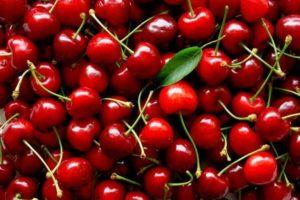
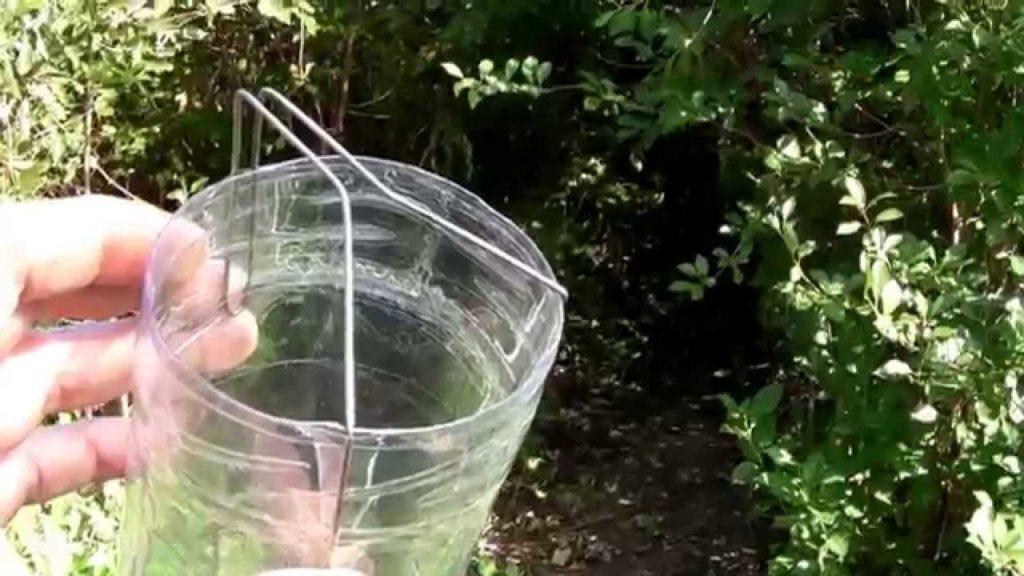
Instead of a bottle, you can attach a small bag or plastic bag.
From a plastic bottle
A 1-liter container is suitable for a fruit collector.
Manufacturing technology:
- step back 3 centimeters from the bottom and make a transverse cut 8 centimeters wide;
- at a height of 12 centimeters from the bottom, make a second transverse cut of the same width;
- cut off a piece of the wall between the edges of the cuts - you will get a hole 9 centimeters long and 8 centimeters wide;
- Cut a 5-7 mm wide groove from the bottom of the hole to the bottom, then extend it 2 cm along the bottom. The groove is needed to grasp the cherry by the stem. The berry will break off and fall into the cherry picker.
- insert a stick of a suitable diameter into the neck of the bottle; a handle from a wooden mop will do;
- secure the stick with a screw.
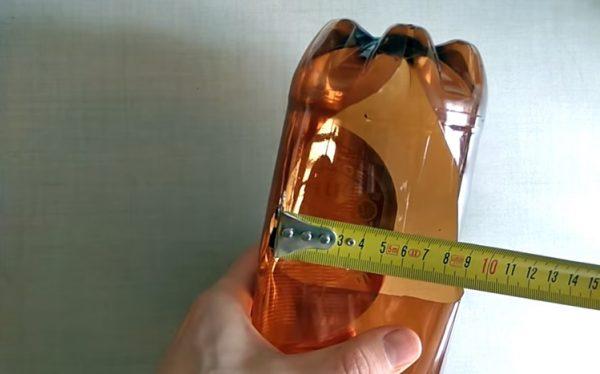
To reach berries hanging at different heights, you can make several fruit pickers with long and short handles.
From a fishing net
A handy device for collecting berries can be made from an old landing net or aquarium net:
- the ring needs to be bent in the form of a groove, in the place opposite the handle attachment;
- The second method is to insert a wire ring of a smaller diameter with a gripping bend inside the landing net.
The handle of the net can be bent near the place where it attaches to the ring, so that the fruit collector can be easily brought to high branches.
From a tin can
A homemade, but potentially dangerous, cherry picker can be made from a tin can. Carefully cut the tines to avoid injury. But first things first:
- you will need a tin can with a diameter of 15 centimeters;
- cut large teeth along the edges so that the berry stalks can slip through them;
- remove the bottom so that you can insert a bag, container, or net into which the cherries will fall;
- Make a hole in the wall of the jar and insert a handle made of any material - a metal or plastic pipe, a wooden stick.
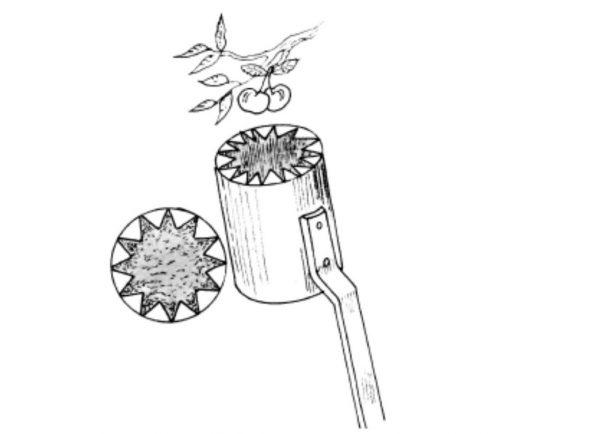
You can use a sheet of tin, bend it into a ring and connect it using cold welding.
Gardeners modify these designs in their own ways, letting their imagination run wild. To adjust the handle length, you can attach a telescopic pole from a mechanical mop. Similar fruit pickers are sold in hardware stores. They are safer because the cutting surfaces are made of plastic, and their handles are equipped with adjustable length and tilt.
We use ladders
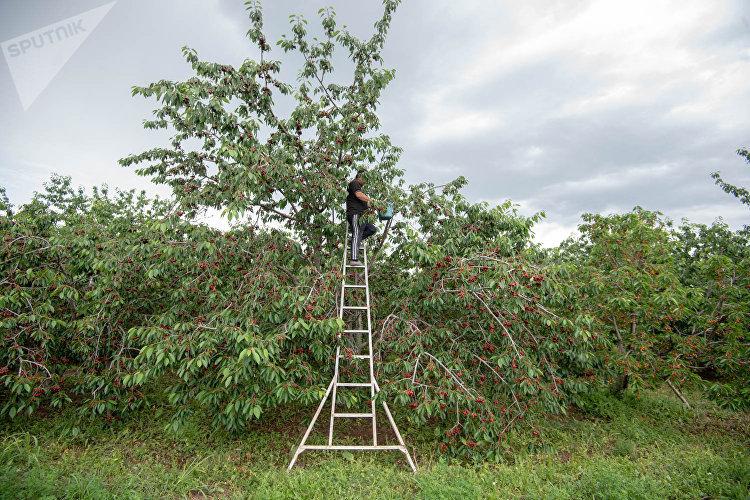
An easy way to reach the tree's crown is to climb a stepladder or ladder, which you can make yourself.
Design requirements
The main requirement for a ladder for working at height is stability. Therefore, a homemade stepladder is made in the shape of a pyramid.
Installation and device
Materials needed:
- 50x50 mm timber - 14 meters;
- timber 25x50 mm - 1 meter;
- 4 meters of any board;
- bolt 10x70 - 2 pieces;
- Nut - 2 pieces;
- nails, paint.
Algorithm for making a stepladder with a removable platform:
- from a 50x50 mm beam, two front posts 2.6 meters long and two rear posts 2.4 meters long are cut;
- mark the locations of the crossbar attachment points on the front posts, measuring a distance of 30 centimeters between them;
- cut 60-centimeter-long crossbars from 25x50 mm timber and nail them to the posts;
- attach the two rear posts to the sides of the resulting staircase and connect them with boards;
- in the places where the rear struts are attached to the front ones, drill holes and connect the struts with bolts;
- Place the posts and measure the distance for the platform; a convenient size is 42x40 centimeters;
- connect the boards for the removable platform with bars so that they rest against the steps from the inside;
- Connect the front and rear posts with a rope to lay the platform.
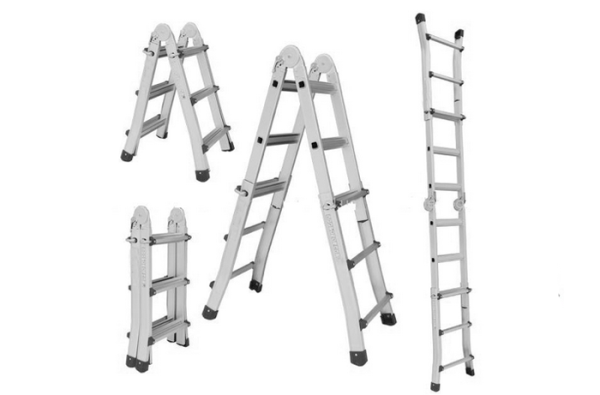
Paint the finished stepladder with durable paint.
Choosing a container for collecting cherries
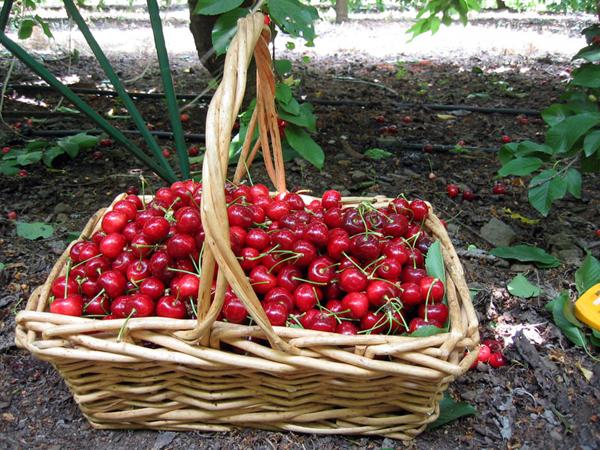
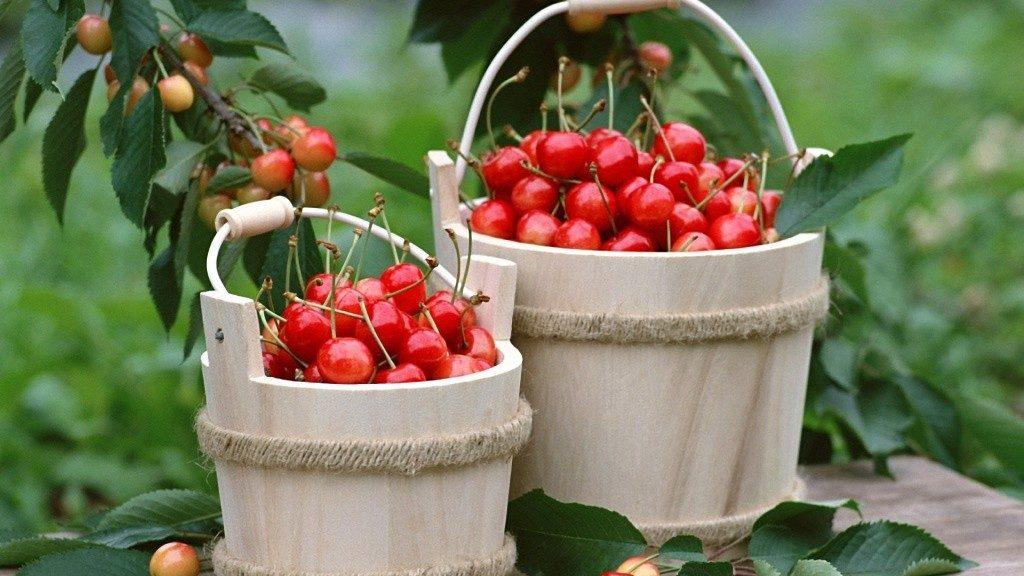
When picking cherries at height, your hands should be free to grab a stepladder or a branch if you lose your balance and avoid falling. Therefore, choose a lightweight container with a handle that can be used to hang it from a branch. A plastic bucket is suitable.
Special berry-picking containers are sold at gardening supply stores. These tall plastic bowls are concave on one side for a comfortable fit and are equipped with long straps.
This container can be worn over the shoulder like a bag, worn on the side, or worn on the front of the body. This leaves both hands free. The container's capacity depends on the lifting capacity and dexterity of the person picking. A 10-liter bucket is heavier to stand on a ladder than a 5-liter one. Moreover, a branch can break under the weight of berries. Therefore, a container with a capacity of 3-5 liters is better.
The steeplejack method
Summer residents who maintain a sporty lifestyle can try an extreme method of cherry picking.
Safety rules
Warnings for garden climbers:
- The work requires high coordination of movements and dexterity.
- If you start to feel dizzy at a distance of 2 meters from the ground, it is better to go down lower.
- Before lifting, check the fastenings and cables.
Work at height is defined as a climb of 130 centimeters. Steeplejacking is performed at a height of 5 meters above the ground.
Necessary tools
For high-altitude climbing you will need:
- safety harness;
- wire hooks;
- berry container;
To be on the safe side, it's best to place a ladder nearby.
Safety belt
The harness is fastened around the waist and has shoulder and hip straps. A cable is attached to the belt with a carabiner. The belt must be able to support the weight of a person carrying a bucket of berries. Therefore, it's best to purchase a certified model from a sports equipment store.
Hooks for pulling up branches
The cherry tree's crown is tangled into small branches that can't support human weight. It's impossible to climb them to the very top. Therefore, metal hooks must be used to pull the branches closer. Here's how to make them:
- you will need a piece of wire 1 meter long;
- Bend both ends into hooks.
One end of the device is comfortable to hold, while the other end is perfect for hooking branches. The dark metal hook blends in with the dense branches. To avoid losing it, paint it white or yellow.
Bucket
A 5-liter plastic bucket with a handle is suitable for working at height. A 10-liter bucket is easy to carry up, but difficult to carry down with a load of berries. Moving a heavy container through the tree is inconvenient—you might accidentally drop it.
A good way to hang a berry bucket from a tree branch is by attaching it to the handle with a hook and soft wire. To avoid having to climb down, a 5-liter container can be transported down using a rope. However, you'll need an assistant to hold the empty bucket down from below.
For cherry picking, you can use a smaller container—a cut-down 2.5-liter plastic water bottle. It's convenient to hang it on a string around your neck or over your shoulder and use it to collect the berries.
Thinning the top
A drawback of this pruning method: falling branches catch on neighboring branches in mid-flight and need to be removed. The berries are shattered when the branches hit the ground. The cherries are torn from their stems and rolled across the ground. Some of the fruit becomes spoiled. But there is a way to preserve the berries intact.
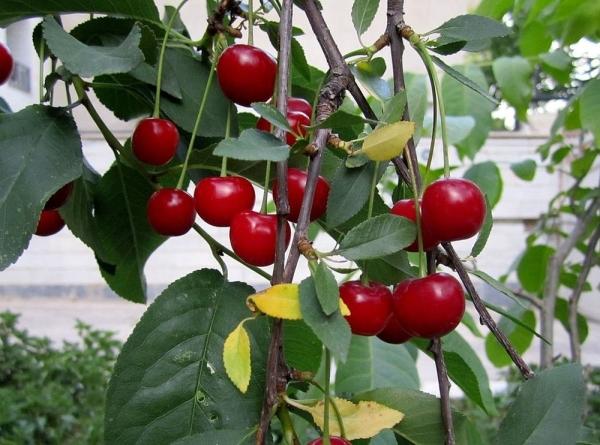
How to optimally prune a branch with juicy cherries
You will need a saw, two long ropes and a partner:
- climb a tree with ropes and a saw, leaving your partner below;
- mark the place where you will cut the branch on the chosen branch and tie the ends of the ropes above it;
- throw one of them down to your partner;
- throw the second one, like a block, onto a strong branch located above and secure it;
- saw off the prepared branch;
- After she hangs on the top rope, coordinate with your partner and lower the branch down.
The harvested cherries are picked on the ground. The trees, with their tops thinned, sprout new shoots bearing large, juicy berries.
How to properly store harvested crops
The cherries are sorted and placed into baskets or crates, which are then stored in the cellar. They can also be packaged in 1-kilogram plastic bags. Another option is to place the cherries in glass jars lined with cherry leaves. There is no need to wash the cherries before storing them.
A small quantity of cherries can be refrigerated. The optimal storage temperature is 1-0°C (33-36°F). Humidity is 90-95%. Under these conditions, the berries will remain fresh for another 15 days after picking. Dark burgundy cherry varieties with firm flesh have a longer shelf life – from one to one and a half months.
Related posts:
 Description and pollinators of the Vladimirskaya cherry variety, planting and care
 Description and varieties of cherry variety Shpanka, planting and care
 Description and propagation of the Bessey cherry variety, planting and care rules
 13 Best Cherry Jam Recipes for Winter
 Description and cultivation of the best varieties of felt cherry, planting and care
 Description and characteristics of the miracle cherry hybrid, planting and care of the variety
 Description and characteristics of 17 dwarf cherry varieties, planting and care
 When and how to prune cherry trees correctly, and tree shaping schemes for a good harvest