
- Why is it necessary to transplant a tree?
- When to transplant a cherry tree
- Spring terms
- Transplantation in autumn
- Preparatory work
- Selecting a new location and preparing the planting hole
- What to put in a hole to feed a tree
- Preparing planting material
- Features and technology of plant transplantation
- Mature tree
- How to dig up a cherry tree for transplanting
- Transportation rules
- Planting technology
- seedling
- Cherry bush
- Bush varieties
- Felt varieties
- What care does a transplanted cherry tree need?
- Mistakes when transplanting cherries
Transplanting mature fruit trees is not recommended and is only done in extreme cases. However, young seedlings must be transplanted to their permanent location. The timing and location must be chosen correctly to ensure the tree produces a harvest of tasty and healthy fruit as quickly as possible. When should you transplant a cherry tree so it establishes successfully and begins bearing fruit quickly? There are some subtleties and secrets that experienced gardeners have accumulated over the years.
Why is it necessary to transplant a tree?
There are a variety of reasons why it may be necessary to replant a cherry tree. During its lifespan, the tree produces a lot of root suckers, which some gardeners consider a drawback. Others use young seedlings as planting material. Cherry replanting is also often necessary for:
- redevelopment of a summer cottage;
- poorly chosen landing site;
- inconvenience in using nearby buildings;
- moving to a new place and wanting to take a valuable plant variety with you.
When to transplant a cherry tree
The success of cherry tree transplantation depends largely on the correct timing. Gardeners advise following the established guidelines and performing the work exclusively in spring or fall.
Spring terms
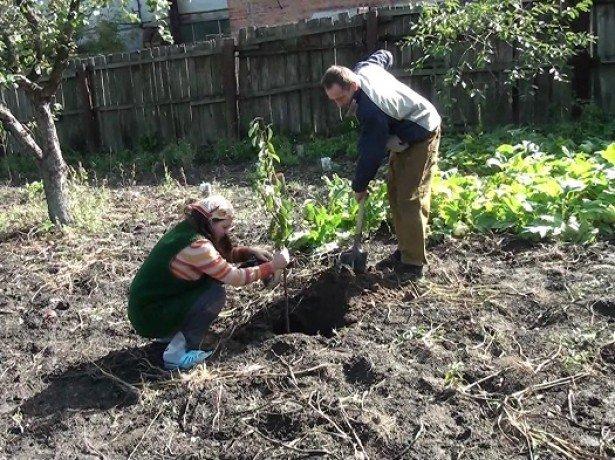
If you transplant cherry trees in the spring, they'll have time to strengthen and root well by winter, making them easier to survive. The timing should be chosen so that the buds don't begin to swell. This timeframe may vary depending on the region. For example, in temperate climates, transplanting is done in the first half of April. The following conditions should be considered:
- the air temperature should reach +10 °C;
- the weather became dry, not rainy;
- there is no ground frost;
- On the day chosen for planting there is no wind.
Transplantation in autumn
If there is a need to transplant a tree in the fall, then you need to focus on the same conditions as for spring transplantation. Before the cold weather sets in, the tree must have time to get stronger and take root. The work is carried out after leaf fall, when sap flow along the trunk decreases and the plant no longer needs to expend energy on nourishing the leaves. The optimal time for this is late September or early October.
Preparatory work
It's important not only to choose the right time for transplanting, but also to choose the right location and prepare the site. These steps are equally crucial, as they determine whether the crop will develop properly and produce a bountiful, high-quality harvest.
Selecting a new location and preparing the planting hole
Cherries prefer sunny locations, yet protected from strong winds and drafts. Groundwater levels are also important considerations. It is preferable to transplant the tree to a small elevation located in the southern part of the garden..
The soil should be neutral, loose, and sandy loam. To help the plant adapt, the soil composition should match that of its previous growing location.
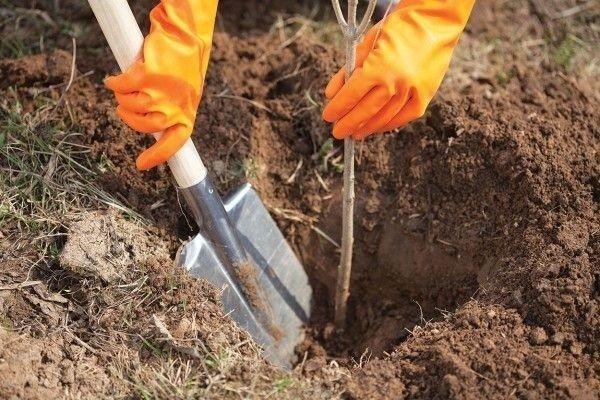
The planting hole for the cherry tree is prepared approximately 0.5 m deep and 0.7 m wide. A drainage layer of broken brick or small stones is placed at the bottom.
What to put in a hole to feed a tree
When transplanting cherries into a hole, it is advisable to add the following fertilizers:
- humus;
- wood ash;
- potassium salt;
- superphosphate.
All fertilizers are thoroughly mixed with the soil.
Preparing planting material
Cherry trees no more than four years old are suitable for transplanting. An older tree has minimal chance of establishing itself in a new location. Felt cherries do not transplant well at any age. It's best to select young seedlings for this purpose. The trees are dug up with the root ball, without shaking it off. All excess branches should be trimmed beforehand, and an antifungal preventative treatment should be applied.
Features and technology of plant transplantation
Cherry tree transplanting is not much different from regular planting, but it does have some special considerations. This is especially true for mature trees.
Mature tree
The most difficult thing to transplant is a mature tree. It's more difficult to transport, and its chances of taking root are significantly lower. Moreover, it won't bear fruit at first.

How to dig up a cherry tree for transplanting
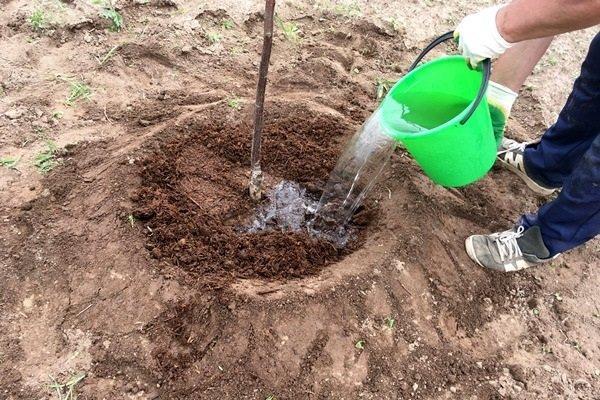
To make transplanting easier, dig up the cherry tree with its root ball still attached, after pouring about five buckets of water underneath. This prevents the soil from falling off the roots. The plant is dug up around the perimeter of the crown, since its root system tends to grow to the length of the branches. The depth of the walls should be about 0.5 m.
Transportation rules
Cherry trees are transported to their new growing location with extreme care. Mature trees are moved short distances in a cart. Sawdust is used to reduce shaking and increase shock absorption. It is also acceptable to transport the plant on iron sheets or coarse cloth. For longer distances, cherries are transported in a special container.
Planting technology
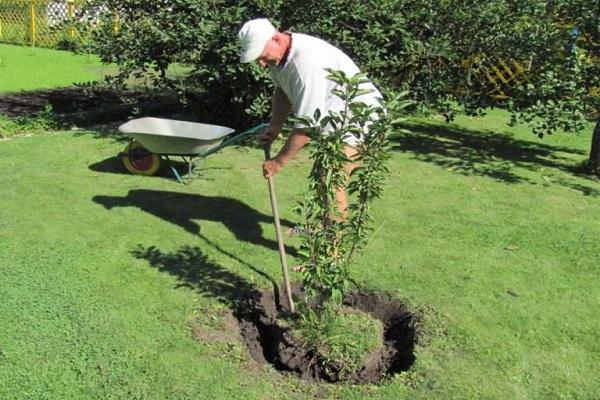
Before planting the tree, add enough nutrient-rich soil mixture to the prepared hole to ensure the root ball is 5-10 cm above the surface. The plant's roots should be freed from the plastic wrap, watered thoroughly to prevent soil from collapsing, and then moved into the hole. The cherry branches should be positioned in relation to the cardinal directions in the same direction as in the previous location. Plant the cherry tree so that the root collar is 3 cm above the ground. If the cherry tree is still weak, you can carefully install a wooden stake to support it, being careful not to damage the root system.
seedling
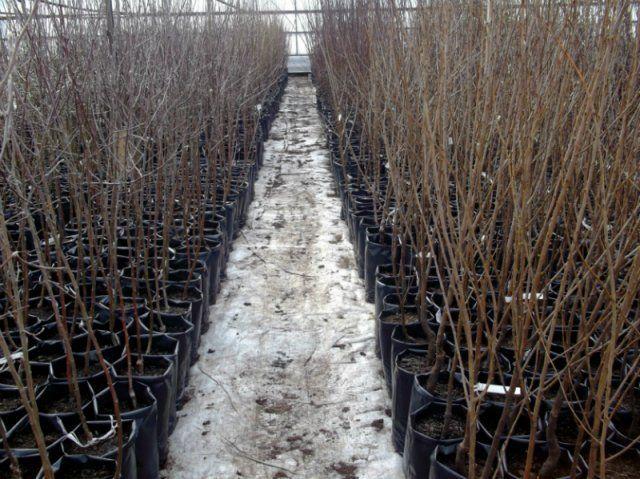
For replanting, select seedlings aged 1-2 years. These are the easiest to establish. The root system of a young tree should be strong and well-developed, free of visible defects and damage, and the trunk should be straight and clean. Leaves should also be free of damage or signs of disease.
Cherry bush
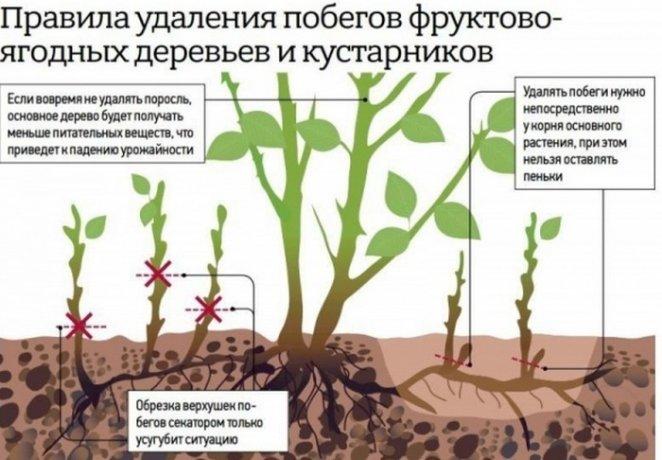
It is recommended to transplant the shoots because they grow and multiply quickly near the mother tree, taking away from it the strength necessary for full fruiting.
Work should be planned for the spring, because in the fall there is a risk of damaging not only the shoots themselves, but also the root of the mother cherry.
To replant a young plant, dig up the soil 30 cm away and trim off a portion of the parent root. The cuts are then carefully cleaned with a sharp knife, then treated with paint and covered with soil.
Bush varieties
Repotting this variety is generally not recommended, as there is a high risk of losing the tree. If the procedure is absolutely necessary, keep in mind the standard guidelines. The repotting process is largely similar to that for the felt cherry. If the bushes become too dense, the plant will stop bearing fruit, so shoots must be removed promptly.
Felt varieties
Transplanting felt cherry trees is generally risky. The process is generally no different from that of other varieties, but the work should be done exclusively in the spring, after the snow has melted. In the fall, there's a high risk of damaging the sensitive roots. Young trees are selected for transplantation, as moving older ones to a new location is pointless. They bear fruit for about 10 years, and the recovery process after transplantation can sometimes drag on for several years. Consequently, you might never get a harvest.
What care does a transplanted cherry tree need?
After transplanting, cherry trees require not only care and attention but also protection from pests. The plant's immune system is not yet sufficiently robust against pathogens. Never allow the soil around the tree to dry out. In dry weather, water once a week. It's a good idea to mulch the soil to prevent excess moisture from evaporating.
To protect against pests and diseases, and to increase the cherry tree's resistance to temperature fluctuations, the trunk is whitewashed.
No additional feeding is required in the first year, but later nitrogen fertilizers, phosphorus and potassium are added.
If your region experiences cold winters, the tree should be prepared according to all the rules, including insulation. Even frost-hardy varieties experience frost damage in the first year after transplanting, so this procedure must be approached carefully. Also, in the fall, the soil around the trunk must be dug over to prevent pests from overwintering there.

Mistakes when transplanting cherries
Inexperienced gardeners are more likely to make mistakes when transplanting cherries, leading to the tree's death or poor survival. The most common mistakes include:
- Transplanting a tree during flowering or after the sap begins to flow.
- Transplanting in rainy weather. Contrary to popular belief, rain does not help seedlings strengthen.
- The planting site was chosen near raspberries or currants. Proximity to these bushes negatively impacts the growth and development of the cherry tree and also promotes disease.
- When digging up the tree, shake off any soil. If this happens accidentally, soak the cherry tree in water for a while, then apply wet clay.
Initially, the process of replanting cherries may seem complicated and labor-intensive. However, if you follow the instructions and recommendations, you'll soon be enjoying a harvest of healthy fruits.
Related posts:
 Description and pollinators of the Vladimirskaya cherry variety, planting and care
 Description and varieties of cherry variety Shpanka, planting and care
 Description and characteristics of the miracle cherry hybrid, planting and care of the variety
 13 Best Cherry Jam Recipes for Winter
 Description and cultivation of the best varieties of felt cherry, planting and care
 When and how to prune cherry trees correctly, and tree shaping schemes for a good harvest
 What tools to use to pick cherries from a tall tree and DIY equipment
 The best recipes for homemade cherry jam with and without pits for the winter, storage