
- Malinovka apple tree: selection and description
- Tree dimensions
- Features of the root system
- Pollinator varieties
- Leaves, flowering and fruiting
- Productivity and annual growth
- Tasting evaluation and scope of application of fruits
- Immunity to diseases and insects
- Resistance to low temperatures and drought
- Pros and cons: is it worth planting in your garden?
- How to plant an apple tree in Suislepskoe
- Deadlines
- Preparing the site and seedlings
- Planting diagram and process
- Caring for a tree
- Watering and fertilizing
- Caring for the tree trunk circle
- Preventive treatments
- Pruning and crown shaping
- Tree grafting
- Preparing for winter
- The nuances of harvesting and storing apples
- Varieties
- Riga
- Columnar
- Red-leaved
- Decorative
Among popular apple varieties, those developed through folk selection are renowned. They are well-adapted to local conditions. One such variety is the Rozov Naliv apple tree. It is undemanding in terms of growing conditions and care, delighting gardeners with a bountiful harvest.
Malinovka apple tree: selection and description
The Rozovy Naliv apple tree was registered in the Russian Federation State Register in 1959. The Malinovka variety had been undergoing trials for 10 years prior. The All-Russian Selection and Technological Institute of Nursery and Horticulture ensures the conservation of this variety. This apple tree is licensed for use in the Volga-Vyatka region.
Tree dimensions
The Rozovy Naliv apple tree grows to a height of 2.5-3 meters. Trees of this variety have a strong trunk and main branches that extend at right angles.
Features of the root system
The root system is powerful, allowing the tree to survive in low temperatures and long periods without watering.
Pollinator varieties
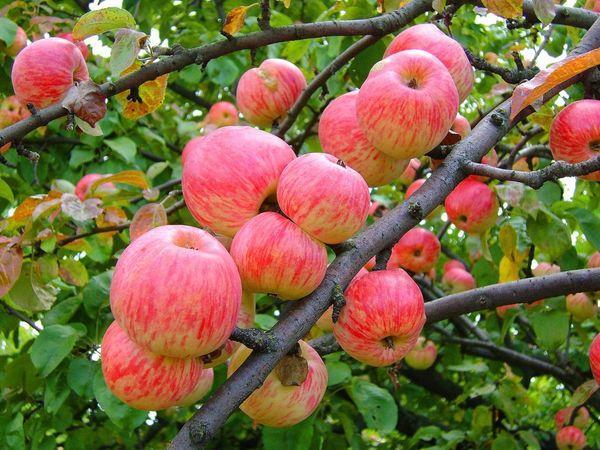
To ensure abundant fruit set, it's important to use pollinating varieties. This can be achieved by planting White Naliv, Melba, or Grushovka alongside Pink Naliv.
It is important to note that the variety in question is self-fertile, but with pollinator trees the yield will be much greater.
Leaves, flowering and fruiting
The dense, compact crown has a pyramidal shape. Over time, it takes on a pyramidal appearance, wide at the base. This is because the main branches of the Pink Filling grow perpendicular to the trunk. The shoots and fruits grow densely on the tree.
The annual shoots are lightly pubescent, with dark burgundy bark. The leaves grow alternately on the branches. They are oval or ovoid in shape with a pointed tip that curves slightly downward. The leaves are lightly pubescent, with finely serrated edges.
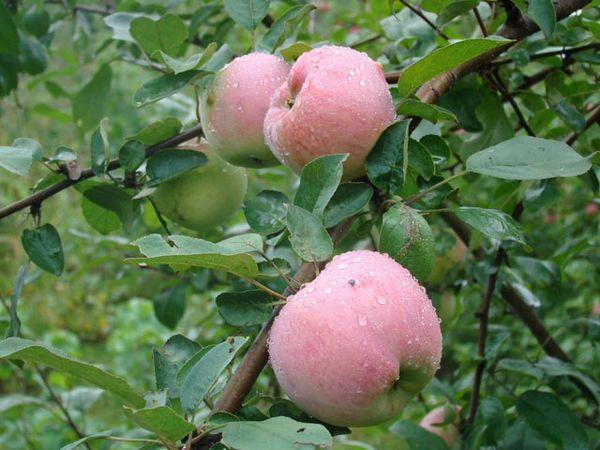
The color of the leaves can be green or dark green.
Apples ripen on last year's growth and spears. The peduncles are short, medium-thick, and slightly curved. They are so strong that they continue to support the apple after ripening.
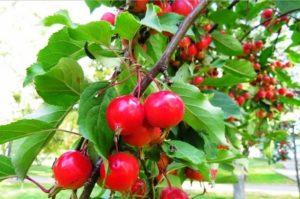
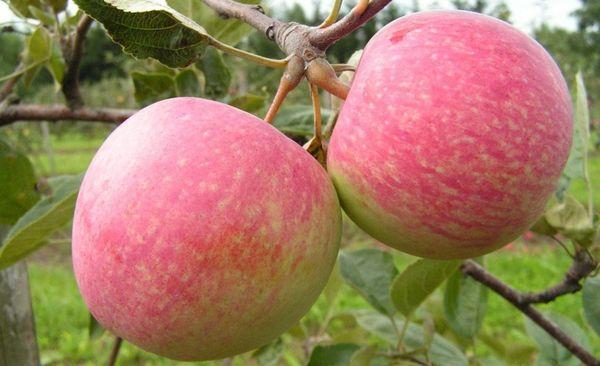
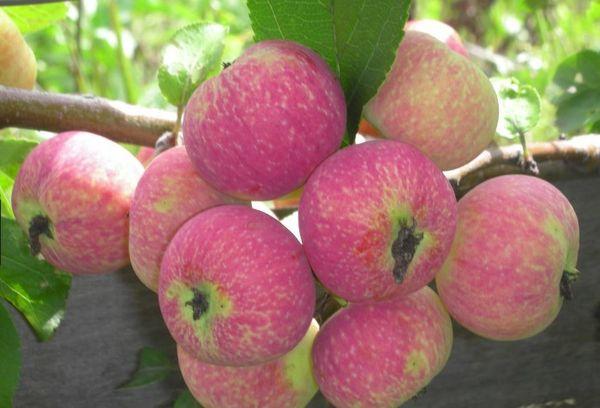
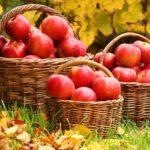
Pink Filling fruits are medium-sized. Each apple averages 120 grams. The largest specimens can weigh 150 grams. They are round-conical in shape, with some apples being slightly flattened. The fruit's surface is slightly ribbed. The funnel is deep and narrow. The skin is smooth, glossy, and of medium thickness.
The primary color of the Pink Filling apple is light green or white. One side is usually red or crimson. Sometimes a slight bluish bloom is visible on the apple.
The pulp is white, juicy, fine-grained and aromatic.
Productivity and annual growth
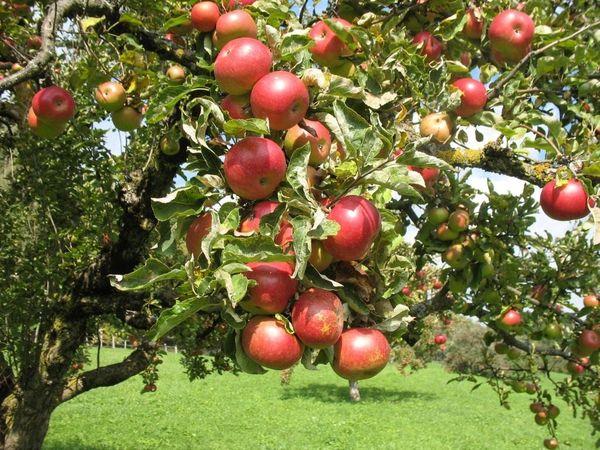
The Rozovy Naliv apple tree harvests in the summer: in late July and early August. The tree begins to bear fruit in its third or fourth year.
Life expectancy usually reaches 35-40 years.
During the season, each tree typically produces between 50 and 80 kilograms of apples.
Tasting evaluation and scope of application of fruits
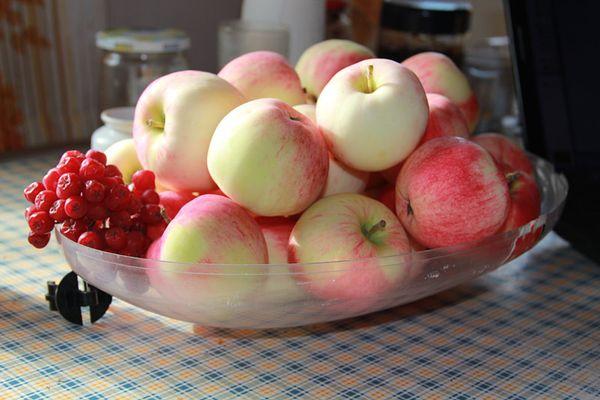
The raspberry apple has a sweet and sour flavor, with a lemonade-like aftertaste. Because the apples don't store well, it's recommended to use them soon after harvest.
Immunity to diseases and insects
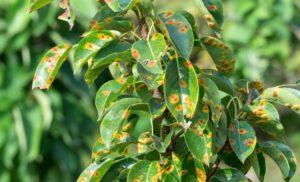
Pink Naliv is resistant to scab infection, provided the weather is not rainy, otherwise it becomes vulnerable.
The Pink Naliv variety is vulnerable to codling moth attacks.
Resistance to low temperatures and drought
The apple tree can withstand frosts over 30 degrees and heat of forty degrees.
Pros and cons: is it worth planting in your garden?
When deciding to plant Pink Naliv apple trees in your plot, you need to take into account its positive features:
- This variety is exceptionally hardy – it can withstand severe drought and severe frosts (down to 32 degrees).
- It does not have strict requirements for soil type and its composition.
- The apple tree begins to bear fruit very early - sometimes this happens in the third year of life.
- The fruit contains a large amount of pectin, which allows you to make delicious jellies, mousses and jams from apples.
- The fruiting is abundant for such small trees. Mature trees produce 50 kilograms of apples per season.
- Pink Filling has a high immunity to scab, although it decreases in rainy weather.
The fruits have a high resistance to burns from direct sunlight.
However, it is necessary to remember that this variety has some disadvantages:
- The variety is vulnerable to a dangerous insect pest, the codling moth.
- In damp weather, there is a high risk of fruit rot infection.
The advantages of this variety indicate that growing Pink Filling apple trees is a good choice for a gardener.
How to plant an apple tree in Suislepskoe
Although this variety doesn't have any special requirements, it grows best in light, loamy, and fertile soils. It's best to plant the seedlings in well-lit areas.
Deadlines
Planting Pink Naliv can be done in spring or fall. In the former case, it's important to do so before the sap begins to flow intensively. If planting in the fall is chosen, it should be done no later than two weeks before the onset of winter frosts.
Preparing the site and seedlings
The holes for the Pink Filling seedlings are prepared several weeks before planting. Afterward, a small amount of peat and compost is added.
Before planting, it is recommended to keep the seedlings in water for 8-12 hours.
Planting diagram and process
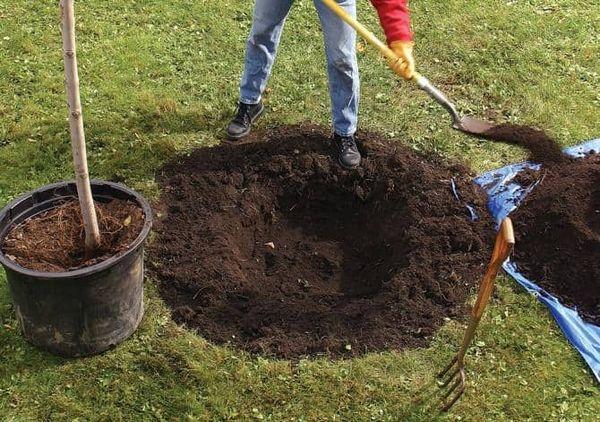
Seedlings should be spaced at least four meters apart. The planting hole should be 50 centimeters deep, wide, and long.
When planting, the roots of the Pink Filling seedling are placed in the hole and carefully spread out. Then, add soil.
Caring for a tree
With proper care, you can count on the tree growing well and producing a rich harvest.
Watering and fertilizing
When watering, maintain moderate soil moisture. Regular fertilization with organic and mineral fertilizers will improve apple tree growth and fruit production. Three or four fertilizations are typically performed during the season, alternating between organic and mineral fertilizers.
They are made by:
- Before flowering.
- After him.
- During the summer.
- After the harvest has been collected.
The minimum watering frequency is once a week. For mature trees, several times a season is sufficient.
Caring for the tree trunk circle
After watering, it is necessary to loosen the soil in the tree trunk circle to prevent a dense crust from forming on the surface.
Regular weeding and loosening of the soil is essential to keeping the tree trunk area clean.
Preventive treatments
To prevent the occurrence of fruit rot, it is necessary to use fungicides.
Insecticides can help prevent codling moth attacks. Trapping belts around the tree trunk can also be used for this purpose.

Another preventative measure against codling moth attacks is to remove old bark.
Pruning and crown shaping
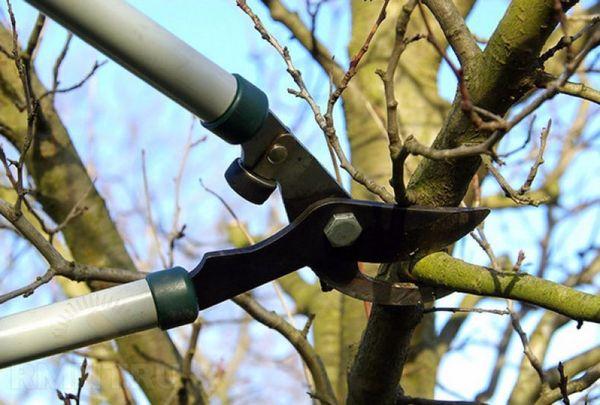
Because the tree grows rapidly, annual pruning and thinning are necessary. This is done in the spring before the buds open.
In the fall, sanitary pruning is carried out - at this time, old, diseased or damaged branches are removed.
Tree grafting
Apple trees can be propagated by grafting onto other fruit trees, while maintaining their original characteristics.
Preparing for winter
It is recommended to paint the lower part of the trunk to protect it from rodents. Since apple trees tolerate frost well, there's no need to insulate them during the winter. However, during particularly severe frosts, you can pile a snowdrift around the trunk to protect the tree.
The nuances of harvesting and storing apples
The shelf life of the Rozovy Naliv variety is poor. During storage, apples begin to spoil after three weeks.
To use apples effectively, they should be eaten immediately or used to make preserves, jams, or juices.
Varieties
There are several varieties of this cultivar. Their characteristics are discussed below.
Riga
Unlike the Pink Filling, the Riga apple tree's fruit stores well. When ripe, it doesn't fall to the ground; instead, it is harvested by plucking it from the branches. The apples are red. Harvesting takes place in September. This variety is frost-resistant and has good disease resistance.
Columnar
This characteristic allows the tree to grow as a single, pole-like structure with virtually no branches. This feature reduces labor costs during apple tree care and harvesting.
Red-leaved
This variety is distinguished by its leaf color. In this case, they are red. The red-leaved apple tree is a hybrid variety. It is known for its undemanding growing conditions and high resistance to diseases and pests.
Decorative
This tree grows up to 8 meters. Flowering occurs in May. The small fruits are brightly colored. The Ornamental apple tree is highly winter-hardy.
Related posts:
 Description and rules for growing the Bratchud apple tree variety
 Description of the Borovinka apple tree variety, cultivation and care
 Description of the Venyaminovskoye apple tree variety, planting and care
 Description and rules for growing creeping apple trees, planting and care
 Description and subspecies of the Sakharny Arkad apple tree variety, cultivation technology
 Description of the Yagodnaya Sibiryachka apple tree variety, planting and growing from seeds
 Description and technology of growing the Vishnevoe apple tree variety
 Description and planting of the Dream apple tree variety, care and propagation