
- History of variety selection
- Description and photo
- Fruit
- Bushes
- Characteristics of the variety
- Productivity and fruiting
- Scope of application
- Resistance to diseases and pests
- Peculiarities
- Advantages and disadvantages
- Growing seedlings
- Timing
- Soil preparation
- Seed sowing pattern
- Care
- Temperature conditions
- Daylight hours
- Irrigation
- Top dressing
- Picking
- Additional feeding
- Planting seedlings in open ground
- Care
- Watering and soil care
- Top dressing
- Spraying against pests and diseases
- Bush formation
- Harvesting and storage
- Secrets of vegetable growers
- Reviews
Vegetables are an essential part of a healthy diet. Eggplants have become a staple in the human vegetable menu. Among the wide variety of eggplants, the Ilya Muromets variety holds a special place. Its excellent flavor and low maintenance make this variety popular with gardeners.
History of variety selection
This variety belongs to the "Russian Bogatyr" group of varieties. It was developed by Gavrish breeders. The goal was to create a high-yielding, low-maintenance variety suitable for cultivation throughout Russia.
Description and photo
A description of the bushes and fruits is provided below. The fruits have distinctive characteristics, and the eggplant bushes are characterized by specific varietal characteristics.
Fruit
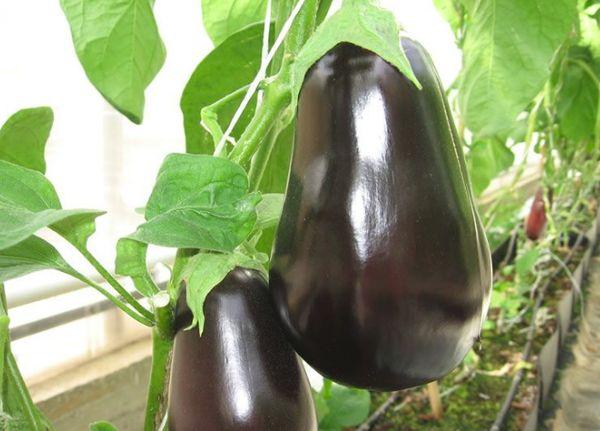
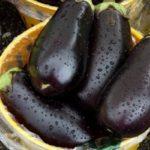
Due to the size of its fruit, the eggplant was included in the "Russian Bogatyr" variety block. Key characteristics:
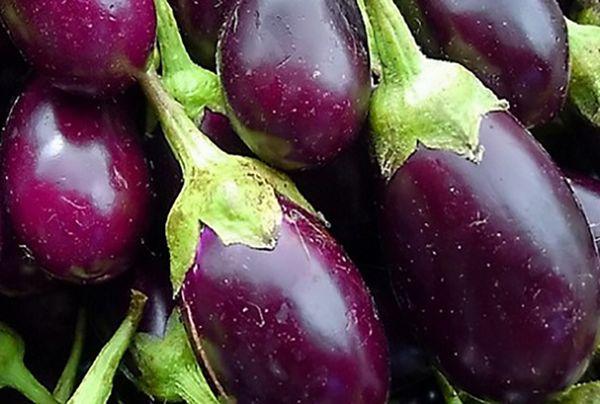
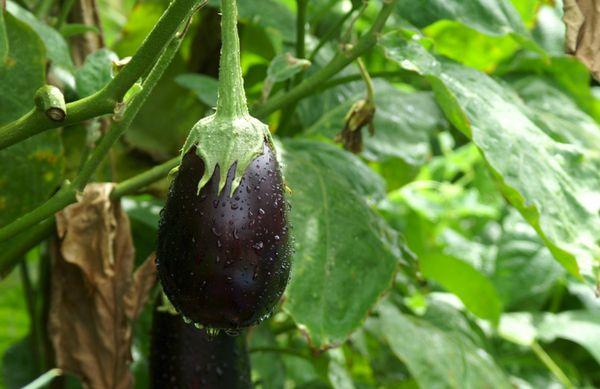
- the length of the fruit, if agricultural practices are followed, reaches 45 cm;
- the fruit diameter is 9 cm or more;
- vegetable weight from 550 to 770 g;
- have a cylindrical shape;
- the skin is not thick, rather hard, with a sheen, purple in color;
- dense structure of the flesh, light beige color, few seeds.
The Ilya Muromets eggplant has excellent flavor. The vegetable's typical bitter taste is absent.

Bushes
The eggplant lives up to its name, as the bush grows about a meter tall. It has a branched structure, is vigorous, and dense. The bush spreads out, and can take up a lot of space in a garden, a factor to consider when planting.
The bush's branches are dense, lightly downy. The stems range in color from green to purple. The leading branches are thick and resilient, not bending under the weight of the fruit. The eggplant's leaf blades are large, oblong-oval, and bright green with a slight pubescence. The edges are partially corrugated.
Characteristics of the variety
This vegetable originates from India; despite selective breeding, the eggplant has retained its dependence on heat and light.
Productivity and fruiting
In terms of ripening time, this variety is considered mid-season. Four months pass from sowing to harvest, with the first vegetables ripening by the second half of August.
The quantity and quality of the eggplant harvest is influenced by:
- a sharp change in temperature (heat during the day, cold at night);
- dryness in the atmosphere and high temperatures, the plant may drop its ovaries;
- eggplant is negatively affected by a lack of moisture, but excess moisture also leads to rotting of the root system;
- In a shaded area, the plant will not produce the desired harvest; when growing eggplant in a greenhouse, it is recommended to install artificial lighting.
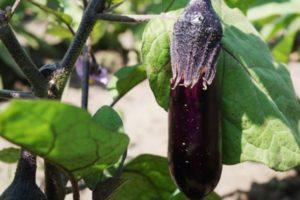
When following the cultivation technique, plants from 1 m2In greenhouse conditions, up to 10 kg or more are collected; in open beds, 1.7-2 kg less.
Scope of application
This eggplant is considered a versatile variety. It is grown commercially for sautéing and caviar, and is used in restaurants as an ingredient in vegetable and meat dishes. It is also suitable for grilling, stewing, and marinating.
Resistance to diseases and pests
The plant is immune to fungal and viral diseases, as well as parasites. The main pests are the larvae of the Colorado potato beetle. Plants grown in open beds are at increased risk of pest infestation. In greenhouses, with excessive humidity and low temperatures, aphid infestation is possible.
This eggplant variety is resistant to late blight and powdery mildew. Diseases such as black rot and black leg are a consequence of improper plant care. To eliminate the problem, reduce watering, allow the root ball to dry out, and remove damaged plants.
Peculiarities
High eggplant yields are achieved by the complete absence of barren flowers. All ovaries produce fruit. The vegetables store well after harvest and withstand transportation well.

Advantages and disadvantages
This eggplant variety has no significant drawbacks. Gardeners note the following positive aspects:
- abundant flowering of the plant, good yield due to the setting of fruits on each flower;
- has immunity to diseases and is not afraid of most harmful insects;
- the plant does not require special care;
- the fruits are characterized by high taste and do not have bitterness;
- the ability to grow in greenhouses and open beds makes the plant accessible to most areas;
- Vegetables can be stored for a long period of time and tolerate transportation well.
A disadvantage is the plant's requirement for sufficient lighting and stable temperature indicators.
Growing seedlings
To shorten the growing season, it is recommended to plant seedlings. Seeds can be harvested independently; eggplant is not a hybrid, so the seeds retain all varietal characteristics and have a shelf life of up to 5 years.
Timing
At the end of February, it is necessary to prepare a place in the greenhouse or container for sowing eggplant seeds.
Soil preparation
If the seedlings will be grown in a greenhouse, loosen the soil and add organic matter and ash. The soil should be kept moist. When growing indoors, sow the seeds in containers filled with peat or soil mixed with compost.
Seed sowing pattern
Treat the seeds with a manganese solution to disinfect them. Make furrows in the soil, 2 cm deep, and lay the seeds.

When sowing in containers, make furrows 1.5-2 cm deep at a distance of 5 cm. Place the seeds at a distance of 4-5 cm. Water with warm water.
Care
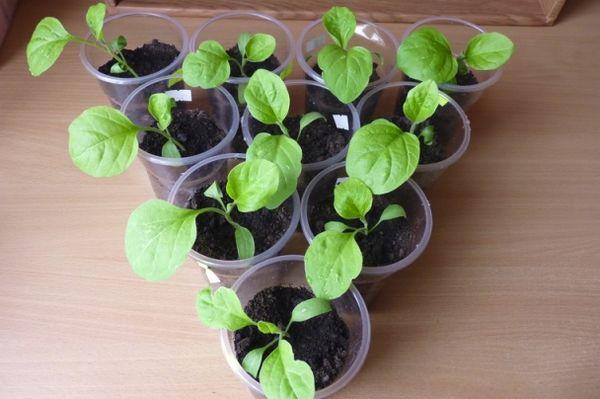
14 days after sowing, shoots appear. With proper eggplant seedlings care by mid-May will be ready for planting in the prepared area.
Temperature conditions
Particular attention is paid to the temperature in the greenhouse; it is not allowed to fall below +15OC.
Daylight hours
Eggplant is a sun-loving plant. The container should be placed in a warm, well-lit location and covered with plastic. Once sprouts appear, remove the covering and protect the seedlings from direct sunlight.
Irrigation
Before germination, water the soil regularly once a week. After germination, water as needed, but no more than once every 10 days.
Top dressing
Seedlings need nutrition. If growth is slow, they should be fed with organic matter. A 1:15 dilution of bird droppings is recommended.
Picking
After 21 days, the seedlings are ready for transplanting. To avoid damaging the roots, carefully remove the seedlings from the container and place them in a prepared container. Peat pots are ideal, but if you don't have any, plastic cups can be used. After a week, the seedlings are ready for planting in open beds or a greenhouse.
Additional feeding
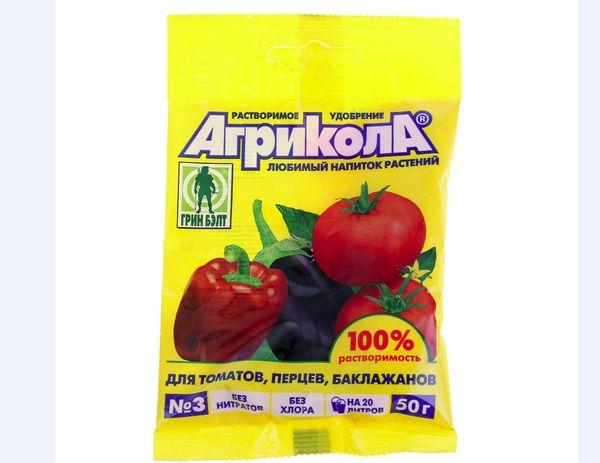
Additionally, foliar feeding is performed 6 days before planting in a permanent location. This is necessary to increase resistance to external aggressive factors and improve survival. Humates and mineral fertilizers are used for this purpose. Agricola is an excellent choice.
Additional root feeding is performed if the seedlings are weak. Complex products are used, such as nitrophoska, Kristalon, and Kemira.
Planting seedlings in open ground
Planting occurs when the soil has warmed sufficiently. It's important to choose the right location. It should be well-lit, not in a low-lying area, and free of drafts.
Loosen the soil, remove weeds, and fertilize with organic matter. Plant seedlings in peat containers alongside the soil. Cut open the plastic containers and remove the seedlings along with the root ball. The recommended distance between plants is 0.5 m, and between rows, 0.6 m.
Care
Proper and adequate care affects the quality and quantity of the harvest.
Watering and soil care
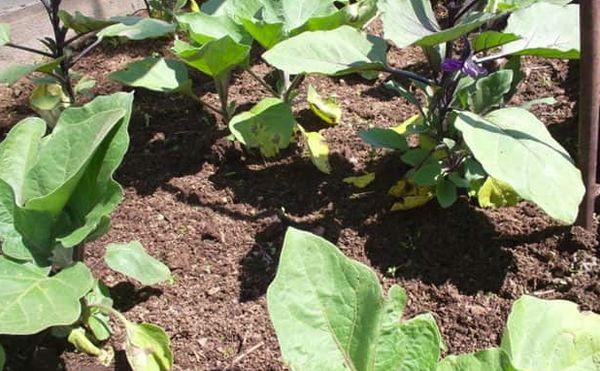
After planting, water the plants once a week, then as needed. Soil care is also important: loosening the soil and removing weeds.
Top dressing
Apply the first root feeding 21 days after planting; organic fertilizer is recommended. The next feeding should be done 14 days later, using phosphorus-containing products. Fertilizing is best done in damp, rainy weather. In dry weather, the soil should be moistened beforehand.
Spraying against pests and diseases
During the growing season, the plant suffers from several diseases. The main ones are root and basal rot, tracheomycosis (fusarium wilt, late blight, verticillium wilt), and leaf mosaic. Disease control is achieved through a number of measures, including soil and above-ground treatments. The following are used:
- biochemical preparations that do not harm beneficial insects (bees), animals or humans;
- chemical agents that can quickly destroy the disease, but have a negative impact on the human body, since the chemicals accumulate in the fruits;
- folk methods using infusions of plants that have fungicidal and insecticidal properties.
The Colorado potato beetle and aphids are considered dangerous pests for eggplants; they can destroy the plant in a few days. Confidor Extra, Aktara, Decis-Profi, and Inta-Vir are used for control. All treatments are stopped before the plant begins to bloom.
Some gardeners use folk remedies to combat pests: decoctions of wormwood and yarrow, dusting, and sprinkling with ash. Beetle larvae are eliminated with a mixture of onions, garlic cloves, dandelion, and soap.
Bush formation
At the beginning of the flowering period, carry out the formation of the bush:
- cut off the leaf blades located before the first fork on the plant trunk;
- remove small flower stalks from the lower branches.
Harvesting and storage
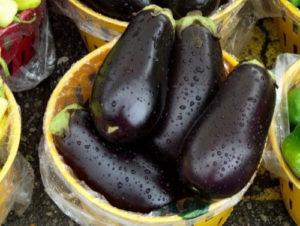
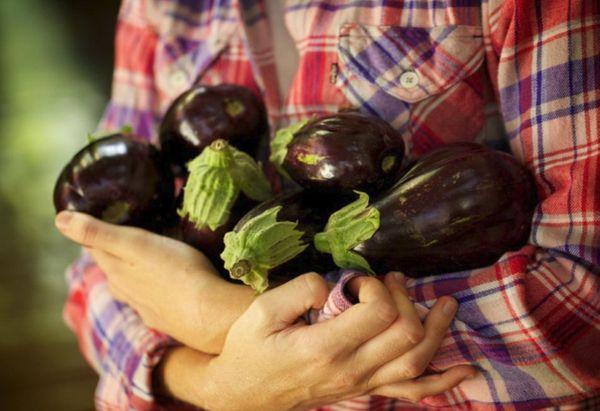
The first harvest of the fruit typically begins 35-40 days after flowering. Ripeness is indicated by a rich purple skin with a dark hue and firm flesh. The fruit is harvested with scissors, leaving a 4-5 cm stalk.
Eggplants can be stored for quite a long period of time. When maintained at the required temperature (+10 OC) and air humidity (90%), the fruits do not lose their commercial qualities for about a month, provided that the eggplants are kept in a dry, dark room.
Secrets of vegetable growers
When growing eggplants, experienced gardeners share secrets that promote healthy plant development, which affects the quality and quantity of the harvest:
- When growing seedlings, use peat pots. Planting eggplants in open beds is stress-free, and the plants are strong and healthy.
- Choose the southern side of the house or fence for planting, so that they will serve as protection for the plant from the winds.
- Eggplant bushes should be watered and irrigated with warm water.
Reviews
Vera Pavlovna, Saratov: "Eggplants grow like crazy in rich, fertile soil. I use manure and bird droppings to feed the plants. Eggplants are heat-loving but don't tolerate extreme heat. The fruits have excellent flavor."
Larisa Nikolaevna, Serov: "Eggplants ripen beautifully under plastic cover in the Northern Urals. I use seedlings that I sow in peat pellets. I begin harvesting as early as mid-August."
Related posts:
 The best eggplant varieties for growing in a polycarbonate greenhouse: planting and care
 80 Best Eggplant Varieties for Different Regions with Descriptions and Characteristics
 Causes and treatment of eggplant pests and diseases, how to combat them at home
 Characteristics and description of the Black Beauty eggplant variety, planting and care
 Planting, growing, and caring for eggplant seedlings at home
 Description and characteristics of the Vera eggplant variety, yield and cultivation
 Description and characteristics of the Clorinda eggplant variety, cultivation and care
 How to grow eggplants outdoors and properly care for the plant