
- Seed preparation
- Calibration
- Checking for fullness
- Disinfection
- Treatment with growth stimulants
- Germination
- Sowing dates
- Selecting soil
- Ready
- Homemade cooking
- Methods
- Traditional
- Into the snail
- Into boiling water
- In peat tablets
- Without land
- Picking
- Care
- Lighting
- Temperature
- Watering
- Living space
- Prevention
- Top dressing
- Fertika Lux
- Gumi Kuznetsova
- Agricola
- "Athlete"
- With your own hands
- Adviсe
- Answers to questions
- The seedlings stopped growing after picking.
- It's withering
- Blackleg
- Hypothermia
- Yellow spots on leaves
- Mechanical damage
- Timing of planting in a greenhouse or open ground
- Master class
In the past, only residents of southern regions could enjoy fresh eggplants from their own gardens. This nightshade species was rarely found in dishes in the temperate climates. With the development of eggplant seedling cultivation technology and the selection of new varieties and hybrids, the vegetable has become available in temperate climates. Proper preparation of planting material and careful care of the seedlings guarantee strong, vigorous plants.
Seed preparation
Before planting, eggplant seeds require preparation. First, the seeds should be sorted by size and tested for germination. Then, disinfect them to prevent the transfer of fungal spores and viruses. Afterwards, the seeds should be treated with growth stimulants and germinated.
Calibration
To grow high-quality seedlings at home with uniform development, eggplant seeds must be calibrated by size. All seeds are sorted and sorted, gathering samples of similar sizes together. Groups of different sizes are planted in separate containers, where the seedlings can develop at a uniform pace without suppressing weaker plants.
You should not use planting material:
- deformed;
- sharply different in color;
- blotchy;
- with signs of mold.
Checking for fullness
Seeds suitable for planting are tested for germination by determining their internal content. The procedure is as follows:
- In a shallow bowl, prepare a solution of table salt in a ratio of 1 teaspoon to 250 ml of water.
- The seeds are placed in a container and stirred to remove air.
- After 5 minutes, the heavy, high-quality seeds will sink to the bottom, while the hollow ones will remain on the surface.
- The material from the surface is discarded, and what remains below is dried and prepared for sowing for seedlings.
Disinfection
Store-bought seeds have already undergone industrial disinfection, but home-grown seeds must be treated. The easiest way is to soak them in a potassium permanganate solution. The concentration should be low—about 1%. Disinfection time should not exceed 15 minutes.

Treatment with growth stimulants
To accelerate seed growth, you can use special growth stimulants. Chemicals help to quickly accumulate nutrients and stimulate seedling growth. However, when growing organic vegetables, avoid using industrial products. Popular stimulants include:
- "Heteroauxin";
- "Kornevin";
- "Zircon";
- "Epin".
Germination
Eggplant seeds don't necessarily need to be sprouted; they germinate easily. However, if desired, this can be done using the standard method. Place the seeds in cheesecloth, place them in a saucer, and moisten. Maintain the moisture until sprouts appear, and keep the temperature above room temperature but below 45°C.
 If the soil before planting was disinfected, then eggplant seeds do not require additional treatment.
Sowing dates
The best way to determine when to plant eggplants at home is to use an annual lunar sowing calendar. For store-bought seeds, planting time information is provided on the packaging and may vary depending on the variety.
The starting point is considered to be the time for planting mature eggplant seedlings. By this time, the weather should be consistently warm, with no risk of sudden cold snaps or frosts. Sprouted seeds are planted 70 days before the expected date, and dry seeds are planted one week earlier. For greenhouse cultivation, the planting time is advanced by three weeks.

Selecting soil
When choosing the right soil for eggplant seedlings, you need to pay attention to the following characteristics:
- good air permeability;
- ability to absorb and retain moisture;
- high fertility;
- balance of organics and minerals;
- neutral acidity;
- disinfection;
- environmental friendliness.
Ready
When purchasing soil for growing seedlings, it's best to choose specialized seedling mixes. Soil and substrate for tomatoes and peppers are also suitable for eggplants. The prepared soil should not contain a lot of clay or excessive amounts of organic matter. Before placing the soil in containers, sift it and break up any lumps.

Homemade cooking
You can make your own soil mixture using one of the following recipes:
- Take equal parts of peat and river sand and mix with 2 parts of humus.
- Mix peat, compost and sawdust in a ratio of 3/5/1.
- Combine 2 parts turf with 3 parts humus and 1 part sand.
The ingredients from any recipe are mixed with wood ash in a ratio of 250 ml per 10 liters of soil.
Methods
There are several methods for planting eggplant seeds for seedlings, each with its own unique benefits. Some accelerate growth, others simplify cultivation, and still others help avoid labor-intensive care later.

Traditional
With the traditional planting technique, seeds are sown in a single container. Soil is added, and longitudinal holes are made about 8 mm deep. The seeds are placed one at a time, spaced at least 10 mm apart. A small amount of soil is sprinkled over the seedlings and watered using a spray bottle. The container is covered with glass or transparent film and placed in a warm place. The cover is removed when the first seedlings appear.
Into the snail
For those looking to save space, planting in a snail is a good option. A synthetic porous substrate is cut into 15 cm strips. Soil is added to a 2 cm thick layer on top of the material and rolled into a tight roll. The soil is lightly pressed down on top of the snail, the seeds are placed about 3 cm apart, and the top is covered with soil or pressed slightly into the snail. The finished snails are placed in a container and covered with plastic wrap until the seedlings emerge.

Into boiling water
This method significantly reduces the time until germination. Place a 4-cm layer of seedling soil in a plastic container. Spread the seeds on the surface of the soil, then water them gently with boiling water. Immediately close the container with a transparent lid. In a warm, bright location, seedlings will appear as early as four days later.
In peat tablets
To avoid transplanting seedlings, you can plant eggplant seeds in ready-made peat pellets. This method will also better preserve the roots and protect the plants from stress. Place the soil circles in a suitable container with individual depressions. Water each circle, and when the soil has expanded, place an eggplant seed in the center and press it 1 cm into the soil. The kit usually includes a special lid; otherwise, cover the container with plastic wrap.

Without land
There's also a soil-free method for sowing eggplant seedlings. Place regular toilet paper on 10-cm-wide plastic strips and spray them with water. Lay the eggplant seeds in a row, 10 mm from the top edge. Place another layer of paper and plastic wrap on top. Carefully roll the strip into a roll and place it in a glass filled with 4 cm of water. Maintain the moisture level and change the water daily.
Picking
If the seedling growing method involves transplanting, the plants should be transplanted into individual containers. The best time to transplant is when the eggplants have developed two true leaves. Peat pots, which can then be placed directly in the ground or a greenhouse, are ideal for transplanting.

The key to successful transplanting is preserving the integrity of the eggplant root system. It's recommended to grow nightshades without this step.
Care
To grow strong, healthy eggplant seedlings, they require careful, high-quality care. A well-developed root system and firm foliage will ensure successful plant survival.
Lighting
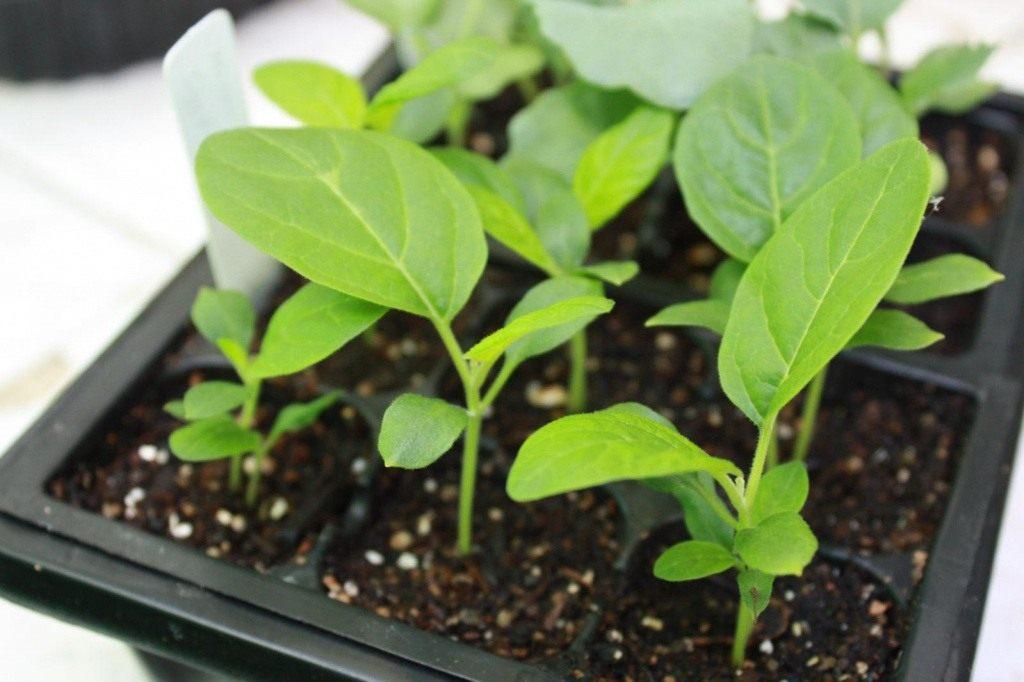
Eggplant seedlings require long daylight hours. It's unlikely that you'll be able to provide the plants with 14 hours of natural sunlight per day, so you'll need to prepare a supplemental light source in advance. Fluorescent or LED lamps should be placed above the seedlings; if the eggplants are placed sideways, rotate the containers periodically.
Temperature
Eggplant seedlings must be kept in a warm room free from temperature fluctuations and drafts. The plant germinates and grows normally when maintained at a temperature of 20-24°C.
Watering
Plants require moist soil at any stage of growth. Avoid both drying out and stagnant water. The amount and frequency of watering depends on the rate of moisture evaporation and the size of the eggplant. The water used for irrigation should not be cold; the optimal temperature is the same as the plant's surrounding environment, around 22°C. It should also be allowed to settle beforehand.

Living space
When growing eggplants, it's important to ensure the plants are spaced freely. As they grow, the seedling containers are positioned to avoid close contact. Leaves should not touch, as this can cause curling, deformation, and upward extension of the central stem.
Prevention
Properly prepared seedlings provide eggplants with resistance to various diseases and reduce the risk of pest infestation. The main preventative measures include pre-planting seed and soil treatment. If these procedures have not been performed, seedlings can be treated with products such as Fitosporin or Fitoverm.

Top dressing
You can begin fertilizing eggplant seedlings when the plants have developed four true leaves, or 10 days after transplanting. The first application of fertilizer should be thoroughly diluted to avoid damaging the plants. If you used prepared soil for sowing the seeds, the eggplants will not require additional feeding.
Fertika Lux
This fertilizer is a dry, chlorine-free mineral mixture. This versatile product stimulates the growth of eggplant seedlings when applied weekly. Dilute at a rate of 1 g per liter of water.
Gumi Kuznetsova
The fertilizer is of natural origin and contains:
- humic acids;
- nitrogen;
- phosphorus;
- potassium.

Seedlings can be watered or sprayed once every 2 weeks with a solution of 8 drops of the product per 1 liter of water.
Agricola
This fertilizer is well suited for root feeding and spraying. The nutrient solution is prepared at a ratio of 2.5 g per 1 liter of water. This product strengthens seedling immunity and eggplant resilience to changing weather conditions. The product is based on:
- phosphorus;
- potassium;
- nitrogen;
- microelements.
"Athlete"
This protective fertilizer stimulates plant immunity, strengthens stems and leaves without accelerating upward growth. Eggplant seedlings are sprayed with the product itself, and for watering, prepare a solution of 30-40 ml of the product per 1 liter of water.

With your own hands
You can make your own complex fertilizer to feed your eggplant seedlings. It's recommended to apply the fertilizers in the following order:
- The first time, the seedlings are watered with a mixture of 1 g of potassium, 1 teaspoon of ash, 4 g of superphosphate and half a teaspoon of saltpeter dissolved in 1 liter of water.
- After 10 days, add a steeped aqueous solution of chicken manure, diluted in a ratio of 1 to 15.
7 days before transplanting the seedlings to a permanent location, it is recommended to feed the eggplants with superphosphate and begin hardening them.
Adviсe
When growing eggplant seedlings, it is recommended to follow the advice of experienced farmers:
- There is no need to compact the soil after planting the seeds, this will prevent access of moisture and air.
- If the containers with seeds are covered with film or a lid, then there is no need to water them.
- Seed germination occurs at 25-30 °C.
- Weak watering is less harmful to seedlings than overwatering.
- Large seedlings tolerate transplanting worse than young ones.
- Cooling the air to 15°C can destroy the seedlings.
- Eggplant is planted in the ground when the stem has produced more than 10 true leaves.

Answers to questions
Many farmers face similar challenges when growing eggplant seedlings. Answers to common questions will help you navigate the situation and solve the problem.
The seedlings stopped growing after picking.
The problem may be caused by damage to the root system when transplanting seedlings. In this case, it is necessary to use a root growth stimulator.
It's withering
Loss of tone can be associated with various reasons:
- stagnation of water at the roots due to excessive watering, then it needs to be reduced;
- drafts that need to be eliminated or the seedlings need to be moved higher;
- stress from transplantation.

Blackleg
Fungal disease is caused by excess moisture. Its presence is indicated by wilting and the appearance of a thin band on the stem near the roots. To treat, normalize watering and spray the plant with Previkur.
Hypothermia
Excessively cold air during hardening off can cause hypothermia in the seedlings. This can cause eggplant leaves to lose their vitality. Watering with water at around 30°C will help protect the plants from dying.
Yellow spots on leaves
Loss of pigmentation and yellowing indicate a nutrient deficiency in the soil. The eggplant continues to grow, but the lower leaves are damaged. The seedlings need to be fed with mineral fertilizers without the addition of organic matter.

Mechanical damage
The appearance of bumps and holes on the green parts of seedlings may indicate a pest infestation. The eggplants should be inspected for insects, identified, and treated with an appropriate insecticide.
If the damage resembles burns, the auxiliary lighting is likely too close. Simply move the light source a little further away.
Timing of planting in a greenhouse or open ground
Seedlings can be transplanted to their permanent locations 60-90 days after germination. This means eggplants sown in February will be fully ready for planting in late spring. Greenhouse planting is not dependent on the weather and occurs in the second half of May. Outdoor planting begins in May, and sometimes as early as early June if cool weather persists. In southern regions, eggplants can be planted a month earlier.
Seedlings ready for transplanting should have 5 or more pairs of true leaves and be at least 15 cm tall. It's also important to avoid overgrowing plants, as eggplants entering flowering will have difficulty establishing, may lose buds, and stunt their growth.
Master class
For a more detailed look at eggplant cultivation techniques at home, watch the video master class. Experienced farmers and agronomists often share tips and demonstrate the nuances of growing nightshades.
Related posts:
 The best eggplant varieties for growing in a polycarbonate greenhouse: planting and care
 80 Best Eggplant Varieties for Different Regions with Descriptions and Characteristics
 Characteristics and description of the Almaz eggplant variety, cultivation and care
 Description and characteristics of the Bibo eggplant variety, cultivation and care
 Causes and treatment of eggplant pests and diseases, how to combat them at home
 How to grow eggplants outdoors and properly care for the plant
 Description and characteristics of the Ilya Muromets eggplant variety, cultivation and care
 How to properly plant and care for eggplants in open ground