
Like any vegetable crop, garlic is susceptible to pests and diseases. Early detection of signs of garlic disease and early control can help increase yields. The question of what to do if plants are affected often arises among inexperienced gardeners, so it's important to understand proper care, preventative measures, and other nuances.
Garlic pests
There are many insect pests that can ruin your harvest. Some garlic pests live and overwinter in the soil, while others flock to the surface of the plant. To begin protecting your plants from pests, it's important to understand the type of insect attacking your crops. This is necessary because the same garden treatments have different effects on different insects.
Stem nematode
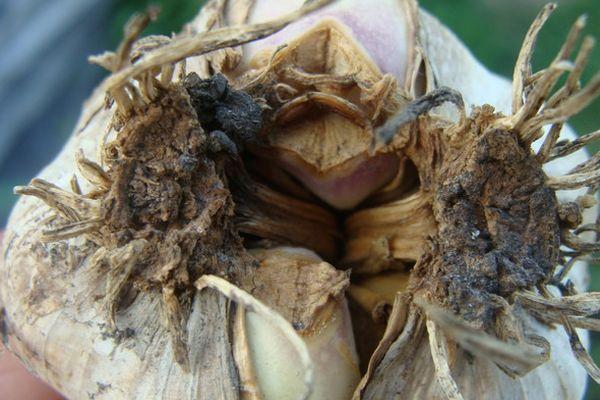
Stem nematode is the most common and damaging pest of garlic. In heavily infested areas, nematodes can destroy entire seedlings. This pest thrives in clayey and heavy soils, which also contribute to the development of neck rot. It appears as a worm, feeding on the sap of the green parts of the plant.
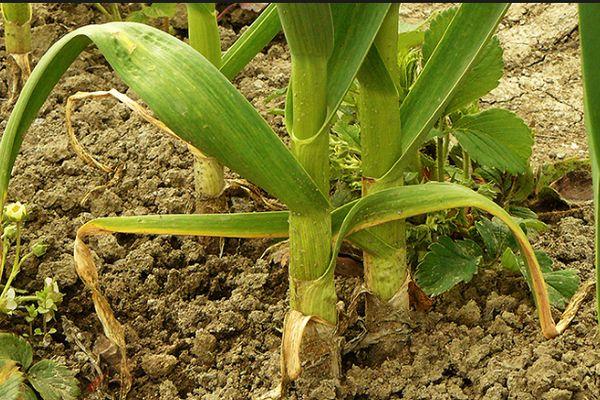
Garlic affected by stem nematode stops growing, the above-ground part turns yellow and withers, and the bottom of the fruit cracks.
Methods and techniques for controlling stem nematodes involve replanting garlic in infested areas after more than four years. If the soil in the beds has a clay structure, fertilize the soil with a mixture of peat and coarse sand when digging. Pre-treatment of the soil is also effective when treating garlic diseases.
Before sowing, the soil should be watered with a solution of table salt, and the garlic cloves themselves should be kept in a similar mixture for an hour.
Onion root mite
The pest damages harvested fruit during storage, but if the insect enters the soil through infected planting material, the plants can be affected during the growing season. The presence of the mite in the soil causes the infection to persist, leading to rotting of the lower portions of the fruit. Female onion mites lay eggs, after which the larvae hatch and chew through the cloves.
To combat root mites, plant the crop after harvesting cucumbers, tomatoes, and cabbage. Also, to prevent and control garlic pests, it's recommended to dry the fruit for a week at a high temperature of 30-40 degrees Celsius (96-104 degrees Fahrenheit) before storing it. During the growing season and storage, inspect the crop and remove any rotting specimens.
Take a look Also
Garlic mite
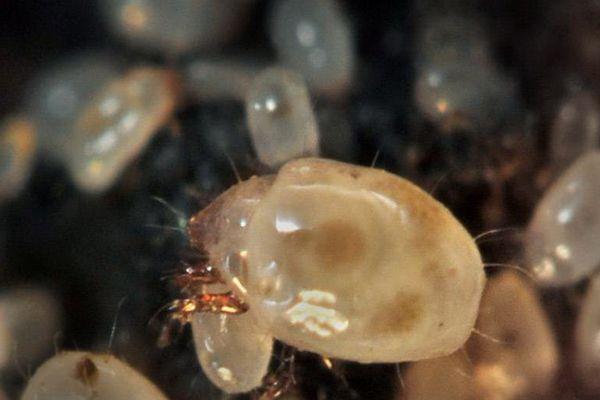
A variety of the four-legged mite most often attacks spring crops. The insect gnaws at the fruit and simultaneously transmits viral infections. The pest's body consists of interlocking transverse rings, with two pairs of legs on the anterior portion. At the end of summer, female mites lay eggs on the leaves, which are frost-resistant and can remain on garlic cloves during storage.
Due to the influence of the insect, the cloves become soft and lose their flavor.
To eliminate garlic pests, regularly inspect the seedlings. If damage is detected, the beds will need to be treated with insecticides. If the pests are actively infesting, yellow spots and dents will form on the garlic cloves, and the leaves will become twisted and corrugated.
Onion fly
Onion flies are most common in loamy and sandy loam soils. They cause maximum damage when the air is excessively humid. Onion flies can be identified in garden beds using the following pest description:
- The onion fly resembles the common fly in appearance, but is smaller. Its body length does not exceed 8 millimeters.
- The insect is ash-gray in color, and its legs are covered with black fur.
- The eggs laid by the female are oblong. The larvae are white and up to 10 millimeters long.
- The fly overwinters as a reddish-brown pupa at a depth of 15-20 centimeters.
Depending on temperature conditions, the insects appear in garden beds from mid-April and continue for a couple of months. Garlic pests typically become active during cherry and lilac blossom season. A week after emergence, the onion fly begins laying eggs, and after another 5-7 days, the larvae emerge and penetrate the soil to the fruit.
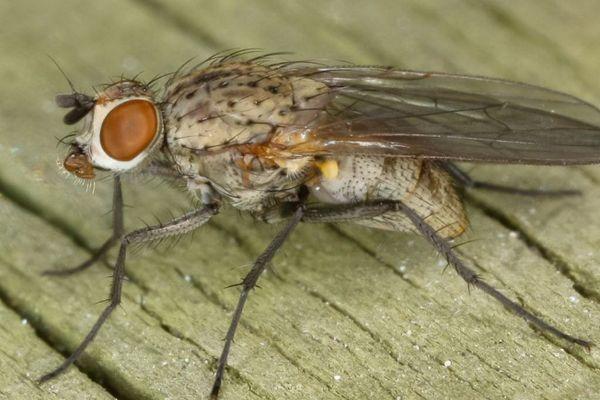
By gnawing through the lower part, the larvae reach the cloves and consume the pulp. During a single growing season, onion flies attack seedlings 2-3 times.
When wondering how to control garlic pests, it's essential to use repellents. One common solution involves mixing 2-3 liters of warm water, 200 grams of tobacco dust, and a spoonful of ground pepper. After mixing the ingredients, let the mixture steep for a couple of days. Then, filter the mixture, dilute it with water to make 10 liters, and add 2 tablespoons of liquid soap.
The solution can be sprayed on the plants and soil every 7-10 days.
Garlic diseases
Not only pests but also garlic diseases can reduce yields. No vegetable crop can be completely protected from adverse external factors, so it's important to know about common diseases and how to eliminate them.
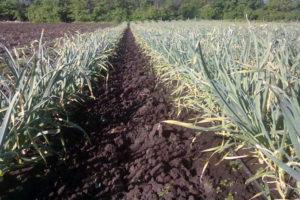
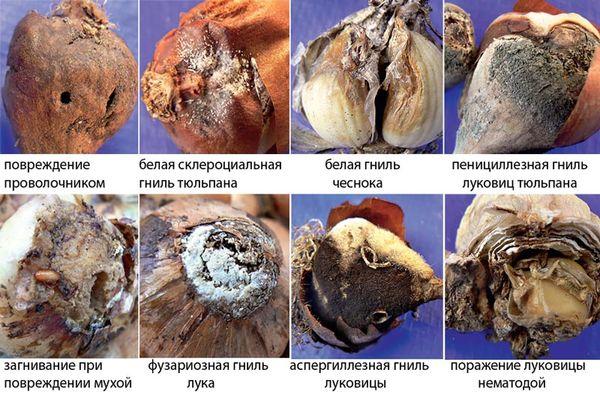
To reduce the likelihood of developing bacterial infections, you should follow these steps:
- observe crop rotation rules and sow the crop in one area 3-4 years after the previous harvest;
- as a previous crop, choose cucumbers, tomatoes, pumpkin, zucchini, cabbage;
- Before sowing, soak the planting material in a warm liquid to kill bacteria, since garlic bacteriosis and other diseases more often attack weak plants;
- clear the beds of post-harvest residues and weeds that grow during the summer season, which hinder the formation of the root system;
- Follow basic care guidelines, including watering, loosening the soil, weeding, and fertilizing.
By following a few simple steps, you can reduce the effects of even such a dangerous disease as garlic downy mildew.
Creating comfortable conditions for growing crops facilitates the ripening process, which is most important for beginning gardeners.
Garlic rust
Rust causes raised orange spots to form on garlic leaves. As the disease progresses, the spots darken, and the above-ground portions of the plants begin to dry out prematurely. Rust is caused by a parasitic fungus, which completes its life cycle on a single seedling. Post-harvest residues in the garden and perennial plantings also serve as sources of infection. Detecting the progress of garlic disease is very easy with regular visual inspection of the plants.
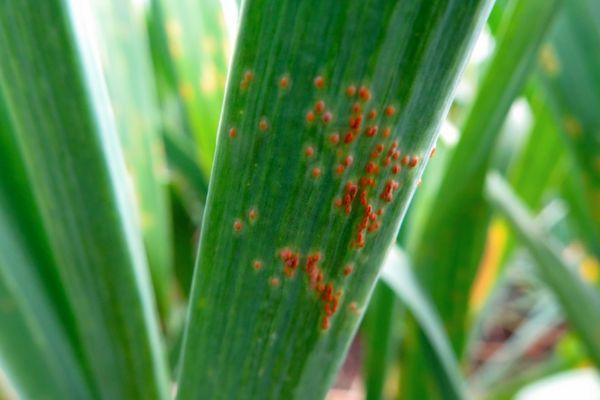
There are several effective methods for combating the spread of rust, including:
- At the beginning of the disease development, it is necessary to pick off and destroy infected leaves yourself.
- If the plantings are in a neglected state, spraying with a weakly concentrated Bordeaux mixture is required.
- Before planting, peel garlic cloves and treat them with a formalin solution. Then, leave them on a dry, stiff cloth in the shade to air out.
- Garlic should be planted at a distance from perennial onions, which can provoke the development of the disease.
A separate method for combating rust is treating crops with a copper sulfate solution or the fungicide Hom. These agents are recommended when rust covers most of the leaf surface. For increased effectiveness, mix the products with finely ground tar soap. Spray seedlings every 1-2 weeks, but stop irrigation completely a month before harvest.
Black mold of garlic
Black mold can be detected by the presence of yellowish spots on the leaves. The development of garlic mold causes the spots to gradually darken and form a coating, which is caused by the parasite's sporulation. The disease progresses rapidly in damp climates and consistently high temperatures. In most cases, black mold is a secondary disease that attacks and rots plants that are already weak or infected with another infection.
With increased atmospheric humidity, the disease can develop on its own, damaging healthy plants.
When faced with infectious garlic diseases, it's important to use countermeasures and control methods. To eliminate black mold, it's essential to adhere to crop rotation guidelines, apply proper agricultural practices promptly, and adhere to appropriate watering and tillage schedules.
Take a look Also
To prevent the disease from damaging the harvest during storage, it's important to provide suitable conditions. The infection typically affects fruits left in a warm room, as well as unripe or incompletely dried ones. Initially, the harvest becomes soft, and when the fungal spores mature, black spores form in the spaces between the scales. The spores are carried by the wind to neighboring crops.
Fusarium wilt of garlic
Garlic bottom rot is called fusarium wilt. Initial symptoms of infection can be seen during the intensive ripening of the crop. When garlic is infected with fusarium wilt, softening of the tissues of the bottom is first observed, followed by the formation of a pale yellow or white mycelium. As a result of the disease, the root system rots, and the above-ground portion turns yellow and wilts.
In high humidity and hot weather, fusarium progresses and spreads to neighboring plants. If the disease spreads to garlic before harvest, the bulbs will dry out during storage and, over time, completely lose their flavor and nutritional value.
If fusarium wilt occurs, it's important to determine the cause. In most cases, the source of infection is contaminated soil or seed. If this is the cause, disinfecting the planting material with copper oxychloride or copper sulfate solution should be used as a preventative measure to protect future plantings. To prevent the progression of fusarium wilt, it is also recommended:
- remove infected plants from the beds;
- Dry the harvested crop thoroughly and store it in a cool place;
- periodically check the area for weeds and plant debris;
- adhere to basic agricultural practices and rules for crop care, taking into account the characteristics of a particular variety.
Related posts:
 Description and cultivation of single-clove garlic, planting and care rules
 Description and yield of the Lyubasha garlic variety, planting and care
 Winter garlic cultivation technology, large varieties and cultivation rules
 The best varieties and types of early and winter garlic with descriptions and names
 How to properly dry winter garlic after digging and where to store it at home
 How and with what to fertilize garlic so that it grows large in open ground
 How to properly plant garlic outdoors and prepare the soil
 11 Best Recipes for Pickled Garlic Sprouts for Winter
To prevent diseases and to strengthen garlic seedlings, I recommend using the bioactivator "BioGrow", it costs very little and will be delivered to your home in just a few days.