
- Growing an exotic tree at home
- How to get seeds from fruit
- To sprout or not to sprout?
- Planting in the ground
- Required soil composition and container size
- How long does it take for seedlings to germinate?
- Culling and replanting sprouted plants
- Further care
- Temperature and humidity
- Lighting and ventilation of the place
- Watering and fertilizing
- Bush formation
- Transfer
- Diseases and pests
- How to propagate a crop at home
- seedlings
- Cuttings
- Features of care in winter
- Will the plant bear fruit?
- Do you need to vaccinate?
- Fruiting and berry picking
- Which varieties are suitable for home growing?
- Hybrid
- Purple
- Giraldi
- Polygamy
- Kolomikta
- Arguta
- Pineapple
- Hayward
- Is it possible to transplant the plant into open ground?
- Growing characteristics in different regions of Russia
Woody vines are rarely used in gardening in Russia. However, modern breeding makes it possible to cultivate exotic plants outside their natural habitat. Actinidia is undoubtedly the most popular vine, and planting and caring for it is of interest to those who want to grow kiwis in their own garden. After all, these fruits are the fruit of a species of this plant. Actinidia has approximately 70 varieties, each with its own distinctive characteristics.
Growing an exotic tree at home
The first attempts to cultivate actinidia in Russia and make it frost-resistant began in the 1930s. This resulted in the development of several varieties with high yields and excellent flavor. You can purchase a seedling from a specialized nursery or grow your own kiwi from seed.
How to get seeds from fruit
To obtain high-quality seeds, it's important to select ripe fruits without dents, cracks, or other damage. Extracting actinidia seeds is simple:
- Grind the pulp of the fruit.
- Place in cheesecloth or mesh cloth.
- Rinse thoroughly under running water to remove juice and pulp.
- Place the plant seeds on paper.
- Dry in maximum shade.
To sprout or not to sprout?
Actinidia seeds cannot be germinated in the usual way; the seed material must be stratified:
- Place in water for 4 days, replacing the liquid daily.
- Place in a stocking and bury in a container with wet sand.
- Leave in a room with a temperature of 19 °C for 1 month, removing and rinsing with water weekly.
- Place the container with sand in the snow or refrigerator for 2 months.
- Return to a room with a temperature of 11 °C.
- Rinse the seeds weekly until they begin to sprout.

Planting in the ground
To plant kiwi, you need to prepare the soil and appropriately sized containers. In early March, each seed, once it begins to open, is planted 4-5 mm deep in moist soil. Further growth of the actinidia depends on proper care of the seedlings. A plant grown from seed begins bearing fruit late, 6-10 years after planting.
Required soil composition and container size
The planting container for actinidia should be spacious and deep enough. A suitable first container for the vine should have a capacity of over 12 liters. Growing actinidia in a pot requires high-quality, nutrient-rich soil. Soil pH should range from 5.5 to 7. You can create your own soil mixture by mixing the following ingredients:
- 4 liters of garden soil;
- 4 liters of rotted pine needles or acidified peat;
- 2 liters of sand;
- 2 liters of grass humus.

How long does it take for seedlings to germinate?
Actinidia takes a long time to germinate. The seeds begin to split approximately 2-3 months after stratification begins.
Placing the containers in a warm place on a well-lit windowsill allows you to get friendly shoots 15 days after planting in the ground.
Seedlings grown from seeds reach 2.5 cm by the end of the first year. The following year, the shoots will grow to 35 cm, and the year after that, to 1 m. At this age, the plants are ready for transplanting to a permanent location.

Culling and replanting sprouted plants
To ensure proper pollination of dioecious actinidia and fruit production, vines of both sexes must be planted close together. Excess seedlings are discarded based on sex after the first flowering. For every 7-10 female plants, 1-2 male plants are needed; otherwise, proper pollination and high yields are impossible.

Seedlings selected for transplantation are planted in individual planting holes, spaced 1.5-2 m apart. The procedure is as follows:
- Prepare holes with a diameter and depth of 0.6 m within 14 days.
- Place 10 cm of drainage material at the bottom.
- Fill the holes halfway with a mixture of soil, humus, wood ash, and superphosphate.
- Place the actinidia in the hole and cover with soil, leaving the root collar above the surface.
- Water the plants.
- Mulch the root circle.
Further care
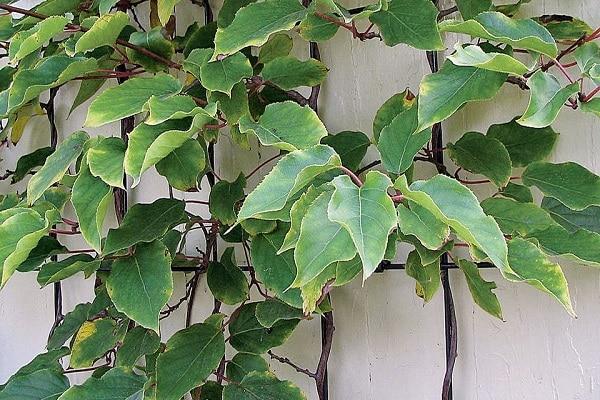
After planting, actinidia requires proper care. The vine must be provided with a secure support, and young shoots need to be trained and tied. Furthermore, the plant thrives in favorable environmental conditions.

Temperature and humidity
Actinidia is a deciduous plant, so if the growing temperature fluctuates seasonally, it sheds its leaves and enters a dormant phase. The same effect occurs due to insufficient moisture.
In winter, the plant needs 7-10 °C; in warm rooms and greenhouses, the foliage on the vines is preserved.
Normal plant growth continues at 20°C. While dormant, some actinidia species can tolerate temperatures as low as -45°C.
Lighting and ventilation of the place
Actinidia thrives in sunny or shaded areas. Ideally, it should receive a combination of bright morning light and partial afternoon shade. The location should be protected from strong winds and drafts.

Watering and fertilizing
Actinidia prefers moist soil, so water the plant as the soil dries out. During dry periods, water every four days at a rate of 80 liters of water per plant.
It is enough to add fertilizer to the soil during watering several times per season:
- in early spring, nitrogen fertilization is sufficient;
- at the beginning of fruit formation, you can add potassium-phosphorus mixtures with a small amount of nitrogen;
- After harvesting there is enough potassium and phosphorus.
Bush formation
Actinidia crown formation begins after three years of cultivation. The plant should be pruned according to the following pattern:
- At the very beginning of spring, it is necessary to thin out the shoots to avoid thickening of the crown.
- In summer, the branches can be pinched to slow down the growth rate of the vine.
- In the fall, plants over 10 years old are rejuvenated. Shoots are shortened to 25 cm.
- Winter is the time for sanitary pruning. It's necessary to remove crossing branches, thick branches, and downward-growing branches.
Transfer
Replanting a mature plant should be done in spring or fall to avoid the sap flow period. Supports for the actinidia should be installed in advance and planting holes prepared. Carefully dig the vine out of the ground to avoid damaging the shallow root system.

Diseases and pests
Dangerous diseases of actinidia are:
- spotting;
- fruit rot;
- powdery mildew.
Prevention and treatment of fungal infections involves spraying with a solution of Bordeaux mixture, soda or chemical fungicides.
Growing in open ground makes actinidia an object of interest for insect pests:
- bark beetle;
- geometer moths;
- lacewings;
- leaf beetle.
The plant can be protected by spraying with chemical insecticides or copper-based preparations in spring and autumn.
How to propagate a crop at home
There are several propagation methods for growing actinidia:
- cuttings;
- arc branches;
- root suckers;
- seeds.

seedlings
Actinidia can be planted not only from seeds but also from a variety of seedlings. The main advantage of this propagation method is the rapid onset of fruiting. Seedlings grown from seeds do not guarantee the preservation of varietal characteristics, while saplings retain all the characteristics of the species. Vegetative propagation simplifies the selection of plants by sex, so the sex of seedlings grown from cuttings is known before flowering.
Cuttings
Actinidia is propagated by cuttings of two types:
- Green. In summer, cut shoots 0.5-1 m long and divide them into sections with three leaves each. Root the cuttings in a sand-humus mixture and cover with plastic wrap, watering and spraying as needed. In spring, before the growing season begins, the plants can be planted in their permanent location.
- Woody cuttings. Cuttings should be taken in the fall and stored vertically in sand at a temperature of about 3°C. In the spring, the branches should be planted in a greenhouse and cared for as green ones.

Features of care in winter
For the winter, the vines need to be removed from their supports, laid on the ground, and covered with a suitable shelter:
- pine branches;
- dry leaves;
- peat;
- special material.
Poisoned bait can be placed under plants to attract rodents that may nest there.
Will the plant bear fruit?
Actinidia will bear fruit abundantly only when the female flowers are pollinated by pollen from the opposite sex. Therefore, it's important to distinguish male from female plants during flowering:
- Male inflorescences are formed from 3 buds, in the center of which there are a large number of stamens and no fruit embryo.
- Female flowers are borne separately on separate stalks. A distinct embryo with a radiate stigma is visible in the center of the bud; stamens are few in number and significantly shorter.

Do you need to vaccinate?
If you want to obtain bisexual vines, you can graft part of a plant of one sex onto the rootstock of the opposite sex. The procedure is usually carried out in the summer by budding or copulation, using, respectively, an actinidia bud or cutting.
Fruiting and berry picking
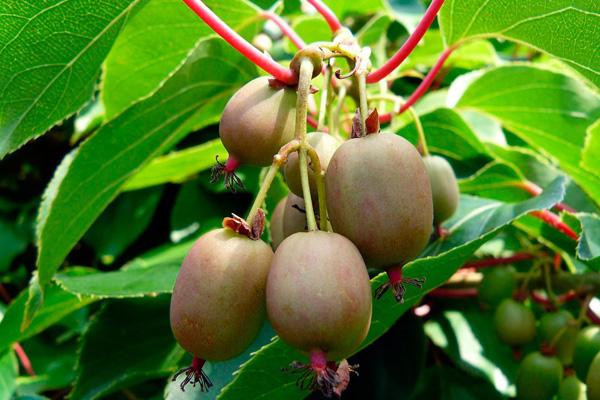
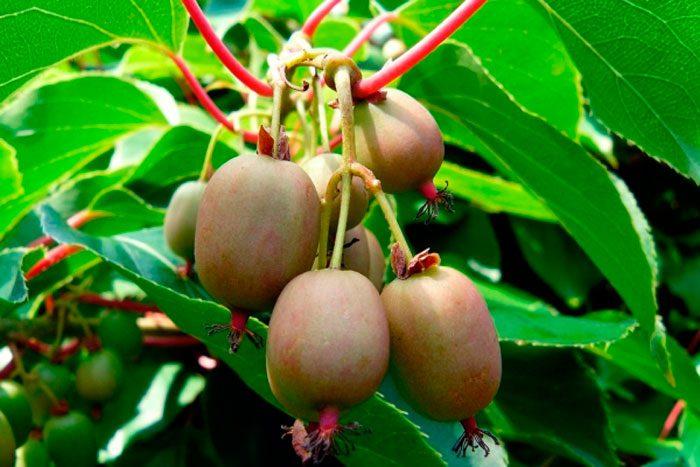
The first actinidia fruits can be harvested 3-6 years after planting, ripening from late August to late autumn. A mature plant produces 12-60 kg of fruit annually. To harvest properly, shake the fruits onto a cloth from a low height. To do this, gently shake the vine; the greenish, ripe berries will quickly fall off, while the unripe ones will remain.

Which varieties are suitable for home growing?
Despite the vast number of actinidia varieties, only a few are grown in Russian gardens. Preference is given to winter-hardy varieties and hybrids that can tolerate cold climates.

Hybrid
Features of this type of vine:
- frost resistance;
- large berries;
- sweet dessert taste.
Popular varieties of hybrid actinidia: Konfetnaya, Kyiv krupnoplodnaya, Souvenir.
Purple
Distinctions of the Chinese type:
- shade-loving;
- high yield;
- sweet purple berries;
- poor frost resistance.
Giraldi
One of the subtypes of Actinidia Agruta has unique features:
- large sweet fruits;
- late ripening.
This variety is very rare and rarely encountered in the wild. Alevtina, Iuliania, and Tuzemka are grown in gardens.

Polygamy
Features of the species:
- vines up to 5 m;
- green leaves with silver spots;
- flowers of white shade;
- berries weighing up to 3 g.
Typical varieties: Patterned and Apricot.
Kolomikta
The subspecies is characterized by:
- frost resistance;
- height up to 10 m;
- leaves with veins covered with reddish fluff;
- male plants have a variegated color;
- fruits 2-2.5 cm with a reddish or bronze tint;
- The berries reach maturity in August.

The most commonly grown actinidia are Lakomka, Waffle and Pineapple.
Arguta
Characteristic features of the species:
- liana length up to 30 m;
- serrated leaves about 15 cm;
- fragrant white flowers;
- spherical green fruits;
- ripening at the end of September.
Well-known varieties: Primorskaya, Samoplodnaya, Krupnoplodnaya.
Pineapple
This variety is characterized by rapid growth and high yields. The fruits are oval-shaped, with green skin and a reddish tint on the sunny side. The flesh has a rich flavor with pineapple notes.

Hayward
The New Zealand kiwi variety is characterized by:
- high resistance to diseases;
- frost resistance down to -25 °C.
- ripening in mid-October;
- large oval fruits of brown-green color;
- sweet and sour taste.
Is it possible to transplant the plant into open ground?
As it grows, the vine reaches a large size and requires ample space. Actinidia can be planted in open ground or grown in a high greenhouse, or as single plants in tubs. For open ground in the garden, it's best to plant varieties adapted to a specific region.

Growing characteristics in different regions of Russia
Having planted Kiwi at a dacha in the Moscow region In the Leningrad region, with careful plant care, you can achieve consistent harvests. It's important to choose Kolomikta actinidia varieties, as they don't require winter shelter and can withstand temperatures as low as -20°C.
In the Krasnodar region, any type of plant can be grown, both for abundant harvests and for decorative purposes.
In central Russia, it's recommended to grow Kolomikta and Arguta varieties, which adapt well to temperate climates. These varieties should tolerate spring frosts and frequent thaws, but to prevent damage, the vines should be insulated for the winter.
In Siberia, actinidia can be grown in greenhouses or carefully covered for the winter. Suitable varieties for the region include Priusadebnaya and Sakhalinskaya.
Related posts:
 Description of the actinidia variety Doctor Shimanovsky, planting and care instructions
 Description of the 5 best varieties of actinidia kolomikta, planting and care instructions
 Rules for growing actinidia in Siberia, the nuances of planting and care
 How to properly plant peas in a greenhouse and open ground
 How to propagate and grow peas, cultivation technology, and care in open ground
 Description and characteristics of the clematis variety Kaiser, planting and care, pruning group
 The best varieties of actinidia for growing in the Moscow region, planting and care
 How to plant grapes step by step, with a description of the process and care