
- What does grafting give to a tree and a gardener?
- What trees can an apple tree be grafted onto?
- On the pear
- On the hawthorn
- To the cherry
- On the plum
- On the quince
- The best time to perform the procedure
- Winter
- Autumn
- Summer
- Spring
- How to choose the right scion and rootstock
- Preparing cuttings
- What is needed for grafting?
- How to determine the grafting site of an apple tree
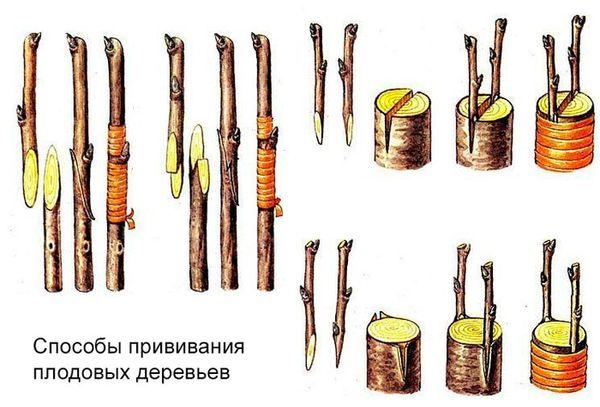
- Methods and technology of grafting apple trees
- Implantation
- Into the cleft
- Copulation with a tongue
- For the bark
- In the incision
- By bridge
- Budding
- By bud or eye
- Human shield
- Caring for a grafted apple tree
- Errors and how to fix them
Every beginning gardener dreams of a fragrant garden with numerous fruit trees and shrubs producing a magnificent harvest. However, reality often turns out differently. Poor fruit production, aging trunks, and poor-tasting apples—this is just a partial list of the problems a gardener may face. Grafting can help solve these difficulties and grow an orchard. Many gardeners wonder how to properly graft an apple tree and whether it can be done effectively on other trees.
What does grafting give to a tree and a gardener?
Growing an apple tree takes a long time, and it won't produce fruit for at least five years. Grafting onto a similar tree can solve several problems simultaneously:
- will significantly reduce the waiting time and will already delight you with a small harvest in the third year;
- on small garden plots with limited land, it will help to obtain several varieties on one tree at the same time;
- will provide the opportunity to quickly replace one type of apple you don’t like with another;
- will save a good variety if the tree is injured and is in danger of dying.
Grafting helps to obtain a good apple harvest even from non-regional varieties.
What trees can an apple tree be grafted onto?
It's undeniable that related trees interbreed well. However, such grafting isn't always possible, and many gardeners experiment with other crops. But are they always successful?
Often, vaccination fails for the following reasons:
- due to natural incompatibility;
- genetic distance;
- discrepancies in life rhythms;
- timing of the onset of winter dormancy and the beginning of sap secretion.
A positive result is possible with a strong fusion between the scion and the parent tree, as well as a close connection between their vessels. This connection is possible with genetically close relatives, such as when grafting onto pome fruit or berry trees.
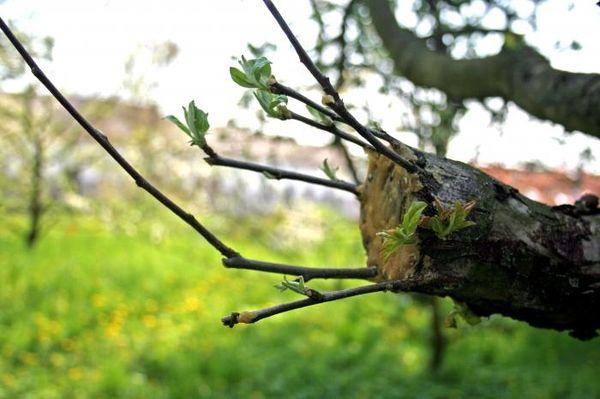
On the pear
Gardeners often want to grow apples and pears on the same tree because they are genetically compatible. However, due to differences in growth and development rates, such a combination often results in malformed growths at the graft site, resulting in a poor harvest and a short-lived apple tree.
On the hawthorn
Hawthorn has strong wood, is drought-resistant, and fairly frost-hardy. The outcome of apple tree grafting will depend on the variety and subsequent care of the graft. Such manipulations often result in small, tasteless apples.
To the cherry
An experiment grafting an apple tree with a cherry tree will most likely end in failure, since stone fruits and pome fruits are genetically incompatible with each other.
On the plum
Apple trees thrive on wild plums. However, the wild plum and apple trees are from different families, making fruit formation problematic in such a community.
On the quince
Quince provides excellent nutrition to the scion, promotes rapid absorption of micronutrients, and results in improved apple yields. However, the scion's lifespan is often short-lived.
The best time to perform the procedure
With the arrival of the first warm days, when the threat of severe frost has passed and the apple trees' sap flow has begun, you can begin making the first grafts. Grafting times vary by region.
Experienced gardeners time their apple grafting to coincide with the start of cherry blossoms. During this period, sap flow is particularly active, and the results are most likely to be positive.
Winter
Apple tree grafting can begin in late December. At this time, simple or improved copulation techniques are used. For best results, use cuttings prepared in the fall.
Autumn
Fruit trees reach their peak vitality with the arrival of autumn. During this period, they begin preparing for winter dormancy: they shed their fruits and leaves, and their metabolic rate steadily slows.
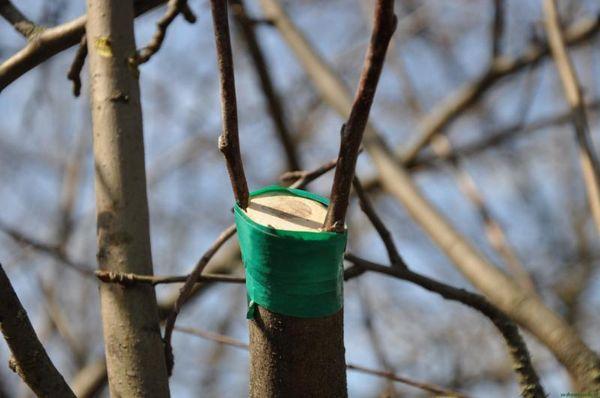
An excellent option for fall grafting is a cleft or bark graft. The grafting site requires careful insulation from frost with a cloth. Fall grafting performed during periods of frost will not yield positive results.
Summer
In July and early August, apple trees experience a reactivation of sap flow. Experienced gardeners perform budding at this time. Summer grafting has several advantages:
- there is no need to store prepared cuttings all winter;
- you can determine the condition of the rootstock by eye;
- The movement of sap and the absence of frost contribute to better survival.
Intensive cell division and active growth of trees during the summer period contribute to rapid survival, since the scion and rootstock are in a state of growth.
Spring
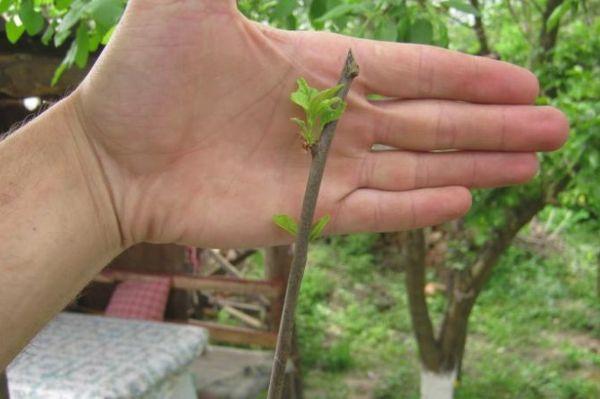
Spring is the perfect time for any gardening work, and grafting is no exception. Once the sap begins to flow, the scions take root well, and there's plenty of time for the cuttings to strengthen before the first frost. If the results are negative, the procedure can be repeated in the summer. Spring grafting can be done using any convenient method; the results will always be excellent.
When nighttime temperatures no longer drop below freezing, apple trees are grafted and continue until the buds swell. Grafting later may be unsuccessful.
Dry, warm days are chosen for grafting. Early varieties, more resistant to cool weather, are grafted first. Grafts are made on the north side of the tree to protect the weak scion from direct sunlight.
How to choose the right scion and rootstock
A young or mature tree, a wild variety, or a cut stump can be used as rootstock. The young tree must be well-rooted and strong. After just a couple of years, it can be used for experiments and grafted onto other varieties. Before grafting onto an older tree, its height is reduced, shortening its metabolic pathway and artificially accelerating it. Spring grafting onto an older rootstock significantly increases the chance of survival.
The quality of the scion determines the tree's productivity and the taste of its fruit. For scions, select a young, fruitful apple tree, no more than 10 years old. A healthy scion will easily attach to any related tree and will bear fruit productively.
Preparing cuttings
Cuttings are taken from young, healthy branches growing on the south side of the tree. Cuttings for cutting are selected from branches growing in the middle layer. The upper branches of trees are usually quite thick, while the lower branches are weak. For cuttings, use small shoots about 40 cm long and up to 6 cm in diameter with short internodes.
Winter and spring grafts are made using cuttings prepared in the fall. They are taken after the leaves have fallen, before the onset of sustained frost, and stored in the snow or another cool place. In regions with mild winters, cuttings can also be taken in winter.
Spring cuttings, harvested before the buds swell, are also used for scion grafting. Summer grafts are made using freshly cut scions with a woody base and at least four formed buds. The green part of the fresh cutting is removed.
What is needed for grafting?
To graft an apple tree you will need:
- healthy scion;
- grafting and budding knife;
- pruning shears;
- plastic bag;
- electrical tape or narrow scotch tape;
- garden var.
A sharp knife guarantees a 90% excellent result. Before use, it should be treated with alcohol.
How to determine the grafting site of an apple tree
Choosing a suitable grafting site is easy. Any level, north-facing area of the tree with smooth bark, free of knots, growths, and swellings will do.
Methods and technology of grafting apple trees
Experienced gardeners use a variety of apple tree grafting techniques. Let's look at the most common ones.
Implantation
To graft apple trees, you'll need a scion and rootstock of the same size. The grafting process consists of the following steps:
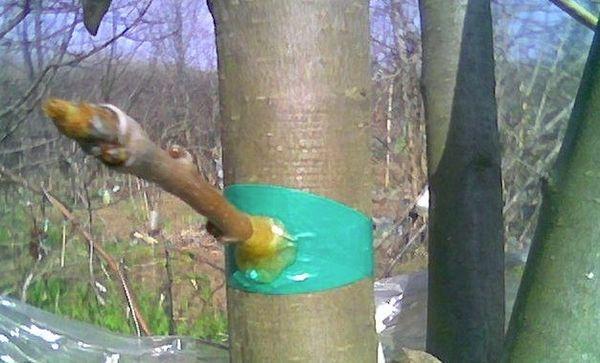
- On the rootstock and scion it is necessary to make an oblique cut at the same angle.
- Connect the scion to the rootstock, coat with garden pitch and secure with tape.
- Wrap the stump with the cutting in a plastic bag and tie it up.
When the cutting has taken root and the first leaves have appeared on it, the bag can be removed.
Into the cleft
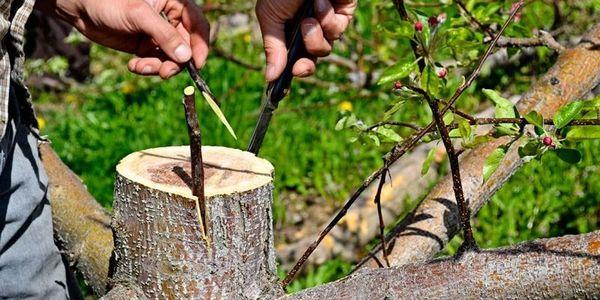
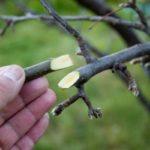
Gardeners most often use cleft grafting to renew old trees or when using grafting materials of different diameters. If the tree is much wider than the scion, multiple grafts are placed. This practice is performed in the spring, before the apple trees begin to actively grow. Let's look at the step-by-step instructions:
- The top of the tree is cut off above the grafting site.
- A neat cut 5 cm long is made in the middle of the trunk.
- A wedge-shaped cut of the same size is made on the cutting.
- The cutting is tightly inserted into the cut, carefully coated with garden pitch and secured with bandaging material.
Over time, wild shoots may appear on the trunk. One or two of these shoots are left to continue the life of the wild plant, while others require prompt removal.
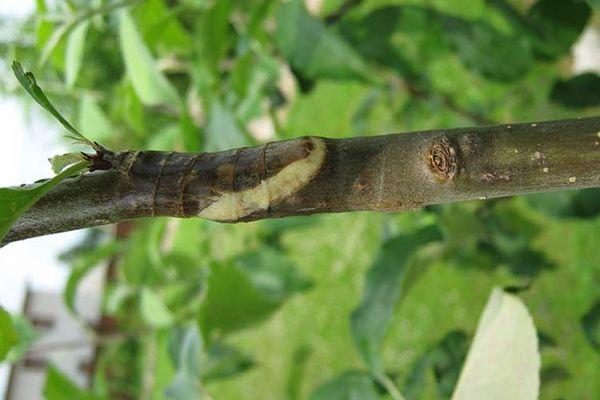
Copulation with a tongue
Gardeners use this method when the scion and rootstock are of equal thickness. Early spring is an excellent time for tongue copulation, but it can also be done at other times of the year:
- An oblique cut of about 2 cm is made on the cutting and rootstock.
- Using a sharp knife, make splits slightly shorter than the outer cut.
- The cutting and rootstock are connected in such a way that the tongue on the cut fits tightly into the cleft.
- The graft is covered with pitch and secured with electrical tape.
For the bark
This graft is used to revive old trees. It's performed in early spring or fall. During this period, the bark is well separated from the rootstock, and the graft is most likely to take root:
- It is necessary to cut off all unnecessary branches.
- Clean the cut area with a knife until it is perfectly smooth.
- Make a longitudinal cut of about 5 cm on the bark of the rootstock, practically without touching the wood, and carefully push back the bark.
- Sharpen the scion with buds and insert it behind the bark.
- The graft is fixed with polyethylene film and treated with pitch.
When grafting with two scions, the wound heals more quickly. During the first three years, the junction is very fragile and requires secure support. Supports tied to the branches will help prevent them from breaking.
In the incision
A 40-50 mm long cut is made in the rootstock. A wedge is cut at the end of the scion, which must be pinched into the cut and firmly secured.
By bridge
Bridge grafting is used to restore sap flow when the bark is damaged and is performed in early spring. The cuttings required are 10 cm longer than the width of the damaged area:
- Incisions are made above and below the exposed area.
- The edges of the cuts are carefully spread apart and the scions are inserted into them. The scion is evenly spaced in a circle.
- Each cutting is carefully secured, and the exposed surface is treated with garden pitch.
Budding
Budding involves transferring just one bud (eye) of an apple tree onto a wild apple tree. This method is used when grafting young trees with thin branches. Budding is performed in early spring or late summer, when the wild apple trees have reached their full potential.
By bud or eye
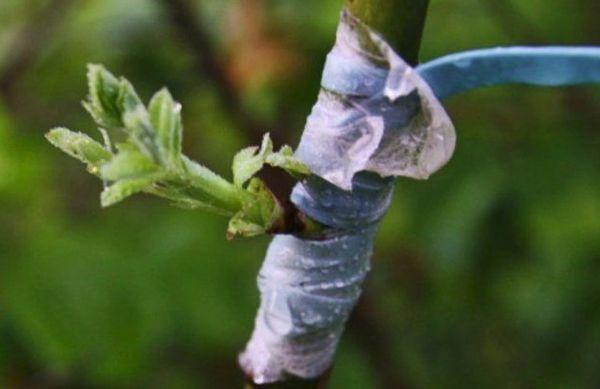
For bud grafting, you'll need shoots up to a year old, medium-length, and with well-developed buds. It's best to take the bud from the center of the cutting. Make an incision in a smooth area near the trunk, carefully part the bark, and insert the bud. Treat the cut with garden pitch and wrap it in plastic wrap. The buds won't produce shoots during the first year; they won't appear until the following season.
Human shield
To graft, cut a graft about 4 cm long and several millimeters thick. It is inserted into a pre-prepared cut in the bark, coated with pitch, and secured with tape.
Caring for a grafted apple tree
After a successful grafting, many novice gardeners do not monitor the further development of the tree or the condition of the scion, although grafting requires close attention.
Shoots from buds located below the graft rob the scion of nutrients and shade it with their leaves. These must be removed.
The garter also requires attention. Grafted cuttings grow rapidly and thicken, so sooner or later, the cutting will inevitably break at the garter. Periodically untie the garter and loosen the material. If duct tape or plastic wrap was used as a garter, unwind it and replace it with a new, looser one.
The intensive growth of a grafted apple tree and the formation of a massive crown increase the risk of scion breakage. Pinching the tops can help prevent irreparable damage.
Grafting sites also require careful maintenance. They require annual inspection and reapplication of the dressing on large, unhealed sections. This will help protect the tree from pests and increase its winter hardiness.
Errors and how to fix them
The outcome of re-grafting done by novice gardeners can be positive if they take into account possible mistakes and try to avoid them:
- Mature trees with a massive crown are regrafted in several stages. This will help prevent the scion from drying out during intensive growth and development.
- Young trees are grafted no earlier than the third year after planting, when they have finally taken root in their permanent location.
- Spring is considered the optimal time for grafting. Grafting later risks the death of the cutting due to imperfect development and instability to weather conditions.
- The bandage is finally removed no earlier than the graft is densely covered with cambium and has become woody.
Timely grafting with healthy cuttings, carried out in accordance with the required technological steps, will ensure a successful outcome. The renewed tree will delight you with a bountiful harvest within a few years.
Related posts:
 Choosing a rootstock for cherry grafting and budding rules for beginners
 How and whether it is possible to graft an apricot, the choice of rootstock, timing and methods of budding
 Timing and methods for grafting walnuts at home in summer
 Rules and methods for grafting plums in summer, tips for beginners
 When and how to properly graft a pear tree step by step for beginners
 Methods for planting and propagating cherries at home
 Timing and methods of grafting a peach tree, rules of procedure
 Methods and rules for grafting lemon trees at home to ensure they bear fruit