
- What to consider before planting
- Selecting a location: lighting
- Optimal soil composition
- Favorable and unfavorable neighbors
- Presence of groundwater
- Preparing the site and planting cherries
- Timing of planting work: spring or autumn
- Depending on the growing region
- From a variety of cherry
- According to the lunar calendar in 2025
- Schemes for placing seedlings
- Dimensions of the planting hole
- What to add to the hole to fertilize the crop
- Landing technique
- Further care
- Loosening and weeding
- Watering
- Trimming
- Pest control
- Common mistakes and how to solve them
A cherry tree can grow in one place for 15 years. How can you grow a cherry tree from a seedling to ensure a harvest and a beautiful garden? To grow a long-lived tree in your garden, you need to know the planting technique, how to space the seedlings, and what fertilizer to use.
What to consider before planting
When choosing a seedling, pay attention to its frost resistance. The Antipka variety grows quickly and propagates easily, but it is not suitable for all climates. It dies in cold. Vladimirka seedlings are more frost-resistant.
It's important to choose the right site the first time to avoid replanting the tree. The cherry tree may not thrive in a new location.
Trees are planted in the spring and the site is prepared in the fall.
Selecting a location: lighting
Cherry trees should be planted in a sunny spot with some shade. For a summer cottage, choose a spot near a fence to protect the tree from the wind. In winter, snowdrifts will form under the fence in the garden, burying the roots.
Optimal soil composition
Cherries have difficulty absorbing nutrients from acidic soil. The soil pH should be between 6.5 and 7.0. Acidity can be determined using litmus paper.
To reduce acidity, add dolomite flour and lime. Add 500-800 grams of the acidifier per square meter and till the area. The shoots can be planted the following year. Cherry trees prefer neutral soil, including sandy loam and loamy, nutritious soil.
Favorable and unfavorable neighbors
In a summer cottage, next to a cherry tree, they plant:
- cherries;
- plum;
- honeysuckle.
Pear trees are neutral, but growing next to cherries will require generous amounts of fertilizer. Otherwise, one tree will be starved of nutrients.
Bad neighbors for cherries are plants with branching roots and wide crowns that absorb a lot of nutrients from the soil. Vegetables that are considered bad neighbors include:
- eggplants;
- pepper;
- tomatoes;
- nightshade.
Fruit trees that are not good neighbors:
- apple;
- raspberry;
- gooseberry;
- apricot;
- black currant.
Cherry trees do not grow well next to deciduous trees: oak, birch, linden, as well as conifers - pine and spruce.
Presence of groundwater
Sites with wet soil are not suitable for planting cherries. If the groundwater table is close to the surface and the site floods during rain and snowmelt, the soil should be drained. Installing a drainage system will speed up water runoff.
Preparing the site and planting cherries
This popular garden plant requires special care. This begins with planting: choosing the right location and time.
Timing of planting work: spring or autumn
In autumn, cherry trees can be planted in October, a month before frost. Select seedlings with developed roots and strong bark.
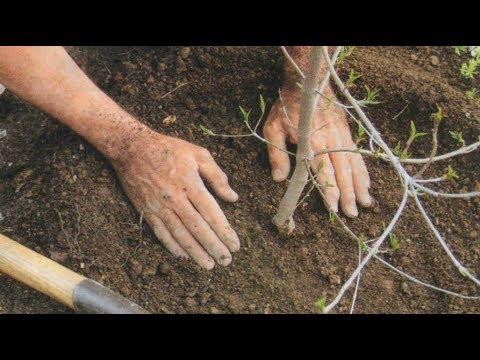
In spring, mid-April is suitable for planting, when the buds have not yet blossomed.
Depending on the growing region
In southern regions, cherries are planted in the fall, in October, before frost. In the central part of the country, the planting time is spring, late March. The soil should dry out after a thaw.
From a variety of cherry
Felt-leaved varieties are planted in early spring—early April or October. Shrub-like steppe varieties are frost-hardy, but early spring, after the snow melts, is also a better time to plant.
Cherry blossoms should only be planted in April. In the fall, the seedlings won't have time to acclimatize before the frosts and will die in winter.
According to the lunar calendar in 2025
Favorable days for planting:
- in April - 7,8, 11,12, 21-25;
- in October - 15-16, 20-21.
Unfavorable days:
- April - 13-15;
- October - 7-9, 12-14, 22-23.
The Moon in Capricorn, Taurus, and Cancer is favorable for fruit trees. Cherries will be strong and fruitful if planted when the Moon is in Sagittarius.
Schemes for placing seedlings
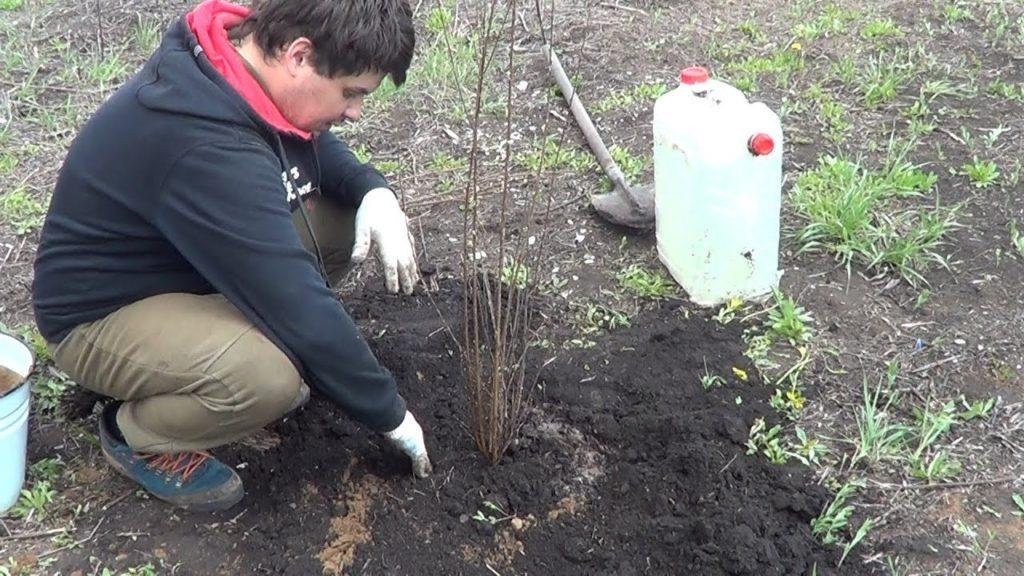
The distance between seedlings is determined by the size of the future crown. For cherry trees, a distance of 3-3.5 meters is sufficient. The space between rows should be 4-4.5 meters.
Dimensions of the planting hole
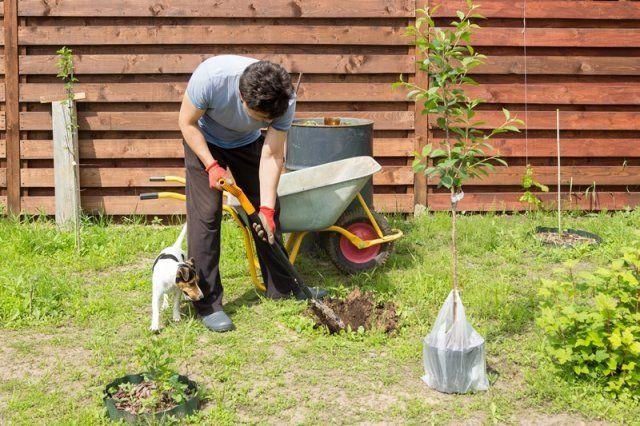
The depth and diameter of the hole are 60-80 centimeters, depending on the length of the roots.
What to add to the hole to fertilize the crop
The excavated soil is mixed with peat and manure. If the soil is loose, sand can be added. Wood ash should also be added to the soil mixture. Nitrogen fertilizer and lime should not be added before planting, as they will burn the roots.
Landing technique
In the fall, seedlings are buried for the winter. In a garden area heavily covered with snow, dig a hole 30-40 centimeters deep at a 45-degree angle. Place the seedling in the hole, water it, and bury it. Cover the top with spruce branches, needles facing outward, to protect from rodents. A thick layer of snow will protect the seedlings from frost in the winter. In the spring, dig them up before planting.
Sequence of actions when planting a cherry tree:
- dig a hole;
- prepare the soil mixture;
- place a wooden stake in the center of the hole to tie up the seedling;
- form a mound around the peg and a ridge along the edges of the hole;
- make a hole next to the peg that is suitable in size for the roots of the tree;
- the distance between the seedling and the peg should be sufficient for tying, but not too close;
- Place the seedling in the hole, leaving the root collar 5-7 centimeters above ground level. The loose soil will settle and lower the tree. If you plant it deeper, the root section will sink into the soil. The seedling will grow poorly and die.
- bury the tree so that it stands firmly;
- make a groove in the ground around the seedling for watering;
- carefully pour from the shower head so that the water does not destroy the mound.
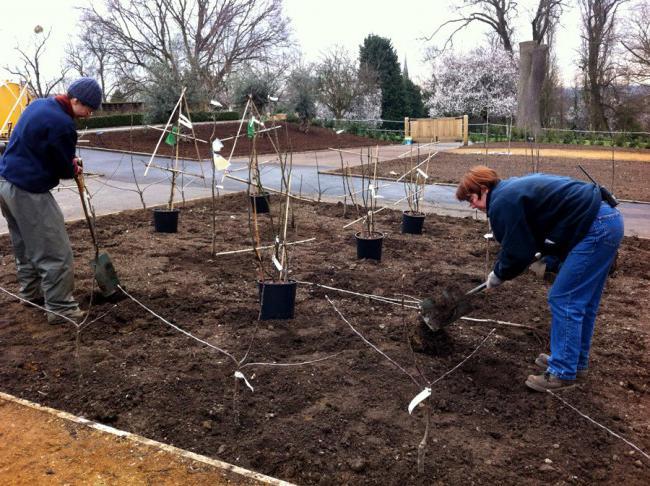
Pour two buckets of water under each seedling. Then tie the plant to the stake with soft rope, wrapping it in a figure-eight pattern. Do not use wire, as the hard material will cut the bark and damage the trunk.
Further care
Weeding and pruning are essential tasks. When growing cherries, it's important to maintain a proper watering schedule.
Loosening and weeding
The soil should be loosened once a month. After rain, the soil should be raked to help it dry faster and prevent it from forming a crust. In the fall, the area around the tree trunks should be dug to a depth of 10 centimeters to avoid damaging the roots. Vegetation under the trunks deprives cherry trees of nutrients, resulting in fewer shoots, flowers, and fruit sets.
Therefore, it is necessary to frequently check the ground under the trees and remove weeds immediately.
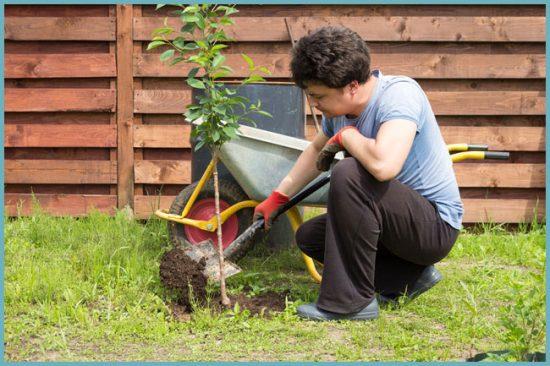
Watering
Cherry trees are watered 4 times per season:
- in the last ten days of May, the first days of June – when flowering occurs;
- at the end of June – when shoots appear;
- in July, when the weather is dry and the berries ripen;
- in September, early October – before wintering.
Make two watering furrows in the tree's trunk circle. The first furrow should be 20-30 centimeters deep, just under the tree's crown. Dig a second furrow 50 centimeters away, 8-10 centimeters deep. Add six buckets of water at a time.
Trimming
Young trees produce many side shoots and require pruning the following spring. To shape the crown, leave four main branches near the trunk on the lower level. Pruning is done annually until fruiting begins. Dead, bare, and interfering branches should be removed.

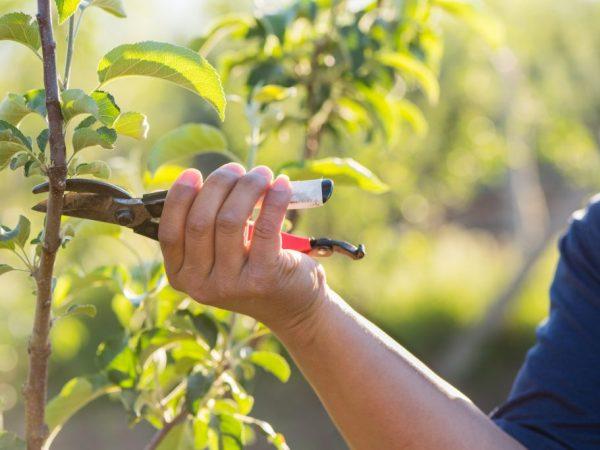
Numerous root suckers can transform several trees into a cherry orchard. However, they drain nutrients from the main trunks and produce small, sour fruits. To harvest large, sweet berries, root suckers should be removed.
Pest control
Spring care includes spraying against parasites.
Cherry pests and how to deal with them:
- Aphids - remove root shoots and weeds. When the buds open, before flowering, spray the trees with an infusion of onion, dandelion, yarrow, and ash;
- Weevil - loosen the soil around the roots in the fall. In the spring, before flowering, shake the beetles off the branches. After the trees have finished flowering, spray them with insecticides;
- Cane moth: During the bud swelling period, pest control is carried out with chemicals. In early June, the root zone is loosened, as this is where the caterpillars nest.
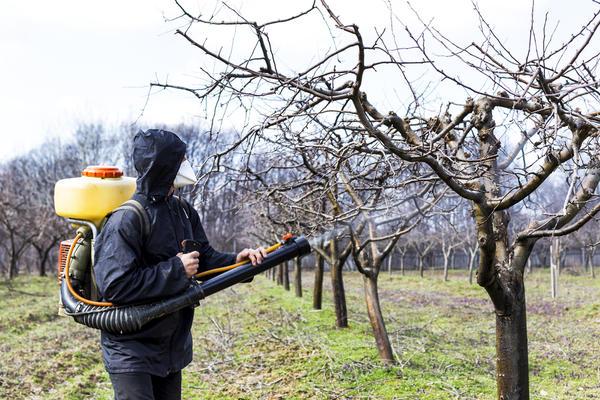
Wilting branches may appear in summer. This is a sign of fungus. Such shoots should be pruned and burned to prevent the disease from spreading to the entire tree.
Common mistakes and how to solve them
Why the cherry tree does not bear fruit or grows poorly:
- The climate is not suitable for the selected variety.
- A shoot has been planted.
- No pollination.
- The seedling is planted too deep, the soil covers the root collar.
- The buds froze over the winter due to insufficient watering during the summer drought.
- Too acidic soil caused a mineral deficiency.
- Damp soil due to groundwater, accumulation of melt and rainwater.
The cherry variety should be selected according to the climate.
Most varieties produce unisexual flowers and pollinate each other. To ensure fruit production, a pollinator variety or related trees, such as cherries, are planted nearby.
Before planting, enrich the soil intended for cherry trees with nutrients, then apply spring and fall fertilizer. Preventing diseases and pests will maintain the tree's productivity. Cherry trees produce small berries without pruning. Therefore, the crown should be thinned in the spring.
Related posts:
 Description and pollinators of the Vladimirskaya cherry variety, planting and care
 Description and varieties of cherry variety Shpanka, planting and care
 Description and characteristics of the miracle cherry hybrid, planting and care of the variety
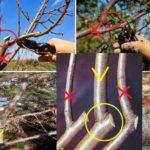 When and how to prune cherry trees correctly, and tree shaping schemes for a good harvest
 When is the best time to transplant a cherry tree? Rules and step-by-step instructions.
 Characteristics and description of the Shokoladnitsa cherry variety, pollinators and fruiting
 Description and cultivation of the best varieties of felt cherry, planting and care
 13 Best Cherry Jam Recipes for Winter