Annual weeds appear in all fields and plots, hindering the development of crops. Let's look at the composition, release forms, operating principle, advantages of the herbicide "Antisapa," instructions for use, dosage, and solution consumption. We'll also discuss safety precautions for handling the product, potential compatibility issues, storage times, and proper storage methods, as well as similar products.
Composition, existing forms of release and purpose
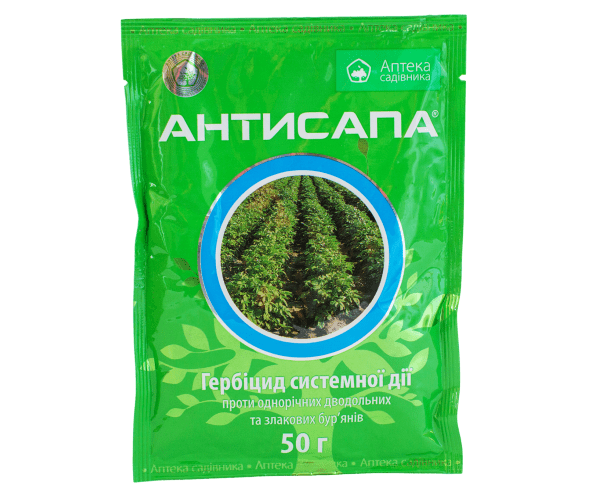
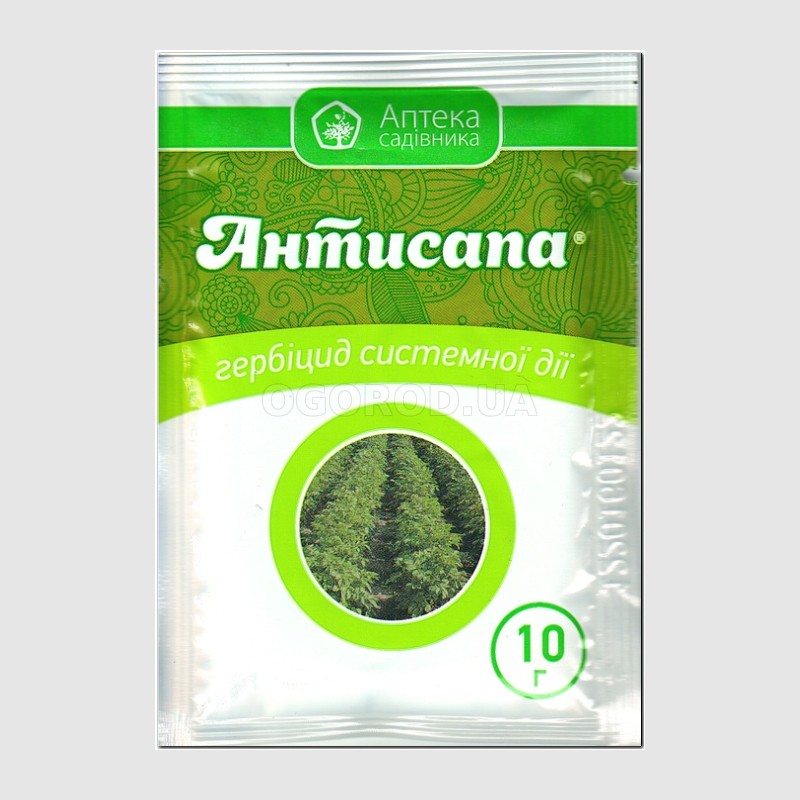
The herbicide "Antisapa" is a systemic herbicide used on potatoes, tomatoes and their seedlings, and soybeans against annual grasses and bipartite weeds. It contains metribuzin at a concentration of 700 g per kg. It is formulated as water-soluble granules in 50 g and 10 g packages.
Operating principle
Metribuzin is absorbed by weeds through their leaves and roots. It inhibits cell division and growth, resulting in the death of the weeds. Not only the above-ground parts but also the roots are inhibited and withered, preventing further weed growth. The herbicide is highly effective and has a long-lasting protective effect: 37-48 days. Depending on the weather, Antisapa helps maintain weeds until summer, provided the herbicide screen remains intact.
Advantages of the product
Advantages of the drug "Antisapa":
- destroys weeds completely, including roots;
- has high activity;
- long-lasting protective action;
- low toxicity;
- low dosage.
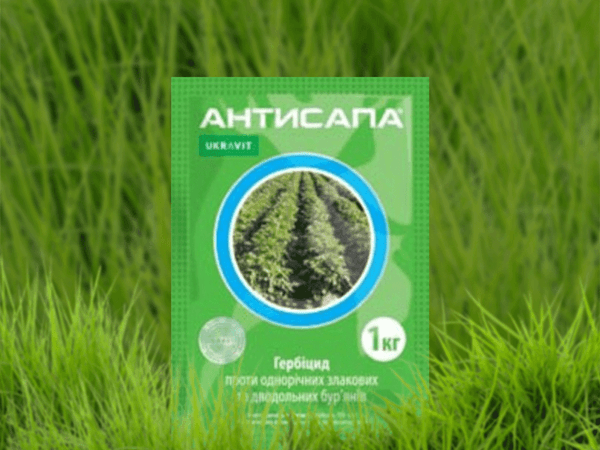
To destroy weeds, only one treatment is carried out.
How to prepare a working mixture
The preparation is diluted in half the volume of water and stirred until smooth. Then, the remaining volume of liquid is added to the tank and stirred again.
Instructions for use and dosage
The herbicide is applied to the soil or weeds by spraying. The application rate per 100 square meters of area (in ml per 5 liters of water) is:
- spraying potatoes before emergence – 5-15 ml;
- spraying when potato stems reach a height of up to 10 cm – 8-12 ml;
- pre-emergence soybean treatment – 5-7 ml;
- processing tomatoes at the stage of 2-4 leaves – 7 ml;
- soil treatment in the area under tomatoes before planting seedlings – 11-14 ml.
The waiting period ends at harvest time.
Antisap application instructions: spray at temperatures between 10-24°C and wind speeds no higher than 5 m/s. For pre-emergence spraying, the effectiveness of the product is affected by the quality of soil preparation and soil moisture. If the soil is dry, incorporate the product into the soil or increase the application rate to 500-600 liters per hectare. At normal soil moisture levels, the application rate is 200-300 liters per hectare.
The solution consumption per hectare depends on the soil composition. For heavy soils, the maximum dosage should be used, while for light soils, the minimum dosage should be used. For sandy soils with a humus content of less than 1%, the product is not recommended.
Precautionary measures
According to the instructions, when working with the herbicide "Antisapa," wear protective clothing. Rubber gloves and a respirator are required. Do not remove them while preparing the solution or spraying.
Do not smoke, eat or drink to avoid contact of skin or mucous membranes with the solution.
After finishing work, wash your hands and face with soap. If the solution comes into contact with your skin or eyes, rinse them with water immediately. In case of poisoning with Antisapa, which can be identified by a deterioration in health, headache, nausea, and weakness, gastric lavage should be performed. If this does not help, seek medical attention immediately.
How toxic is it?
Antisapa is slightly toxic to humans and is classified as a Class 3 hazard product. It does not harm bees, soil and its inhabitants, or plants of the current year or subsequent years. Restrictions apply only to humus-poor soils, where beets and onions should not be grown in the season following spraying. It is also not recommended to use the product in greenhouses.
Take a look Also

Possible compatibility
Antisapa herbicide is compatible with other similar herbicide products for the same crops. Before preparing a combined solution, if compatibility is uncertain, test the compatibility by mixing a small amount of both products in a separate container. If there is no sediment, foam, separation, clumping, or incomplete dissolution of one of the products, mixing them is permissible.
How to store it correctly and for how long
Store Antisapa herbicide in warehouses or pesticide and fertilizer rooms. Proper storage conditions include a dark, dry, and ventilated area at above-zero temperatures. Keep the herbicide out of reach of children and animals. Use the entire working solution on the day of preparation; prolonged storage reduces its effectiveness, making it uneconomical to use.
Analogues
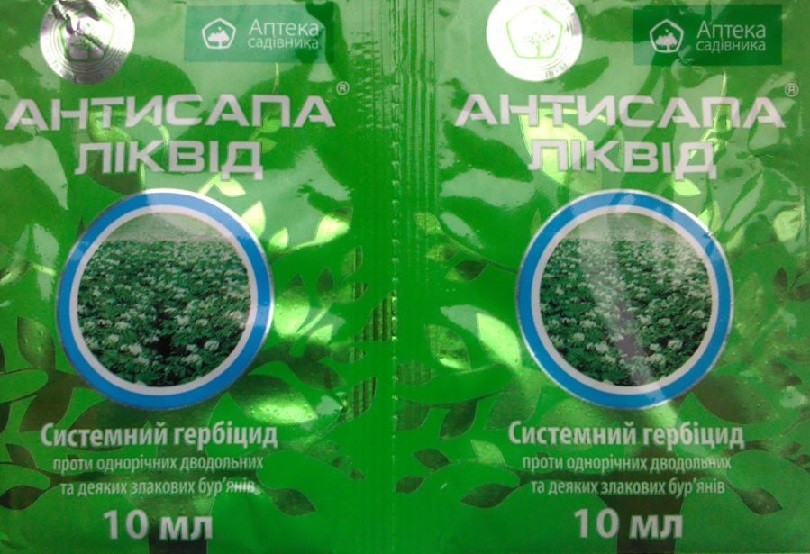
The drug has analogues of metribuzin: Antisapa Liquid, Zenkor, Mistral, Monster, Ogorodnik, Lazurit.
Antisapa herbicide helps control weeds in soybean, potato, and tomato crops. It has a low dosage and is economical to use. It's cost-effective because just one treatment completely eliminates weeds, preventing them from interfering with crop growth. Weeds are completely killed because the product targets not only the green parts but also the roots. Weeds will no longer appear during the current season.
Related posts:
 Composition and instructions for use of the herbicide Ballet, application rates and analogues
 Instructions for use and composition of the herbicide Galigan, dosage and analogues
 Instructions for use and composition of the herbicide Axial, dosage and analogues
 Instructions for use and composition of the herbicide Puma Super 100, application rates
 Composition and instructions for use of the herbicide Panther, application rates
 Top 10 Systemic Herbicides and How to Choose the Right One
 Instructions for use and composition of the herbicide Hacker, application rates and analogues
 Instructions for use and composition of the herbicide Elumis, application rates and analogues