
- Composition and existing forms of release
- What weeds does it work on and how does it work?
- Speed of action and what symptoms does the effect manifest itself with?
- Is there resistance?
- Calculation of consumption
- Preparation of working solution and its application
- Precautionary measures
- How toxic is it?
- Is compatibility possible?
- Storage rules
- Analogues
Post-emergence herbicides are used in agriculture to treat grains such as wheat and barley. Some kill both common and resistant weeds. Let's look at the purpose and action of the herbicide "Bomba," its advantages and disadvantages, application rates, and recommended solution consumption. We'll also discuss how to properly prepare the solution, the toxicity of the product, its compatibility with pesticides, and alternatives.
Composition and existing forms of release
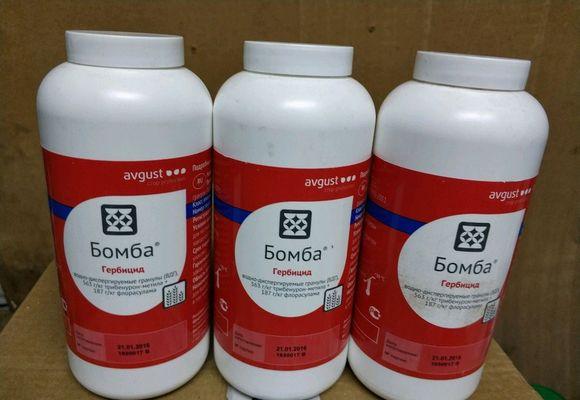
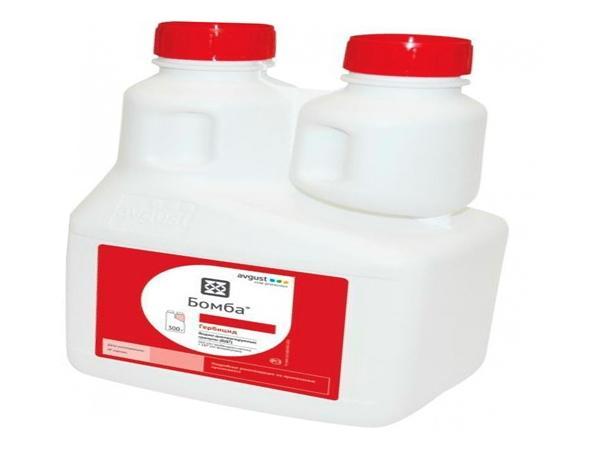
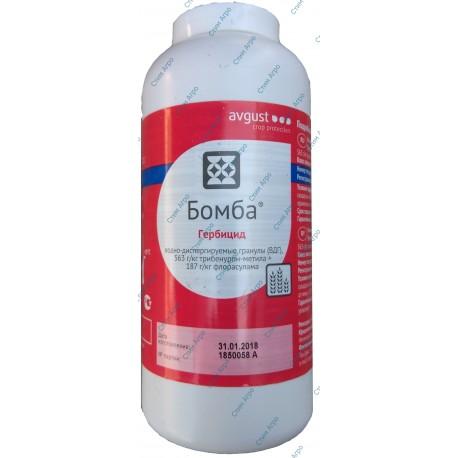
The product "Bomb" is manufactured by the Russian company "August" and is available in 100g bottles and 2.4l canisters. The active ingredients are tribenuron-methyl (563g per liter) and florasulam (187g per liter). The product is sold as water-dispersible granules. Based on its penetration method, it is classified as a systemic pesticide, and based on its mode of action, it is a selective pesticide.
What weeds does it work on and how does it work?
The most effective time to treat grain crops is when weeds are in the early stages of development. "Bomb" destroys one-year-old dicotyledonous weeds (2-6 leaves) and perennial weeds (rosette stage and pre-stem formation). It is effective against cleavers, sow thistle, thistle, and species resistant to 2,4-D and MCPA.
The effectiveness of the herbicide is due to the combined action of two substances from different classes.
Tribenuron-methyl is absorbed by the leaves and roots of weeds and moves freely within the tissues. The substance blocks acetolactate synthase, which helps synthesize essential amino acids. This leads to rapid growth inhibition and subsequent death of the weeds. Florasulam inhibits acetolactate synthase, which is necessary for the synthesis of valine, isoleucine, and leucine.
Speed of action and what symptoms does the effect manifest itself with?
Weed growth stops on the day of application of "Bomb." After this, the leaves become chlorotic and the growing points die. Within 2-3 weeks, the weeds die.
Is there resistance?
At the recommended rates, weeds do not develop tolerance to the product. "Bomb" is a non-phytotoxic herbicide, and the instructions do not specify crop rotation restrictions.
Calculation of consumption
"Bomb" is used for spraying wheat and barley at a rate of 0.02-0.03 kg per hectare. Crops are sprayed when the grains are in the tillering stage, i.e., the second internode formation stage. Winter wheat and barley are treated in the spring. The solution consumption rate is 50-300 l/ha, and for aerial application, 25-50 l/ha. The waiting period is two months.
Preparation of working solution and its application
To prepare the spray liquid, fill the tank with water to 1/3 of its volume, add the granules, and stir until dissolved. Add water to the tank to reach the required volume, and stir again.
Precautionary measures
Despite the low toxicity of the product, it is necessary to wear protective clothing that covers exposed parts of the body when working with it. Wear a respirator and transparent plastic goggles, and thick rubber gloves. Do not remove these protective equipment while working. After finishing work, wash your hands and face, and rinse any areas that may have been splashed with the solution. Rinse your eyes and mouth if the solution comes into contact with them.
How toxic is it?
The herbicide "Bomba" is classified as a Class 3 hazard to humans and beneficial insects. This group includes low-toxicity products. Poisoning with them is rare, but possible. If symptoms of poisoning occur after using the herbicide, you should perform a stomach cleanse by drinking water and taking activated charcoal tablets.
If the condition does not improve, you should consult a doctor immediately.
Is compatibility possible?
The manufacturer's instructions recommend using "Bomb" with "PVA Adew" (also manufactured by "August"). The herbicide is compatible with 2,4-D and dicamba. It can be mixed with other pesticides in tank mixes.
Storage rules
The herbicide "Bomba" has a shelf life of three years after production. During this period, it should be kept in its original packaging with the lid closed. Store in a cool, dry, and dimly lit area. Keep away from medications, food, and animal feed.
After the expiration date, any remaining product must be discarded; expired product is unsuitable for treatment. The prepared solution should not be stored for more than 24 hours; it should be used within the same day of preparation. Dispose of any remaining product in an area not used for growing crops.
Analogues
Based on their active ingredients, Bomba substitutes include Agrostar, Amstar, Argamak, Hextar, Granat, Granilin, Granstar, Gray Forte, Gyurza, Kalibr, Magnum Super, Sanflo, Starbox, Status Max, TriAlt, Trimmer, TT, and Express. Any of these products can be used as a replacement for Bomba when treating winter or spring wheat and barley crops.
The new herbicide "Bomba" is designed for weed control in wheat and barley crops. It can be used on both spring and winter crops. The manufacturer has incorporated two active ingredients from different chemical classes into the product, making it more effective. These ingredients disrupt processes in weed cells, causing them to stop growing and die. A single treatment is sufficient for effective control, with weeds dying within 2-3 weeks. Afterward, crops can grow unimpeded until harvest. This herbicide increases crop yields.
Related posts:
 Composition and instructions for use of the herbicide Ballet, application rates and analogues
 Instructions for use and composition of the herbicide Axial, dosage and analogues
 Instructions for use and composition of the herbicide Galigan, dosage and analogues
 Instructions for use and composition of the herbicide Trizlak, dosage and analogues
 Top 10 Systemic Herbicides and How to Choose the Right One
 Grenader herbicide instructions for use, dosage, and analogues
 Instructions for use and composition of the herbicide Helios, dosage and analogues
 Luger herbicide instructions for use, dosage, and analogues
