
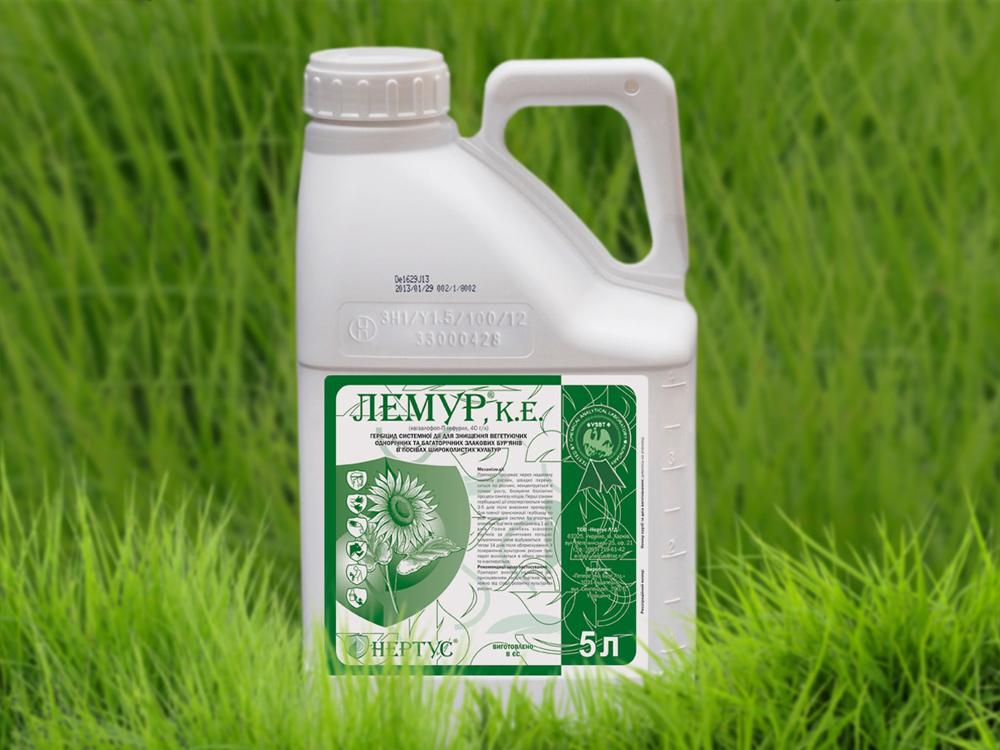
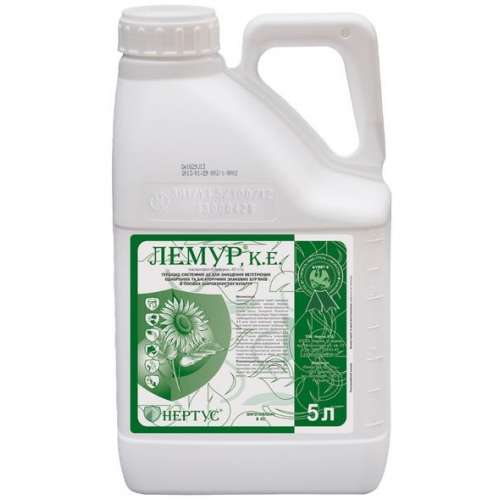
Modern agriculture could not exist without herbicides. A constant labor shortage, the lack of mechanical damage compared to weeding, and the ease of growing food and other crops—all these factors have made these products essential in the fight for a healthy harvest. "Lemur" is a post-emergence herbicide used on sunflower, rapeseed, flax, and vegetable crops.
Composition, dosage form and purpose
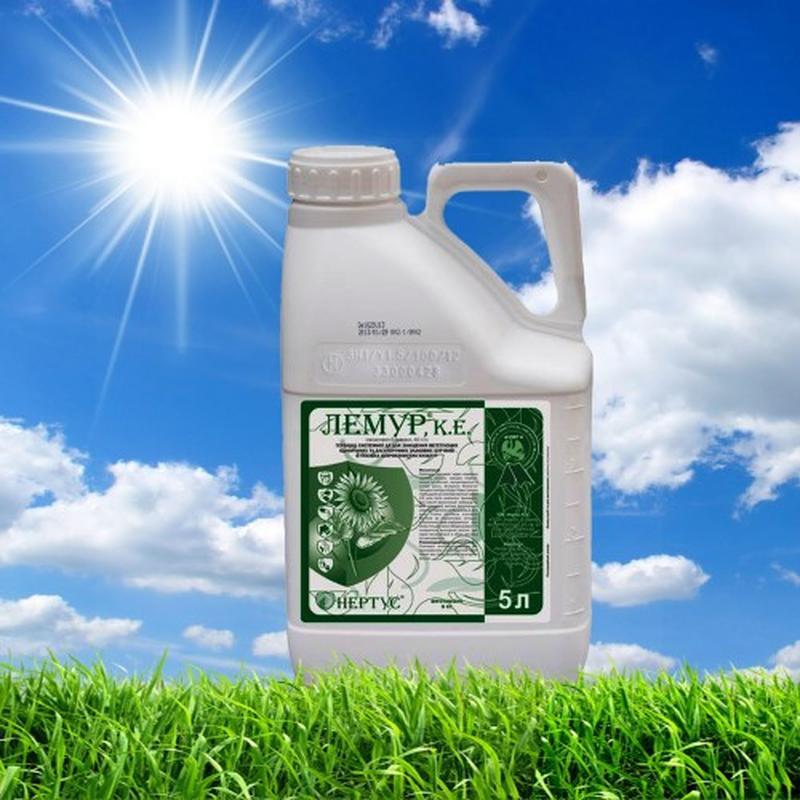
The herbicide "Lemur" is produced as an emulsifiable concentrate. It contains 40 g/l of the active ingredient quizalofop-P-tefuryl (quizalofop-P-tefuryl). It is packaged in 5-liter canisters. This herbicide is designed to control grass weeds in fields containing vegetable, industrial, and forage crops.
How does the product work?
The herbicide "Lemur", after overcoming the outer covering of the weed, moves through the vessels to the centers of growth, disrupting the energy exchange by interfering with the synthesis processes.
How does the action manifest itself?
The weed stops its vigorous growth, typical of spring. After 4-5 days, necrotic spots appear, and the leaves and stems change color. After 1-2 weeks, active partial drying results in the death of annuals, and then perennials.
Pros and cons
The benefits of using herbicides have long been recognized.
One negative quality can be considered, although it’s a stretch: the results of the treatment are not immediately visible.
Calculation of consumption
200-300 liters of working fluid are required to spray 1 hectare of field area.
| Culture | Competitor | The rate of the herbicide "Lemur", l/ha | Spraying time of the preparation |
| Chickpeas, soybeans, peas, beets, flax, onions (not green onions), carrots, garlic, cabbage, rapeseed, sunflower, tomato, potato | Annual cereals (foxtail grass, barnyard grass, meadow bluegrass) | 0.75-1 | A weed with 2-4 leaves (beginning of tillering). The crop's development phase is not taken into account. |
| Perennial cereals (creeping wheatgrass) | 1-1.5 | The weed is 10-15 cm tall. The cultivated plant is in any phase. |

Preparation of the working mixture
The weed spray is diluted immediately before application. For best results, follow these steps:
- The preparation is stirred.
- Fill the sprayer tank halfway with water.
- Slowly pour in a thin stream of the herbicide "Lemur" with the hydro mixer turned on.
- Knead for 10-15 minutes.
- Add the remaining water to obtain the required concentration of the working fluid.
- Stir for 5 minutes.
Terms of Use
The herbicide "Lemur" is applied to the emerging crop. The greatest effect is achieved when the beneficial plant has not yet overgrown the weed, and almost all of the product will reach the pest. In the early stages of growth, the crop cannot compete in growth rate with the pests that emerged simultaneously. Therefore, it is important to assess the situation to determine whether it is appropriate to delay spraying.
Following the product's instructions for use will save herbicide and reduce the risk of worker injury. Recommended:
- Stir the liquid continuously while spraying.
- Select weather conditions: wind speed – no more than 4 m/s, air temperature – 10-25 °C, precipitation – no earlier than half an hour after spraying the herbicide “Lemur”.
- Perform the operation in the evening.
Safety precautions
Workers must wear protective clothing, chemical-resistant gloves, a respirator, and protective goggles. All participants must be briefed on safety precautions, first aid, and the name of the herbicide. During the treatment, do not talk, smoke, eat, drink, or touch your face with gloves. Before lunch, wash your hands and face thoroughly with soap. Eating should be done at least 200 meters away from the spraying area.
How toxic is it?
The herbicide "Lemur" belongs to hazard class 3 (moderate) for humans and bees. It is recommended for use in private gardens. No signs of poisoning, allergic reactions, or persistent hypersensitivity to the product have been observed after skin or oral contact. After field treatment, agricultural machinery work may resume after 3 days, and manual work after 7 days.
Possible compatibility
"Lemur" combines well with many herbicides, fungicides, insecticides, and other beneficial substances. In an experimental field with various weed types, mixing quizalofop-P-tefuryl in a single working solution with "Betanol" (active ingredient: desmedipham), "Bezagran" (active ingredient: bentazon), and "Lontrel" (active ingredient: clopyralid) resulted in record soybean and beet yields. Other products are tested for compatibility before combining.

Storage conditions and shelf life
The herbicide "Lemur" must be stored in a designated pesticide room. Ventilation is mandatory. Canisters containing the product must not be left near an open flame. Access to them must be restricted. Storage temperature: from -15°C to +35°C.
Analogues
To avoid the development of weed groups resistant to the drug, the herbicide "Lemur" must be alternated with protective agents containing other active ingredients.
| Culture | Weed | Time and method of application | Pesticide |
| Spring rape, soybeans, corn, sugar and table beets, sunflower | Annual cereals and some dicotyledons (amaranth, crabgrass, self-seeding of cereal crops, purslane). | Spray before weeds emerge. During dry periods, apply 2-3 cm of soil. | Dual Gold |
| Vegetable, industrial, medicinal plants | Annual and perennial cereals | Spray at any stage of the weed's vegetation, preferably early. | Fusilade Forte |
| Legumes for grain | Cereals and dicotyledons | Spraying. Crop before budding. 1-3 leaves of cereals and 2-4 true leaves of dicotyledonous weeds. | Corum |
| White cabbage (except early-ripening varieties) | Annual cereals and dicotyledons | Spray the soil 1-7 days after planting the seedlings. Water within 20 hours of completion. | Butizan 400 |
| Carrots, soybeans, beets, flax, onions, potatoes | Almost all cereals. | Spraying at early stages of weed development. | "Centurion" |
Take a look Also

Related posts:
 Composition and instructions for use of the herbicide Ballet, application rates and analogues
 Top 10 Systemic Herbicides and How to Choose the Right One
 Instructions for use and composition of the herbicide Axial, dosage and analogues
 Instructions for use and composition of the herbicide Galigan, dosage and analogues
 Instructions for use and composition of the herbicide Lornet, application rates and analogues
 Instructions for use and composition of the herbicide Helios, dosage and analogues
 Composition and instructions for use of the herbicide Panther, application rates
 Instructions for use of Cassius and the herbicide composition, dosage, and analogues