
- Composition, existing forms of release and purpose
- The mechanism of action of the product
- Advantages of the herbicide
- Calculation of consumption
- How to prepare a working mixture
- Instructions for use
- Precautionary measures
- How toxic is it and is compatibility possible?
- Storage conditions and periods
- Analogues
Corn farmers face the challenge of weeds, which choke out the crop and rob it of nutrients. Among the many chemical crop protection products, they often choose the post-emergence herbicide Stellar, which effectively kills most annual and perennial weeds. Before using the product, read the instructions carefully to ensure successful results.
Composition, existing forms of release and purpose
The systemic herbicide "Stellar" contains two active ingredients: dicamba at a concentration of 160 grams per liter and topramezone at a concentration of 50 grams per liter. This balanced formula effectively controls annual grasses and perennial broadleaf weeds that choke corn crops.
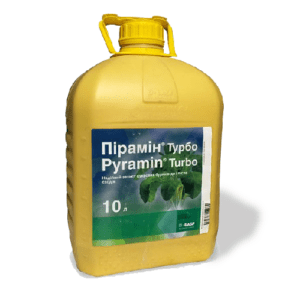
The chemical is produced as a water-soluble emulsion. It is packaged in 10- and 5-liter plastic canisters. This post-emergence herbicide is manufactured by BASF.
The mechanism of action of the product
The chemical's action is based on the interaction of two active ingredients with weeds. Dicamba has a systemic effect. After spraying, the substance penetrates the weed's leaves, and if the soil is sufficiently moist, it also reaches the root system. Dicamba then penetrates the weed's growth points and blocks them.
This disrupts the hormonal balance of the weeds, resulting in the grass growth and cell division ceasing and the plant dying.
The second component, topramezone, belongs to the triketone class, which is an analogue of a natural herbicide. It also has a systemic effect, instantly penetrating all parts of the weed and inhibiting its growth. Complete weed death is observed within a week of application.

Advantages of the herbicide

Farmers who have used post-emergence herbicide on their corn fields have noted several advantages of Stellar over other chemical pesticides.
Calculation of consumption
When treating a field with a crop, use 1 to 1.5 liters of post-emergence herbicide, depending on the severity of the infestation. Spraying begins when the weeds begin to grow and the corn has three to five true leaves. Apply 200 to 300 liters of the working solution per hectare of crop. Repeat treatments are not required.

How to prepare a working mixture
Prepare the spray solution immediately before starting work. Fill the sprayer tank with clean, cold water (halfway full) and turn on the agitator. Immediately add the recommended amount of post-emergence herbicide and wait for it to dissolve. Then, add water, keeping the agitator running, and add 0.5% of the total volume of the working solution of DASH surfactant. Once the solution is ready, begin treating the corn field.
Instructions for use
Weed control should be carried out early in the morning or evening, away from the scorching sun. The recommended air temperature is no higher than 25°C (77°F). Although the chemical is impervious to precipitation, at least five hours must pass between application and the onset of rain, so consult the weather forecast when planning your work. To prevent the herbicide solution from spilling onto adjacent crops, wind speeds should not exceed 4 m/s.

After finishing work, the remaining liquid is disposed of in accordance with safety requirements, and all tools are washed with running water.
Precautionary measures
When working with chemicals, adhere to safety rules:
- The farmer's entire body must be protected by clothing, rubber gloves must be worn on his hands, and his head must be covered with a scarf.
- Prevent chemical vapors from entering the respiratory system by using a respirator.
- Drinking and smoking are prohibited during work.
- After processing, all clothes are washed and dried in the open air.
- A farmer takes a shower to wash off drops of chemicals that accidentally fell on his body.
If the herbicide comes into contact with your skin or eyes, rinse with plenty of water and seek medical attention, taking the product label with you. If the chemical is accidentally swallowed, rinse your stomach with plenty of water and take several tablets of activated charcoal before seeking medical attention.

How toxic is it and is compatibility possible?
The post-emergence herbicide "Stellar" is prohibited for use in water protection zones of bodies of water, as it is highly toxic to fish. It is classified as hazard class 2 for humans and class 3 for honeybees. The herbicide is approved for use in tank mixes to enhance its performance. However, a chemical compatibility test is required before use.
Storage conditions and periods
It's recommended to store the chemical in a locked utility room to prevent access by children and pets. The room should be dark and dry, with a maximum temperature of 30 degrees Celsius.
If storage rules are followed, the shelf life of the post-emergence herbicide "Stellar" is 3 years.
Analogues
If necessary, the herbicide "Stellar" can be replaced with preparations such as "Pool" or "Dialen Super".
Related posts:
 Instructions for use and composition of the herbicide Aksifor, dosage and analogues
 Hermes herbicide instructions for use, dosage, and analogues
 Luger herbicide instructions for use, dosage, and analogues
 Instructions for use and composition of the herbicide Basis, application rates and analogues
 Instructions for use of the continuous herbicide Rap, its composition and dosage
 Instructions for use and composition of the herbicide Fabian, application rates and analogues
 Instructions for use and composition of the herbicide Pivot, dosage and analogues
 Composition and instructions for use of the herbicide Pilaraund, application rates