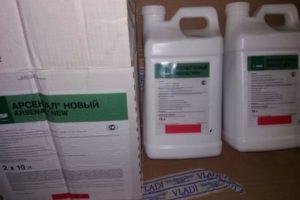
Grain crops need to be treated with herbicides to keep the crops free of weeds. Let's look at the composition of "Propol" weed killer, its effects, advantages and disadvantages, dosage and application rates, how to properly prepare the solution, and how to use it according to the instructions. How toxic is this product, is it compatible with pesticides, how to store it, and what is an acceptable substitute for it in agricultural and private farms.
Composition, dosage form and purpose
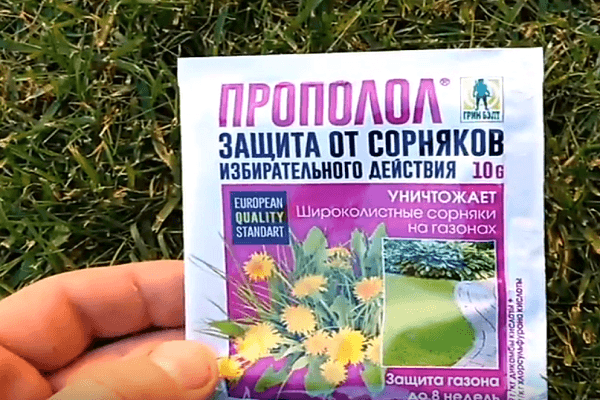
Propolol is manufactured by Technoexport, a private limited company, in the form of water-soluble granules in 1 kg sachets containing 10 granules per package. The formula contains two active ingredients: dicamba at 659 g per kg and chlorsulfuron at 41 g per kg. Propolol is a systemic pesticide with selective action.
It is used for spraying spring and winter wheat and barley, winter rye from 1-year-old 2-lobed crops (including species resistant to 2,4-D and 2M-4X) and some perennial weeds.
Operating principle
Dicamba and chlorsulfuron are absorbed by weed leaves and, if the soil is sufficiently moist, also by the roots. They then migrate to the growing points and suppress them. Weed growth ceases within a few hours.
Pros and cons
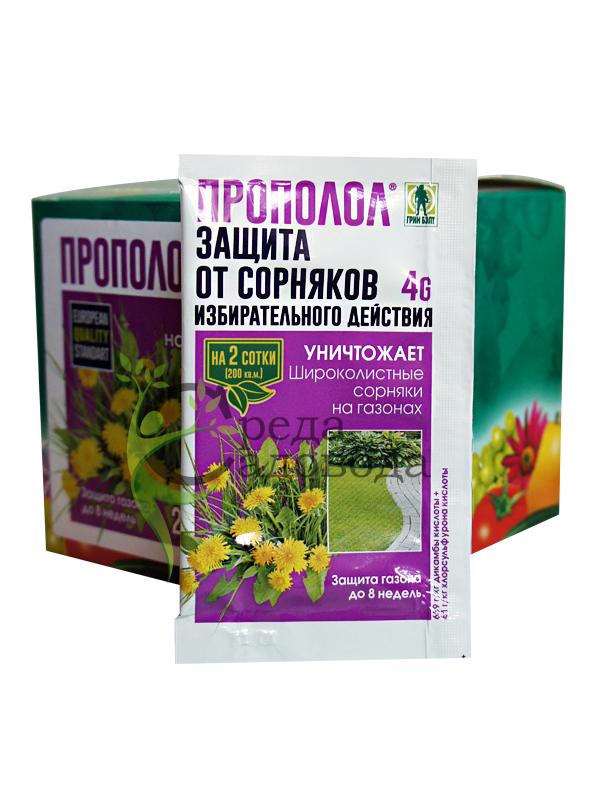
Advantages of the drug "Propolol":
- provides protection to all grain crops;
- penetrates both through leaves and through roots into weeds;
- high tolerance;
- weed growth stops within 2 hours;
- complete death occurs after 2-3 weeks;
- at the application rates it is not toxic to grains;
- It's not expensive.
Disadvantages of "Propol": slow action under unfavorable conditions.
Calculation of consumption for plants
Application rates depend on the stage of crop development and the timing of application. For spring grains, spray at the tillering stage and on weeds in the early stages of development at a rate of 0.12 kg per hectare. For winter crops, the rate is 0.12-0.135 kg per hectare in spring, and 0.135-0.15 kg per hectare in autumn. The solution consumption rate is 200-300 l/ha, the number of sprayings is one, and the time before harvest is 60 days. Fieldwork can be resumed three days after spraying.
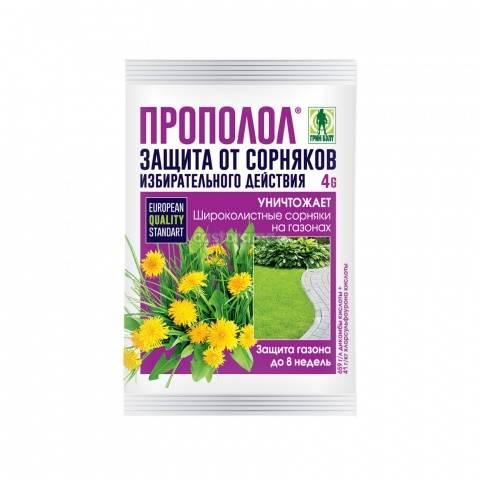
In private farms, Propolol is used to spray grassy lawns. Treatment is carried out in May or June, or in late summer or early fall, 3-4 days after mowing. 2 grams of granules are diluted in 5 liters of water, at a rate of 5 liters per 100 square meters. Work on the lawn can be resumed 7 days after treatment.
How to prepare a working mixture
The Propol solution is prepared using the standard method: first, the granules are dissolved in a third or a quarter of the volume of water until the liquid reaches a uniform consistency. Then, the remaining water is added to the sprayer tank and stirred. During the spraying process, the solution is stirred several times to maintain a uniform consistency.
Instructions for use
"Propol" is used on soils with a pH of 7 or lower. Do not apply the solution during frost, during hot weather, or if there is a risk of rain for 4 hours after application. If reseeding is necessary, the area should be sown exclusively with grain crops.
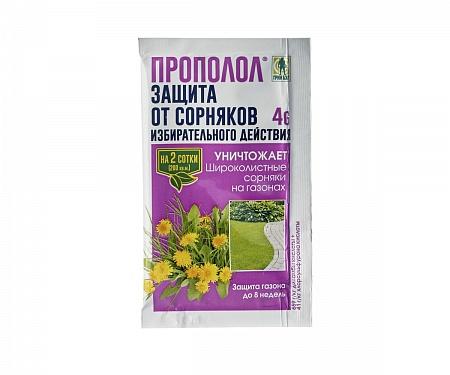
At a rate of 100-150 g/ha, the herbicide "Propolol" is safe for crop rotation. Winter rapeseed can be sown after grain crops this season. When applying, ensure the solution does not drift and does not come into contact with vegetables, industrial crops, or fruit trees (which are sensitive to this herbicide).

What precautions should be taken when using
When handling the product, wear protective clothing made of thick fabric with long sleeves that protect your hands from the solution. Wear a respirator, plastic goggles, and rubber household gloves. Do not remove protective equipment until the end of the work. After spraying, wash your hands and face with soap. Rinse the solution from your skin and flush your eyes with clean water.
If the product gets into the stomach, it is necessary to rinse with plenty of water and medical charcoal (1 tablet per 10 kg of weight).
How toxic is it?
Propol is moderately toxic to humans and animals; it belongs to Class 3 for both humans and beneficial insects. It is also safe for grain and subsequent crops when used at the manufacturer's recommended dosage and rate.
Possible compatibility
The herbicide "Propolol" is compatible with agrochemicals containing clopyramide, propiconazole, and tridiamefon (if application times are observed). In any case, compatibility testing should be performed when preparing a combined solution.
Storage conditions and periods
The herbicide has a shelf life of 5 years in its original packaging. Store the granules in a dry, dark place, away from moisture and sunlight. Do not store near food, feed, or household products. Agrochemicals and fertilizers can be stored here. The diluted solution has a shelf life of only 1 day.
Similar means
Herbicides similar to Proweed that can be used in agriculture include: Antal, Governor, Diachem, Diana, Dicamba, Vspolokh, Cowboy, Dimesol, Dublon Super, Banvel, Dicambel, Lart, Diastart, Monomax, Diamax, Optimum, Dialen Super, Referee, Deimos, Serto Plus, and Fenizan. Deimos, Lintur, and Dicameron Grant can be used in private farms.
The herbicide "Propolol" is used to protect grain crops and lawns from common weeds, including those resistant to certain herbicides and perennial weeds. Its effectiveness has been proven in field applications; one treatment is sufficient for complete weed control.
Related posts:
 The best eggplant varieties for growing in a polycarbonate greenhouse: planting and care
 Methods for planting and propagating cherries at home
 How to properly plant peas in a greenhouse and open ground
 Description of varieties of sowing peas and cultivation, to which family they belong
 Description and characteristics of the best seeds of pea varieties and types
 Is it possible to soak treated cucumber seeds before planting and how to do it correctly?
 How to propagate and grow peas, cultivation technology, and care in open ground
 How to control carrot flies with medications and folk remedies