
- Composition, dosage form and purpose
- What plants does it affect?
- Operating principle
- How does the effect manifest itself?
- Calculation of consumption for plants
- Preparation and use of the working mixture
- Precautionary measures
- How toxic is it?
- Possible compatibility
- How to store it correctly and for how long
- Analogues
Perennial and annual weeds are constantly being controlled in fields. Let's review the instructions for the herbicide "Rimanol," including its weed control, purpose, dosage, and consumption. We'll also discuss how to prepare and use the solution, how toxic it is, and whether it can be combined with other pesticides. We'll also discuss how long it can be stored, and what alternatives it can be used with.
Composition, dosage form and purpose
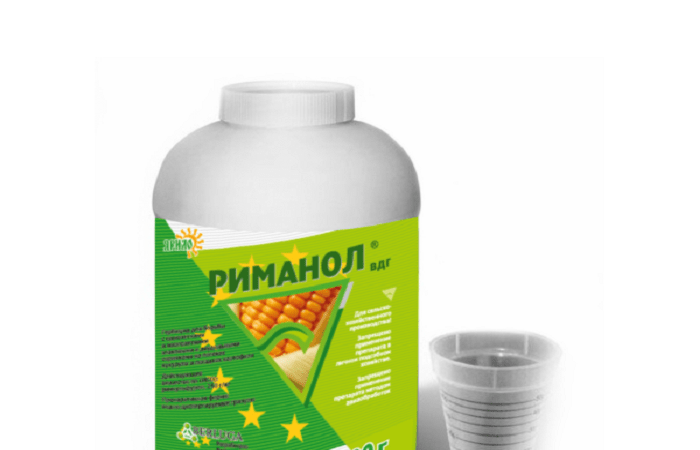
Rimanol is manufactured by Garant Optima, AFD LLC, and comes in the form of water-dispersible granules containing the active ingredient rimsulfuron at a concentration of 250 g per kg. Rimanol is a systemic herbicide with selective action. It is packaged in 0.5 kg cans.
Designed for treating corn and potatoes, its application replaces pre-emergence and pre-sowing herbicide treatments.
What plants does it affect?
Apply the herbicide after crop emergence, targeting 1-year-old bilobar, 1-year-old, and perennial grass species. 1-year-old grass species are sensitive to the herbicide at the 1-4 leaf stage, while perennial grasses are sensitive at the rosette stage (sow thistle) and at a height of 10-15 cm.
Operating principle
The solution penetrates weeds through the leaves, making its effectiveness unaffected by soil moisture. Rain also doesn't interfere with the product's effectiveness, as it is completely absorbed by the plants within three hours of application.
Rimsulfuron migrates throughout the plant and reaches the roots. The substance interferes with enzyme synthesis, gradually killing the weeds.
How does the effect manifest itself?
As a result of enzyme synthesis disruption, growth stops, and weeds die within 5-20 days. They finally die within 2-3 weeks.

Calculation of consumption for plants
To combat annual weeds, corn is sprayed once when 2-6 leaves have formed. Rimanol at a dose of 0.04 kg per hectare is mixed with Dar-90, a surfactant-containing product, at a rate of 200 ml per hectare. A rate of 200-300 liters is used per hectare. To combat perennial weeds, corn is sprayed at the same stage and when the weeds reach a height of 10-15 cm. The application rate is 0.05 kg per hectare, with the same consumption rate.

Potatoes are sprayed with herbicide after hilling, when the weeds are at the 1-4 leaf stage, and perennials are 10-15 cm tall. The application rate is 0.05 kg per hectare, requiring mixing with Dar-90. 200-300 liters of the prepared solution is used per hectare. For double treatment, as with corn, the dosage is 0.03 + 0.02 kg per hectare. The waiting period for potatoes is shorter – 50 days. Work can be resumed in treated areas after 3 days.

Preparation and use of the working mixture
The solution is prepared as follows: first, pour a third of the tank's volume of water, then dissolve the granules in it. Stir and add the remaining water. Spray the potatoes or corn on a dry, windless day. Spraying from aircraft is also possible.
Rimanol is not recommended for use on sweet corn or corn grown for seed propagation. It is not recommended to use the product if the crops are overgrown (plants have more than 7 leaves).
Do not use Rimanol before or after spraying with organophosphate herbicides. Allow a 10-day interval between these treatments. Without this interval, nearly simultaneous herbicide treatments may result in crop toxicity.
Precautionary measures
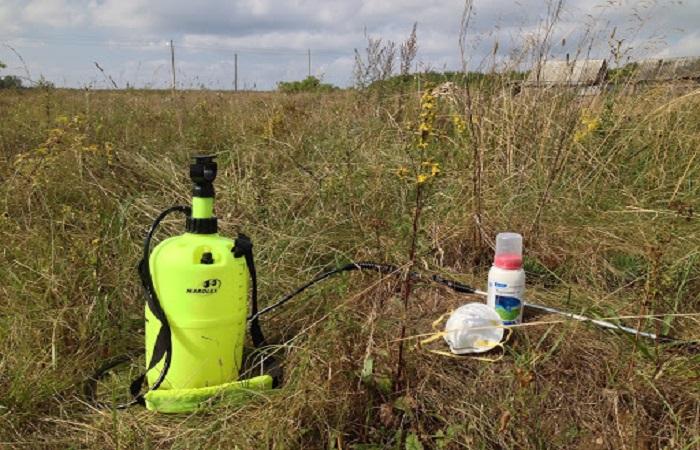
When handling Rimanol, wear rubber gloves, goggles, a respirator, and thick clothing with long sleeves. Avoid contact with skin and mucous membranes. If this happens, rinse the affected area with water. If the solution gets into your eyes, rinse them with water.
How toxic is it?
Based on toxicity, the herbicide "Rimanol" is classified as Class 3 (low toxicity). It is also low toxicity to bees. It should not be used near bodies of water, fish farms, or water sources, as rimsulfuron may be hazardous to aquatic life.
Possible compatibility
Rimanol should not be combined with organophosphate pesticides. If both treatments are necessary, allow at least 1.5 weeks between applications. Rimanol works well with other pesticides.

How to store it correctly and for how long
The herbicide has a shelf life of two years in undamaged, tightly sealed, original cans. The storage location should be dark, dry, and ventilated. Fertilizers and other agricultural products may be stored with Rimanol herbicide. Do not store it with food, feed, or household chemicals.
Do not use Rimanol after the expiration date. The diluted solution can only be stored for 1 day; after that, its effectiveness decreases.
Analogues
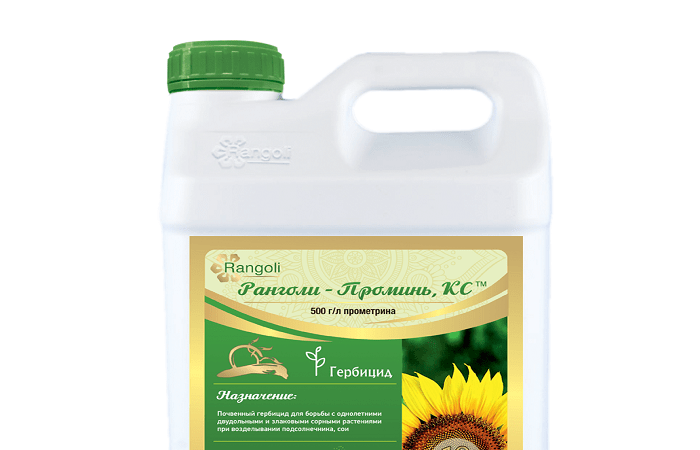
Rimsulfuron is found in the following products: Basis, Altis, Cordus and Cordus Plus, Romulus, Dendy, Ringoli-Tiran, Rimex, Arkan, Taurus, Trimer, Titus and Titus Plus, Escudo, Mais, Prefect, Cassius, Arpad, Rimus, Shantus, Tesis, Cicero, and Grims. They can be considered substitutes for Rimanol for agricultural use.
The herbicide "Rimanol" is used to protect corn and potatoes from annual and perennial weeds. It is economical, requires only a small application rate and consumption rate; one or two sprays are sufficient to eradicate harmful vegetation. It is low-toxic to humans and bees, but it is not recommended for use on crops older than a certain age. It is not used on crops other than potatoes and corn.
Related posts:
 The best grape varieties for growing in the Urals, planting and care rules in summer
 Carrot care guidelines for outdoor cultivation to ensure a good harvest
 Instructions for use and composition of the herbicide Escudo, dosage and analogues
 Descriptions and names of varieties and the best types of radish, planting and care
 How to properly plant peas in a greenhouse and open ground
 Description of varieties of sowing peas and cultivation, to which family they belong
 Descriptions of the 20 best cherry varieties for the Moscow region, their planting and care
 The best eggplant varieties for growing in a polycarbonate greenhouse: planting and care