
- Composition and existing forms of release
- Advantages and disadvantages
- How it works
- Rules for preparing the solution
- Average consumption rates
- Instructions for use against weeds
- Soybeans
- Tomatoes
- Carrot
- Potato
- When is it prohibited to use?
- Security measures
- The degree of toxicity of the herbicide
- Its compatibility with other means
- Features of crop rotation
- Storage rules and periods
- Existing analogues
Weed control takes a lot of effort and money, as proper soil cultivation is essential for a good harvest. Zenkor herbicide will help you cope with this difficult task, and the included instructions will guide you to the exact dosage. This systemic product will eliminate even stubborn broadleaf and grass weeds in just a few days.
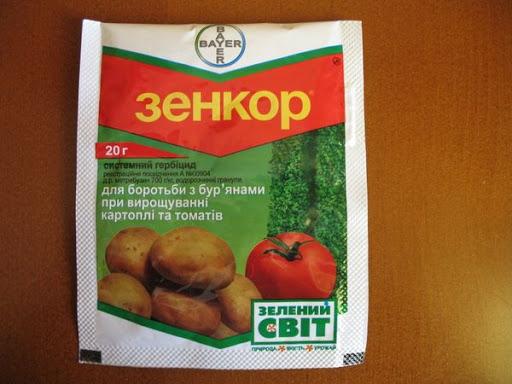
Composition and existing forms of release
This product belongs to a group of systemic herbicides. It is designed to control both dicotyledonous and annual weeds. It is effective due to its active ingredient, metribuzin. It works by inhibiting photosynthesis in weed cells.
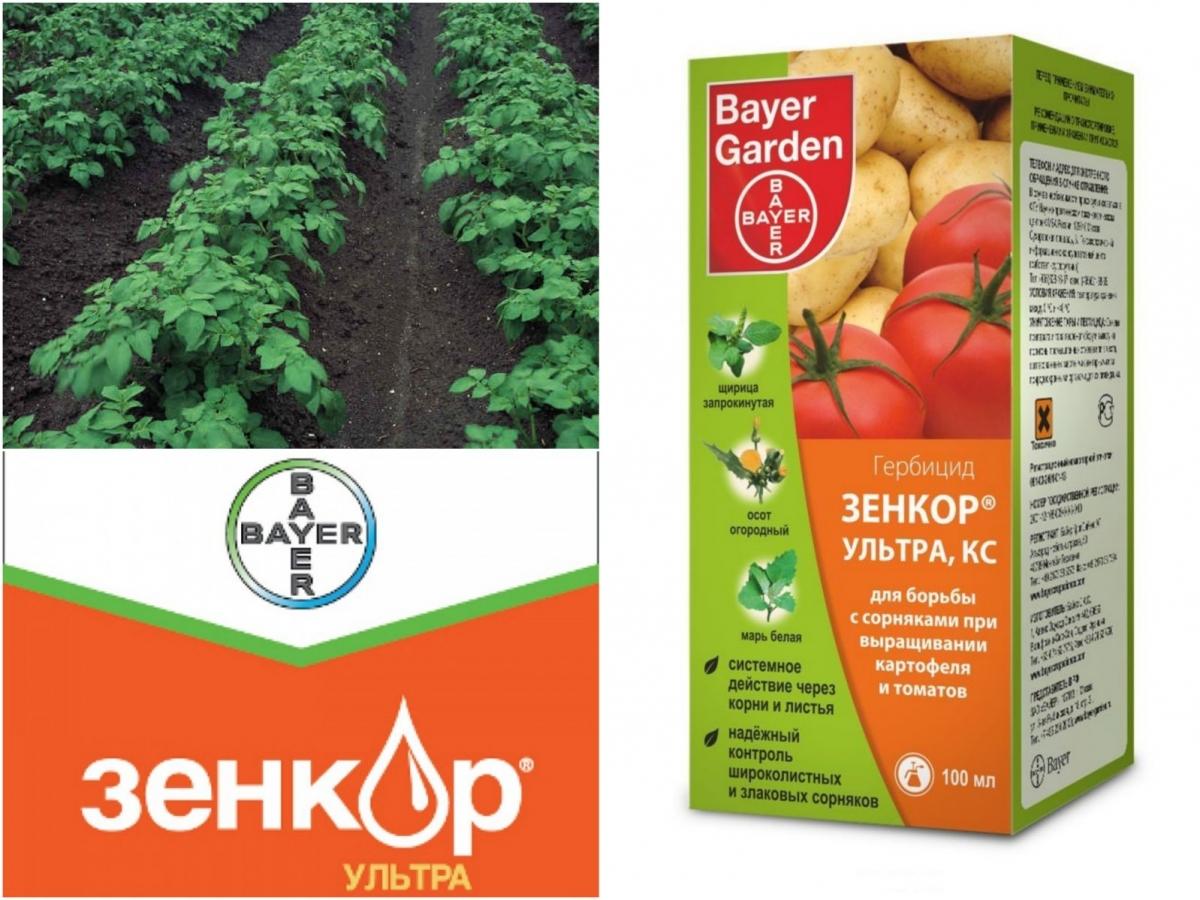
Manufacturers produce Zenkor in 3 types:
- small, fast-dissolving granules;
- concentrated emulsion;
- dry powder.
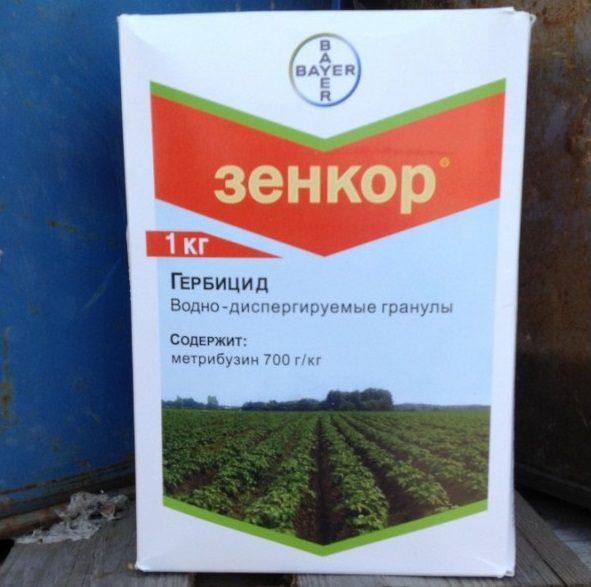
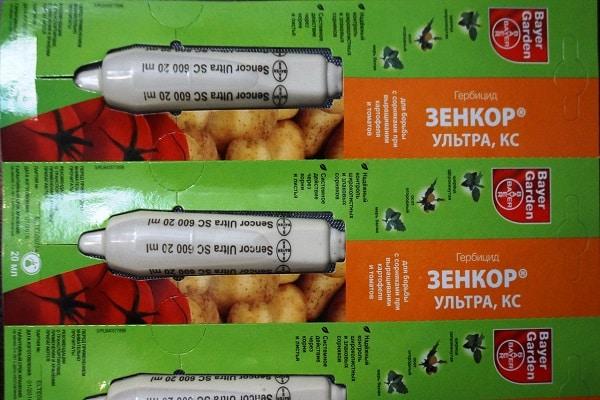
The emulsion is sold in glass bottles of 20 or 100 ml. The product, produced in dry form (powder and granules), is packaged in small 20 g sachets or larger 20 kg containers.
Advantages and disadvantages
How it works
After weed treatment, metribuzin penetrates deep into the plant's cell membranes. The herbicide enters the weed cells through the leaves and root system. The active ingredient inhibits the movement of electrons, which are essential for photosynthesis. As a result, the weeds die.
"Zenkor" is used for soil treatment before sowing and for weed control during the pre- and post-emergence phases. Weed control is achieved 14-20 days after application. "Zenkor" successfully combats hard-to-eradicate grasses, as well as broadleaf and dicotyledonous pests.
The following plants will not withstand the aggressive agent: foxtail, wild radish, most types of knotweed, stinging nettle, ragweed, chickweed, Virginia bugleweed, sow thistle, wild oats, chickweed, hairy bidens, meadow chamomile, black nightshade, field foxtail, common barnyard grass and many other herbs.
The timing of treatment depends on the plant species. In some cases, the soil is sprayed shortly before planting the seedlings. For other crops, a double treatment is appropriate (a pre-emergence treatment is supplemented by a spray on emerging weeds). A single spray is most often used on plants in the active growing phase.
Rules for preparing the solution
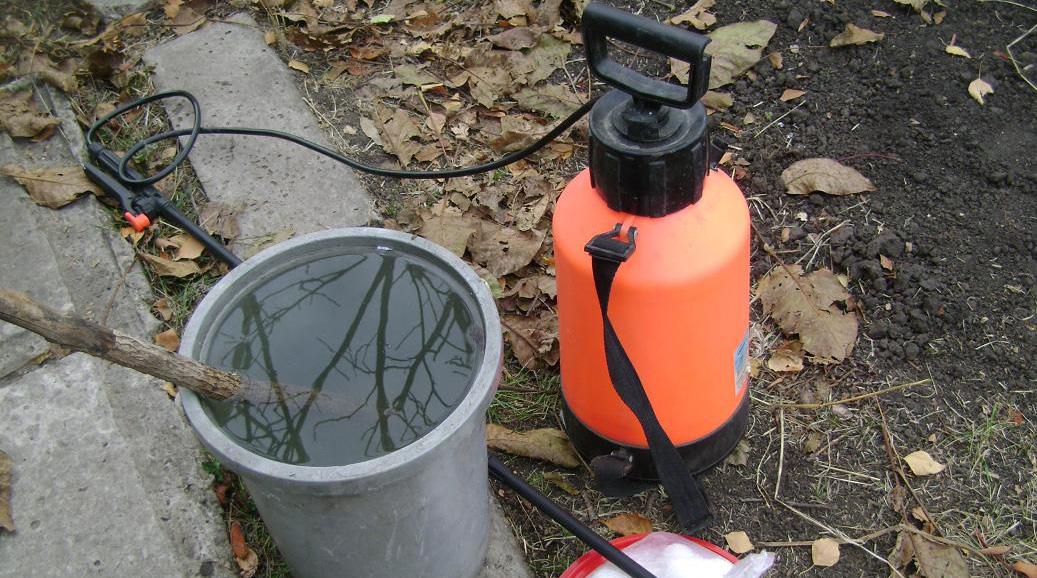
The product is diluted in clean water. If Zenkor is available in granular form, a solution is made from 15 g of the product and ½ a bucket of water. The resulting solution is thoroughly mixed. It will take 30 minutes for the herbicide to completely dissolve. The liquid form is much more convenient to use: dissolve 8-11 ml of the product in 5 liters of water. Detailed information is printed on the packaging.
Average consumption rates
To achieve good results, it's important to consider not only the weed species but also the soil composition. On clayey, heavy soil, the product consumption will be much higher than when treating plants growing in light, loose soil.
Average consumption rates of the drug:
- clay soil – 15 g per 100 m2;
- light soil - 5 g per 1 hectare;
- ordinary soil – 10 g per 100 m2.
Instructions for use against weeds
Before beginning the procedure, the soil must be prepared. To do this, level the soil thoroughly, breaking up any large clods. Then, it's advisable to lightly moisten the soil to a depth of 1.5-2 cm. If the soil is heavy, increase the concentration of the preparation to the maximum permissible level.
The optimal air temperature for carrying out work is from 10 to 22 degrees.
Soybeans
The soil is sprayed once, before the first soybean shoots emerge. 0.6-1.0 kg of active substance is used per hectare of soil. The consumption rate of the prepared solution is 200 to 300 liters per hectare.
Tomatoes
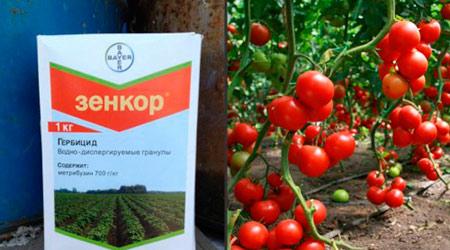
When growing tomatoes from seedlings, the procedure is repeated twice. First, the soil is treated shortly before planting the seedlings. For this, 11-14 g of the solution is diluted in 5 liters of clean water. This amount of solution is sufficient for treating 100 square meters of soil. The seedlings are sprayed twice, every 2-3 weeks.
Tomatoes grown without seedlings are treated when they have 2-4 leaves. To prepare the solution, mix 7 g of the solution with 5 liters of water. The calculation is based on 100 square meters of soil.
Carrot
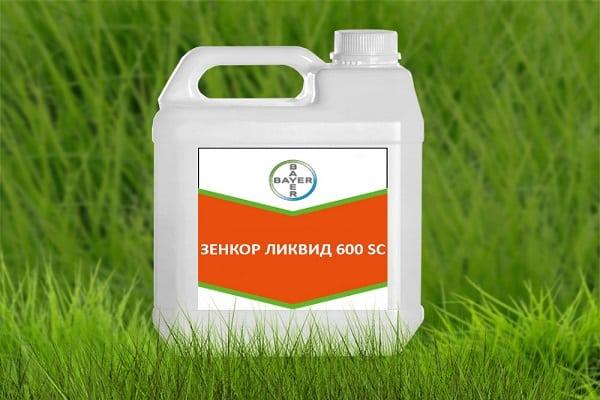
To control weeds when planting carrots, only the enhanced herbicide "Zenkor Liquid" is suitable. This product can be safely used on beds containing root vegetables. The first application is before planting. The optimal concentration is 3 ml per 100 square meters of soil. Repeat the application during the active growth stage. The recommended application rate is 3-5 ml per 100 square meters of soil.
Potato
The soil intended for planting potatoes is treated once, before the first shoots appear. The solution is prepared at a rate of 5-15 g per 5 liters of water per 100 square meters of soil.
When is it prohibited to use?
The manufacturers of Zenkor warn against using the product during the daytime. Treatment should only be carried out early in the morning or evening. Zenkor is intended for outdoor use only. Spraying plants in greenhouses is prohibited. Treatment should be carried out at least 50 meters away from children's playgrounds, institutions, and recreation areas. The product should not be mixed with nitrogen fertilizers.
Security measures
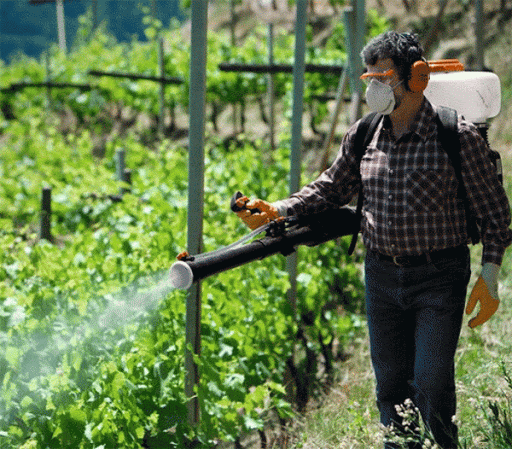
Do not use food storage containers for household purposes. It is recommended to use a separate plastic container for preparing the solution. Wear protective gloves, a mask, or a respirator while preparing the solution. This will prevent the chemical from entering the respiratory tract or coming into contact with exposed skin.
The solution is ready for use immediately after preparation. Any remaining product is disposed of. To do this, dig a small hole in a remote corner of the plot, pour the chemical into it, and cover the hole with soil.
Spraying should be done wearing thick, protective clothing, gloves, and a respirator. After finishing work, remove the protective suit and thoroughly wash your hands and face with soap.
Take a look Also
The degree of toxicity of the herbicide
All metribuzin-based products are classified as hazard class 3 for humans, so the herbicide can be used safely. The product poses little risk to bees (hazard class 4), but the maximum distance between the site and the apiary should be at least 2 km.
Its compatibility with other means
Zenkor is compatible with almost all types of pesticides. Despite this, each combination should be tested first. When preparing tank mixes, each product should be diluted with water before use. Dry products should never be mixed. Zenkor should not be mixed with insecticides or nitrogen fertilizers.
Features of crop rotation
After using the preparation, it is not recommended to sow sunflower, legumes, sugar beets and rapeseed on the treated soil the following year.
Storage rules and periods
The product remains usable for 48 months from the date of manufacture. Store the herbicide in a dry, dark place, out of reach of children and animals. Store Zenkor at temperatures ranging from 0 to 40 degrees Celsius.
Existing analogues
An effective replacement for the herbicide "Zenkor" can be the preparations "Kupol", "Ogorodnik", "Metrizan" or "Lazurit".
Related posts:
 Instructions for use of Zenkor Ultra weed control for potatoes
 Instructions for use and composition of the herbicide Zontran, dosage and analogues
 Classification, selection and application of herbicides for beet treatment
 Instructions for the use of herbicides for potatoes, similar preparations
 Instructions for use and composition of Glyphora for weed control, dosage, and analogues
 Instructions for using Fitosporin for cucumbers and processing rules
 Causes and treatment of eggplant pests and diseases, how to combat them at home
 Types of garden fungicides and descriptions of the top 24 best, instructions for use