
Growing crops always involves weed control. Let's explore the capabilities of the herbicide Zontran, including instructions for use, composition and formulation, how it works, and its pros and cons. We'll also explore how to prepare the solution, dosage and consumption, toxicity and compatibility, storage times and methods, and alternatives.
Composition, dosage form and purpose
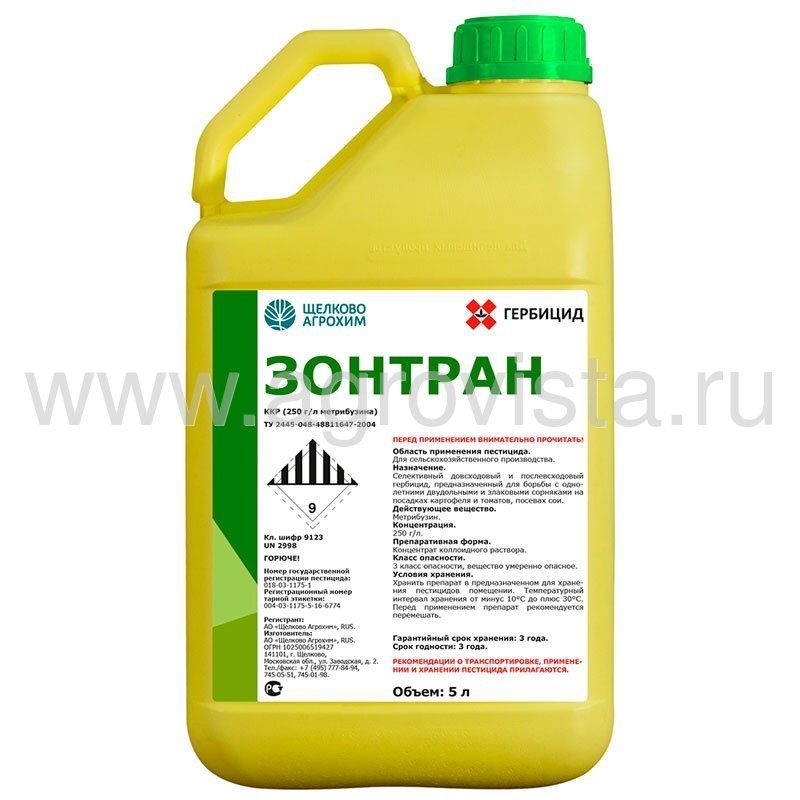
The manufacturer of Zontran, Shchelkovo Agrokhim CJSC, produces it as a concentrated colloidal solution. The active ingredient, metribuzin (250 g per liter), is a triazinone. It is a pesticide with systemic and selective action. It is available in 5- and 10-liter canisters.
"Zontran" is used before and after emergence to treat seeded and planted tomatoes, potatoes and soybeans against 1-year-old 2-lobed and cereal weeds.
Operating principle
Metribuzin inhibits the transport of electrons involved in photosynthetic processes. It is readily absorbed by roots and seedlings and can also penetrate leaves. Its concentrated colloidal solution allows metribuzin to quickly penetrate weeds and adhere well to leaves. This ensures high bioefficacy even at low application rates.
This herbicide inhibits the emergence of vegetative weeds, and its use helps delay the emergence of subsequent weeds. It protects crops from weeds for up to one month (depending on the weather).
Weed growth is stopped immediately after treatment with Zontran. Visible symptoms of suppression appear within 2-7 days, and complete weed death occurs within 10-15 days.

Pros and cons
Advantages of the herbicide "Zontran":
- absorbed by the leaves and roots of weeds;
- low consumption and high efficiency in comparison with preparations containing metribuzin, produced in dry form;
- protects crops from the emergence of new weeds by creating a “screen” on the soil;
- reduces the pesticide load on plants and soil and reduces the cost of processing;
- It is considered the most effective drug of all those containing metribuzin and intended for the protection of tomatoes and potatoes;
- helps prevent potato infection with late blight due to the absence of weeds in the beds.

Disadvantages: can only process a small number of crops, long waiting period for tomatoes – 60 days.
Calculation of consumption

Application rate of "Zontran" in agriculture (in liters per hectare) and consumption per hectare:
- tomato seed for spraying the crop at the stage of 1-2 and 2-4 leaves - 0.4 + 0.8 (300-400);
- tomato for processing at the stage of 2-4 leaves - 1.2-1.5 (300-400);
- for spraying tomato seedlings 2-3 weeks after planting – 1.7 (500);
- for processing potatoes before emergence and on tops 5 cm high – 1 + (0.4-0.6) (200-300);
- for processing potatoes on tops 5 cm high – 1.1-1.4 (300-400);
- soybeans before emergence – 0.6-1.2 (200-300).
The waiting period for potatoes is 30 days, for tomatoes and soybeans – 60 days.
Application rates of "Zontran" in private household plots and solution consumption:
- sowing tomatoes with 2-fold treatment – 4 + 8 ml/3 l of water (3 l/100 m2);
- tomatoes sown in the phase of 2-4 leaves – 12-15 ml/3 l (3 l/100 m2);
- tomato seedlings – 17 ml/5 l of water (5 l/100 m2);
- potatoes with 2-fold spraying – 10 ml/3 l + (4-6) ml/3 l (3 l/100 m2);
- potatoes 1-time spraying – 10-15 ml/3 l (3 l/100 m2).
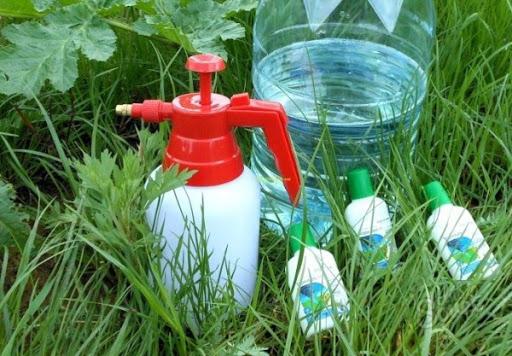
In private households, two sprayings of "Zontran" are carried out; the waiting period is 1 month for potatoes and 2 months for tomatoes.
How to prepare the mixture and instructions for use
The solution is prepared according to the standard procedure: first, pour one-third to one-half of the water into the tank, add the solution, and stir. Once the solution is completely dissolved, add the remaining water.
Precautionary measures
When working with the herbicide "Zontran," wear protective clothing. Wear gloves, a respirator, and goggles. Do not remove protective equipment while working. Wash your face and hands after finishing.

How toxic is it?
Zontran is classified as a Class 3 toxicity product for bees and humans. Its use near water bodies and fish farms is prohibited. It is non-toxic to plants when used in the recommended dosage and according to the instructions.
Possible compatibility
Zontran can be mixed with many herbicides and other pesticides used in agriculture. However, as the manufacturer recommends, in each case, when using them together, especially with micronutrient fertilizers, it is necessary to check the physical and chemical compatibility of the products.
How long and how to store it properly
Zontran has a shelf life of 2 years. Store in its original containers with the lids closed. Store in a dark, dry, and warm place. Do not use expired herbicide. Any prepared solution left standing for more than 1 day should also be discarded.
Similar means
For agricultural use, Zontran can be replaced with metribuzin-containing products: Artist, Rangoli-Guillotine, Kontakt, Lazurit, Tiron, Zenkor Ultra, Soil, Unimark, Zino, Torero, Lazurit Super, Zenkoshans, Metrifar 70, and Zenkor Techno. Similar products for private farms include Lazurit, Lazurit T, and Zenkor Ultra.
Zontran is used in agricultural and private farming operations to control one-year-old weeds in tomato, potato, and soybean crops. This product features low dosage, low consumption, and excellent effectiveness. It demonstrates superior performance compared to dry products with the same active ingredient.
Related posts:
 Instructions for use of Cassius and the herbicide composition, dosage, and analogues
 Instructions for use and composition of the herbicide Puma Super 100, application rates
 Instructions for use and composition of Glyphora for weed control, dosage, and analogues
 How to propagate and grow peas, cultivation technology, and care in open ground
 How to make a garden bed from scratch without grass and weeds: ideas and methods with and without weeding
 How to properly plant peas in a greenhouse and open ground
 Agrostar instructions for use, herbicide composition, dosage, and analogues
 Description of varieties of sowing peas and cultivation, to which family they belong
