
- Why do you need to tie up peas in the beds?
- Methods and schemes of fastening
- What material is suitable for garter?
- What supports and garters can you make yourself?
- Natural support
- Fence
- Support stakes
- Wigwam
- Portable trellis
- Support on the grid
- Bicycle rim trellis
- Review of purchased materials for tying up peas
When planting peas outdoors, it's essential to know how to tie them up. This helps improve the quality of the harvest. There are many ways to install supports. You can make your own or buy a ready-made one at the store. Not all materials are suitable for tying up legumes, and some can be detrimental to the plant's development.
Why do you need to tie up peas in the beds?
There are several reasons why gardeners should take care to tie up pea stems in a timely manner:
- This procedure improves air, light, and heat access to the lower tiers of the plant. These conditions are essential for the uniform ripening of the sweet harvest.
- The risk of rotting, fungal and bacterial diseases is reduced, as all parts of the plant are well warmed and ventilated.
- It is easier to carry out preventive and therapeutic treatments of the plant.
- The vertical planting method allows you to save space on the site.
- The ripe crop is easy to harvest, with the pods visible. Harvesting the crop on time encourages the formation of new, young pods, prolonging the fruiting period.
- The harvested fruits are stored longer, as they are less often affected by pests.
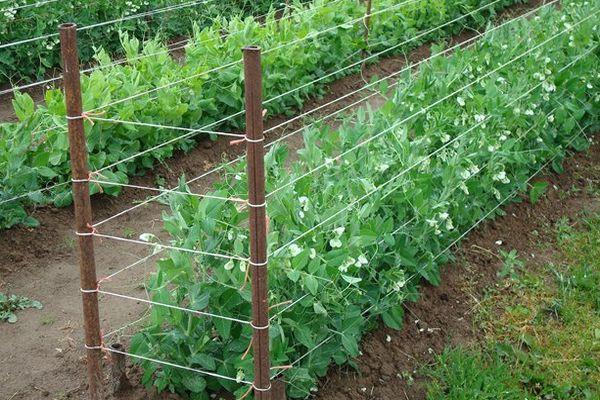
You can build a simple or more complex tying structure. The key is to select the right materials and follow all the instructions.
Methods and schemes of fastening
Each gardener chooses their own method for tying up peas. Some opt for a simple structure consisting of pegs with a rope stretched between them, while others build portable structures or construct devices from scrap materials.
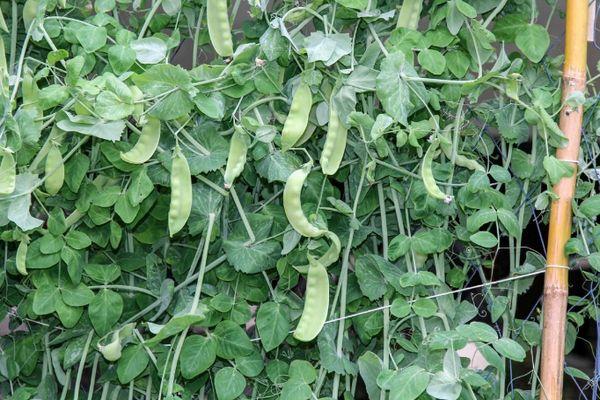
If the bushes are small, wooden stakes are installed 12 centimeters from the stems. They can be placed at any time, but it's best to do so when the stems reach 25 centimeters in height.
For a large plantation, a row trellis is suitable. It's best to install the structure before sowing the peas. This will prevent damage to the plants later.
Take a look Also
What material is suitable for garter?
As a garter material, you can choose:
- hemp or polyethylene cord;
- Special clips for tying up plants are convenient to use;
- cut strips of soft fabric;
- Plastic ties with a convenient latch allow you to fix the stem at the desired distance from the support.
Avoid using coarse materials that could damage the plant, such as twine or metal wire. Rain or wind can cause the stem to crack where it's tied.
What supports and garters can you make yourself?
You can make a support for peas yourself:
- A strong tree branch, which is placed near each bush, can serve as a support.
- From several branches you can build a support in the form of a hut.
- You can connect the bars together above the bush.
Any materials readily available around your garden are suitable. Bicycle wheels, poles, and cords, for example, will do.
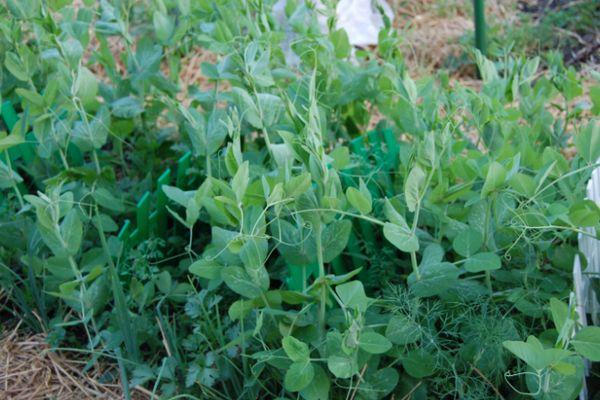
Natural support
Another plant planted nearby with a stronger, straighter stem sometimes serves as natural support for peas. For this purpose, sunflowers, corn, and other grain crops can be planted nearby.
Fence
The simplest and easiest way is to plant peas along a fence. The fence can be wooden or made of chain-link fencing.
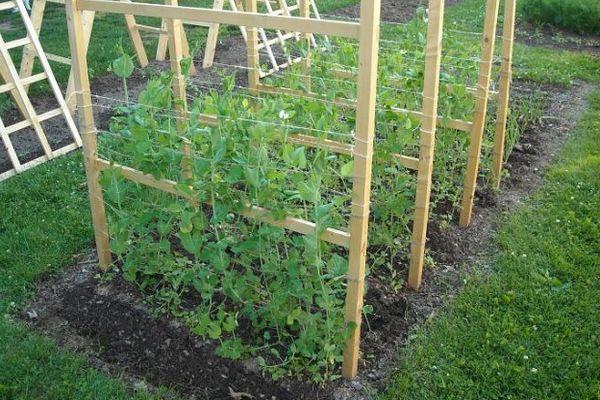
- A wooden fence is the ideal option. It retains heat for a long time and doesn't overheat in the sun.
- The advantage of a chain-link fence is that the holes in the mesh allow the plant tendrils to cling to the plant's tendrils, and it does not block the passage of light.
- It's bad if the fence has a metal base. The material quickly heats up in the sun and becomes hot. This can cause the pea stalks to dry out.
If the fence is solid, consider the planting location. Peas are planted on the side that receives most of the day's sunlight.
Support stakes
If you only have a few bushes in your garden, there's no point in creating complex structures. It's enough to drive stakes up to 1 meter high near each bush, 12 centimeters from the stem, to avoid damaging the roots.
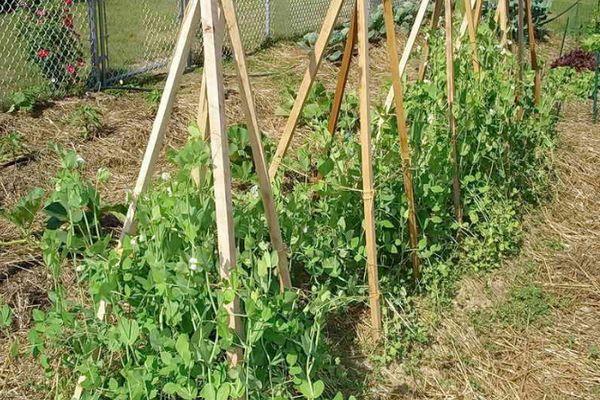
There's another way to install stakes. Stake them 50 centimeters apart along the entire length of the bed. Ropes or netting are tied between the stakes. As the peas grow, their tendrils cling to the support, creating a kind of green wall.
The disadvantage of this method is the need to make a large number of pegs, which do not look very aesthetically pleasing on a summer cottage plot.
Wigwam
A pole up to 2 meters long is installed in the center of the plot where the peas will be planted. Stakes are installed in a circle at 70-centimeter intervals, the tops of which are connected with wire near the central pole. Ropes or thin twigs are tied to the pole for support.
Portable trellis
According to crop rotation rules, peas cannot be planted in the same spot three years in a row. Therefore, experienced gardeners install portable trellises.
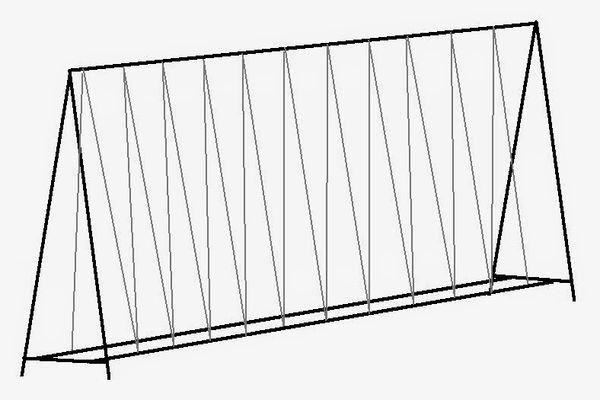
The 2-meter-long vertical posts are connected with screws, and the structure is secured with four side posts. Twine is then tied to the horizontal beams at intervals of 30 centimeters.
In its finished form, the structure resembles two staircases connected to each other, or a triangle.
Support on the grid
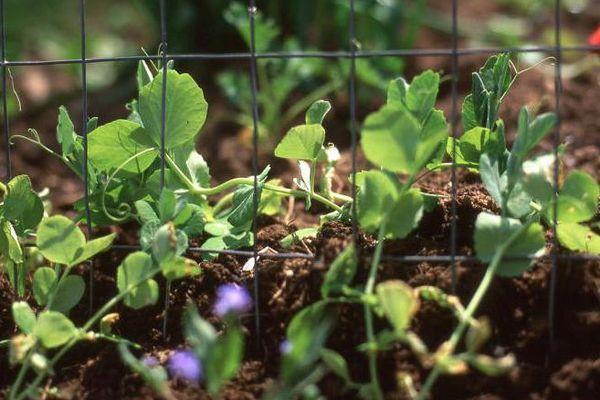
At the store, you should purchase a 2-meter-wide metal or plastic construction mesh. There are two ways to install the mesh in a vegetable garden bed:
- Stake stakes are driven into the edges of the bed, and the netting is then attached to them. This creates an arch over the bed. Peas are planted on both the outer and inner sides of the structure, preferably in a staggered pattern.
- Chain-link fencing can also be installed as a fence. It is stretched between stakes. The stakes are driven in three places. The mesh is secured to the stakes with wire.
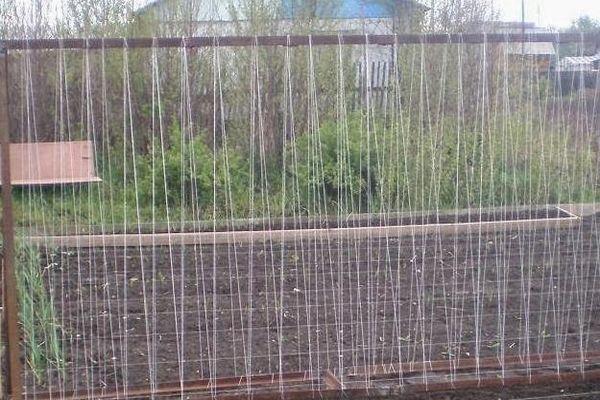
You can make your own net. Install 2-meter-high supports on both sides of the bed. Tie twine to them in several rows.
Bicycle rim trellis
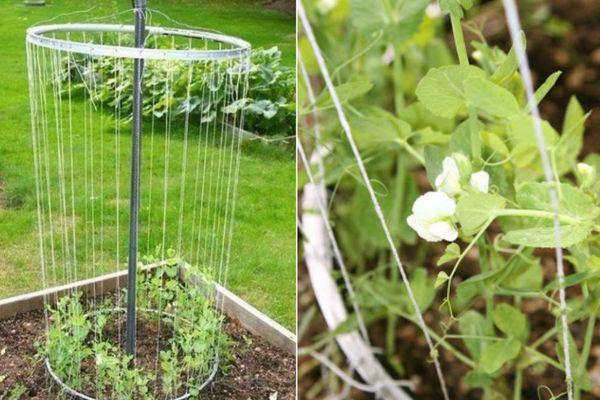
A unique and convenient way to tie up peas is to create a trellis using a bicycle rim. One finished trellis can hold up to 30 plants. To create this trellis, you'll need two bicycle rims without spokes, a 2.2-meter-long rebar stake, and some twine.

Place one hoop on the ground and install rebar in its center. Attach the other hoop to the other end of the vertical support with wire. String is stretched between the two rings.
Review of purchased materials for tying up peas
The store offers a wide selection of supports for any climbing plants:
- Rigid galvanized mesh. It's installed in one place, so after three years, you'll need to select a new location and support for the peas. For growing legumes, a mesh size of 1-2 centimeters is best. The base doesn't rust and will last for many years.
- Plastic mesh. This material allows the support to be installed only during the warm season; it is removed for the winter. Therefore, the structure must be lightweight.
- Trellis made of metal, plastic, or wood. Decorative versions of these supports are even available, perfect for adorning your garden.
- Greenhouse arches (they should be at least 1 meter long). Initially, the arches are used as a greenhouse for vegetables, and in the summer, they are converted into supports for climbing plants.
The tying procedure must be carried out carefully. The fragile stems of peas are easily damaged. The materials must be of high quality. This will ensure a bountiful harvest in both quantity and quality.
Related posts:
 How to properly plant peas in a greenhouse and open ground
 Description and characteristics of the best seeds of pea varieties and types
 How to propagate and grow peas, cultivation technology, and care in open ground
 Description of varieties of sowing peas and cultivation, to which family they belong
 How to plant, grow, and care for peas at home on a windowsill or balcony
 The health benefits and harms of peas for men and women, and recipes for treating diseases
 Description of pea pests and diseases, treatment and control measures
 How to plant and grow peas indoors and in a greenhouse