
The pear is one of the most common crops in our climate, delighting gardeners with its delicious and nutritious fruits. Growing this easy-to-grow fruit tree is usually straightforward, but sometimes problems arise that negatively impact yield. Unfavorable conditions and infectious diseases can cause pears to drop unripe fruit.
Reasons for pear ovary loss
The abundant bloom of pear trees in spring is a cause for celebration. But the joyful mood is dampened when the still-green fruits suddenly begin to fall. Various factors can cause this. Moreover, the tree often sheds its fruit not for one reason, but for several reasons at once.
Unsuitable climatic conditions
If the spring is warm and sunny, it's possible that too many ovaries are forming. The plant can't fully produce all the fruit, so it activates its natural mechanisms to correct the problem: it simply sheds some of the ovaries.
Bad weather, such as windy and rainy conditions, also contributes to fruit drop. Heavy rain and strong gusts of wind knock down young shoots and developing ovaries.
Sharp fluctuations in soil temperature, when the difference between day and night temperatures is more than 8°C, negatively affect pear fruiting.
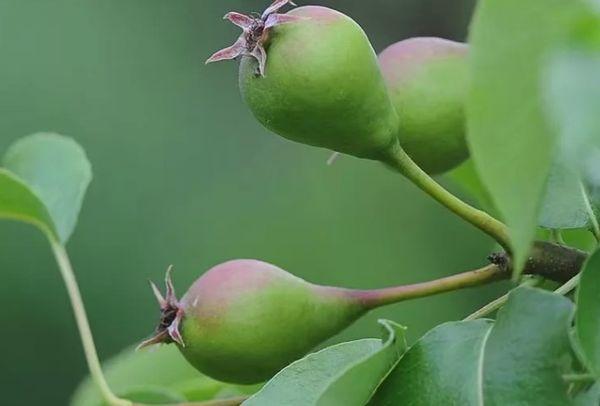
Nutritional deficiencies
Nutritional deficiencies are a common cause of fruit falling before ripening. During the fruiting phase, the plant intensively absorbs nutrients, which depletes the soil. Therefore, fruiting pear trees require fertilizing: with nitrogen at the beginning of the season, potassium and phosphorus mid-season, and organic matter at the end.
In rare cases, increased soil acidity can cause pear tree fruit to fall.
Insufficient or excessive soil moisture
Fruit set begins in June. However, this summer month is characterized by unstable weather conditions. Heavy rainfall and dry days are possible. Therefore, it is necessary to carefully monitor soil moisture levels.
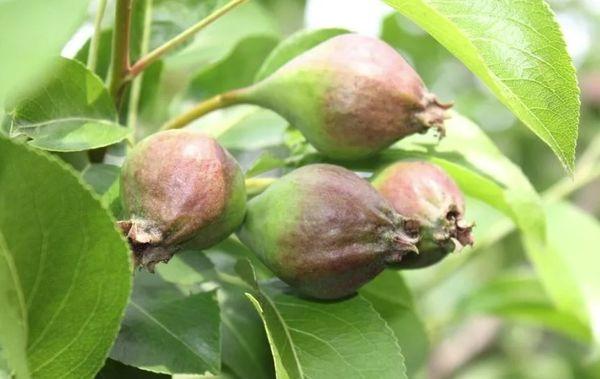
Diseases and pests
Pear trees shed fruit when affected by rust, scab, and rosette disease. Insect pests that can cause problems include blossom beetles, leafhoppers, and codling moths.
What to do if pear ovaries fall off?
To avoid losing your harvest, you need to act quickly. But sometimes, despite all the measures taken, a diseased pear tree cannot be saved. The first thing you should do is check the soil moisture level, as improper watering is most often the cause of problems with pear yield.
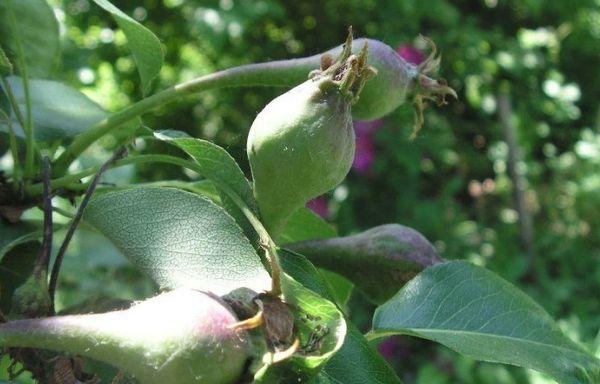
Restoring the health of fruit trees
Measures to help stop pear fruit drop:
- Watering regulations. Pears aged 3-5 years are watered 5-8 times per season, with a 10-liter bucket of water poured under the tree at each time. Pears aged 6-10 years require watering 10-12 times per season.
- Regulating fertilizing. If fruit drop has just begun, use urea: dissolve 2 tablespoons in a 10-liter bucket of water. Spray the tree with the solution from the trunk to the crown. Avoid spraying in rainy or windy weather. If the problem has become severe, use the following remedy to save the pear: collect the weeds in a bucket, fill it with water, add 10 grams of superphosphate, and a cup of ash. Let the solution steep, covered, in a shaded area for two weeks. Before use, dilute the solution at a ratio of 1 liter per 10 liters of water. Pour four buckets of water under the tree.
- Pest control. In the fall, sticky traps are placed in the garden to attract many pests. Once a season, fruit trees are sprayed with fungicides to reduce the risk of fungal infections: Horus (10 mg per 10 liters of water) and Skor (2.5 mg per 10 liters). The soil is dug twice a season. Insecticides are used against insects. If the garden is attacked by codling moths, you can make a solution of 10 g of mustard and 1 liter of water and let it steep for 2 days. Dilute 200 ml of the solution in a 5-liter bucket of water, and pour 2.5 liters under the pear tree. Treatment should be continued for no longer than a month.
- Restoring normal soil acidity. Acidic soil is neutralized by adding dolomite (400 g per 1 m2). The neutralized area must be at least 1 m away from the trunk.
Prevention
A gardener should constantly monitor the health of fruit trees. Problems that lead to fruit drop are easier to prevent than to fix.
Preventive measures:
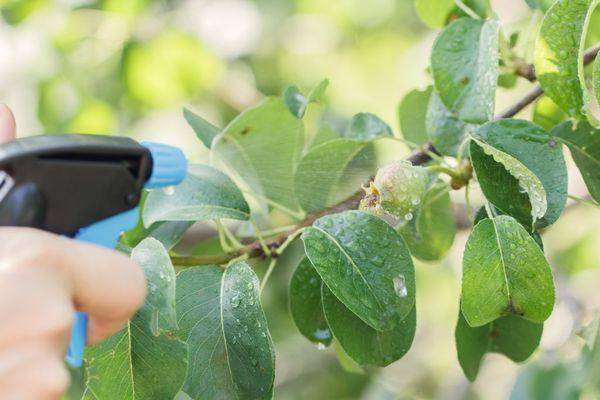
- Spraying trees with Bordeaux mixture. The first time, in early spring, a 3% solution is used. The second time, a week before flowering, a 1% solution is used.
- Treating pears at the beginning of spring with a 1% solution of colloidal sulfur to prevent attacks by harmful insects.
- Treatment with copper sulfate after harvest. Use 100 g of solution per 10-liter bucket of water. Use 2 liters of solution per tree.
- Removal of damaged shoots and sealing of cuts to prevent infectious pathologies.
Tips and advice from experienced gardeners
The pear tree is unfussy; with standard but regular care, its yield does not decrease. Proper watering, fertilizing, and disease protection are sufficient to ensure consistent fruit set.
Fruit drop is a major stress factor for pear trees. To alleviate this stress, use immunostimulants such as Vympel, Immunocytophyte, and Nitrophoska.
To reduce the likelihood of fruit drop, experienced gardeners advise:
- Each time you water, use a probe to check the moisture penetration depth. It should be 50-60 cm. If the moisture level is insufficient, add water.
- Use mulch to retain soil moisture. The mulch thickness should be 10 cm.
- Water in the evening or in non-sunny weather.
- After each watering, loosen the soil around the trunk.
- Choose disease-resistant varieties for planting: Kudesnitsa, Avgustovskaya Rosa, Severyanka, Dukhmyanaya.
- Consider the variety's suitability to the climate conditions in the growing region. Otherwise, the yield will be low.
Pear trees begin bearing fruit at an early age. However, for a young tree, abundant fruiting can be debilitating. Therefore, the pear tree sheds excess fruit—another possible reason for a lack of harvest. In this situation, the gardener's only option is to wait until the tree becomes strong enough to bear fruit consistently.
Related posts:
 Description and full characteristics of the Yakovlev Memory pear variety, planting and care
 Description and full characteristics of the August Dew pear variety, planting and care
 Description of the 23 best pear varieties for the middle zone, planting and care rules
 Description of the Rogneda pear variety, planting and care instructions
 Description and full characteristics of the Lada pear variety, care and cultivation
 Description of the Cathedral pear variety, planting and care features
 Description and characteristics of 14 varieties of the Bere pear variety, planting and care
 Description and characteristics of the Marble pear variety, pollinators and cultivation subtleties