
- Characteristics and description of the Red Lady variety
- Appearance of the bush
- Potato yield and taste
- Application of the root crop
- Advantages and disadvantages of culture
- Optimal conditions for growing potatoes
- Selecting and preparing a site
- Preparing planting material
- Timing and technology of planting
- How to care for the variety
- Irrigation
- What and how to fertilize plantings
- Loosening and weeding Red Lady potatoes
- Hilling up the beds
- Protection from diseases and pests
- Harvesting and storage
- Vegetable growers' reviews of Red Lady
The Red Lady potato variety is an early-ripening vegetable widely grown in the CIS countries. Because it's easy to care for, even an inexperienced gardener can grow it. To ensure successful planting and proper care of the seedlings, it's important to familiarize yourself with all the instructions.
Characteristics and description of the Red Lady variety
The Red Lady potato was developed by German breeders. The variety has been listed in the state register since 2008. It is zoned for cultivation in the Central Black Earth, Far Eastern, Middle Volga, and Caucasus regions. This early-ripening variety ripens two months after planting, but has a long growing season. The potato is ready for storage after 90 days. The plant tolerates short-term drought and is undemanding in terms of soil and care.
The variety exhibits resistance to late blight, scab, fungi, and nematodes.
Appearance of the bush
Red Lady potato plants grow with strong, straight stems. They remain erect throughout the summer. The foliage is spreading, and the bush itself is upright and short, reaching up to 0.5 meters in height. This intermediate-sized plant has stems covered with foliage. Most leaves are medium-sized, while some are large, elongated, and emerald-colored. Lavender-colored flowers adorn the garden when budding.
Potato yield and taste
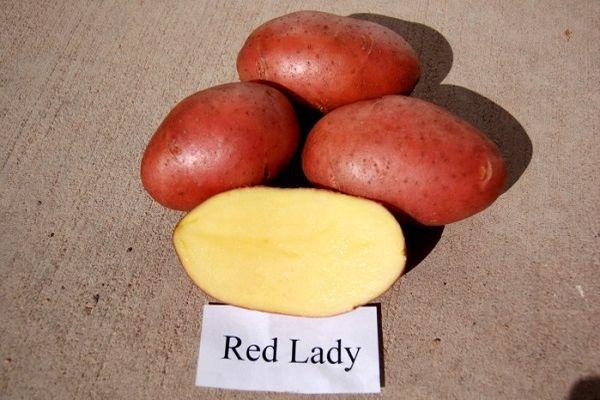
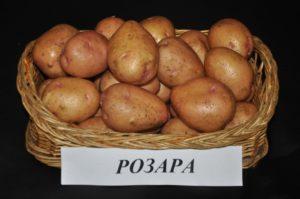
The Red Lady variety produces a heavy yield, with 165 to 300 centners (0.5 to 10 lbs) per hectare. These potatoes are suitable for growing for personal consumption or for sale. The tubers weigh up to 150 grams and are dusty rose-colored, with a pale cut. The potatoes are oval in shape and uniform in size, with a minimal yield of small specimens.
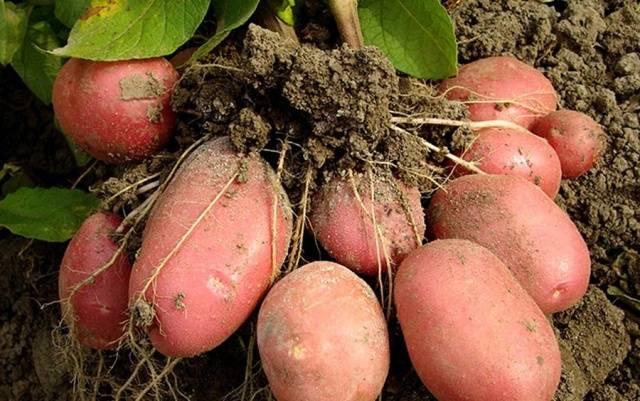
Each plant produces up to 15 tubers. The skin is thin and dense, making the vegetables resistant to mechanical stress. Red Lady potatoes withstand long-distance transportation well and have a long shelf life. The potatoes have few, superficial eyes, making peeling easier. The potatoes contain 12.5-16.8% starch. 100 grams of potatoes contain 830 kcal.
Application of the root crop
Red Lady potatoes are suitable for any dish thanks to their versatility. They can be mashed, baked, fried, boiled, or added to salads and entrees.
Advantages and disadvantages of culture
Red Lady potatoes have a number of positive and negative qualities.
| Pros | Cons |
| Early ripening period | The need for regular fertilization with complex mineral compounds |
| Excellent taste | The quality of the harvest is affected by the length of the day |
| Resistance to drought and diseases | If you don't follow the care rules, the bushes may become infected with late blight. |
| Good shelf life, can be transported over long distances | |
| High content of useful microelements |
Optimal conditions for growing potatoes
Growing Lady Red potatoes is not difficult; you can follow standard planting techniques.
 Seedlings should be purchased from nurseries or reputable market sellers. Before purchasing, be sure to review the quality certificate. This document includes information about the species, batch details, and supplier contact information.
It's advisable to choose elite varieties; a portion of the harvest from these root crops can be used for continuous planting for 4-5 years without replanting. Plant in loose, sandy black soil. In the North, potatoes can be grown in greenhouses, while in the South and temperate latitudes, they can be grown in the garden.
Selecting and preparing a site
Red Lady potatoes prefer to grow in a sunny spot away from tall trees. The beds are prepared in the fall, the soil is tilled, organic matter is added, and mulched. Ideal pre-planting crops include carrots, beets, cucumbers, legumes, and grains. Two weeks before planting, the soil is loosened again and weeds are removed.

Preparing planting material
Before planting, sort the seedlings. Select medium-sized specimens free of damage and rot. The fruits should weigh up to 100 grams. For an early harvest, it is advisable to sprout the tubers. Keep them in a sunny spot for three weeks. Before planting, soak the seedlings for 30 minutes in a root growth stimulating solution. Effective solutions include Prestige, Matador, and Kaiser.
Timing and technology of planting
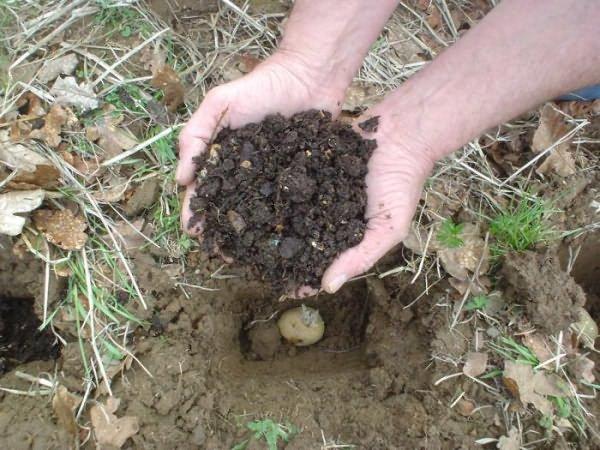
Red Lady potatoes are planted when the soil warms up to 10 degrees Celsius. This usually occurs in mid- to late April. The soil is fertilized in the fall with manure and superphosphate. In the spring, ash and complex biological preparations are added to the holes.
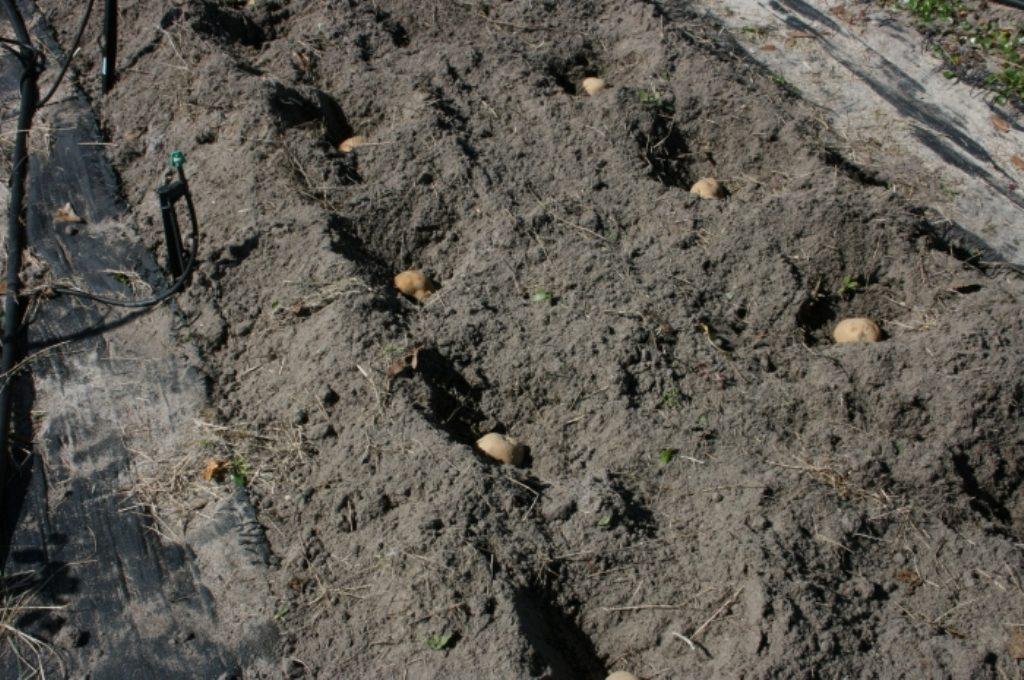
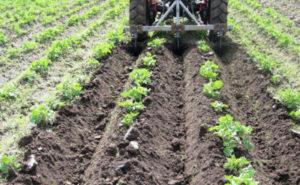
Maintain a distance of 60 cm between rows and 35-40 cm between bushes. Plant at a depth of 5 cm; unsprouted tubers at a depth of 8-10 cm.
How to care for the variety
Caring for Red Lady potatoes is simple; the key is regularity. The plants need to be loosened, fertilized, hilled, and watered. The plants should be treated with insecticides to prevent diseases and beetles.
Irrigation
Potato plants should be watered three times per season. The first irrigation is done during flowering, when the tubers are forming. The second irrigation is done as the potatoes are wilting. The final irrigation is done a week before harvest.

What and how to fertilize plantings
Fertilize Red Lady potatoes 3 times during the growing season.
- When inflorescences appear, apply 500 g of mullein and urea per 10 liters. One bush will require 0.5 liters of solution.
- During budding, add 15 g of double superphosphate, potassium sulfate, and 100 g of wood ash to a bucket of water. The recommended dose per bush is 0.5 liters of solution.
- During flowering, a month before harvesting, 30 g of superphosphate and 250 ml of manure are diluted in 10 liters of water.
By using fertilizers, the yield increases and the protective properties of plants improve.
Loosening and weeding Red Lady potatoes
Potatoes don't grow well in weed-ridden soil; the plants need to be weeded until harvest. The soil is loosened as soon as weeds reach half a spade's depth. Afterward, the plants are mulched with straw. This helps control weed growth and conserve soil moisture.
Hilling up the beds
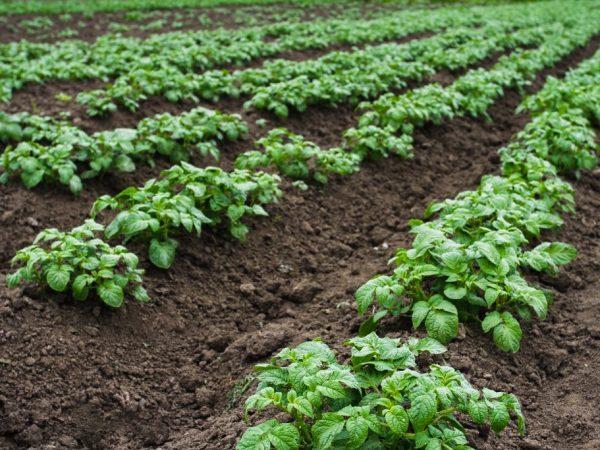
Hilling is carried out 2-3 times per potato growing seasonThis procedure is necessary to stimulate the maturation of stolons and tubers. There are two types of hilling.
- The classic method. Soil is raked into the beds from the spaces between the rows. Early hilling ensures that the tops are half-covered by soil, promoting additional rhizome growth, and increasing yield.
- Fan-shaped. The soil is not raked to the sides, but rather placed inside the bush. The stems are carefully spread apart, and the center is filled with soil. This ensures full sun access to all plants, doubling the yield.
The first hilling is carried out after the seedlings have formed, and the second one is carried out a month after the first.
Protection from diseases and pests
Red Lady rarely gets sick, but is occasionally attacked by harmful bugs. The tubers are almost never affected by late blight, but the tops are susceptible.
To prevent this, hill up the bushes and treat them with copper-containing products. Two treatments will be required throughout the growing season.
Colorado potato beetles and wireworms also cause damage to the crop. They can be controlled by spraying with insecticides such as Tabu, Stop-Zhuk, and As-Selective Profi+. Avoid spraying the tubers with chemicals two weeks before harvest. Alternatively, you can treat them with a solution of onion peels and soap. As a preventative measure, the tubers are sprayed with chemicals before planting.
Harvesting and storage
Red Lady potatoes are harvested 55 days after germination and the tops have wilted. Harvesting can be done mechanically or manually. Harvesting typically occurs in August-September. After harvesting, the plants are removed and the soil is dug according to the rules.
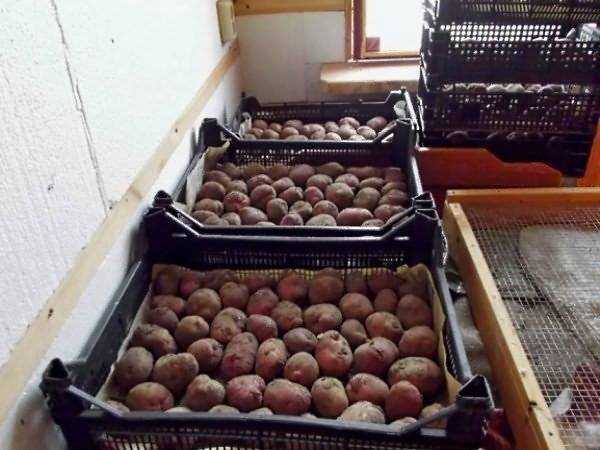
Place the tubers under a canopy and allow them to air dry for 3-4 hours. Once the harvest is dry, sort through them, discarding any rotten or damaged ones. Place the healthy potatoes in a wooden box, layering them 0.5 meters deep.
Store vegetables in a basement or cellar with a temperature of up to +4°C and humidity of 90%. Ventilate the room and inspect the tubers every three days.
Vegetable growers' reviews of Red Lady
Gardeners respond positively to the Red Lady potato; many people like it.
Viktor Sergeev, 48 years old, Makeyevka
Greetings everyone! I've been growing Red Lady potatoes since last summer, and the harvest was a great success. I harvested 460 centners from 2 hectares, selling some to wholesalers. I've made entrees with the vegetables, fried them with lard, and the taste is incredible. I highly recommend growing Red Lady potatoes.
Rostislav Boyko, 50 years old, Zaporizhzhia
Hello! I've fallen in love with the Red Lady potato because it's easy to care for and produces a bountiful harvest. The fruit is tasty and large, and the plants bloom beautifully.
Ilya Denisenko, 54 years old, Mariupol
Greetings! I've been gardening for 20 years, growing various varieties of potatoes. The Red Lady variety is my favorite, though I only discovered it recently. The potato isn't fussy; the only thing I've ever had to deal with was the Colorado potato beetle, which I killed with Confidor Maxi.
Related posts:
 Description and technology of growing Red Delicious apples
 Description and rules for growing the Red Ice cinquefoil variety, planting and care
 Description and characteristics of the Red Scarlet potato variety, planting and care
 Description and subtleties of growing the Red Chief apple tree variety
 Description and characteristics of the Red Star clematis variety, planting and growing rules
 Description of the Pink Lady tomato and its cultivation using the Dutch method
 Description of the Shedi Lady tomato and recommendations for growing the hybrid variety
 Description of the best potato varieties of domestic and foreign selection