
- Large-flowered clematis Red Star: description and characteristics
- Advantages and disadvantages of the variety
- Required conditions for growing
- Use in landscape design
- Planting and care features
- Preparing the site and seedlings
- Planting dates and patterns
- Watering and fertilization regime
- Mulching and loosening the soil
- Pruning group and tying to supports
- Specifics of preparation for the winter period
- Diseases and pests: treatment and prevention
- Reproduction methods
- Gardeners' reviews of clematis
Clematis is a perennial vine used for vertical landscaping. It is planted near arbors, pergolas, arches, and trellises. The Red Star clematis variety can bloom twice a year. Proper cultivation practices are essential for this. Below is a description and characteristics of the large-flowered clematis, information on planting and care, and its use in landscape design.
Large-flowered clematis Red Star: description and characteristics
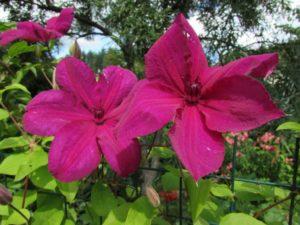
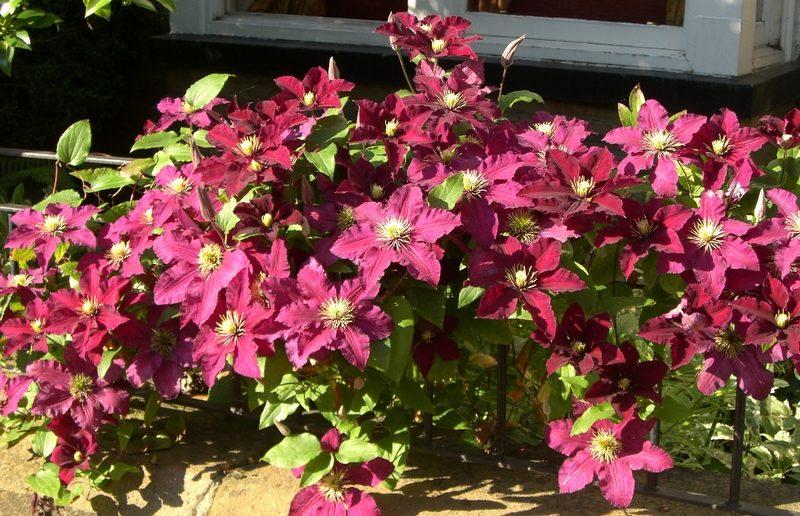
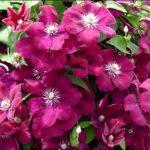
The shoots of this plant reach a height of 3 meters. They are capable of climbing independently using tendrils. The leaves are green and opposite. In spring and fall, the branches of the Red Star clematis are covered with large inflorescences, up to 14 centimeters in diameter. The slightly wavy petals are raspberry-red. Long cream-colored stamens emerge from the center of the bud. In spring, clematis blooms on last year's shoots. In fall, buds open on the new branches of the current year.
Additional information: In ancient times, clematis vines were used to weave baskets and tie up garden crops.
Advantages and disadvantages of the variety
The positive qualities of clematis Red Star include the following characteristics:
- possibility of use for vertical gardening;
- beautiful view during flowering period;
- the ability of the crop to bloom twice a year;
- ease of care;
- good immunity;
- frost resistance.
No significant disadvantages have been identified in this variety of clematis.

Required conditions for growing
Select a sunny location protected from cold winds for the plant. The most suitable planting areas are the south and southwest sides of the plot. Groundwater in this area should not be too close to the soil surface. Choose loose, permeable soil. Red Star clematis is planted in spring or fall. Seedlings with a closed root system will establish themselves most quickly.
Please note: Planting clematis near a metal fence can cause leaf burn.
Use in landscape design
Clematis vines are used for vertical landscaping. They are planted near arbors and let their vines climb arches and pergolas. If planted near chain-link fencing, they create a flower hedge. Red Star clematis looks beautiful next to low shrubs such as barberry, turf, and boxwood. Low-growing conifers make a striking frame.


Planting and care features
Clematis is a perennial plant, so its location must be chosen promptly. Proper planting and care determine the growth of the vines and the decorative appearance of the inflorescences.
Preparing the site and seedlings
The soil on the site is cleared of plant debris. A hole is dug and filled with fertile soil consisting of the following components:
- turf soil;
- peat;
- humus;
- river sand;
- wood ash.

Saplings aged 1-2 years are planted. The younger the plant, the easier it will take root in its new location. The root system is placed in water for 1 hour, with potassium permanganate added for disinfection. For better rooting, the clematis can then be soaked in a growth stimulant solution. If the shoots are too long, they are shortened to 15-20 centimeters.
Planting dates and patterns
In regions with unstable climates, clematis is planted in the spring. This allows the bushes to establish themselves safely before the winter cold sets in. In southern regions, clematis can be planted in the fall. If seedlings with a closed root system are purchased, they can be planted anytime from spring to fall. Planting is performed as follows:
- dig a hole measuring 50x50 centimeters;
- lay a drainage layer consisting of small stones and expanded clay;
- the prepared substrate is poured into a mound;
- straighten the root system, place the seedling in the middle of the hole;
- fill the soil so that the shoot is buried 8-10 centimeters deep;
- watered generously.

To conserve moisture and prevent the roots from overheating, the soil around the clematis is mulched. A support is installed near the bush. This is necessary to support the young shoots. As they mature, the shoots will cling to it with tendrils and grow upward.
Watering and fertilization regime
Clematis Red Star is a moisture-loving vine. Water the plant at least once a week. During dry summers, water more frequently. At least one bucket of water is poured under a young plant, while a mature clematis requires about 20 liters of water.
Fertilizing the vine begins the year after planting. In the spring, nitrogen is applied to promote shoot growth. During the budding period, mineral fertilizers are applied. In August, before the second flush of flowering, the bushes are fed with potassium and phosphorus.

Mulching and loosening the soil
The root zone of clematis is sprinkled with peat, straw, grass clippings, and sawdust. Mulching helps retain moisture in the soil. It also protects the root system from the sun's rays. After watering, the soil around the bushes is loosened. This procedure promotes root respiration and removes weeds, which can carry pests and pathogens.
Important! Clematis requires warmth for its shoots, while its root system needs coolness. Therefore, mulching the area around the trunk is essential.
Pruning group and tying to supports
Throughout the season, remove diseased, dry, and broken shoots. Then, Red Star clematis, which belongs to pruning group 2, is shaped as follows:
- pinch the top when planting;
- last year's stems are shortened to 12 buds;
- the current year's vines are not touched, since buds will form on them, which will bloom in the fall;
- branches older than 3 years are cut to the stump;
- no more than 12 shoots are left on the bush.
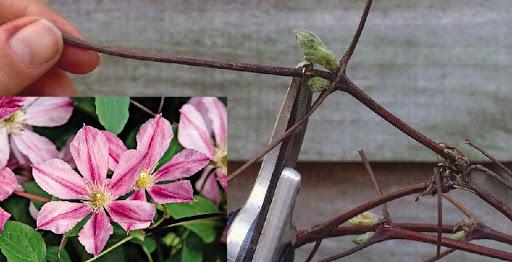
Long vines require support. This will ensure the bushes look attractive not only during flowering but also afterward.
Specifics of preparation for the winter period
In mid-autumn, clematis are given a moisture-replenishing watering. The root circle is covered with a 12-centimeter layer of soil. If a harsh winter is expected, the vines are removed from their supports and coiled. Spruce branches are laid on the ground, and the clematis branches are placed on them. The structure is covered with agrofibre. As soon as the sun warms in the spring, the covering is removed to prevent root rot. Even if the clematis freezes during a harsh winter, it does not necessarily die. New shoots will grow from the root collar within 1-2 years.
Diseases and pests: treatment and prevention
Red Star can be susceptible to fungal diseases if not properly cared for. This usually occurs when the plant is overwatered, especially from above. Bushes can also be susceptible to septoria leaf spot, powdery mildew, and gray mold. Copper-containing preparations are used for treatment and prevention.
Aphids and spider mites can infest the vine. These pests suck out the plant's cell sap, weakening the plant. Insecticides are used to treat the vine. Removing plant debris from the root zone and then spraying the soil with Fundazol will prevent diseases and pests.
Reproduction methods
Red Star clematis is propagated by layering, cuttings, and division. Gardeners rarely propagate by seed, as not all parental traits may be passed on. Most often, clematis is propagated by division. To do this, the root system is dug around and divided into sections with a sharp shovel. Each section is planted separately.
Gardeners' reviews of clematis
Gardeners praise the Red Star clematis as a beautiful vine that can be a beautiful addition to any home. The bushes require little maintenance. With proper cultivation, they produce large, crimson-red blooms twice a year.
Irina, 43, Vladimir Oblast: "My Red Star showed its first flowers the following year. Then it consistently formed buds in late May and early September. The inflorescences are cherry-raspberry-colored, large, and double. I don't cover the clematis for the winter: even if it freezes, it quickly recovers."
Olga Petrovna, 52, Moscow region: "I planted the Red Star clematis in a sunny spot. I know the roots need to be kept cool, so I generously mulched the area around the roots with straw. It blooms twice a year. In the fall, the inflorescences are smaller, and the blooms aren't as profuse as in the spring."
Related posts:
 Description of the burning clematis, planting and care in open ground, propagation
 Description and pruning group of clematis President, cultivation and care
 Description and characteristics of Manchurian clematis, cultivation techniques
 Description and pruning group of clematis Rouge Cardinal, cultivation and propagation
 Description and characteristics of the clematis variety Comtesse de Bouchaud, planting and care instructions
 Description of clematis varieties, planting and care, propagation methods
 Description and characteristics of the clematis variety Kaiser, planting and care, pruning group
 How to propagate clematis at home: timing, methods, and technologies