
- Description of the Red Delicious apple tree
- Main pros and cons
- Selection and growing regions
- Tree size and annual growth
- Fruiting of apple trees
- Flowering and pollinators
- Ripening time and harvesting of fruits
- Yield and tasting qualities
- Transportation and storage of apples
- Resistance to diseases and pests
- Winter hardiness
- Landing specifics
- Optimal timing
- Site selection and preparation
- Landing algorithm
- Further care of the apple tree
- Watering
- Fertilizers and their application rates
- Rules for pruning and crown shaping
- Preparing a tree for winter
- Seasonal treatments
- Reproduction
- Gardeners' reviews
Experienced gardeners have long noticed the Red Delicious apple variety. The name derives from the English words "Red" and "Delicious," literally describing the fruit. This variety has been cultivated in many countries for a century, during which time numerous subvarieties have been successfully bred.
Description of the Red Delicious apple tree
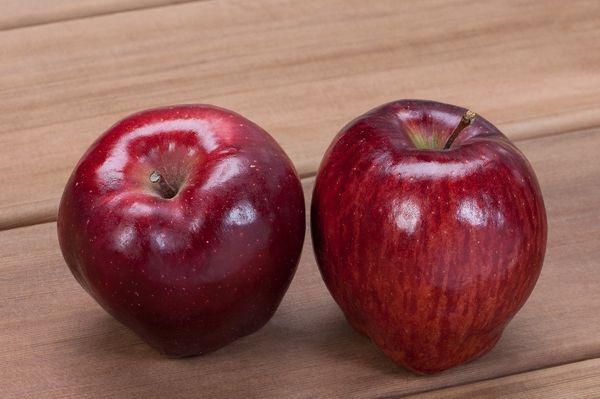
Each apple variety has its own unique characteristics, which include its external features, botanical characteristics, development period, and ripening time. The American Red Delicious apple boasts numerous advantages.
Main pros and cons
The pros and cons are based on reviews from gardeners and observations from agricultural experts. They note the following positive aspects of the Red Delicious variety:
- beautiful and whole fruits with a sweet and sour taste;
- suitable for fresh consumption and for preserves;
- a tree of medium height with a compact crown;
- long shelf life;
- timely fruiting of uniform ripeness.
The negative side of the Red Delicious variety includes:
- low frost resistance;
- weak resistance to apple scab;
- possible loosening of the pulp during storage;
- the predominance of sour taste in the northern regions;
- average self-pollination;
- formation of bitter spot in fruits.
Selection and growing regions
The Red Delicious apple tree's origins are not linked to selective breeding. The variety was first discovered in the US state of Iowa, where a farmer accidentally spotted a branch bearing red fruits with an incomparably sweet flavor. This successful subvariety was later recognized by the US Apple Association and Russian scientists, who included it in the State Register with a recommendation for cultivation in the North Caucasus region.
Tree size and annual growth
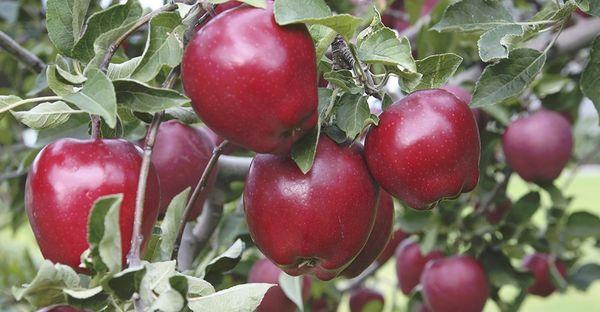
The Red Delicious apple tree has attractive appearance characteristics: firstly, it typically reaches a height of up to 6 m, or even less (4 m) with a dwarf rootstock. Secondly, the stems have a distinctive reddish-brown color. The straight, growing stems, with a predominance of short shoots and ringlets, form a neat crown. The plant's foliage is medium, with elongated or oval leaves of a rich green hue.
During the flowering period and until midsummer, the leaves are covered with a noticeable sheen. The crown appears pyramidal when young, but with each passing year, as it grows to 10 cm, it widens and takes on a rounded appearance.
Take a look Also

Fruiting of apple trees
Red Delicious apples are a late-ripening variety; their growing season includes flowering, fruit formation, and fruiting.
Flowering and pollinators
Thanks to warm weather, pinkish buds with oval petals open in late May. Gardeners note the abundant blooms, which greatly enhance their garden trees. The Red Delicious variety is poor at self-pollination, so it is recommended to plant it with pollinator apple trees such as Empire, Idared, Golden Delicious, Renet Simirenko, Melrose, Delicious, and Prima.
Ripening time and harvesting of fruits
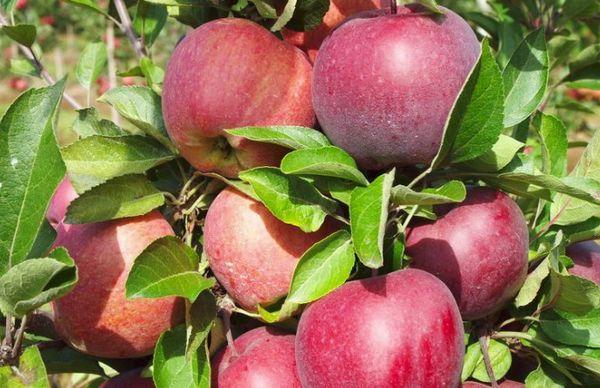
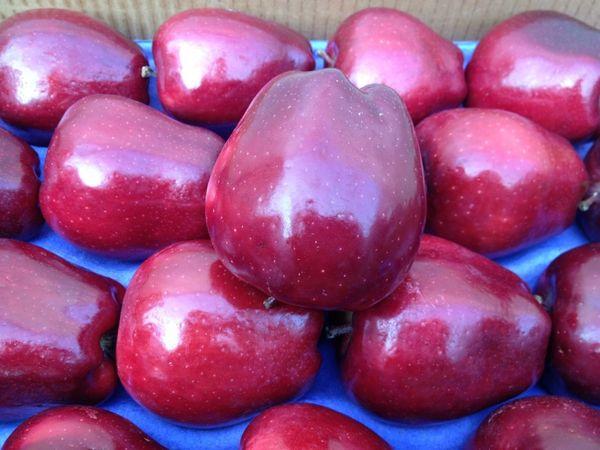
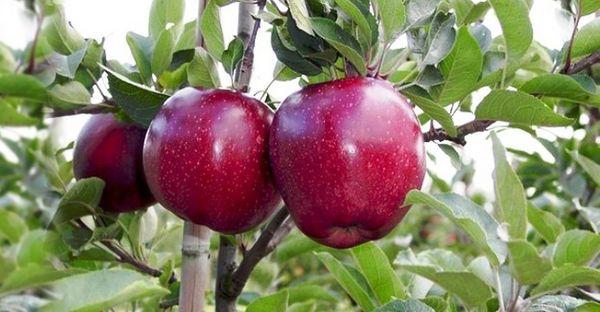
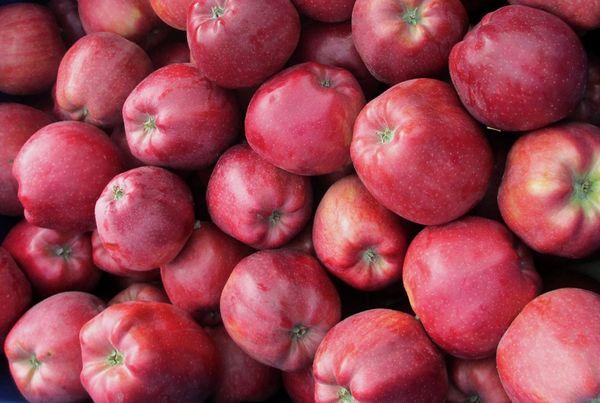
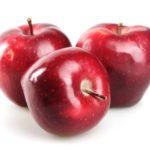
By mid-September, the first ripe, conical fruits are visible; they are characteristically red with a raspberry blush. Red Delicious apples are large, weighing up to 200 g on average, but can reach up to 300 g in favorable growing regions. The apple skin is thick and even tough; some gardeners prefer to remove it before eating. Another advantage is their high resistance to damage.
Yield and tasting qualities
Speaking of tasting qualities, it's worth mentioning that the Red Delicious apple tree is listed among the top 15 varieties in America. It is prized for its flavor, its undemanding nature, and its long shelf life at home.
The most delicious Red Delicious apples ripen in dry regions with minimal rainfall. Fruit production begins five years after planting, with a tree yielding 150 kg of juicy fruit. During the first few years, yields are much lower—up to 30 kg. They are eaten fresh, made into jam, mashed into juice, and used as a filling for Charlotte pie.
Transportation and storage of apples
Of particular importance to gardening enthusiasts is the long-lasting beauty and nutritional value of apples. This variety can be stored in a cellar or refrigerator until March. This factor makes the Red Delicious variety an advantage when exporting to other regions.
Resistance to diseases and pests
The main enemy of the Red Delicious apple tree is scab. Its bacteria attack all parts of the plant, with obvious symptoms including spots, ulcers, and peeling. Apple trees grown in temperate climates are often susceptible to the disease.
The best treatment is preventative measures, which should be carried out in the spring and fall. These include weeding, weeding, tree inspection, and spraying with Bordeaux mixture.
Red Delicious apple trees can be damaged by codling moths, birds, and rodents. To combat these, trees are inspected and, if found, destroyed, or special solutions can be prepared using products such as Dimethoate, Atom, Ditox, Zolon, Fufanon, and Iskra M. Mix 10 ml of each product in 10 liters of water.
Winter hardiness
The Red Delicious apple tree is a late-ripening variety and lacks strong immunity, so the trunk and root system are sensitive to sudden changes and low temperatures, which can quickly kill the plant.
Landing specifics
To grow a fruitful Red Delicious apple tree, you need to prepare the site, purchase planting material, and use helpful planting tips.

Optimal timing
In cooler regions, planting is carried out in the spring; during the warm seasons, the tree will be able to adapt to the soil and thicken the bark on the trunk and shoots.
In southern regions, it is preferable to plant a young Red Delicious apple tree in the fall, when the heat subsides.
Site selection and preparation
The site for planting the Red Delicious apple tree should be chosen away from drafts and cold winds. It's important to choose a flat spot without any microdepressions to prevent stagnant water from causing root rot and trunk decay. In September or October, depending on the climate, the soil in the garden is dug up, and any weeds found on the surface and deep within are carefully removed.
When planting in the spring, repeat the procedure, remove the remains of last year's plants, add 5 kg of rotted manure or humus, 550 g of wood ash, and 1 tbsp of nitroammophoska to the soil.
Landing algorithm
A hole is dug 70 cm wide and 75 cm deep. This planting pattern will ensure proper development of the main root and secondary roots. After digging the hole, fill it with a 3 cm layer of drainage material made from brick fragments, pebbles, or expanded clay.
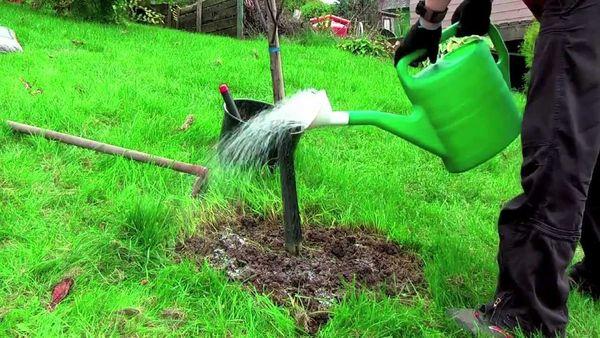
Next, fertilize the soil with a mixture of equal parts peat, humus, and river sand. Add a small amount of the mixture to the bottom of the hole, move the seedling, straighten the roots, and cover with soil. Tie the fragile young plant to a support. Form a circle around the Red Delicious apple tree's trunk and compact it, keeping the root collar 2 cm above the soil. Then water it generously with warm water.
When planting a seedling, consider the location of the groundwater table; a depth of 2 m is desirable. For dwarf rootstocks, 1.5 m is sufficient.
Further care of the apple tree
Timely watering, soil cleaning, and pruning are essential gardening tasks. Experienced gardeners devote considerable time to these tasks, as they ultimately reap a bountiful harvest of delicious, healthy fruit.
Watering
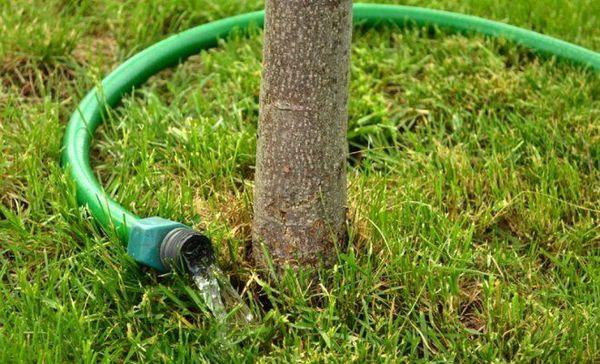
Although the Red Delicious apple variety thrives in dry climates, watering is essential. An initial irrigation should be done in the spring, when the soil has warmed up, then repeated after two weeks, then a month later, and during the summer months, two more heavy waterings of 2-3 buckets of water per tree.
Fertilizers and their application rates
For the first five years, the tree's trunk is carefully cultivated: the soil is loosened, and weeds are removed by the roots. In subsequent years, the grass is mown regularly. Fertilizers recommended for apple trees are used to feed the Red Delicious apple tree. This process is carried out in several stages:
- In spring, add 1 tablespoon of nitroammophoska to the soil around the tree.
- During flowering, 250 g of wood ash is scattered around the tree trunk circle.
- During the ripening period, mix 1 teaspoon of potassium salt and superphosphate with water and water.
Rules for pruning and crown shaping
Formation of the apple tree crown Red Delicious requires preventative measures to ensure full fruit development. Branches should be thinned starting in the fourth year.
Every year, dried and damaged shoots are carefully removed, and those that are strongly inclined are also trimmed.
Preparing a tree for winter
After autumn pruning, fallen leaves, debris, and weeds are removed from the soil. The soil around the tree is dug to a shallow depth, then mulch is applied.
Seasonal treatments
In the spring, the garden plot is cleared, damaged bark is removed from the Red Delicious apple tree trunk, and the trunk is then whitewashed. This is necessary to repel various insects and larvae, and to prevent fungal diseases. Garden trees are sprayed with special solutions against scab, leaf spot, moss, mites, aphids, and codling moths. Copper sulfate, urea, Bordeaux mixture, and iron sulfate are used.
Reproduction
Propagation is carried out using either seed or dwarf rootstocks; the latter option will result in a more compact Red Delicious tree. Rootstock propagation develops and strengthens the root system, while the other method focuses on the crown, using shoots grafted with special pruning shears and staking.
Gardeners' reviews
Yaroslav Ponomarev, 56, Novosibirsk Oblast: "To ensure Red Delicious apples are tasty and plentiful, it's important to ensure they have pollinators, which often increase the yield. Pollinators also enhance the fruit's flavor. I selected the Prima and Golden Delicious apple trees mentioned above for my neighbors, and planted them in different areas of the orchard for cross-pollination. It's important to remember that apple trees require bees for pollination. I have several beehives in my orchard, so my annual yield per tree is above average, reaching 180 kg."
Olga Shumilina, 31, Volga region: "A beautiful garden is the result of good care and the right planting location. The branched apple tree thrives in full sun, but it's best to plant one part in the shade. I love the fruit of this variety; they're predominantly sweet, and their firm skin maintains its shelf life for a very long time. If you look closely, you'll see grayish spots on the raspberry-colored fruit, which look unique. I adore apples for their nutritional value and versatility as a table apple. The Red Delicious apple tree is a must-have for any gardening enthusiast."
Related posts:
 Description and rules for growing the Red Ice cinquefoil variety, planting and care
 Description and subtleties of growing the Red Chief apple tree variety
 Description and characteristics of the Red Lady potato variety, planting and care features
 Description and varieties of Gala apple trees, planting and care in open ground
 Description of the Chudnoe apple variety, planting and caring for a dwarf tree
 Signs and treatment of apple tree cancer, varieties resistant to the disease
 Description and characteristics of the Golden apple tree, planting and care instructions
 Description and characteristics of the Red Star clematis variety, planting and growing rules