
- When and how was the Red Chief variety developed?
- Regions suitable for cultivation
- Pros and cons of the Red Chief variety
- Characteristics of fruit crops
- Tree size and annual growth
- Lifespan
- All about fruiting
- Cyclicity
- Flowering and pollinators
- Ripening time and yield
- Tasting qualities of apples
- Fruit collection and use
- Sustainability
- To diseases and pests
- To unfavorable climatic conditions
- Secrets of planting apple trees
- Optimal timing
- Site selection and preparation
- Preparing seedlings
- Technological process of landing
- What can be planted nearby?
- Specifics of caring for the Red Chief variety
- Watering and fertilizing
- Trimming
- Caring for the tree trunk circle
- Preventive treatments
- Winter protection
- Methods of reproduction
- Gardeners' reviews
- Conclusion
Red Chief apples are a late-ripening variety distinguished by their excellent flavor. The small tree can be grown in small garden plots. The red fruits are easy to store and transport.
When and how was the Red Chief variety developed?
The variety was first noticed in the United States. The hybrid was the result of cloning the Red Delicious in 1914. The apple tree was first planted in West Virginia.

Regions suitable for cultivation
This variety is moderately winter-hardy. Therefore, it should be planted in regions where late spring frosts are not observed. The tree is suitable for cultivation in central and southern regions. However, with proper insulation, it can be grown in all regions.
Pros and cons of the Red Chief variety
The apple tree variety has the following advantages:
- grows in all types of soil;
- quickly adapts to a new growth location;
- with proper insulation, suitable for all regions;
- the fruits are firm and can be stored;
- the fruits have an attractive appearance;
- the culture carries diseases;
- the branches are strong and rarely subject to mechanical damage;
- fruits with high taste qualities.
Flaws:
- does not tolerate the appearance of scab;
- requires care to increase yield.
Despite its shortcomings, the Red Chief apple tree is often used in gardening.
Characteristics of fruit crops
The apple tree has attractive characteristics that must be taken into account when planting a seedling.

Tree size and annual growth
A mature tree reaches 7 meters in height. The crown is not very developed, and the branches are strong and can withstand weight. The tree does not grow vigorously; branches grow 5-7 cm per year, depending on weather conditions.
Lifespan
The tree can grow in one place for a long time. However, fruit production occurs within the first 8-15 years after planting.
All about fruiting
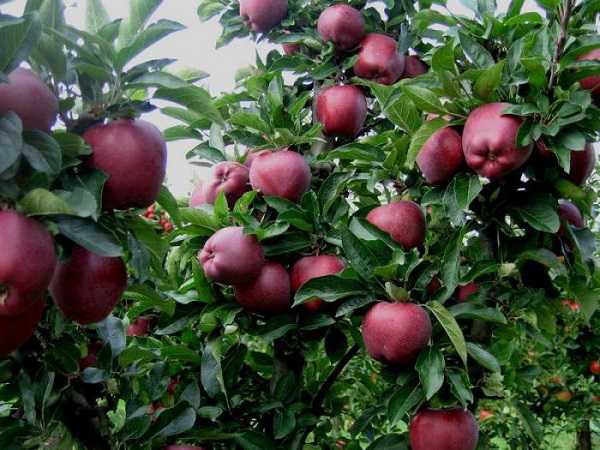
The cultivar is distinguished by its abundant fruiting and large berries, which are located in large numbers on the branches.

Cyclicity
The frequency of fruiting depends on the weather conditions in the region. Dry weather conditions, which persist for several years, reduce the yield.
Flowering and pollinators
The tree has poor self-pollination, so pollinator crops must be planted in the same area. These include Golden Delicious and Gloucester. The tree blooms in mid-May, but if the spring is prolonged, the flowering period may extend to late May.
Ripening time and yield
Apples ripen late. Full ripening occurs in early October. The yield is high, but at 5-6 years of age, the yield is average. Yields increase annually and can reach up to 150 kg.
Important: The fruit holds well on the branches, so once ripe, the apples can be harvested within a month.

Tasting qualities of apples
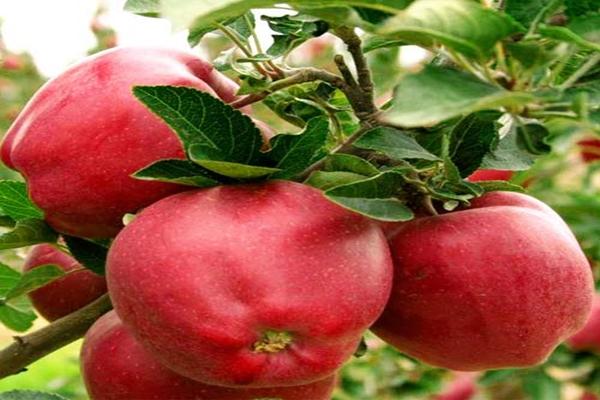
The apples have a sweet flavor and juicy flesh. The average fruit weight is 180 grams. The fruits have red skin and an elongated shape. The flesh is creamy in color and has a high sugar content.
Fruit collection and use
Apples should be harvested after they are fully ripe. The fruits ripen in October. Once harvested, apples can be stored for 2-3 months. Apples are also used for canning and other preserves.
Sustainability
The crop is immune and is often planted en masse in gardens.

To diseases and pests
The tree is susceptible to most diseases. It has weak immunity to spotting and scab. Among pests, it is often damaged by the codling moth.
To unfavorable climatic conditions
The crop is susceptible to frost damage in late spring. It also does not tolerate harsh winters, when temperatures drop below -25°C. With proper care, it tolerates drought well, but yields are reduced.
Secrets of planting apple trees
Growing an apple tree requires proper care. A properly planted tree produces fruit and is rarely susceptible to disease.
Optimal timing
The seedling can be planted in the ground in late fall or early spring. In spring, planting occurs in mid-April. In fall, the seedlings are planted in late September.
Site selection and preparation
When choosing a site, the following criteria must be taken into account:
- the place should be sunny;
- the groundwater level should not be close to the soil;
- the planting site should be protected from drafts and wind;
- The landing site should be located on a hill.
The selected area must be cleared of weeds and stones. The area is dug. A planting hole is dug, measuring 60 x 60 cm and 50 cm deep. Before planting, a nutrient mixture is prepared consisting of 1 part humus, 2 parts soil, 1 part sand, and 1/6 part mineral fertilizer.


Preparing seedlings
Before planting, the seedlings must be properly prepared. Inspect the roots of the seedlings for any growths or damage. Place the seedling in a growth activator for two hours. After this, it can be planted in the hole.
Technological process of landing
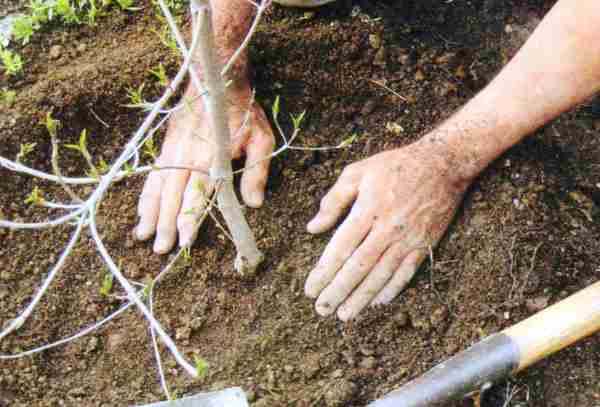
Before planting, line the hole with dry branches or broken brick for drainage. Place the seedling and spread the roots. Cover with soil and install a wooden stake, which will serve as a support for the first year. Cover with soil and water generously.
What can be planted nearby?
To ensure the crop thrives, it's important to choose the right neighboring crops. The Red Chief apple variety can be planted in the same plot with dwarf apple varieties, as well as with varieties that share similar characteristics. Pears and plums can also be grown in the same plot. It's not recommended to plant apple trees in the same plot with walnut and apricot trees.
Specifics of caring for the Red Chief variety
Proper care determines the quality of the fruit and the yield of the crop. Proper care also speeds up the adaptation process for young plants to their new growing environment.
Watering and fertilizing
The plant prefers plenty of moisture. Young plants should be watered every 6-7 days. Once the tree is one year old, it should be watered every 10 days. Mature trees should be watered twice a month, with up to 5 buckets of water per plant.
You need to feed the apple tree according to the following algorithm:
- the second year after planting, nitrogen fertilizers are added; in the fall, peat or humus should be added;
- 3-4 years after planting, it is necessary to use complex minerals;
- During the fruiting period, it is necessary to apply potassium-phosphorus fertilizers.
The crop needs to be fertilized twice a year, using complex fertilizers in the spring and organic fertilizers in the fall.
 Important: Before watering, remove weeds and loosen the soil. The roots must receive sufficient oxygen.
Trimming
Young seedlings are pruned immediately after planting. At least five buds should be left on the trunk. In the second year after planting, lateral shoots should be removed and the crown should be shaped. Branches should not grow opposite each other, as this can negatively impact yield. Pruning should be done twice a year. The crown improves in spring. Sanitary pruning should be performed in the fall.
Caring for the tree trunk circle
The soil around the trunk should be regularly loosened and weeds removed. Weeds often act as disease carriers. The trunk should also be whitewashed with lime once a year.


Preventive treatments
In early spring, treat the tree prophylactically with Bordeaux mixture, which kills disease strains. It's also important to spray the plant with fungicides before wintering to kill pest larvae. If damaged bark is present, remove sections and treat with a copper sulfate solution.
Winter protection
At the end of October, the roots should be insulated with humus and spruce branches. For trees up to two years old, the branches should be insulated with burlap or special fiber. Mature trees do not require insulation.

Methods of reproduction
The tree is propagated using the following methods:
- Layering is done using an annual plant that needs to be planted at an angle to the soil. After a year, the young shoots are dug into the soil. A year later, new shoots emerge from the points where they touch the soil. The seedlings are transplanted to their permanent location in the spring.
- Seedlings – this method allows you to plant a specimen that quickly takes root in a new location. The shoots used are those that emerge from the parent rootstock.
Regardless of the propagation method, the seedling must be at least 1 year old.

Gardeners' reviews
Nikolai Petrovich, 34, Oryol Oblast: "The apple tree is easy to harvest. The apples are densely packed, the branches are strong, and don't break under the weight of the fruit."
Marina, 26, Perm: "The fruits are juicy, have an attractive appearance, and can be stored in the basement for a long time. They are suitable for canning and eating fresh."
Conclusion
The Red Chief apple tree is popular among gardeners. It adapts easily to any soil conditions. The fruit is large and, with proper care, keeps well. The tree's compact size simplifies harvesting.
Related posts:
 The best grape varieties for growing in the Urals, planting and care rules in summer
 How to properly plant peas in a greenhouse and open ground
 The best eggplant varieties for growing in a polycarbonate greenhouse: planting and care
 Growing and caring for almonds, planting and pruning rules at home
 Descriptions of the 20 best cherry varieties for the Moscow region, their planting and care
 How to propagate and grow peas, cultivation technology, and care in open ground
 Description of varieties of sowing peas and cultivation, to which family they belong
 80 Best Eggplant Varieties for Different Regions with Descriptions and Characteristics