
- The history of selection and regions of cultivation of the Evis Delight strawberry
- Advantages and disadvantages of the variety in comparison with others
- Varietal characteristics of strawberries
- Bush size and appearance of the leaf blade
- Flowering and pollination
- Ripening time and yield
- Taste qualities of the fruit and its further sale
- Resistance to adverse conditions
- Susceptibility to diseases and insects
- How to plant Evis Delight strawberries
- Site selection and preparation
- Selecting seedlings
- Timing and technology of planting seedlings
- Organization of competent care
- Regularity of watering by season
- How and what to feed the bushes with
- Weeding and loosening the soil
- Mulching
- Shelter for the winter
- Preventive treatments
- Secrets of reproduction
- Seeds
- By dividing the bush
- Sockets
- Gardeners' reviews of the variety
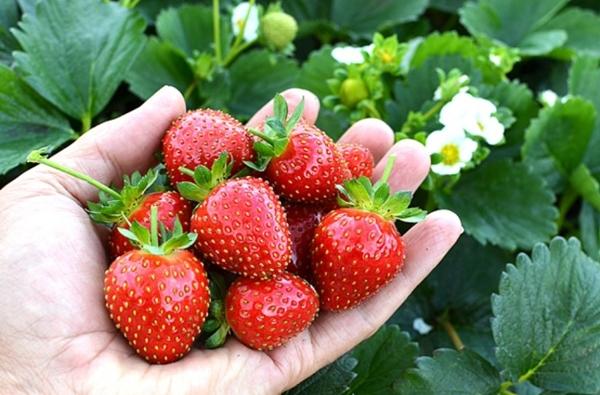
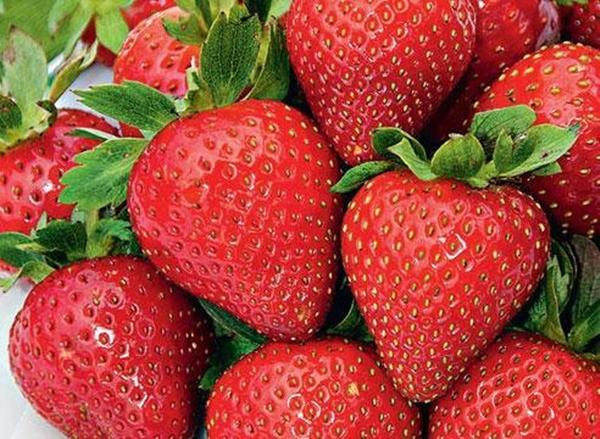
The Evis Delight strawberry variety was developed relatively recently, but has already become a favorite among gardeners for its outstanding qualities. This everbearing, high-yielding variety can be grown commercially. It can be grown in a greenhouse or open ground, as well as in pots or indoors. The berries are large, have a pleasant flavor, and have excellent commercial qualities.
The history of selection and regions of cultivation of the Evis Delight strawberry
This variety is a hybrid of two everbearing varieties – 02P78 and 02EVA13R. It was developed in England in 2004 and patented and approved for sale in 2010.
The berry is suitable for growing in southeast England and other regions with a similar climate. It is also successfully cultivated in Russia, Ukraine, Belarus, and Poland.
Advantages and disadvantages of the variety in comparison with others
The advantages of this type include:
- remontancy;
- high productivity;
- good taste and commercial qualities of fruits;
- resistance to extreme weather conditions;
- disease resistance;
- the possibility of growing in open ground, greenhouses, tunnels and at home;
- possibility of commercial use;
- the presence of upward-facing flower stalks, which simplifies harvesting;
- the possibility of growing seedlings from self-collected seeds.
The disadvantages include:
- the need to renew plantings every 2 years to maintain yields at a high level;
- susceptibility to anthracnose;
- susceptibility to damage by insect pests;
- weak ability to form whiskers.
Varietal characteristics of strawberries
This variety of strawberry has a number of characteristic features that distinguish it from other varieties.
Bush size and appearance of the leaf blade
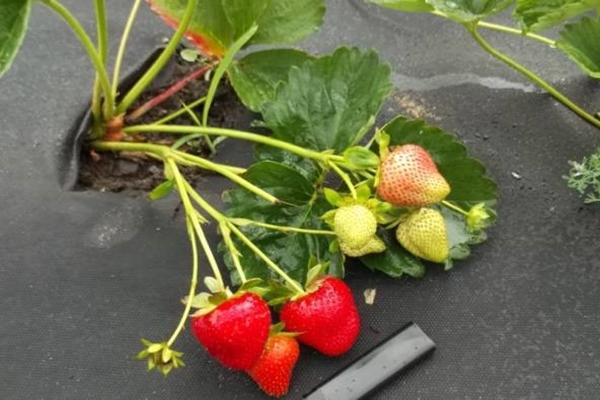
The bushes are large, reaching 35-40 cm in height, yet appear compact and take up little space due to their weak tendrils. The leaves are large, medium-wrinkled, and dark green.
Flowering and pollination
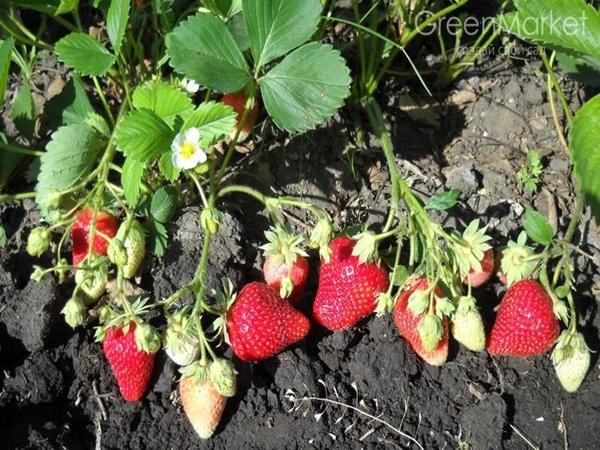
Strawberry blooms from mid- to late-season. Flowers are numerous and large. The flower stalks are long, erect, and pointed upward, positioned above the leaf blades. This facilitates harvesting and protects the fruit from dirt, disease, and pests.
When grown outdoors, flowers are pollinated naturally. When grown indoors, they must be pollinated manually using a brush.
Ripening time and yield
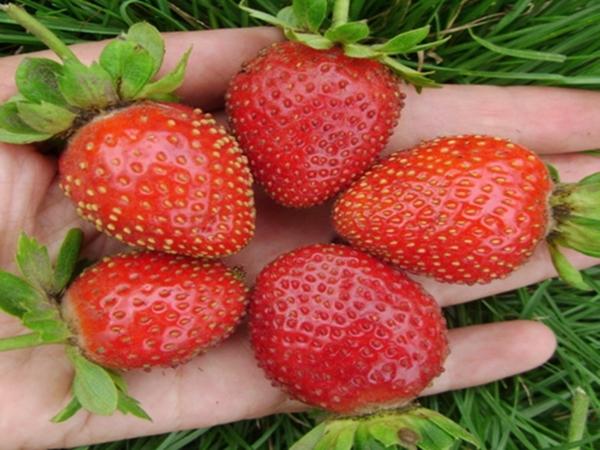
This everbearing variety produces a high yield for two years from planting. Fruiting continues from July to October. Each berry weighs 20-40 g. Up to 1.5 kg of fruit can be harvested from a single bush per season.
Taste qualities of the fruit and its further sale
The berries have a very sweet flavor and a strong strawberry aroma. The flesh is quite firm, allowing them to be stored for a long time and withstand transportation without losing their marketable appearance. The fruits are versatile: they can be eaten fresh or used in various desserts, drinks, and winter preserves.
Resistance to adverse conditions
The plant adapts well to various climatic conditions – it can easily withstand bad weather, while maintaining high yields and quality of fruit.
Susceptibility to diseases and insects
The crop is resistant to most diseases, but is susceptible to anthracnose. The variety is susceptible to insect pests.
How to plant Evis Delight strawberries
Compliance with planting recommendations is necessary for normal rooting, growth and fruiting of plants.
Site selection and preparation
The plot should be located on a southwest-facing surface with a slope of no more than 2-3 meters. Northeast-facing plots, marshy areas, and low-lying areas are not suitable for growing this variety. Groundwater should be at least 60 cm below the soil surface. Strawberries require full sunlight to produce fruit, so avoid planting them in areas with heavy shade.
It grows well in areas where radishes and legumes were previously grown, but wilts in beds where onions, celery and pumpkins were grown.
It should not be planted next to tomatoes, eggplants and peppers, or near bushes and trees with a strong root system that will interfere with the normal development of strawberry roots.
The soil should be light, loose, and have a pH of 5-6.5. Two weeks before planting, add about 6 kg of organic fertilizer and mineral fertilizer at a rate of 40 g per 1 cm.2.
Selecting seedlings
Strawberry seedlings are sold packaged in peat pots. The plants should be strong, with no signs of damage or disease.
Purchased seedlings should be watered for 3-4 days before planting. Immediately before planting, water thoroughly to separate the seedlings from the pot.
Timing and technology of planting seedlings
Planting of seedlings takes place in March – April. Strawberries are planted at a rate of 4 bushes per 1 m2The distance between seedlings in 1 row should be about 30 cm, between adjacent rows – 50 cm.
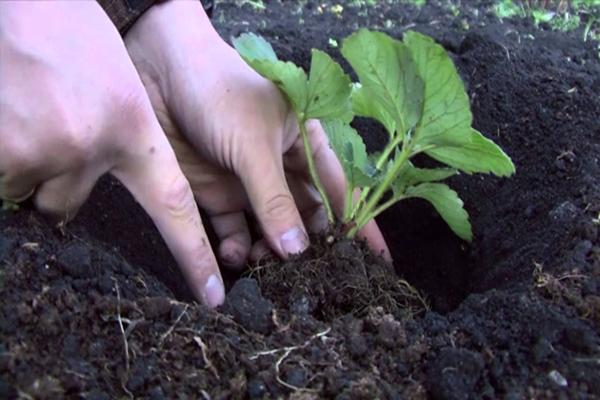
Holes are dug in the soil, the seedlings are placed in them, the roots are covered with soil, compacted, and watered. The first flower stalks are pinched off to prevent them from weakening the young plants.
Organization of competent care
To ensure that strawberries produce a consistently high yield, it is necessary to properly care for the planted plants.
Regularity of watering by season
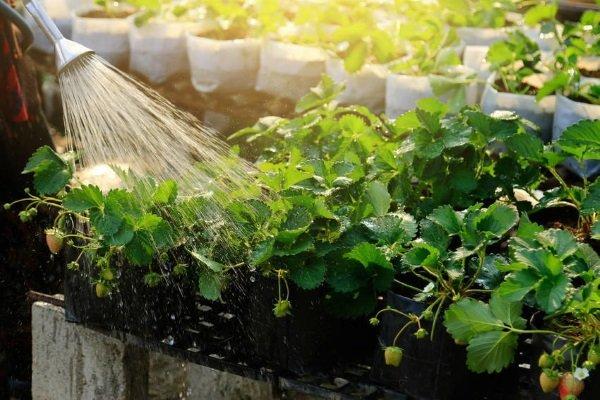
Strawberries need to be watered regularly, taking care not to overwater them. Use only settled water. Drip irrigation should be alternated with root-applied water.
Immediately after planting, the seedlings are watered daily. After two months, switch to watering every 3-4 days. During the fruit formation period, strawberries need to be watered daily. On hot days, water twice a day: morning and evening.
How and what to feed the bushes with
In the spring, nitrogen-containing fertilizers should be added to the soil. They stimulate plant growth. In the summer, during fruiting, fertilizers containing potassium and phosphorus are needed. These should be applied every 10-14 days. Organic matter is also recommended: bird droppings or cow manure diluted in water for irrigation. Compost is added to the soil in late fall.
Weeding and loosening the soil
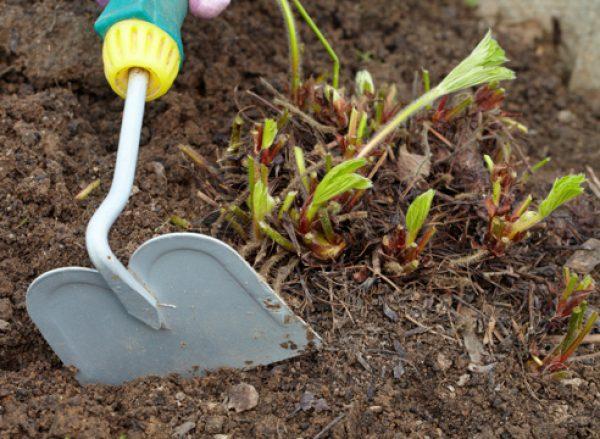
After watering or rain, the soil should be loosened and weeded. Loosening improves the soil structure and promotes aeration of plant roots.
Mulching
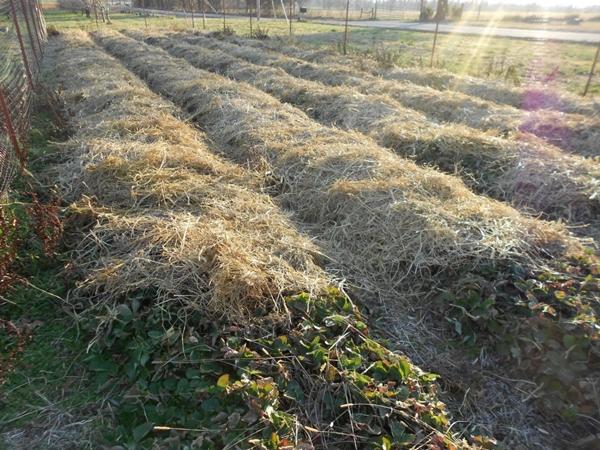
After loosening the soil, mulch it to reduce moisture evaporation and prevent weed growth. Straw, humus, coconut coir, grass clippings, pine needles, roofing felt, and agrofibre are all used as mulch.
Shelter for the winter
The Evis Delight variety is characterized by good frost resistance. However, in cold climates, it should be covered with pine needles, spruce branches, fallen leaves, or straw during the winter, and then covered with snow to protect it from severe frosts.
Preventive treatments
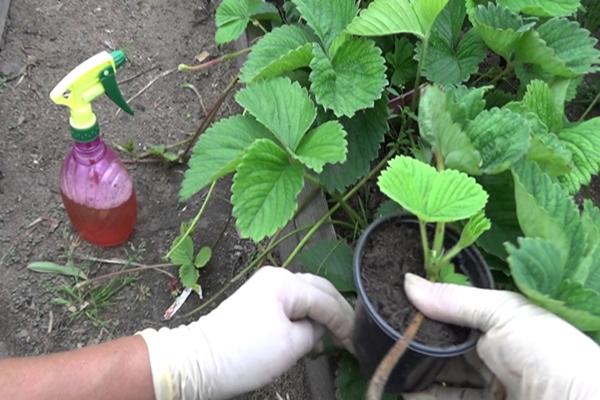
To prevent diseases and pests, strawberries are treated with fungicide and insecticide solutions. These treatments are carried out in the spring, before flowering, and in the summer, during the ripening period.
Secrets of reproduction
There are three ways to propagate strawberries: by seeds, by dividing the bush, and by rosettes.
Seeds
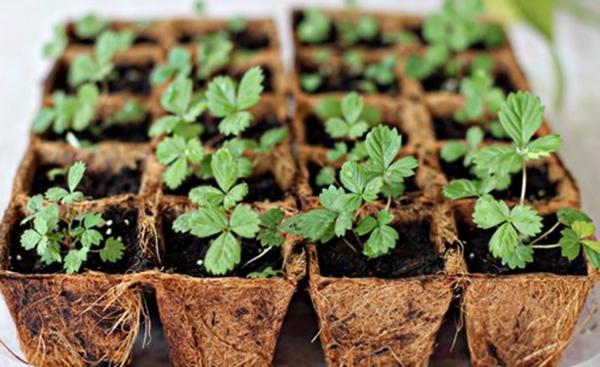
Evis Delight strawberry seeds can be purchased at specialty stores or collected yourself. To do this, dry the berry skins in the sun, then spread them out on a surface and carefully remove the seeds with a wooden stick.
The seeds are placed in a container with soil and moistened using a drip irrigation system. The seedlings are grown at a temperature of 24°C with good ventilation. Daylight hours should be 12 hours.
By dividing the bush
To propagate strawberries this way, dig up a strong bush and divide it, leaving a bud or growing point. The cut area is treated with an antiseptic and sprinkled with ash.
Sockets
The variety's ability to form runners is weak. Bushes for propagation are selected in advance and their flower stalks are removed to stimulate runner growth. After the rosette has rooted and two or three leaves have appeared, it is separated from the mother plant and planted in a garden bed.
Gardeners' reviews of the variety
Sergey, 44, Kamensk-Uralsky: "I've been growing this variety for several years now. I replant it every two years. I harvest the seeds myself. The berries are delicious; you can eat them fresh or make jam."
Tamara, 56, Ramenskoye: "I like Evis Delight for its excellent fruit flavor and ability to produce several crops per season. For propagation, I leave one bush and pluck all the flowers. It becomes a rosette producer."
Marina, 45, Svetlogorsk: "I've been growing this variety for several years now. The yield is high, and the berries have a pleasant flavor, although they become less sweet in rainy years. The berries are positioned very well on the bushes: they don't get soiled, and ripe fruit is immediately visible."
Alla, 39, Volzhsky: "I bought seedlings and planted them equally in open ground and in a greenhouse. The yield from the open-ground plants was half as much. The fruits are large, juicy, with firm flesh, and retain their sweetness even in autumn. They are often attacked by insects, so it's necessary to treat them for all known pests."
Related posts:
 Description of the Florence strawberry variety, planting and care features
 Description and characteristics of the Vima Zanta strawberry variety, planting and care scheme
 How to grow strawberries at home
 Description of the everbearing strawberry variety Selva and cultivation technology
 Timing and rules for fertilizing strawberries, and the best fertilizer for a good harvest
 Description and characteristics of the Zenga Zengana strawberry variety, planting and care
 Description and characteristics of the Korona strawberry variety, planting and care scheme
 The best varieties and cultivation of everbearing strawberries, fertilizing and propagation