
- Characteristics of the Festival Chamomile strawberry
- Selection and growing conditions
- Botanical description of the bush and shoots
- Flowering and fruiting
- Flavor properties of berries and their use in cooking
- Shelf life and transportability
- Resistance of the variety to diseases and frost
- Pros and cons
- Methods of propagation and planting
- By dividing the bush
- Rooting rosettes from whiskers
- Seed method
- Techniques for growing garden strawberries
- Preparing seedlings and the site
- Timing and technology of planting bushes
- Watering, weeding and loosening
- How to feed the variety
- Mulching the beds
- Diseases and pests: protection and prevention
- Wintering
- Gardeners' reviews of the variety
New strawberry varieties are constantly appearing on the market, and breeders surprise everyone every year with either incredible berry size, fantastic yields, or delicious flavor. But there are strawberry varieties that gardeners and homesteaders have been successfully growing for decades. Such a variety is the beloved strawberry with the beautiful name "Festival Chamomile."
Characteristics of the Festival Chamomile strawberry
Despite its long history and widespread distribution, the variety has its own characteristics that many gardeners are not aware of.
Selection and growing conditions
This strawberry was developed by breeders V. P. Kopan and K. N. Kopan at the Institute of Horticulture of the National Academy of Agrarian Sciences of Ukraine. It is a relatively old variety, created back in the 1950s. Two strawberry varieties, Zarya and Redcoat, were crossbred.
Moreover, the new variety successfully inherited the best qualities of both parents. It was added to the State Register of Plant Varieties in 1992. The strawberry was named in honor of the "World Festival of Youth and Students," which took place in 1957.
Botanical description of the bush and shoots
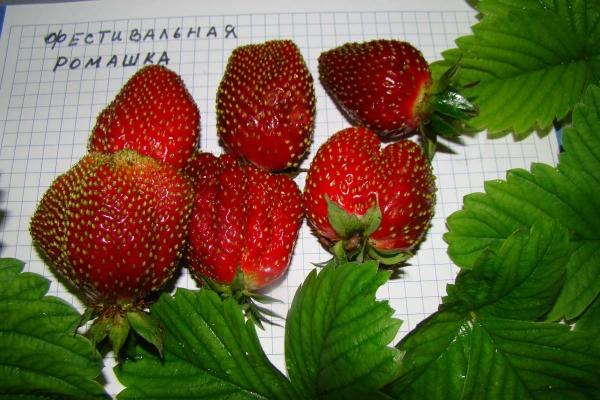
This strawberry variety is characterized by a tall yet compact, semi-spreading bush. The foliage is medium-sized, rich green, lusterless, and slightly wrinkled. The runners are numerous and greenish-red.
Flowering and fruiting
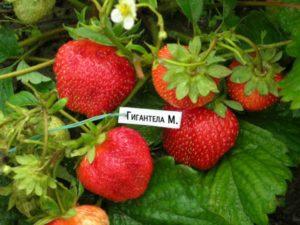
Blooms are abundant and uniform. The flower stalks are thick, strong, and short, borne at or slightly below the foliage. They hold the ripening berries aloft for a long time. Festival Chamomile is a mid-season variety.
In the southern regions, strawberry fruiting begins in late May-early June, and in the middle zone – in mid-June.
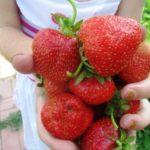
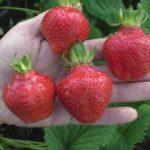
In more northern regions, it ripens from early July. The berries are large and fleshy, especially in the first few harvests, typically weighing 35-45 grams. However, in subsequent harvests, the berries become significantly smaller, and the last ones are generally half the size. The berries are barrel-shaped, often irregularly shaped, with pronounced ribs. They are bright red, with a beautiful sheen. When cut, the flesh inside is the same color.
Flavor properties of berries and their use in cooking
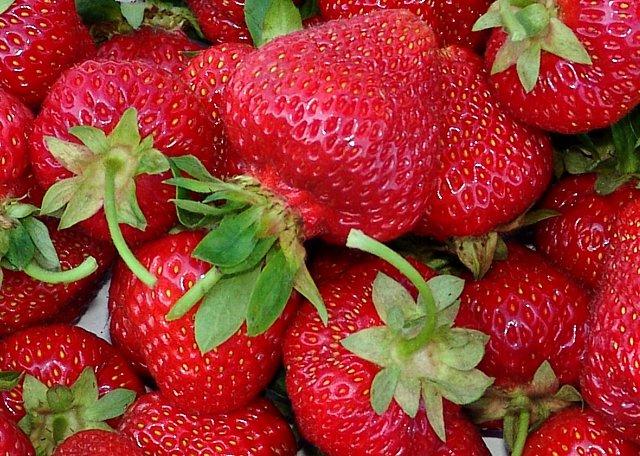
The berries of this variety are firm, but the strawberry flesh is juicy, aromatic, and has a sweet-tart flavor. Festivalnaya Chamomile fruits are versatile. They are suitable for whole-fruit canning, as well as for making jams, marmalades, jellies, and soufflés. Due to their excellent taste, they are widely used in cooking for decoration and in fillings. The berries are also frozen and dried.
Shelf life and transportability
The fruits have excellent shelf life and transportability, remaining undamaged and leak-free for a couple of days during transportation. Storage at 2°C (39°F) increases shelf life severalfold.
Resistance of the variety to diseases and frost
Festivalnaya Chamomile is resistant to some strawberry diseases, particularly gray mold (botrytis) and white spot. However, it has weak immunity to verticillium wilt and powdery mildew. This variety has high frost resistance, making it widely grown throughout the country. It can be grown in the central part of the country, as well as in the Urals and even Siberia.
Pros and cons
Like many strawberry varieties, Festival Chamomile has its pros and cons that need to be taken into account:
Pros:
- good winter hardiness and drought resistance of the variety;
- resistance to some diseases;
- the possibility of growing both in open ground and in greenhouse conditions;
- versatility of berry use, suitability for sale in fresh berry and vegetable markets;
- good shelf life and transportability;
- The berries are tasty, aromatic, with a piquant sourness.
Disadvantages:
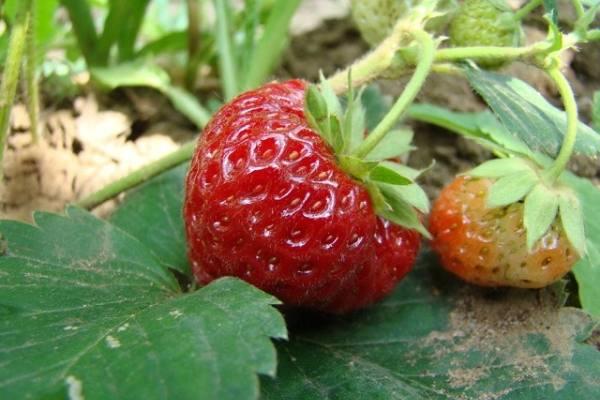
- the fruits become significantly smaller during the selection process, the fruiting period is extended;
- The festival daisy produces a large number of tendrils, so regular removal of them is necessary;
- average, by today's standards, yield indicators (up to 500 grams per bush);
- the berries are often irregular in shape, lacking alignment and homogeneity;
- Short flower stalks make it difficult to find the berries among the foliage, but protect the fruits from the scorching sun.
Methods of propagation and planting
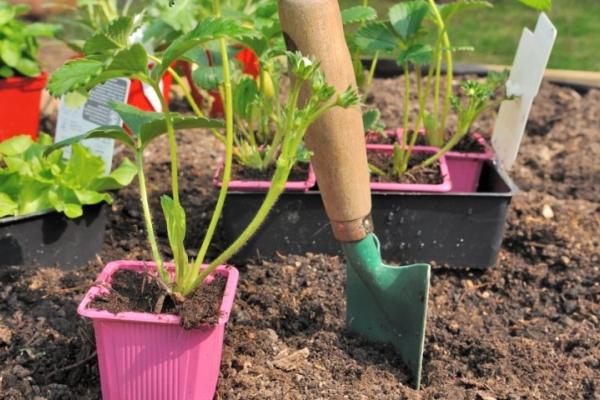
Festival chamomile can be propagated in several ways, including division and rooting of rosettes. Planting is done using seedlings in cups (ZKS) and bare-root seedlings (BRS).
By dividing the bush
The variety can also be propagated by division. To do this, in early spring or fall, the mother plants are dug up and divided into sections with roots attached. Any excessively long roots and some leaves are trimmed off, and the strawberries are ready for planting.
Rooting rosettes from whiskers
Festival chamomile produces abundant runners, so propagation is easy. Place cups filled with substrate next to the bed and pin the rosettes of runners into them. Water regularly using a sprinkler. If the strawberry roots become entangled in the cup or pot, the runners can be cut off, and the seedlings can be transplanted to a new location after a few days.

Seed method
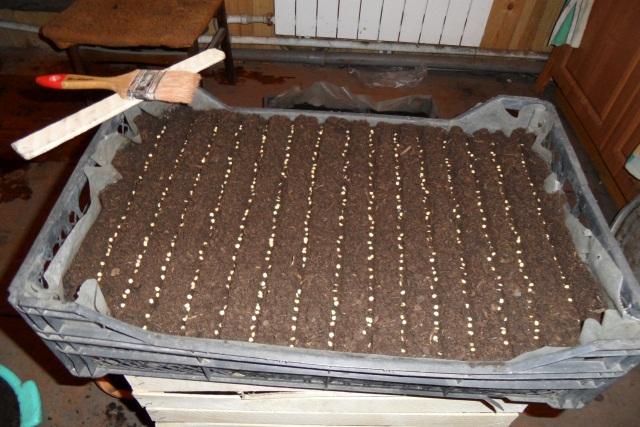
This method is not suitable for propagating varietal strawberries, regardless of whether the seeds are store-bought or home-harvested. This method of propagation results in a divergence of the parent plant's traits in the offspring.
Techniques for growing garden strawberries
To obtain good, stable yields when growing strawberries, a certain cultivation technology is followed.
Preparing seedlings and the site
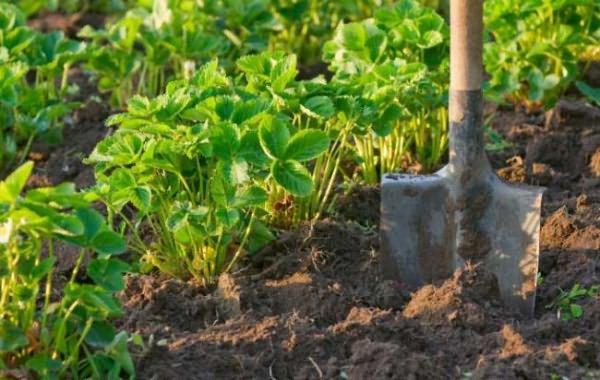
In the fall, they begin preparing the beds. The area is thoroughly weeded, and organic matter (rotted manure) is added at a rate of 0.5 to 1 ton per 100 square meters, depending on the soil fertility.
Also, add 20 grams (1 tablespoon) of granulated complex fertilizer, such as nitroammophoska, per square meter. Then, dig the area and water it.
The seedlings' roots are trimmed back to 10-15 centimeters (4-6 inches), depending on their size, and their leaves are trimmed. One or two leaves are left on the roots to reduce moisture evaporation after planting and promote rapid establishment. Before planting, the roots of the seedlings are soaked for a day in a solution of fungicide and rooting stimulant.
Timing and technology of planting bushes
The timing depends on the region and weather conditions. In the fall, in the central zone, planting occurs in the first half of September, while in more southern regions, it can begin in the second half of September and even continue until mid-October. In the spring, planting in the south begins in late March and preferably continues until mid-April. In the central zone, planting begins in late April and continues until mid-May.
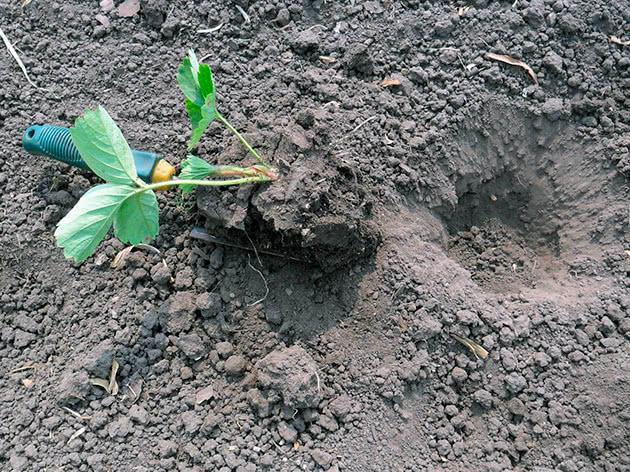
When planting, add a mound of garden soil or nutrient substrate to the bottom of the planting hole, then place the seedling on it, and carefully spread the roots along the sides of the mound.
It's important to ensure they don't bend, as this affects the strawberry's survival rate. Then, the seedlings are covered with soil, compacted gently, and watered generously. The core of the strawberry should be level with the soil.
Watering, weeding and loosening
To maintain high yields and healthy strawberry bushes, water them regularly and thoroughly. The frequency depends on soil type and weather conditions. In the south, especially with sandy soil, garden strawberries are watered every other day.
In more northern regions, the frequency of irrigation is reduced to 1-2 times a week or even less often.
To combat weeds that drain nutrients from the soil and deplete strawberries, weed and loosen the soil in the root zone weekly. Frequent loosening after watering is especially important in heavy, clayey soils.
How to feed the variety
To reach its full potential, the festival chamomile requires fertilizing with organic and mineral fertilizers. In early spring, when growth begins, water the strawberries at the roots with a mullein solution or nitrogen-rich fertilizers.
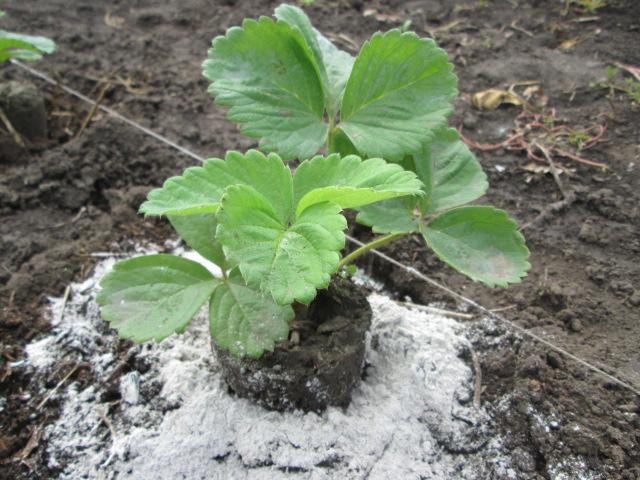
It's beneficial to combine watering with foliar spraying. Before flowering, during fruit set, and when fruit ripens, use complex mineral fertilizers high in potassium and phosphorus. Organic farming advocates choose fertilizing strawberries with wood ash.
Mulching the beds
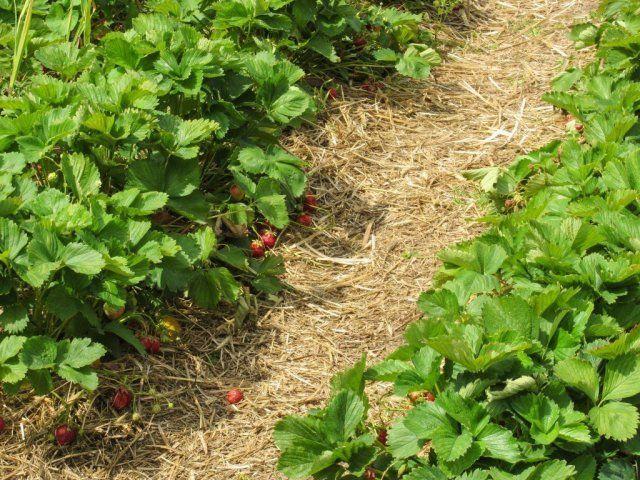
Mulching is an effective agricultural technique for growing strawberries. It reduces the need for watering, protects the roots from exposure during strong winds, and prevents weed growth.
Agrotextiles, agrofibre, film, or organic matter are used. Organic mulch made from green manure is especially useful – as it decomposes, it enriches the soil with nutrients and helps prevent diseases. However, it should be applied at least 10-15 centimeters thick.
Diseases and pests: protection and prevention
To maintain strawberry health, preventative treatments (2-3 times per season) with fungicides (Ridomil Gold, copper sulfate) and insecticides (Aktara, Calypso) are necessary. If signs of disease or pest infestation are detected, treatment should be carried out immediately.
Wintering
Although the Festival Chamomile has high frost resistance, it is advisable to cover it for the winter. This procedure is carried out in October or early November, depending on the region. The best option for covering is white agrofibre, with a density of 30 or 50.
Gardeners' reviews of the variety
Elizaveta Strelnikova, Ryazan.
"I've had it for a long time; I got it from my grandmother. I remember its taste and aroma from childhood. Now I have plenty of varieties, but I'll never part with Romashka!"
Olga Evsyukova, Anapa.
"Unpretentious, productive, delicious, sweet—that's all I can say about my beloved Festival Chamomile. I've been growing it for a long time, and I'm still very happy with it."
Related posts:
 Description and characteristics of the Festivalnaya strawberry variety, planting and care
 Description of the Florence strawberry variety, planting and care features
 How to grow strawberries at home
 Description of the Holiday strawberry variety, cultivation and propagation methods
 Description and characteristics of the Vima Zanta strawberry variety, planting and care scheme
 Description of the everbearing strawberry variety Selva and cultivation technology
 The best varieties and cultivation of everbearing strawberries, fertilizing and propagation
 Description and characteristics of the Korona strawberry variety, planting and care scheme