
- Which varieties are suitable for seed propagation?
- Ducat
- Tristar
- Geneva
- Gigantella
- Sarian F1
- Queen Elizabeth
- Moscow Delicacy F1
- What are the advantages of the seedling method?
- What difficulties may you encounter?
- Step-by-step instructions for sowing seeds
- Preparation of seed material
- We are choosing the time
- Depending on the variety
- From the growing region
- Optimal soil composition
- Selecting a container for future seedlings
- How to sow
- Conditions for growing strawberries
- Rules for caring for seedlings
- Watering
- Top dressing
- Picking and planting in open ground
- Mistakes of novice gardeners
How to properly grow strawberries from seeds? This question arises among gardeners who are trying to grow berry seedlings this way for the first time. This procedure has its own specific features and technologies. If you follow all the rules, your strawberry seedlings will grow strong and healthy. The seedling method has its advantages: a high return on investment and ease of implementation.
Which varieties are suitable for seed propagation?
Not all strawberry varieties can be propagated from seeds. Scientists have developed strawberry varieties that possess this ability.
Ducat
Large, red, conical berries with excellent flavor. This variety is frost-resistant and moisture-loving. It tolerates adverse weather conditions well.
Tristar
This dessert variety has distinctive characteristics. It produces fruit on runners, so there's no need to trim them. Fruiting occurs twice a year. The berries are large, elongated, and sweet.
Geneva
This variety was introduced for cultivation in the late 20th century. The bushes tolerate adverse weather conditions well. Fruit sets twice per season. The berries are large and red.

Gigantella
One of the largest berry varieties, each fruit weighing up to 130 g. Seeds can be used for further propagation. Fruiting occurs once per season.
Sarian F1
This large-fruited variety is resistant to frost, drought, and fungal diseases. It is suitable for greenhouse cultivation. The berries are large and the yield is high.
Queen Elizabeth
This everbearing variety allows for seed collection for future planting. Fruiting continues throughout the season. The fruits are large, red, and transport well. The berries are a vibrant red color.

Moscow Delicacy F1
This strawberry is a hybrid, everbearing variety. High-yielding bushes produce up to 1.5 kg of berries per bush. The fruits are large and have a pleasant sweet flavor. They are bright red in color, with seeds located on the surface. They are suitable for planting in beds and creating hanging arrangements.
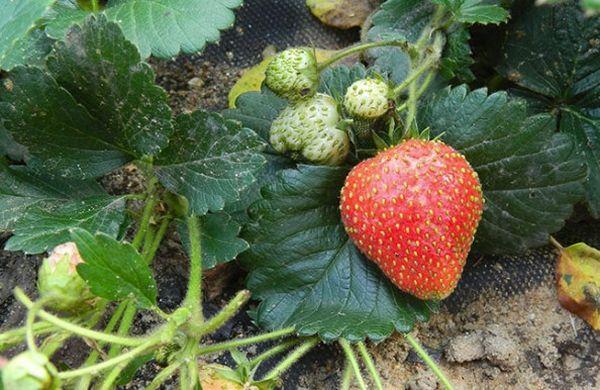 Important! Varieties marked F1 strawberries cannot be propagated from seeds collected from the bush. The resulting strawberries will not have the qualities of the mother plant.
What are the advantages of the seedling method?
Planting strawberries from seeds has its advantages:
- the seeds are stored for a long time, there is no need to worry about the safety of the bushes;
- makes it possible to choose a variety suitable for the gardener;
- seeds are cheaper and provide a high return on harvest;
- You can propagate strawberries by harvesting your own crop.
What difficulties may you encounter?
When planting strawberry seeds, you may encounter certain difficulties:
- the grains of the crop are small, and when sowing into separate containers it is problematic to distribute the seeds evenly;
- low seed germination occurs due to lack of moisture or heat;
- the occurrence of fungal diseases on seedlings occurs due to excessive watering;
- In unsuitable soil, the grains will not germinate.
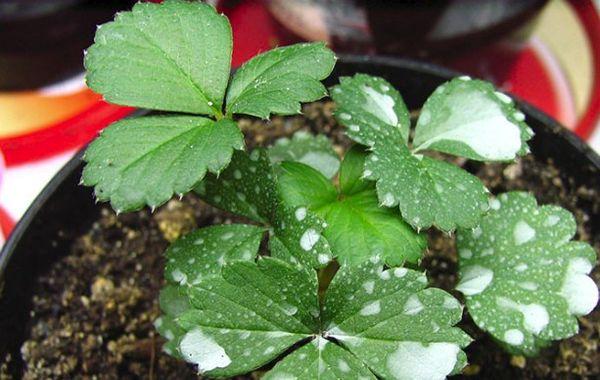
Step-by-step instructions for sowing seeds
To obtain the required number of seedlings ready for transplanting into open ground in a timely manner, it's important to plant the seeds correctly. Sowing times vary slightly for each variety.
Preparation of seed material
Strawberry seeds need to be prepared before planting. To do this, follow these steps:
- The grains are soaked in a weak solution of potassium permanganate for 15-20 minutes.
- Select a transparent container with a lid.
- Cover it with a dry napkin, cotton wool, gauze or cotton pads.
- Moisten with water.
- Spread the seeds on the surface using a toothpick.
- Close with a lid.
- Leave in a warm place for 2 days.
- Periodically moisten the gauze with a spray.
- Then transfer the container to the refrigerator for 2 days.
- They monitor the humidity in the box.
Important! It is preferable to use melted snow water for wetting, rather than tap water.

We are choosing the time
The timing of seed sowing varies depending on the climate zone. If you sow too late, the plants won't have time to take root.
Depending on the variety
For early-ripening varieties, plant seeds in mid-March. For late- and mid-season varieties, plant in January. Each variety has its own recommended planting dates, indicated on the manufacturer's packaging.

From the growing region
In the south, seeds are germinated in mid-March, as the region's climate is most favorable for growing the crop. In the north and central regions, planting occurs in early to mid-February.

Optimal soil composition
To grow strawberries from seeds, use ready-made soil mixes, which are sold in agricultural stores. You can also make your own:
- forest land 1 part;
- sand 1 part;
- peat, vermicompost, 3 parts each;
- 2 parts turf;
- mixture of sand and peat 1 part.
Before planting, the soil is baked in an oven at 200°C. Then, it is transferred to the balcony for 2 days. During this time, the seeds will undergo stratification.
Selecting a container for future seedlings
Different types of containers are used for growing strawberries in pots. Suitable for seedlings:
- plastic cassettes, sold in specialty stores;
- boxes made of boards allow you to use them for several years in a row;
- plastic disposable cups, make a hole in the bottom before planting;
- ready-made peat boxes.

How to sow
If you sow strawberries correctly, the first shoots won't take long to appear. Planting in shared containers is easier. Seeds are sown in groups and then transplanted into individual seed pods. Sowing follows a specific pattern:
- 2/3 of the container is filled with soil composition.
- Moisten with water.
- Make grooves 1 cm deep.
- Distribute the grains evenly.
- Without burying the seedlings, cover them with cling film.
- Transfer to a warm place.
Important! If a large amount of condensation appears on the surface, ventilate the container; if the opposite occurs, spray it with water.
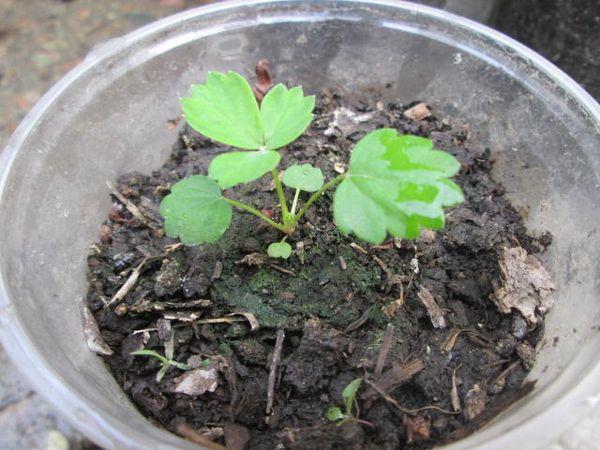
After shoots appear and two leaves form on each plant, the seedlings are sown into separate boxes and left in them until they are transferred to open ground.
Conditions for growing strawberries
You can germinate seeds indoors. The room temperature should be at least 22°C. Lighting should be provided for at least 12 hours a day. Direct sunlight is harmful to seedlings, so they should be shaded. If light levels are insufficient, artificial lighting should be provided.
Rules for caring for seedlings
Caring for young plants will strengthen them and maintain their health. The stronger the seedlings, the faster they will establish roots in their permanent location.
Watering
Water the seedlings carefully. Overwatering can lead to blackleg infection, which can lead to the complete death of the plant. To prevent root erosion, apply water in small doses at the base of the plant. Water every three days.
Top dressing
Fertilize with potassium, phosphorus, and magnesium twice before transplanting to open ground. The first time is after the seedlings have rooted. The second time is one week before transplanting.
Picking and planting in open ground
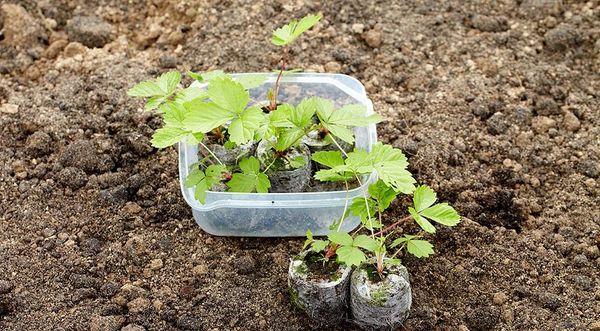
Planting strawberry seedlings in open ground is easy, especially if they're in biodegradable containers. Planting begins when the last frost has passed and the bush has five true leaves. Dig holes in the bed, spacing the plants 30 cm apart. Water each hole, then transfer the seedling to it. Cover with soil and hill up.
Mistakes of novice gardeners
When germinating seeds, novice gardeners make some mistakes:
- If you do not harden the grains in the refrigerator, the future plants will be less resistant to adverse conditions.
- Overwatering seedlings leads to the formation of rot and fungal infections.
- Late sowing of seeds impairs the rooting of strawberries after picking.
- Transplanting seedlings into open ground too early increases the risk of freezing.
- Incorrectly selected soil may not produce seedlings.
Related posts:
 How to grow strawberries at home
 Description of the Florence strawberry variety, planting and care features
 Description of the Holiday strawberry variety, cultivation and propagation methods
 Description and how to plant the Garland strawberry variety
 Description of the everbearing strawberry variety Selva and cultivation technology
 Description and characteristics of the Vima Zanta strawberry variety, planting and care scheme
 Signs of disease and pest attacks on strawberries, treatment methods
 Description of the Fireworks strawberry variety, planting and care