
- History of the variety and regions of cultivation
- Pros and cons of the Fireworks strawberry
- Varietal features and characteristics of the variety
- Bush size and appearance of the leaf blade
- Flowering and pollination
- Ripening time and yield
- Taste qualities of the fruit and its further sale
- Winter hardiness and drought resistance
- Immunity and susceptibility to diseases and parasites
- Planting strawberries
- Site selection and preparation
- Selecting seedlings
- Timing and technology of planting seedlings
- How to care for Fireworks garden strawberries
- Regularity of watering
- What fertilizer does the variety like?
- Weeding and loosening the soil
- Mulching
- Shelter for the winter
- Preventive treatments against diseases and pests
- Methods of reproduction
- Seeds
- Preparation of seed material
- Necessary soil and container
- Timing and rules for sowing
- Pricking out and care
- By dividing the bush
- Sockets
- Gardeners' reviews of the variety
Strawberry (garden strawberry) Fireworks is the result of crossing the variety Redcoat strawberries with the Zenga Zengana varietyThe result of many years of testing, scientific research, and selection was a large-fruited, stress-resistant berry, which was added to the State Register of the Russian Federation in 2000. Thanks to its excellent consumer properties, the Feyerverk strawberry is grown across a vast territory from Irkutsk to Vladikavkaz throughout central Russia.
History of the variety and regions of cultivation
The Fireworks strawberry variety was developed in the 1980s at the Michurin Research Institute of Genetics and Breeding. Years of crossbreeding involved crossing the Zenga Zengana variety, which can withstand temperatures as low as -24°C. With prolonged drought, the Canadian strawberry variety Redcoat, a high-yielding variety, was developed. It wasn't until 1990 that geneticists achieved an optimal result, combining the best parental qualities.
Pros and cons of the Fireworks strawberry
The positive characteristics of the Fireworks strawberry variety include:
- regular shape and medium size, which makes the berries attractive for freezing, making jam, preserves, and compotes;
- strawberries contain a large amount of sugar (7.3% with an average of 4.6%);
- high in folic acid;
- strawberry bushes do not freeze in winter;
- flowering occurs in the second half of June, so there is no need to worry about recurrent frosts;
- the consistency of strawberries is dense, the berries tolerate transportation well;
- a young plant does not get sick for 3-4 years;
- A selective feature is resistance to powdery mildew and fruit rot.

The Fireworks strawberry variety doesn't have many disadvantages, but they do exist:
- not all fruits are large in size; on old bushes the berries become smaller;
- Every 4 years the bushes are transplanted to a new location to avoid disease;
- It is difficult to grow strawberries from seeds.
Varietal features and characteristics of the variety
Before purchasing seedlings, study the characteristics of strawberries.
Bush size and appearance of the leaf blade
The bush is quite large, the branches are erect, and when growing, they form a ball shape 20-25 cm high. The dark green, glossy leaves have serrated edges.
The plant tends to form whiskers that reach medium length.

Flowering and pollination
The white flowers do not curl, and the sepals are quite large and complex, with a short stalk. They break easily when pressed. A single bush produces 15-60 flowers. They are located below the leaves, so the fruits will lie on the ground without support. They hang in clusters, resembling fireworks. The flowers are bisexual and do not require insects for pollination.
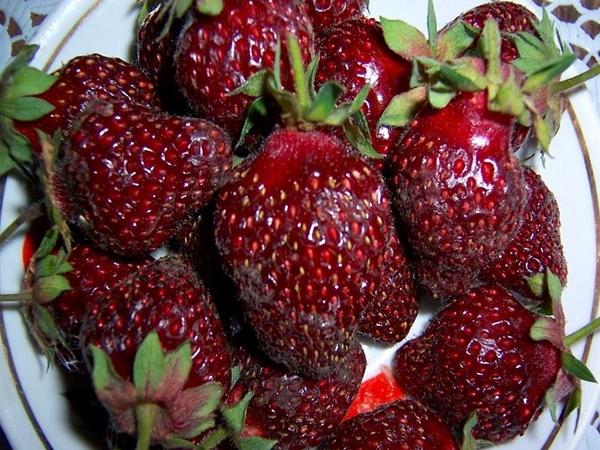
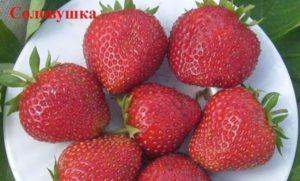
The cone-shaped berries weigh up to 35 grams, with an average weight of 13-15 grams, and are bright red in color with a distinct gloss.
Ripening time and yield
The Feyerverk strawberry variety blooms in central Russia under favorable weather conditions in late May to early June, and in Eastern Siberia in mid- to late June. A cold spring with recurrent frosts delays flowering by 1.5 to 2 weeks. Berries appear in late June to early July. Fruiting lasts for two weeks, with the last fruits harvested between July 15 and 20. A young bush yields an average of 50 berries (or 600-700 grams). One hectare yields 160 centners.

Taste qualities of the fruit and its further sale
Fireworks strawberries have a distinctive sweet and sour flavor and a distinct aroma. When cut, the flesh is bright red and dense, with no air pockets. Thanks to its high sugar content (7.3%) and low acidity (1.2%), tasters rate Fireworks strawberries 4.8 out of 5.
Winter hardiness and drought resistance
Thanks to selection, Fireworks has high resistance to diseases and adverse climatic conditions.
The variety is quite winter-hardy; when covered with spruce branches, it can withstand frosts down to -25 C. In Eastern Siberia it requires denser cover for the winter (spunbond, sawdust, spruce branches).
In summer it easily tolerates short-term drought, but the berries will be smaller than usual.

Immunity and susceptibility to diseases and parasites
During the first 3-4 years, with regular loosening, fertilizing, and watering, the bushes are extremely disease-free. Without repotting, gray mold, late blight, and powdery mildew appear in the fourth year. The plant is resistant to spider mites. Young plants exposed to temperature fluctuations (frosts or heat waves) during the growing season are highly likely to be affected by brown or white spot (3 out of 4 points).
Planting strawberries
Future yields depend on correct actions during planting.
Site selection and preparation
Peaty soils are not suitable for growing the Fireworks strawberry variety. A well-lit, shade-free area is ideal. To improve fertility, add rotted manure and wood ash when digging.
Large berries are impossible without good moisture, but too much is also harmful. This must be taken into account when preparing the beds. If the groundwater level is high and there is a risk of overwatering in the summer, strawberry beds should be high and narrow. To prevent complete moisture loss, seedlings are planted in depressions.
Selecting seedlings
The fastest way to grow the Fireworks variety is propagation using runners or division. Seedlings can also be purchased, but only from a trusted online store. High-quality seedlings are immediately recognizable: their leaves are young and green, and their root system is well developed.

Timing and technology of planting seedlings
Seedlings of the Fireworks variety are planted in late August or early September. At least a month must pass from harvest, even if flower stalks have been removed from the mother plant. Due to the growing season, by August the bush reaches its greatest vigor, gaining foliage and becoming suitable for propagation. The latest planting date in central Russia is early September. If planting later, early frosts will prevent the plant from establishing roots and will cause the plant to die. Planting bushes in July is also undesirable due to the heat, which negatively impacts rooting.
How to care for Fireworks garden strawberries
The health of the crop depends on compliance with care rules.

Regularity of watering
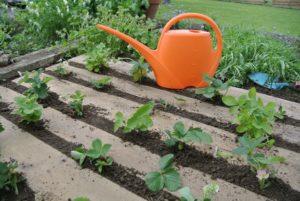
Starting in May, strawberries are watered every 5-6 days. During flowering and fruiting, water every 2-3 days at a rate of 1 liter per bush.
What fertilizer does the variety like?
The Fireworks strawberry plant is fertilized five times per season: after the snow melts, before flowering, when the berries are setting, during ripening, and after harvest. In early spring, the bushes are watered with a solution of rotted cow manure (2 kg of cow manure per 10 liters of water) or a urea solution (carbamide) at a rate of 2 tablespoons per 10 liters.
Before flowering, strawberries are fed with potassium-phosphorus fertilizers (nitroammophoska, nitrophoska). During flowering, the bushes are sprayed with a boric acid solution (2 g per 10 l), and when fruiting begins, a mullein solution with added nitrophoska is applied under the bush. After harvesting, universal complex fertilizers (diammophoska) are applied.

Weeding and loosening the soil
Regular weeding improves root nutrition. Weeds drain moisture and should be removed regularly.
Mulching
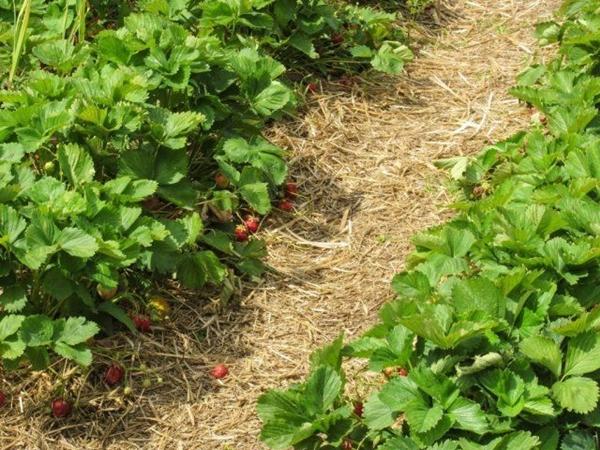
Mulching retains moisture in the summer and also protects the roots from frostbite in the winter.
Shelter for the winter
The best shelter for the Fireworks strawberry is a 20-30 cm layer of snow. Snowless winters pose a risk of frost. However, early sheltering is also fraught with overheating and death of the plant.It's best to add snow to the beds. If this isn't possible, in the event of unexpected frosts and no snow cover, the owner can cover the bushes with spunbond. Spruce branches will also reliably protect the bed without interfering with air circulation.
Preventive treatments against diseases and pests
The Fireworks strawberry has a strong immunity, so it doesn't require treatment against diseases and pests. The only disease the plant is susceptible to, white and brown spot, can be controlled by spraying with a solution of two Alirin-B tablets per liter of liquid.

Methods of reproduction
There are several methods for propagating this variety on a plot.
Seeds
Propagation by seed is a very convenient way to obtain high-quality and healthy seedlings, but the process is time-consuming. The Fireworks variety is mainly sold in cassettes (seedlings), and seeds are difficult to find commercially.

Preparation of seed material
To grow from seed, leave the largest and ripest berries in the summer, cut off the top layer containing the seeds, and dry them. Sowing in the ground can be done at any time of year, but January-February is best.
This variety is quite finicky; most seeds fail to germinate without prior preparation, or the seedlings lodge early. To prevent this, stratification is used to simulate the effects of winter conditions. A tray filled with cotton pads or paper towels serves as a container. Several seeds are placed on the trays. The pads or paper towels are then soaked in a growth stimulant solution (Zircon, Epin). The seeds are covered with a clean pad and cellophane, and the tray is refrigerated for 3-4 days.
Necessary soil and container
For planting seeds, use special containers or any plastic cups. In the latter case, they must be washed with dishwashing liquid and then rinsed with boiling water. If there are no holes in the bottom, make some to allow excess liquid to drain.

Timing and rules for sowing
Fill the containers with soil. You can prepare it yourself from a mixture of coconut fiber and vermicompost, or buy special seedling soil. Two weeks before planting, douse the soil with boiling water to kill pathogenic bacteria.
The seeds are placed on top of the soil with a toothpick, as they are very small and moist, without covering them. Then, cover the container with plastic wrap or a transparent lid and place it on a windowsill. If the window faces north, turn on a grow light during the day. The first shoots will begin to appear within a month. To prevent condensation, remove the wrap or lid once a day.
Pricking out and care
The seedlings are pricked out when 3-4 fully developed leaves appear. The plants have threadlike roots, so dig them up with the soil ball. They are planted in soil of a similar composition, pre-watered with warm water.

By dividing the bush
A four-year-old plant is suitable for dividing the bush. Carefully dig the bush up with a lump of soil and place it in a bowl of water. After soaking, gently shake it, and the bush will divide itself. From the separated rosettes, select those with young leaves. These are planted in cups for further growth, as the root system is very weak and will not be able to nourish the plant.
Sockets
Rosettes form on runners that extend from the bush during the growing season. The strongest rosette is the one closest to the bush. It should have at least four leaves and several roots. This rosette is placed in a container and covered with soil. Three to four rosettes are selected from the bush, and the remaining runners are trimmed. The mother plant receives special care: water it daily and feed it with a nutrient solution. At the end of August, the rosette is transplanted from the container to a permanent bed.

Gardeners' reviews of the variety
Alina, 47: "The Fireworks strawberry variety is easy to maintain. Over three years, the bushes haven't had a single illness and have produced a good harvest. All you need to do is loosen the soil and remove old leaves."
Vladimir, 58: "It tolerates snowy winters well. It's resistant to recurrent frosts. The 'Fireworks' strawberry variety produces a good yield. The berries are juicy, sweet, and aromatic."
Nadezhda, 67: "Strawberries are great for freezing. They are uniform in size and shape, smooth and even. You can harvest up to 1 kg from a single bush per season. They propagate well through rosettes."
Related posts:
 Description of the Florence strawberry variety, planting and care features
 How to grow strawberries at home
 Description of the Holiday strawberry variety, cultivation and propagation methods
 Description of the Malling Pandora strawberry variety, planting and care
 Description and characteristics of the Vima Zanta strawberry variety, planting and care scheme
 The best varieties and cultivation of everbearing strawberries, fertilizing and propagation
 Description and characteristics of the Zenga Zengana strawberry variety, planting and care
 Description and characteristics of the Korona strawberry variety, planting and care scheme