
- Mulching strawberries: goals and objectives
- When should mulch be applied?
- Selection of materials and technology for the procedure
- Biological materials
- Straw
- Needles
- Hay, fresh grass and green manure
- Fallen leaves
- Shredded bark
- Humus and compost
- Sawdust
- Inorganic mulching
- Cardboard
- Spunbond as mulch
- Covering film
- Lowland peat
- Agrotextile
- What mistakes do novice gardeners make?
By mulching strawberries, gardeners strive to create more comfortable conditions for their growth and development. The protective layer can also nourish the plants with nutrients and serve as a preventative measure against diseases, weeds, and pests.
Mulching strawberries: goals and objectives
Mulching involves covering the soil surface with special materials. This is done for several reasons:
- After watering or rain, a crust does not form on the surface when the moisture dries.
- Obstacles are created for insect pests.
- Weeds cannot grow under a layer of mulch.
- The treated soil is protected from being washed away during heavy rains.
- Drying out of the soil is prevented because evaporation through mulch occurs more slowly than without it.
- When using some options, soil warming in the spring improves, allowing for an earlier harvest.
- In the southern regions of the Russian Federation, mulching can be used to protect the soil from overheating.
This procedure can be beneficial or harmful, depending on how correctly it is applied.
When should mulch be applied?
Mulching can be used repeatedly when growing strawberries. The first time during the warm season, it should be done immediately after planting—when the berries begin to set.
Thanks to this preparation, they do not touch the ground during growth and maturation.
As the cold season approaches, before the onset of winter frosts, the plants will need mulching again in the fall. This is done to protect the bushes from the winter cold. This mulch is removed in the spring to prevent it from interfering with the strawberry plant's growth.

Selection of materials and technology for the procedure
When choosing a mulching method, not only the properties of the mulch, but also climatic conditions and soil properties must be taken into account.
Such materials are divided into:
- bulk;
- leafy.
The first layer is poured in a 10-15 centimeter layer over the entire bed. The second layer is placed over the bed, extending 20 centimeters beyond the edges. These layers need to be covered with soil. Fertilizer is usually added to the soil before applying the mixture.
Biological materials
For the procedure in question, materials of organic origin can be used.

Straw
To use straw as mulch, it needs to be shaken thoroughly. This shakeout removes any weed seeds that may be present.
Then the straw needs to be thoroughly dried. This material is carefully spread out in an even layer 15 centimeters thick. Gradually, the mulch will settle and compact.
The straw in the area will gradually rot. This will result in the growth of a microorganism called Bacillus subtilis. It's beneficial because it helps plants fight fungal infections.
Needles
You can use not only pine needles but also small twigs, bark, or pine cones for this purpose. After mulching, this material will quickly rot, creating a fertile, nutrient-rich layer.
Pine needles have a preventative effect, protecting plants from gray mold. In spring, the sharp needles prevent weeds from growing and keep slugs away from the strawberry plants.
Pine needles are also a good choice for autumn treatments, as they can protect strawberries from winter cold.
 Its disadvantage is that it is not recommended for use in acidic soils. This is because the pine needles, when rotting, make the soil even more acidic.
Hay, fresh grass and green manure
Grass clippings can also be used as mulch. For example, weed residues can be used for this purpose. However, they must be cleared of roots and seeds.
Hay or freshly mown grass can be used for this purpose, provided they are well dried. Otherwise, they will rot.
Green manure crops are plants whose roots can absorb nitrogen from the air and enrich the soil. When used as mulch, they provide additional nutrition for the plants. Hay is less durable than straw, but it is nutritious, rots quickly, and creates a beneficial layer for strawberries.

Fallen leaves
Some believe that the material resulting from decomposing fallen leaves is no less useful than manure. It makes the soil light and loose, making it easily digestible by plants. Leaf mold is used for mulching. This material is collected in piles, regularly moistened, and mixed. This mixture is used as mulch.
Shredded bark
Bark mulch helps retain soil moisture and prevents weeds and insects. It also encourages the development of large numbers of earthworms. This type of mulch prevents fungal infections in strawberries and reduces soil acidity.

Humus and compost
Using humus and compost helps plants retain moisture in the soil and maintains the right temperature to prevent excessive cooling or overheating. This method of mulching strawberries also protects the soil from erosion.
However, the layer must be regularly renewed due to the fact that soil organisms quickly process it.
This mulch layer should be 10 centimeters thick.
Take a look Also
Sawdust
If you cover the soil around the strawberry bushes with wood shavings or sawdust, this will prevent it from drying out too quickly.
The weakness of this mulching method is its insufficient protection of plants from insect pests. Insects are free to thrive among the sawdust.
Sooner or later, this type of mulch begins to rot and decompose. In the process, it takes nitrogen from the soil, which is essential for strawberries. If you decide to use sawdust for this purpose, you'll need to increase your nitrogen fertilizer intake.
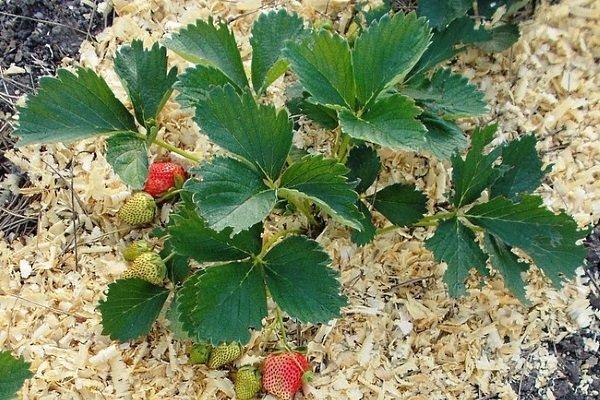
Furthermore, this method leads to soil acidification. To compensate for this effect, it is recommended to sprinkle the soil with dolomite flour or wood ash.
Inorganic mulching
It is possible to use various artificial materials as mulch for strawberries.
Cardboard
Cardboard can be used for mulching. Thick packing paper is also suitable. Using newspapers or other printed materials is not recommended, as printing ink can be harmful to plants.
To properly cover the bed, lay the cardboard sheets so that the edges extend 20 centimeters beyond the edge. Apply an even layer of soil on top, 10 centimeters thick.
The prepared material is left for a week, cut into the desired locations with a trowel, and the strawberries are planted. Immediately afterward, water the strawberries. Water only in the immediate vicinity of the strawberry plants. This is important to prevent the cardboard layer from becoming soggy.

After some time, when it becomes clear that the strawberries have grown, a layer of hay, straw or mown grass is placed on the soil.
Spunbond as mulch
This material is not suitable for mulching strawberries during the winter. This is because it provides poor protection from the cold. Another drawback is that air cannot pass through this material, which can lead to root rot.
During spring frosts, condensation may form on the spunbond, the moisture from which can harm the plant.
Gardeners prefer to use black material for spring mulching. They choose spunbond with a density of at least 50 grams per square meter. If applied correctly, the soil will warm up much better, resulting in an earlier harvest.

In southern regions of Russia, a two-layer spunbond is used. The bottom layer is black, and the top layer is white spunbond. This type of mulch helps prevent excessive soil heating.
 The same goal can be achieved in another way - by scattering hay or dried grass over the surface of the spunbond.
When mulching strawberries in spring, first remove debris from the beds, remove weeds, and dig up the topsoil. Dig 10-centimeter-deep furrows around the perimeter of the beds. Then, make small round holes or cross-shaped cuts in the spunbond every 30 centimeters. Next, make another row, spaced 60 centimeters apart. Add more if needed.
Now you need to cover the bed and dig holes for the strawberry seedlings in the appropriate places.
Covering film
When using film, remember to cover its edges with soil. If the material isn't sealed properly, rapid moisture evaporation won't be prevented. This type of mulch film doesn't act as compost. Therefore, before laying it down, the soil should be fertilized with organic matter.

Lowland peat
This type of peat has a neutral pH. It is not only suitable for this procedure but also a valuable organic fertilizer.
Agrotextile
Plants can breathe under agrotextile. When mulched in spring, this material can protect the soil from overheating. However, soil covered with it quickly loses moisture.
What mistakes do novice gardeners make?
Mulching, in particular, is intended to allow the soil to breathe. Therefore, walking on it is not permitted. If necessary, lay down boards and walk on them. In the fall, mulching should not be done just before the cold weather sets in. It should be done no later than a month after the onset of frost.
In spring, winter mulch shouldn't be left in place for too long. It should be raked to the edge and allowed to breathe. Spring mulching should be done after the soil has warmed up well.
Related posts:
 How to grow strawberries at home
 Description of the Florence strawberry variety, planting and care features
 Description and characteristics of the Vima Zanta strawberry variety, planting and care scheme
 Description of the everbearing strawberry variety Selva and cultivation technology
 The best varieties and cultivation of everbearing strawberries, fertilizing and propagation
 Signs of disease and pest attacks on strawberries, treatment methods
 Description of the Holiday strawberry variety, cultivation and propagation methods
 Timing and rules for fertilizing strawberries, and the best fertilizer for a good harvest