
- History of breeding and regions of cultivation of Rumba strawberries
- Pros and cons of the variety
- Characteristics and features of strawberries
- Bush size and appearance of the leaf blade
- Flowering and pollination
- Ripening time and yield
- Taste qualities of the fruit and its further sale
- Winter hardiness and drought resistance
- Immunity and susceptibility to diseases and parasites
- Planting in a garden plot
- Required soil composition
- Selection and preparation of beds
- Selecting seedlings
- Timing and technology of planting seedlings
- Subtleties of further care
- Watering mode
- Top dressing
- Weeding and loosening the soil
- Mulching
- Shelter for the winter
- Preventive treatments
- Methods of reproduction
- Seeds
- By dividing the bush
- Sockets
- Gardeners' reviews of the variety
A Dutch strawberry variety, Rumba, recently appeared on the market. It attracted gardeners with its high yield and resistance to cold and drought. For gardening enthusiasts, this variety could be a real find. Simply understand the planting and care instructions for Rumba strawberries and you'll be able to delight yourself and your loved ones with a harvest of sweet, aromatic berries.
History of breeding and regions of cultivation of Rumba strawberries
The Rumba strawberry variety was developed by breeders at the Dutch holding company Fresh Forward, led by Bert Meulenbroek. Scientists from Wageningen University and the Fragaria Holland association participated in the development. The holding registers all its berry varieties under the names of famous dances. One of their latest berry varieties, Salsa, has become a competitor to many leading strawberry varieties. A similar fate is predicted for Rumba.
Scientists have developed a variety that can grow and thrive in continental climates. In temperate regions and Scandinavian countries, strawberries are planted outdoors. Research and testing of berry ripening in greenhouses have also shown positive results.
When growing strawberries indoors, it is necessary to maintain the temperature regime so that the berries do not become soft from excess heat.
Rumba strawberries are cultivated in Northern and Central Europe and Scandinavia. They are considered promising for regions of Russia, Belarus, and Ukraine. Ukraine has already included the variety in the register of plants recommended for cultivation in Polesia, steppe regions, and the forest-steppe zone.

Pros and cons of the variety
Gardeners note the following advantages of the variety:
- the berries ripen early;
- up to 400 g of berries are harvested from each bush;
- the fruits are dense, juicy, and of the same size;
- the plant is frost-resistant;
- does not require additional pollination;
- has immunity to some types of diseases.
Among the disadvantages, agronomists highlight:
- special soil selection;
- the plant requires special care, in particular, shelter for the winter;
- For a stable taste, the berry requires special climatic conditions, otherwise it becomes sour.

Characteristics and features of strawberries
According to its creators, the Rumba strawberry may soon replace well-known early-ripening varieties. It has a number of characteristics that give it an advantage over its garden counterparts.

Bush size and appearance of the leaf blade
The plant grows to a height of 30-40 cm. The bush has a well-branched foliage system. The leaves are large, dark green, and serrated. A tall flower stalk rises above the foliage system. Each flower stalk produces 5-6 berries. The fibrous root structure allows it to withstand light frosts.
Flowering and pollination
The plant blooms in May-June. The inflorescences are simple, each containing 5-6 flowers. The stamens are well developed, with a large amount of pollen.
Flowering is bisexual, so the plant pollinates itself.

Ripening time and yield
The harvest is collected in May-June, once per bush during the growing season. In the first year after planting, the plant produces 150-200 g of berries, and in subsequent years, 400-500 g. With professional care, a bush can yield up to 1.5 kg of strawberries.
Taste qualities of the fruit and its further sale
The main characteristic of this variety is its perfect marketability. The round-conical, bright red berry is fleshy, sweet, and juicy. Its subsequent distribution depends on the agricultural industry where it is grown. Due to its excellent appearance, aroma, and flavor, it is ideal for retail.
Strawberries are also ideal for making strawberry jams, compotes, and preserves, both homemade and commercial. Any unsold produce can be processed at a nearby fruit and vegetable canning plant. The berries freeze well without losing their flavor.
Winter hardiness and drought resistance
The plant is cold-resistant and can withstand temperatures down to -25 degrees Celsius. In northern regions, it is recommended to cover the bushes with agrofibre until spring. Strawberries do not tolerate drought and require regular watering. Without sufficient moisture, the berries do not achieve their desired size (they should be bright, fleshy, and weigh at least 20 grams).

Immunity and susceptibility to diseases and parasites
Rumba has high disease resistance. Frequent watering can cause the plant to rot. Gray mold can be controlled with an Alirin-B solution. Apply twice, one week apart, then spray: one tablet of concentrate per 1 liter of water.
Planting in a garden plot
Strawberries are planted in late April or early September. This allows them to adapt more quickly before the onset of heat or frost.
Required soil composition
Rumba is fussy about soil. The originator identified the following soil types:
- sandy loam soil;
- black soil;
- loam;
- forest gray substrate (slightly acidic).
It is not recommended to plant strawberries in excessively clayey soil or soil where groundwater rises 0.8 m above ground level.

Selection and preparation of beds
Choose a site sheltered from the wind and well-heated by the sun. Rumba bushes are not compact, so the holes should be spaced 30-40 cm apart. Experienced growers plant 4 bushes per 1 m.2Then add 0.5 kg of compost to each hole and add 500 ml of water. If necessary, add a solution of calcium sulfate or ammonium sulfate. Fertilizing is also possible.
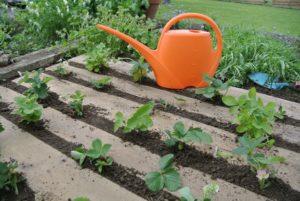
Selecting seedlings
Before planting, seedlings should be kept in a cool place for three days. Before planting, soak the roots in a copper sulfate solution (30 ml per 10 liters of water) for three minutes. Disinfection will prevent fungal diseases. After soaking, rinse the plants thoroughly with water and remove the lower leaves. Trim the roots so that they are no longer than 10 cm.

Timing and technology of planting seedlings
Seedlings are planted in both spring and fall. The bush is planted in the center of prepared holes filled with fertilizer and water. The leaves are spread out, and the roots are covered with soil. The compacted soil is watered (approximately 1 liter per plant) and mulched.
Subtleties of further care
Rumba strawberry bushes require care during and after the season. This includes watering, fertilizing, weeding, loosening the soil, mulching, winter protection, and preventative treatments.
Watering mode
When night frosts end and warm spring weather arrives, the plant requires constant, abundant watering. Water with a rain shower before flowering. Once flowers appear, water only at the roots. During hot weather, water every 3-4 days at a rate of 10-12 liters per 1 m.2 (bucket). In cool and rainy summers, watering once a week is sufficient.

Top dressing
The primary fertilizer for garden strawberries is potassium. Fertilizers containing potassium are used in spring, summer, and winter. They nourish the plant. Their minerals help the plant form sweet, fleshy fruit, true to its variety. To increase the berry's sugar content, the plant is fed during flowering, ovary formation, and fruit set.
Weeding and loosening the soil
Weeds must be removed periodically, as they can harbor pathogens and pests. Loosen the soil after removing old mulch and before the growing season.
Mulching
Agronomists recommend mulching the soil with sawdust. This will prevent the rhizome area from drying out or becoming overly wet. Inorganic materials, available at gardening stores, can be used.
Mulch prevents many diseases, promotes the reproduction of worms and insects, and creates a fertile soil layer.

Shelter for the winter
In northern climates and cold winters, when temperatures can drop below -25 degrees Celsius, it is recommended to cover the Rumba. For this, use a lightweight material such as film or agrofibre.
Preventive treatments
Preventative maintenance is carried out throughout the plant's life. Mulch needs to be changed, plants need to be spaced out to avoid overcrowding, weeding needs to be done, and dead leaves, dead bushes, and plants that have reached the end of their lifespan need to be removed.
Take a look Also

Methods of reproduction
Rumba strawberries are propagated by seed germination, division of the bush or rosettes.
Seeds
The seeds are soaked in a solution of any growth enhancer. Once the seeds have swollen, they are scattered over the soil in the seedling container. Watering is done by misting the soil. The container is covered with a glass lid. After the first shoots appear, the seedlings are transplanted into peat pots. The growing period is one month, after which the plants are planted outdoors.

By dividing the bush
This propagation method is used in the fall. Then, the young plants will be able to produce their first harvest in the spring. To divide the bush, it must be dug up. Then, carefully divide it into two equal parts and plant them in separate holes.
Sockets
In June, the plants begin to produce runners with rosettes. These are cut from the bush and planted in moist soil. They are cared for like adult plants. They will produce their first harvest the following year.
Gardeners' reviews of the variety
Irina, Novosibirsk:
"The Rumba variety is a wonderful one, very productive, with berries that are simply caramel-sweet! But it has a difficult winter, often getting wet and requiring protection from moisture. After this snowy winter, many of the bushes were soaked, and only two bushes remain, so the berries aren't very large, but they're still very sweet and firm."
Yudzhiya, Moscow:
"The Rumba variety is truly unique! Its berries are cloyingly sweet! I've never seen that in any other variety. And it's more resilient than Kimberly. The berries are more numerous, and significantly larger. An excellent variety! I highly recommend it."
Svetlana, Kemerovo:
"Rumba is just my taste—sweet, with a slight tartness. If there were more sunny days in the summer, it would be sweeter. I also love sweet berries. The aroma is strong, though; we picked the last berries at the end of August and thoroughly enjoyed the scent. I even wondered if it was everbearing. As for diseases, I'm not sure. I only planted one bush, and it was a rainy summer. I cut off the leaves, as I did with the rest of the berries. I'll make a final decision next year."
Related posts:
 Description and characteristics of the Rumba grape variety, cultivation technology
 Description of the Florence strawberry variety, planting and care features
 Description and characteristics of the Vima Zanta strawberry variety, planting and care scheme
 How to grow strawberries at home
 Description and characteristics of the Korona strawberry variety, planting and care scheme
 Description of the everbearing strawberry variety Selva and cultivation technology
 The best varieties and cultivation of everbearing strawberries, fertilizing and propagation
 Description and how to plant the Garland strawberry variety