
- Sowing strawberry seeds for seedlings
- How to prepare planting material yourself
- Selecting a container and soil for sowing
- Sowing and growing seedlings
- Transplanting bushes into open ground
- Choosing a site for strawberries
- We prepare and disinfect the soil
- We apply fertilizers
- Preparing seedlings
- Technology for planting strawberries in open ground
- Deadlines
- In the spring
- In summer
- In the fall
- We maintain the distance between the bushes
- Planting methods
- Trapezoidal beds
- Film tunnels
- Plastic bags
- Vertical garden bed
- Compatibility of strawberries with other plants
- Predecessors
- What to plant nearby
- Which neighbors should you avoid?
- Common errors and how to fix them
Strawberries are traditionally planted in open ground. Bushes are purchased from nurseries and then propagated by stolons. Planting strawberries from scratch involves sowing seeds and growing seedlings. Seeds, seedlings, and soil are prepared before planting. Depending on the size of the plot, a choice is made regarding how to plant garden strawberries: in trapezoidal or vertical beds, in plastic bags, or in tunnels.
Sowing strawberry seeds for seedlings
Seedlings can be successfully grown under artificial lighting starting in January. Strawberry seeds planted in March benefit from natural daylight.
Light is the main condition for seed germination.
How to prepare planting material yourself
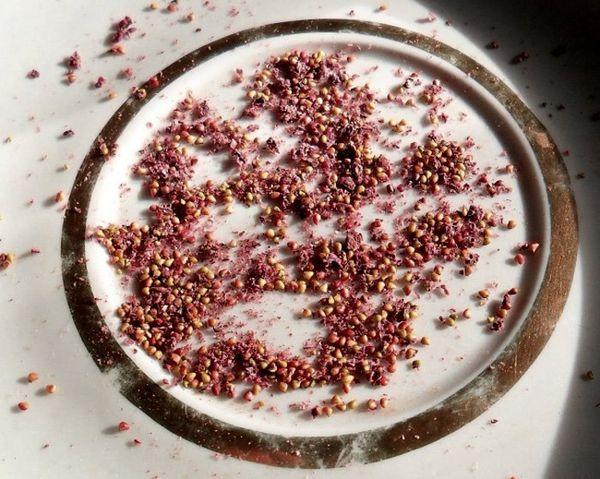
Strawberry seeds germinate slowly. Soaking them will speed up sprouting:
- you will need a plastic container with a lid, cotton pads or cotton rags;
- holes are made in the container lid to allow air to enter;
- cotton pads and scraps are moistened in water;
- 3-4 seeds are placed on one piece of cloth and covered with a second piece on top;
- The packets with seeds are placed in a container and the lid is closed.
The seeds are kept in a warm place for 48 hours. Then the containers are transferred to the refrigerator. The low temperature is necessary for stratification, which lasts 14 days.
Selecting a container and soil for sowing
To plant sprouted seeds use:
- plastic container, cup;
- peat pot.
Yogurt cups will work if you make holes in the bottoms for water drainage and install drainage.
Soil composition:
- compost;
- garden soil;
- wood ash.
Mix equal parts soil and compost, adding 1/10 ash. Bake the mixture in the oven. Ready-made universal soil or peat tablets will work.
Sowing and growing seedlings
After 14 days, the seeds are planted and transplanted.
Sowing methods:
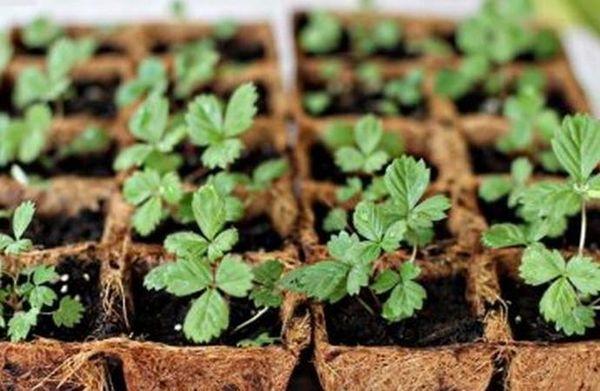
- Fill a plastic container with drainage and soil, then moisten the soil with a spray bottle. Pick up the seeds with tweezers or a toothpick and lightly press them into the soil surface. There's no need to cover them with soil. Close the container with a lid and place it in a warm, well-lit area.
- Sprouted seeds are planted in peat pellets. After refrigeration, the containers are kept at a temperature of 20 degrees Celsius, with humidity controlled. When sprouts appear, the pellets are removed. The peat pellets are soaked in water and placed in the containers. One seed is placed in each pellet, pressing it firmly against the surface. The containers are sealed with a lid and stored in a warm, bright place.
Seed care involves monitoring humidity. The soil and peat pellets should be moistened periodically, and the containers should be aired and wiped. Lack of condensation indicates insufficient moisture.
After 3 strong leaves appear, the sprouts are planted and pricked out:
- plastic cups and peat pots are filled with drainage and soil;
- a small depression is made in the moist soil;
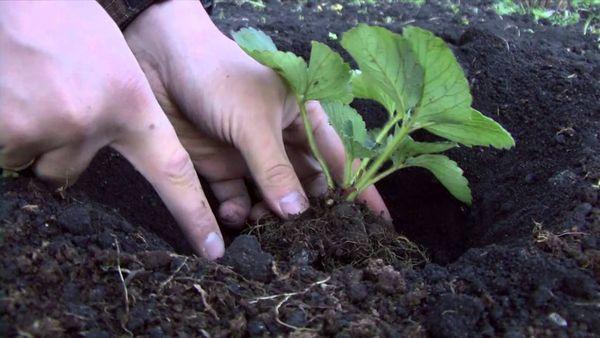
- The sprout is planted so that the central bud with leaves is on the surface.
Take a look Also
The seedlings are watered under the roots using a teaspoon.
Transplanting bushes into open ground
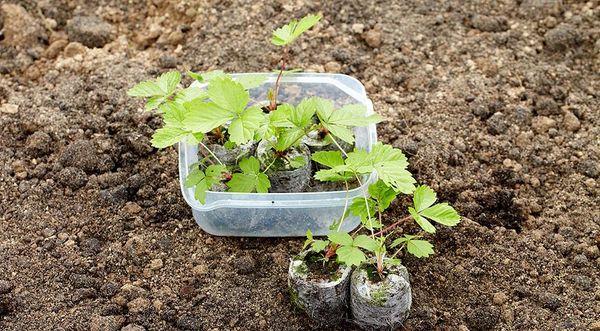
To ensure that the rosettes remain in one place for 3-4 years, it is necessary to prepare the seedlings and soil before planting.
Choosing a site for strawberries
Conditions for fruitful growth of bushes in open ground:
- illumination;
- ventilation;
- moderate humidity;
- absence of weeds.
Fungus will develop in soil that is too wet. Groundwater levels should be deeper than 70 centimeters from the surface.
We prepare and disinfect the soil
Sandy and sandy-loamy soils, containing 3% humus, are suitable for strawberries.
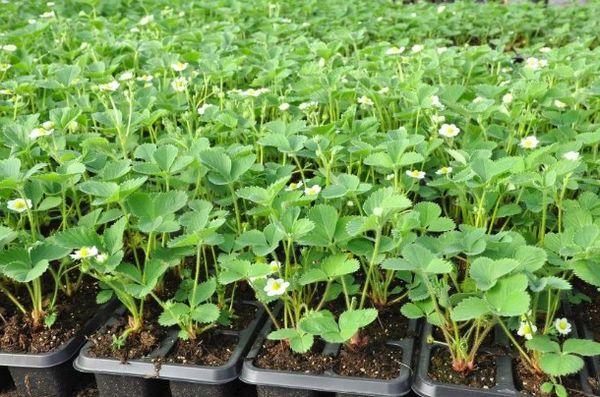
Before planting, clear the area of weeds and treat the soil with potassium permanganate or Fundazol. Dig the soil with organic fertilizer to a depth of 20-30 centimeters.
Strawberries love neutral, slightly acidic soil, rich in potassium, magnesium, calcium, phosphorus and boron.
We apply fertilizers
To prepare the fertilizer, you will need:
- compost, horse manure and garden soil - 1 bucket each;
- wood ash - 2 cups.
Horse manure can be replaced with compost mixed with 2 liters of vermicompost. Prepare the site 1-2 months before planting.
Preparing seedlings
What you need to do before landing:
- water the plants generously an hour before digging;
- dig up the seedlings;
- keep the roots in a growth stimulating solution for 1 hour.
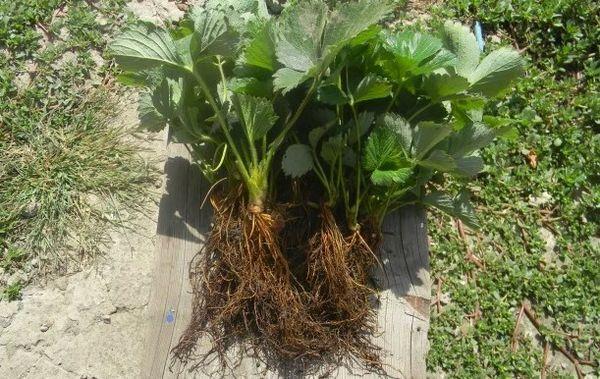
Roots longer than 10 centimeters are trimmed with scissors. Fifteen minutes before repotting, the plant is dipped in hot water.
Technology for planting strawberries in open ground
Season and planting density influence the yield of young bushes.
Deadlines
Spring, mid- and late summer, and autumn are favorable times for growing strawberry seedlings in the ground.
In the spring
The further south the region, the earlier strawberries are planted—from mid-April to mid-May. This period is suitable for planting seedlings from seeds.
In summer
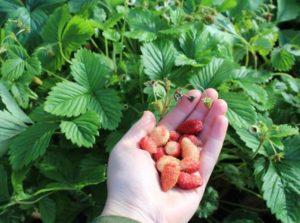
From mid-July to August, the stolons are planted. By winter, they will have time to grow strong roots. Summer is also a good time to plant seedlings.
In the fall
Seedlings planted in September and October produce a small harvest the following year and do not survive the winter well. However, if the flower stalks of autumn-planted seedlings are removed in the spring, they will produce numerous strong stolons.
We maintain the distance between the bushes
Arrangement methods:
- 20x60 - the compacted method is suitable for late varieties, the distance between bushes is 20 centimeters, between rows - 60 centimeters;
- 30x60 – for early varieties;
- 40x60 – for mid-season large rosettes.
The closer the first bushes are planted, the higher the yield. Maintain a distance of 80 centimeters between beds containing different varieties to avoid confusion between the stolons.
Planting methods
Some methods of setting up strawberry beds allow you to harvest throughout the year.
Trapezoidal beds
The seedlings are placed on earthen platforms, which are reinforced on the sides with boards, slate or brick.
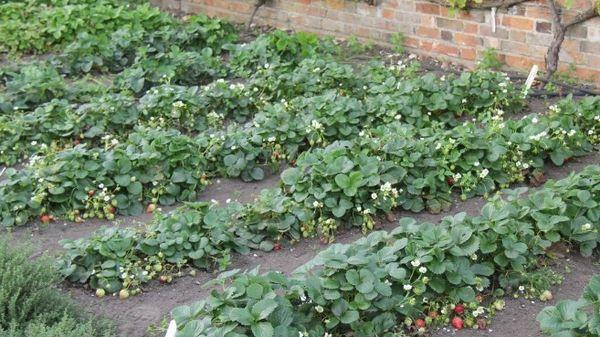
Garden bed layout:
- length - 1.5-3 meters;
- width - 60-120 centimeters;
- height - 20 centimeters.
A shallow mound is sufficient for strawberries. A thick layer of soil will freeze in winter, and the plants will die.
How to properly alternate embankment layers:
- metal mesh, geotextile;
- drainage - bark, shavings;
- fertilizer - manure;
- cardboard, paper, burlap;
- plant organic matter and mineral fertilizers;
- soil.
The topsoil should be at least 10 centimeters thick. The finished bed is watered generously and left for 3 days. The mound is then covered with plastic. The beds should be prepared in the fall to allow the soil to mature under the plastic over the winter. In the spring, plants are planted in the resulting nutritious soil.
Film tunnels
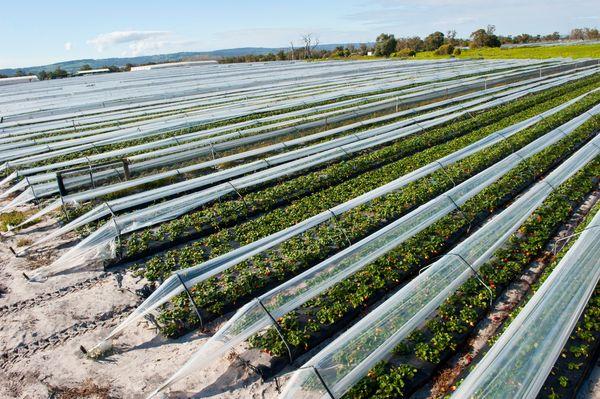
Step-by-step instructions for setting up a covered garden bed:
- wire arches up to 80 centimeters high are produced;
- the arcs are stuck above the garden bed at intervals of up to 100 centimeters;
- the structures are connected with transverse wire;
- The arch is covered with film on top.
Holes are made in the covering to allow air to enter. Planting strawberries under film tunnels accelerates ripening.
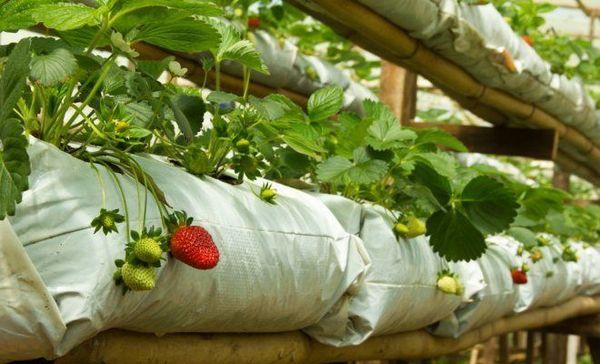
Plastic bags
This method allows you to plant strawberries all year round:
- fill the bag with drainage and soil;
- moisten the soil;
- make slits;
- Plant strawberry bushes through the holes.
The bags are arranged and hung, saving space. This method is used indoors to grow strawberry varieties year-round.
Vertical garden bed
For planting, use plastic pipes with a diameter of 2 and 15 centimeters:
- Large holes are made in a wide pipe for planting bushes;
- holes are made in a thin tube for watering;
- a thin pipe is inserted into a wide one and installed vertically on the ground;
- Soil is poured inside between the pipes.

Water will flow evenly through a thin tube to the seedlings.
Compatibility of strawberries with other plants
When planting seedlings, take into account the rules of crop rotation and fruit and vegetable neighborhood.
Predecessors
It is useful to plant strawberries after the following crops:
- beans;
- parsley;
- garlic;
- radish;
- dill.
Tulips and daffodils prepare the soil for strawberries well.
What to plant nearby
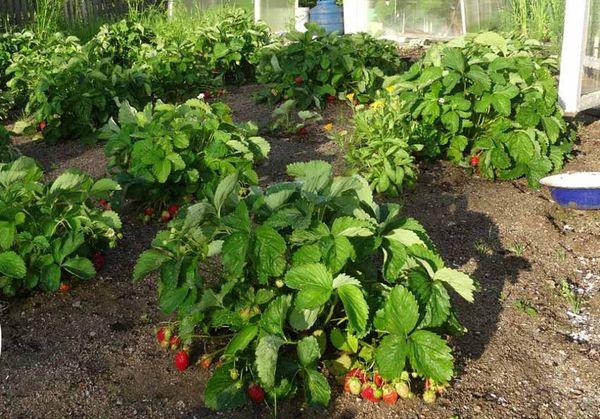
The following vegetables are a good neighbor:
- onion, garlic;
- parsley;
- salad;
- carrot.
These plants repel pests. Strong, fruitful bushes grow alongside delphiniums and irises.
Which neighbors should you avoid?
Strawberries should not be planted next to the following vegetables:
- tomatoes;
- potato;
- cucumbers;
- watermelons, melon;
- pumpkin;
- zucchini.
The secretions from their roots poison the seedlings.
Common errors and how to fix them
Problems that arise when growing seedlings:
- The sprouts are drying up.
Dry air from outside disrupts the microclimate in the container with seeds.
What to do: do not remove the lid completely, but leave it slightly open so that the seedlings get used to the external environment.
- The sprouts bend to the ground and die.
A thin root emerges to the surface and dries out.
What to do: cover it with soil.
- Mold has appeared.
Fungus develops from excess moisture in the container.
What to do: Remove mold with a cotton swab. Air out and dry the container. Treat the soil with an antifungal agent. Then, remove excess condensation promptly.
To protect seedlings from diseases, simply soak them in water at 45 degrees Celsius before planting. The plants do not require additional feeding.
The prepared soil will be saturated with nutrients within a month. Roots longer than 5 centimeters bend during planting, and the seedlings die from lack of nutrition. Therefore, it is important to prune the roots.
Related posts:
 How to grow strawberries at home
 Description and how to plant the Garland strawberry variety
 Description of the Florence strawberry variety, planting and care features
 Description of the everbearing strawberry variety Selva and cultivation technology
 Signs of disease and pest attacks on strawberries, treatment methods
 Description and characteristics of the Vima Zanta strawberry variety, planting and care scheme
 Step-by-step instructions for planting strawberries on black covering material and growing rules
 The best varieties and cultivation of everbearing strawberries, fertilizing and propagation