
- The benefits of growing strawberries under agrofibre
- Are there any downsides?
- Types of covering material
- How to choose film for strawberries
- Step-by-step instructions for planting strawberries under plastic
- Preparing the soil and the future planting site
- Cover the strawberries with mulch fabric
- How to plant a plant on covering material
- Site preparation
- How to lay agrofibre correctly
- Bush planting patterns
- Timing and immediate planting
- Further care
- Top dressing
- Features of watering
- Moustache removal
- Errors and recommendations
How to plant strawberries using black or transparent covering material? This question interests many gardeners. Before planting, you need to purchase film or agrofibre. Each material has its pros and cons. Covering the beds with agrofibre eliminates the need for a drip irrigation system. The soil warms up faster under film, and the berries ripen earlier.
The benefits of growing strawberries under agrofibre
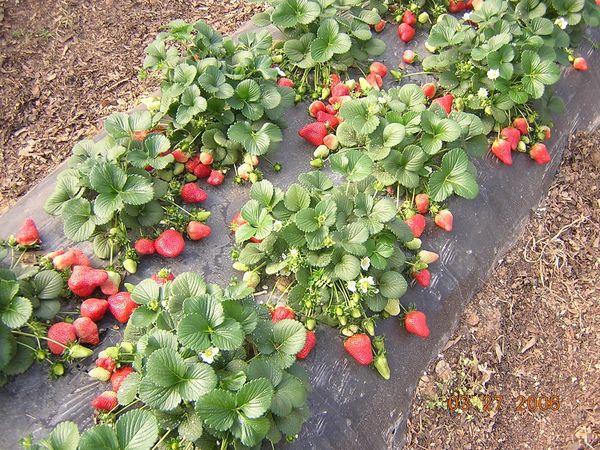
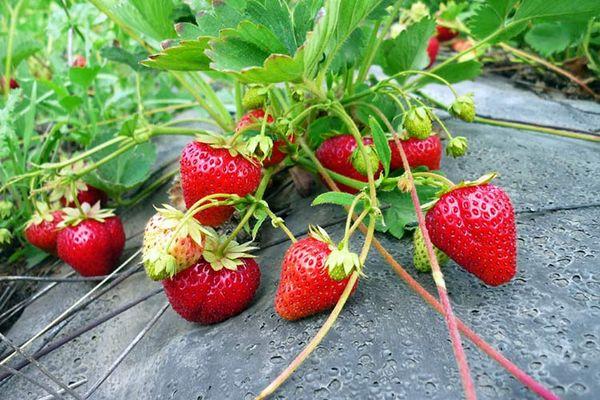
Strawberries are a heat-loving crop. In cool, rainy summers, it's difficult to get a good harvest of sweet berries. One option is to use a method of growing strawberries in open ground, invented in Finland. This northern country is an innovator in sweet berry production. Finns grow strawberries using a special material—a dark mulch—that accelerates the ripening process and improves their marketability and flavor.
When growing strawberries using the Finnish method, polyethylene film (usually black) or agrofibre is used. The covering material is spread over the soil. Using dark film requires additional drip irrigation.
You can plant strawberries in the garden and cover them with transparent plastic film or light-colored agrofibre. This cover will protect them from frost, rain, and hail, but you'll need to remove it regularly during sunny weather or for watering.
Advantages of using covering material:
- uniform heating of the soil;
- earlier ripening of berries;
- preventing the development of weeds and the rooting of tendrils;
- fertilizer applied to the soil remains in the upper layers;
- protecting the soil from drying out and weathering;
- the berries do not get dirty or rot;
- crop yield increases;
- care of the beds is simplified;
- the number of waterings is reduced.
Are there any downsides?
Growing strawberries under dark film has its disadvantages:
- additional costs for purchasing materials;
- drip irrigation equipment;
- insects and slugs can breed under the film, and mold can develop;
- In hot weather, roots can overheat and begin to rot and rot.
Types of covering material
As a covering material you can buy:
- ordinary dark polyethylene film;
- white or transparent film;
- two-layer black and white polyethylene material;
- reinforced film;
- spunbond;
- white or black agrofibre (agrotex, agril).
Each covering material has its own advantages and disadvantages. For example, black film is impermeable to water, strongly absorbs sunlight, and requires drip irrigation and an additional layer of hay to protect against overheating. Transparent film prevents soil overheating and protects against sudden cold snaps, but it will encourage weed growth.
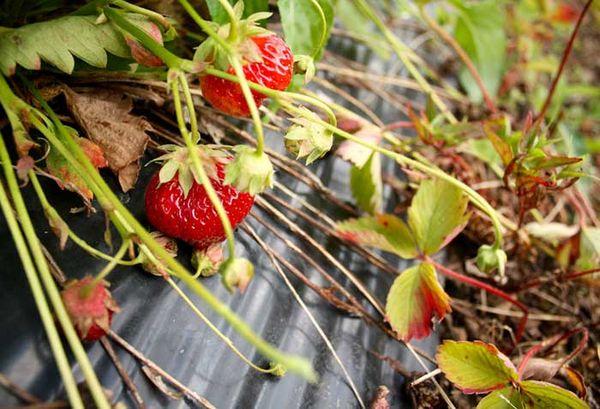
It's best to buy black agrofibre. This material's structure allows for air to pass through, allowing for watering. Weeds don't grow under agrofibre, mold doesn't form, condensation doesn't accumulate, and the soil warms up quickly. This material has a long lifespan and doesn't crack by the end of the season.

How to choose film for strawberries
Polyethylene film is suitable for covering strawberries. It's impermeable to water and air. There are several types of film suitable for growing berries, each with a different color and shelf life. The minimum shelf life of the covering material is 2-3 years.
Film comes in a variety of colors, but darker ones are best—the berries ripen faster on them. More expensive materials already have round holes for seedlings. The film's width is selected based on the size of the garden bed; the thickness should be 40 microns.
In addition to film, you can purchase agrofibre. This material is more expensive and has a lifespan of 3-4 years. Agrofibre comes in white and black. White agrofibre is laid over strawberries. This material protects plants from frost, heavy rain, hail, and wind. Black agrofibre is laid on the soil. This material prevents weed growth and warms the soil well, but allows air and moisture to pass through. Its density should be 50-60 grams per square meter.
Step-by-step instructions for planting strawberries under plastic
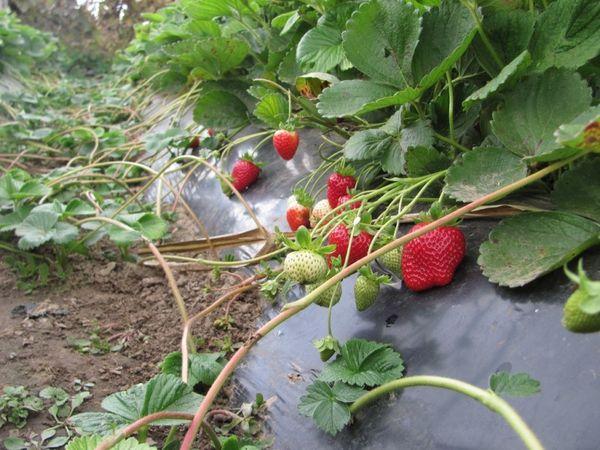
Using dark film prevents weeds and increases strawberry yield. The berries don't become contaminated, rot, or be damaged by slugs and other insects. When using dark film, you'll need to install a drip irrigation system beforehand.
Preparing the soil and the future planting site
Strawberries are planted in raised beds or on level ground. The site should receive ample sun exposure. Strawberries produce poor fruit in the shade. It's best to grow the plants under plastic in raised, narrow beds. Strawberry bushes thrive in sandy and loamy soils with a neutral pH. Suitable predecessors include legumes, onions, radishes, carrots, garlic, and parsley. Bad: tomatoes, potatoes, cabbage.
Before planting, the soil should be dug over, cleared of weeds, leveled, and fertilized. Bed preparation begins in the fall. The soil is tilled and limed, fertilizer is added, and raised beds are created. For every square meter of soil, you'll need 1.5 buckets of well-rotted humus or compost, 300 grams of wood ash, and 100 grams each of ammonium nitrate, superphosphate, and potassium sulfate.
Excessively clayey soil can be diluted with peat and sand. In the spring, before covering the beds with plastic, preventatively treat the soil with fungicides (Fitosporin, Topaz) and insecticides (Aktara, Actellic).
The bed width should be 0.90-1 meter. In such a bed, strawberries can be planted in two rows. The distance between adjacent rows should be 50 centimeters. Before covering the bed with plastic, set up a drip irrigation system, i.e., lay a long hose next to each row to supply water.
Manufacturers do not recommend walking on the plastic. It is preferable to create narrow beds with two rows of strawberries, with straw placed on top of the plastic between the rows or on top of the plastic.
Cover the strawberries with mulch fabric
Step-by-step instructions for planting strawberries under film:
- Mark out future beds, prepare the soil, lay hoses for drip irrigation.
- Cut the film into strips according to the size of the bed.
- Cover the soil with black polyethylene material: roll the film over the surface so that there are no folds, secure the edges with stones, boards, or iron staples.
- Pull the cord along the line of the intended rows.
- Mark out the location for the future holes at a distance of 30-40 centimeters from each other.
- At each marked point, make a cross-shaped cut 20 centimeters long with a sharp knife and bend back the edges of the film.
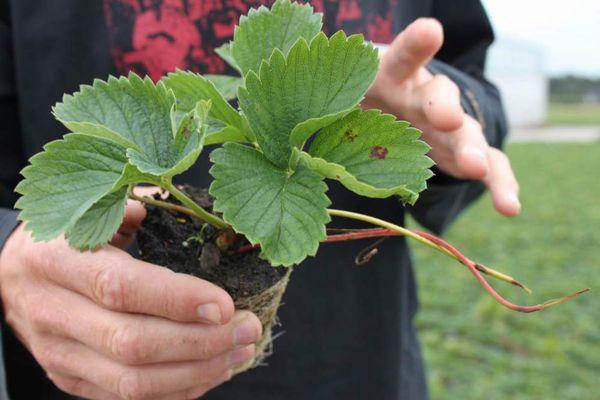
- Make holes in the resulting holes and plant strawberry seedlings there.
- Water each bush.
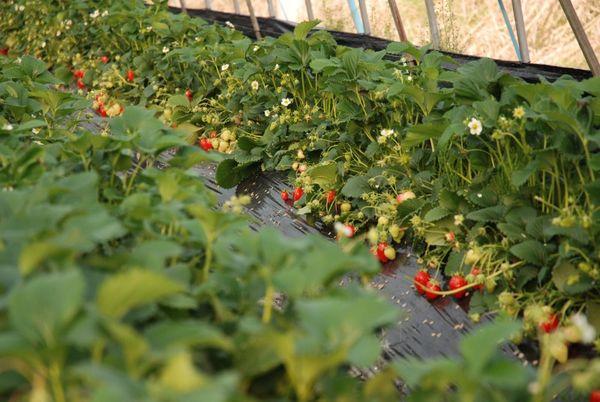
Strawberries growing in the garden can be covered with plastic film. This procedure is best done in the spring, before flowering. Before covering, weed, fertilize, and level the soil, and install a drip irrigation system. Water the dry soil generously and treat it with fungicides.
Then, plastic film is spread over the bed and temporarily secured with boards. The location of the strawberry bushes is determined by touch and a hole is made in the film above them. The plants are carefully pulled out through the holes, and the film is spread across the ground. Once all the bushes have been removed, the fabric is taut and permanently secured around the edges.
How to plant a plant on covering material
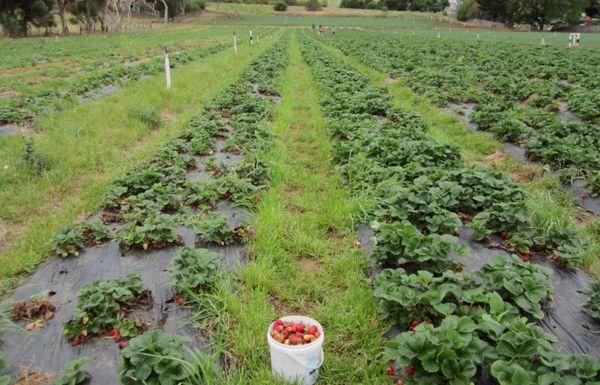
You can cover the bed with agrofibre. This material has a porous structure that allows air and moisture to pass through easily. Strawberries grown on agrofibre are larger and cleaner. It's an environmentally friendly material, with the same composition as food containers. Strawberries should be planted on agrofibre that has been previously laid on the soil. This material insulates the plants and prevents weeds from growing.
Site preparation
First, you need to make a bed. A sunny, non-waterlogged spot is ideal for planting strawberries. You can also create a raised bed. The soil surface should be dug over, leveled, and the edges reinforced with boards to prevent soil from collapsing. The bed should be 1-2 meters wide.
You can mark out a spot for strawberry rows on a level surface. Each bed should have 2-4 rows. In the fall, fertilize the soil with well-rotted manure (1.5 buckets per square meter), wood ash (300 grams), superphosphate, potassium sulfate, and urea (100 grams per square meter). The soil is then diluted with sand or peat. In the spring, you can carry out preventative treatments with fungicides and insecticides.
How to lay agrofibre correctly
First, measure the length and width of the bed and purchase a small amount of covering material (40 centimeters). Then, spread the agrofibre on the ground. If multiple sheets are needed for the cover, overlap them by 20 centimeters. The material should be pressed down at the edges and secured with stones or staples to prevent it from being blown away by the wind.
Bush planting patterns
Agrofibre can be sold with pre-cut holes. In this case, strawberry seedlings are planted in these holes. If there are no holes, you will have to mark the spots yourself. There are several ways to plant the bushes.
Strawberries are planted in a staggered pattern or parallel to each other. In the former case, plan to plant in several rows (2-4). The holes should be spaced in strips, leaving 50 centimeters of open space between them. Holes in the covering material are made in a staggered pattern, 30 centimeters apart.
With the parallel row method, a cord is stretched across the surface of the agrofibre and cuts are made for the seedlings at intervals of 30 centimeters. Leaving 50 centimeters of space, another row is made with the same spacing for the future holes. The length of the cross-shaped cut should be 20 centimeters both horizontally and vertically.

Timing and immediate planting
Strawberries can be planted in the spring (April-May) using agrofibre. When planting in the spring, gardeners face a problem: a lack of high-quality seedlings. The runners and rosettes appear in the summer (after fruiting). Therefore, it's best to plant in August.
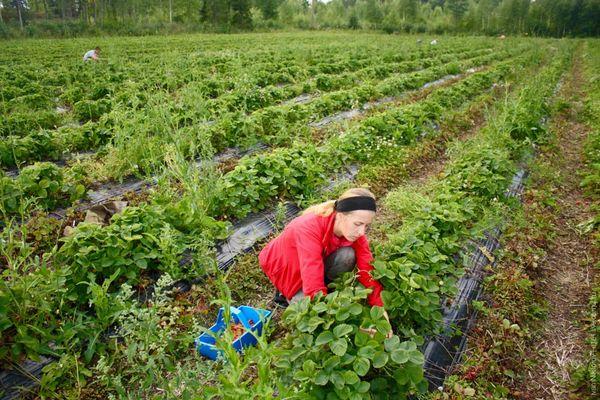
When propagating in the fall, carried out in September, the covering material will need to be removed and cleaned after winter. Strawberries planted in the spring take root better. Not all seedlings have time to adapt to their new location during fall planting.
Strawberry bushes are planted in pre-prepared and well-moistened holes, the roots are covered with soil, and watered. Before planting, the roots can be shortened and soaked in a growth stimulator. The planted plants should be covered with the corners of agrofibre. The rosette of leaves should be above the soil surface.
Further care
If strawberries are planted on agrofibre, they are cared for in the same way as in open ground. When planting under dark plastic, a drip irrigation system is used for watering.
Top dressing
During the first season after planting, bushes growing in well-fertilized soil do not require fertilizing. Fertilizer should only be applied in the second year. In early spring, the bushes are fed with organic matter or nitrogen-containing substances. Before flowering, the soil is fertilized with potassium and phosphorus. After fruiting, when new flower buds are forming, the bushes are fed again with complex fertilizers.
Features of watering
Strawberries are watered once a week. The covering material retains moisture for a long time. Strawberries grown under agrofibre are watered with a hose, while those grown under plastic are irrigated using a drip irrigation system. No more than 10 liters of water are used per square meter of plot.
Moustache removal
Summer runners won't be able to establish themselves on plastic or agrofibre. These shoots should be removed. If you plan to plant the seedlings in a new location, the runners can be left in place.
Errors and recommendations
When planting strawberries under plastic, gardeners make a number of mistakes. For example, they create wide beds and space the numerous rows too close together. It's better to create a narrow bed with two rows spaced 50 centimeters apart.
If you plan to cover the strawberries with plastic, the bed should be raised to prevent rainwater from pooling and instead allow it to drain away. On level ground, permeable agrofibre can be used as a cover.
Strawberries don't respond well to fresh manure and lime. These additives can cause their bushes to "burn." Liming and organic fertilization are applied in the fall for spring planting, or in the spring for summer planting.
Related posts:
 Description and characteristics of the Vima Zanta strawberry variety, planting and care scheme
 Description of the everbearing strawberry variety Mara de Bois and growing rules
 Description and characteristics of the Korona strawberry variety, planting and care scheme
 Description of the everbearing strawberry variety Selva and cultivation technology
 Step-by-step instructions for planting and propagating strawberries with runners in August
 Description of the Florence strawberry variety, planting and care features
 Description of the Solovushka strawberry variety, planting and care instructions
 Description and how to plant the Garland strawberry variety