
- The benefits of propagating strawberries using tendrils
- The right time
- In the spring
- In summer
- In the fall
- How to prepare planting material
- What kind of mustache is used for cultivating the crop?
- Do I need to root them in pots?
- The nuances of planting in open ground
- Selecting a site
- We prepare and disinfect the beds
- How to Plant Seedlings: Step-by-Step Instructions
- Planting on agrofibre
- Caring for planted bushes
- Watering
- Mulching
- Weeding
- Hilling
- Trimming
- Top dressing
- Shelter
Strawberries are beloved by gardeners for their delicious berries and low maintenance. They are easily propagated by several methods during the spring and fall seasons: seeds, runners, and division. Below is information on planting strawberries using runners in August: the advantages of this propagation method, how to prepare planting material, the nuances of planting outdoors, and caring for established plants.
The benefits of propagating strawberries using tendrils
Growing garden strawberries using runners has the following advantages:
- the ability to grow a large amount of planting material;
- ease of growing;
- the ability to regulate the number of strawberry bushes on the site;
- good plant survival rate;
- preservation of the qualities characteristic of the variety.
The runners can be easily planted in a strawberry bed, and caring for them also does not require much expense.
The right time
Strawberry runners are planted in autumn, spring, and summer. Each period has its own characteristics.
In the spring
To propagate the crop in the spring, planting begins immediately after the onset of warm weather. This gives the garden strawberries time to take root and absorb water and nutrients from the soil by fall. Even if the planting produces berries during the summer, it's best to remove them. This way, the bushes will become well established and produce a bountiful harvest the following spring.
In summer
The best summer month for planting strawberries is August. By this time, young runners have already formed and are easily transplanted into prepared beds. The layers are trimmed with pruning shears, and the rosettes are carefully dug out with a shovel. Only one rosette is planted per hole, as the bush needs enough space to develop.
In the fall
Experienced gardeners prefer to propagate strawberries in the fall, specifically in September. At this time, the weather is cooler and heavy rains begin, allowing the bushes to establish easily. When planting in the fall, the root zone is mulched before the onset of frost, and the plants are covered with spruce branches.
How to prepare planting material
A strawberry harvest depends largely on the correct selection of planting material. Plants that have produced fruit well are noted in advance and their runners are selected. Over the course of the season, many rosettes develop on a single vine, but the strongest ones are those from the first and second tiers.
What kind of mustache is used for cultivating the crop?
The runners growing close to the mother plant are suitable for propagation. They are the most viable. The further the rosettes are from the bush, the smaller and weaker they are. Few people know that strawberry plants come in male and female varieties.

For propagation, use female plants: they are usually smaller and more compact. Male plants are easily distinguished by the fact that they do not bear fruit. Their runners are large, but they do not produce fruit, so there is no point in leaving them. The plants selected for propagation should be dug around on all sides, then carefully picked, being careful not to damage the roots. Strawberries can be grown both outdoors and indoors.
Do I need to root them in pots?
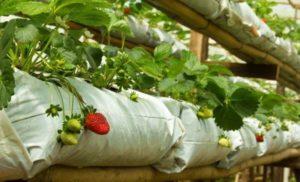
Some gardeners prefer to grow strawberries in containers. This method is beneficial for the following reasons:
- pots can be moved around the area, choosing sunny places, and also brought indoors when frost sets in;
- convenient to harvest;
- the berries do not get dirty from rain or watering;
- saves space in the garden.

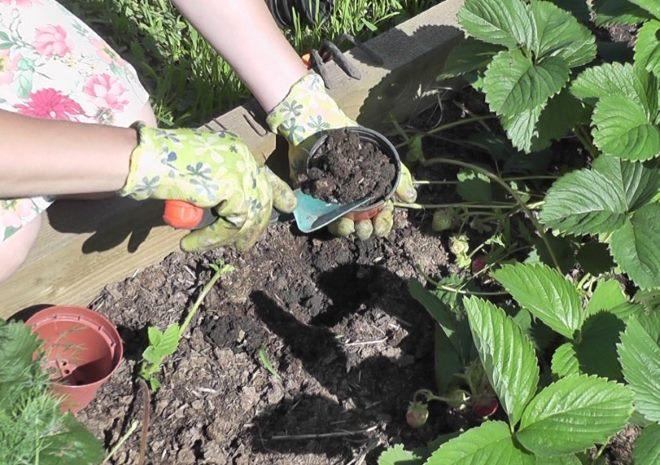
Growing strawberries in pots requires significant investment and effort on the part of the gardener. To propagate strawberries in garden beds, plastic cups can be used. They are filled with soil, the runners are guided into them, and the rosettes are gently pressed into the soil. Once the young plants are well developed, the cuttings are removed, and the strawberries are planted in the garden beds.
The nuances of planting in open ground
Strawberry yield depends not only on the quality of the planting material but also on the planting location and soil. The more favorable the conditions, the better the yield. Garden strawberry leaves should show no signs of disease.
Selecting a site
The key to strawberry growth is warmth, so choose a sunny, wind-free planting site. Strawberries dislike flooding, so the bed should be elevated. Loamy or sandy loam soil is ideal. Heavy soil should be treated with a rooting agent, while light soil should be weighed down with clay.
We prepare and disinfect the beds
To disinfect the soil of any larvae or pathogens, it should be treated after thawing. Ammonia water or simply boiling water can be used for this purpose. Organic farmers can also treat the soil with biological preparations, such as Fitosporin.

The strawberry planting area is cleared of debris and dug over. During this process, the soil can be enriched with compost or humus with added mineral fertilizer. Fertilizer is applied six months before planting. Strawberries are planted in one or two rows.
Important! Garden strawberries should not be planted after potatoes, cabbage, pumpkins, or sunflowers. You can enrich and disinfect the soil by sowing green manure six months before planting.
How to Plant Seedlings: Step-by-Step Instructions
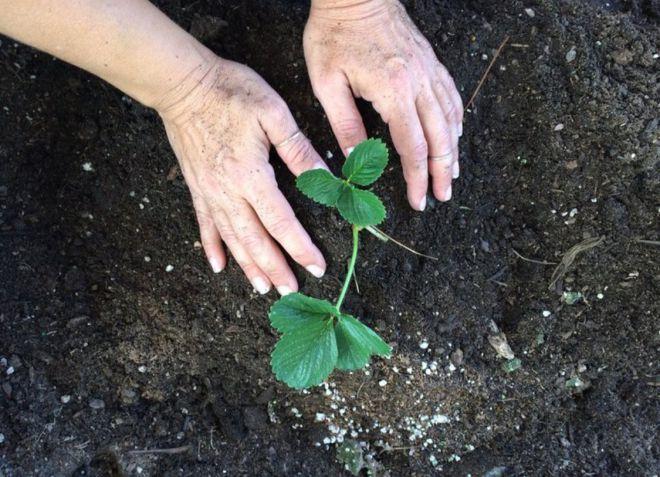
To dig up strawberry roots, use a garden spade. Carefully do so to avoid damaging the delicate root system. Plant the bushes as follows:
- Dig holes 15-20 centimeters deep, spaced 30-40 centimeters apart. The distance between plants depends on the bushiness of the variety.
- The interval between rows is 60-65 centimeters.
- The strawberry root system is spreading out; one bush should be planted in each hole.
- The plants are covered with soil up to the root collar.
- The tree trunk circle is lightly compacted and watered.

Warm water is used for irrigation, otherwise garden strawberries may be affected by fungal diseases.
Planting on agrofibre
Before laying agrotextile and planting the strawberry bushes, the beds are carefully leveled. Then, a covering material is laid out and secured to the sides with cobblestones. Planting locations are marked on the material in a cross-shaped pattern with chalk. The corners are turned outward, and holes for the strawberries are dug in the slits.
Caring for planted bushes
To help strawberries take root quickly, they need proper care, especially in the first few days after planting: water, feed, mulch, weed, hill up the bushes, and cover them for the winter.

Watering
Immediately after planting, water the strawberries frequently to ensure rapid establishment. This is done in the evening, after the heat of the day but before sunset. Use settled water that has been warmed by the sun during the day. Mature plants are watered after the top layer of soil has dried. Water the bushes generously but infrequently, otherwise they may be susceptible to fungal diseases.
Mulching
To retain soil moisture, strawberries are mulched with peat, straw, or sawdust. This material also prevents the berries from becoming soiled after rain or watering. The mulch is applied in a 10-15 centimeter layer. Another useful property of the cover is that it protects the root system from freezing in winter.


Weeding
Strawberry roots are close to the soil surface, so weeding should be done carefully. It's best to do this a few days after watering. This not only removes weeds but also loosens the soil. Weeding allows air to reach the roots and prevents many diseases and pests.
Hilling
Exposure to rain and tap water causes the soil to settle, exposing the root system of plants. This impairs growth and fruiting. Furthermore, exposed roots can freeze during the cold winter. To prevent this problem, hill up the bushes after watering.

Trimming
When planted in August in warmer regions, strawberries not only have time to root but also to develop runners. These need to be removed, as they drain the plant's energy needed to survive the winter. Dry, yellow leaves, which hinder the plant's growth, are also trimmed. Use clean, disinfected tools for this.
Top dressing
In the year of summer planting, strawberries are not fertilized. The following spring, nitrogen-containing fertilizers are applied to promote the growth of green mass. After harvesting, they are treated with complex mineral fertilizers containing a high concentration of potassium and phosphorus.
In the fall, feed the bushes with potassium, for example, sprinkle 2 cups of wood ash per square meter of the beds, then water them.
Shelter
Garden strawberries planted in August are not yet fully established, so they will need a shelter. This is constructed from spruce and pine branches, sawdust, and dry leaves. In winter, the beds are covered with snow. They can also be covered with agrofibre, which retains heat well. In the spring, the shelter is removed to prevent the strawberry bushes from rotting.
Related posts:
 Description of the Florence strawberry variety, planting and care features
 Description and characteristics of the Vima Zanta strawberry variety, planting and care scheme
 How to grow strawberries at home
 Description of the everbearing strawberry variety Selva and cultivation technology
 Description of the Holiday strawberry variety, cultivation and propagation methods
 Description and how to plant the Garland strawberry variety
 Description of the Solovushka strawberry variety, planting and care instructions
 Description and characteristics of the Zenga Zengana strawberry variety, planting and care