
- Description and Features
- History of selection
- Properties
- Caloric content
- Benefits and harms
- Acidity
- Characteristics of the bush
- Vine
- Bunch
- Productivity
- Taste qualities
- Winter hardiness and drought resistance
- Disease resistance
- Applications of berries
- How to plant correctly
- Recommendations for choosing deadlines
- Site selection and preparation
- How to select and prepare planting material
- Planting diagram
- Care instructions
- Watering
- Top dressing
- Mulching
- Garter
- Disease prevention
- Bird protection
- Pest control methods
- Wasps
- Spider mite
- Leaf roller
- May beetle larvae
- Preparing for winter
- Pruning and shaping
- Spring
- Summer
- Autumn
- Methods of reproduction
- Cuttings
- seedlings
- By grafting method
- Bends
- Advantages and disadvantages of the variety
- Harvesting and storage
- Tips and advice from experienced gardeners
Breeders are working hard to cultivate grapes that can grow not only in the south but also in temperate latitudes. One frost-hardy variety is Rumba. It's easy to grow, and its fruit has a high market value. Below is information on planting, care, propagation methods, and the advantages and disadvantages of this variety.
Description and Features
Rumba grapes can quickly form a vigorous, well-developed vine. The first few clusters will appear as early as 2-3 years after planting. This early-ripening variety is ready for harvest as early as August. Remaining the bunches on the vine for a while will preserve their flavor and appearance.
History of selection
The Rumba grape is a product of domestic selection. Amateur breeder V. U. Kapelyushny developed this early-ripening hybrid by crossing Vostorg and Cherrel. Initially zoned for the Rostov region, the variety later spread to other regions, including those with cold climates.
Properties
Rumba grapes are a table variety, and their fruits are consumed mainly fresh.
Caloric content
Rumba grapes are sweet, with a sugar content of up to 24%. The fruit contains 69 calories per 100 grams. They also contain a wealth of beneficial nutrients.
Benefits and harms
Grapes provide the following benefits:
- prevents the formation of blood clots;
- treats pathologies of the cardiovascular system;
- removes heavy metals from the body;
- improves the functioning of the digestive system;
- is an antioxidant;
- calms the nervous system;
- improves the condition of skin, hair, nails.
In addition to the benefits, grapes can be harmful when consumed in the following cases:
- in case of diabetes mellitus;
- in case of exacerbation of peptic ulcer disease;
- for hypertension, liver cirrhosis.
Please note! It is advisable to consume grapes a few hours after a main meal, otherwise fermentation may occur in the intestines.
Acidity
The acid content of Rumba grapes is 5-7 g/l. This table grape is consumed primarily fresh. It is rarely used for winemaking.
Characteristics of the bush
The Rumba grape is self-fertile. The vine produces both male and female flowers. Therefore, planting pollinators nearby is not necessary.
Vine
Grape shoots reach 5-6 meters in length. Young vines are green, but mature ones turn brown. The leaves are deeply dissected and five-lobed.
Bunch
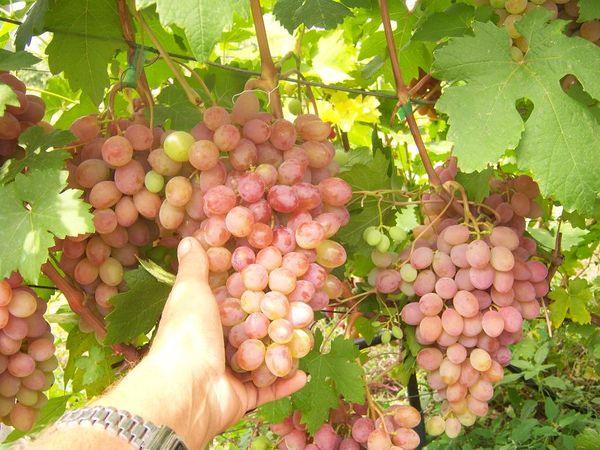
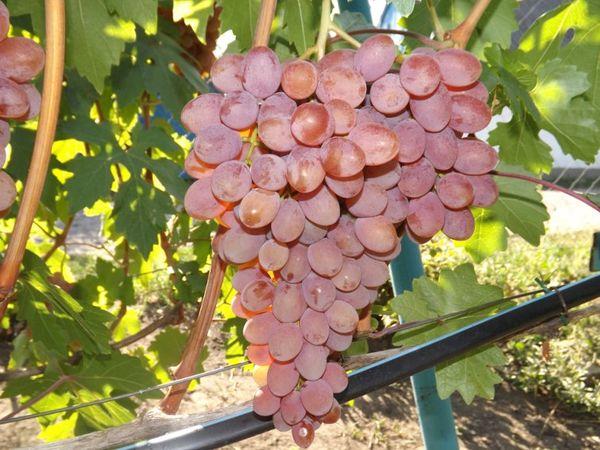
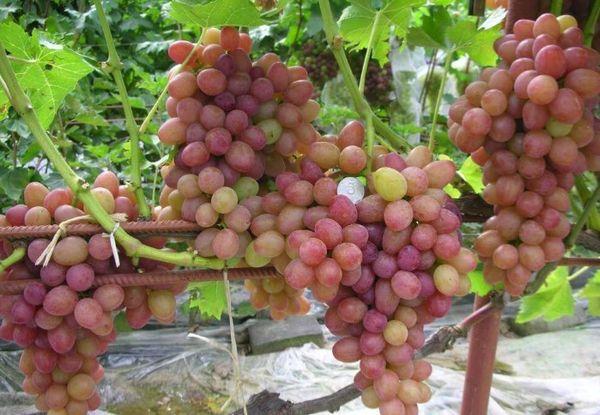
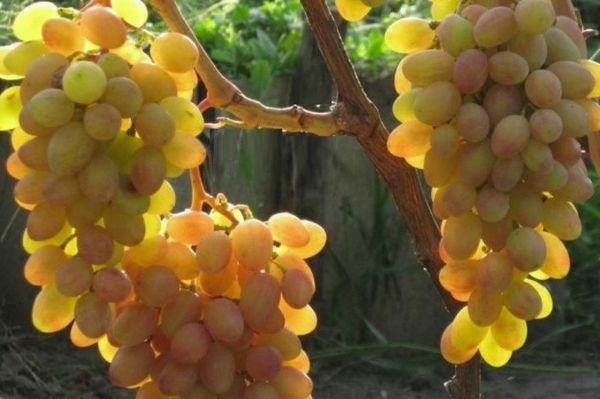
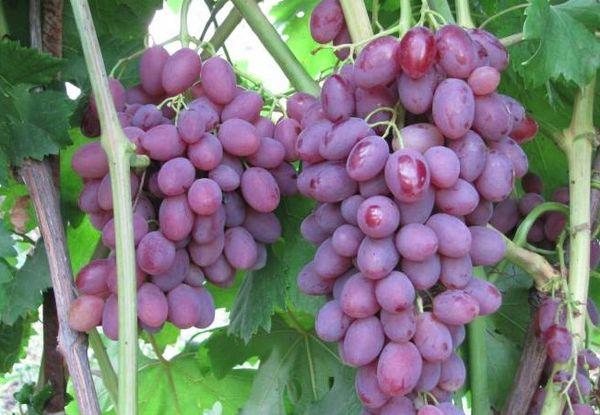
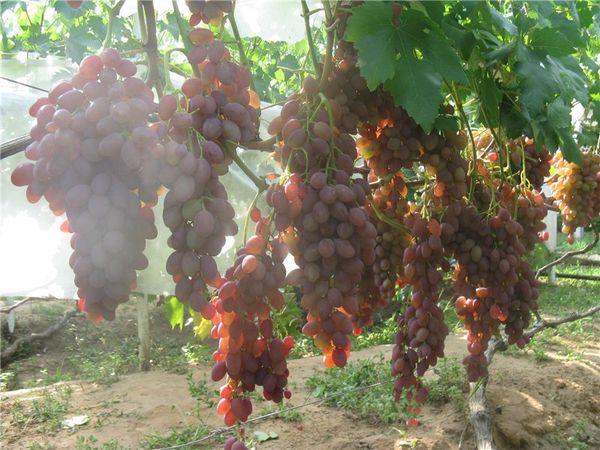
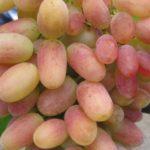
Rumba grape clusters weigh between 800 and 1200 grams. The berries are oblong, coral-pink in color, reaching 2-3 centimeters in length and 1.5-1.8 centimeters in width, weighing 6-10 grams. The clusters are moderately loose, preventing them from rotting during rainfall.
Productivity
Rumba grapes are a high-yielding variety. A single vine yields 50-60 kilograms of berries. The first bunches begin to ripen 95 days after bud break. The bunches remain on the vine for a long time, preserving the flavor and appearance of the berries. This quality makes them ideal for gardeners who rarely visit their plots.
Taste qualities
Rumba grapes are delicious and sweet. The skin is firm, and the flesh is meaty and crisp. The longer the bunches hang on the vine, the more intense the cherry flavor and aroma of the berries become.
Winter hardiness and drought resistance
The variety tolerates winter temperatures down to -25°C. In the year of planting, the bushes require shelter. Rumba grapes cope with drought easily; abundant watering is only necessary when planting the seedlings.
Disease resistance
The variety is resistant to the main grape diseases—mildew, powdery mildew, and gray mold. However, to prevent these diseases, the bushes need to be sprayed with antifungal agents several times per season.
Applications of berries
Rumba grapes are primarily eaten fresh. They can also be used to make juices and compotes. This variety is popular for its attractive clusters of large berries and pleasant flavor. The grapes are easy to transport and store for long periods.
How to plant correctly
Carefully select planting material and avoid buying it from random sources. Seedlings grown in the same region where they will be growing will thrive best.
Recommendations for choosing deadlines
Rumba grapes are planted in the spring or fall. Spring planting is recommended for colder regions: this allows the vines to establish themselves well before frost. Grapes are planted before bud break. In the south, plants can be planted in the fall, but at least a month before the onset of frost.
Site selection and preparation
Choose a sunny location for the plant, protected from northern winds. Grape vines can be planted near fences or outbuildings. The variety is undemanding of soil: it will grow in any type of soil, as long as it's not waterlogged. Two weeks before planting, dig a hole and mix the soil with compost.
How to select and prepare planting material
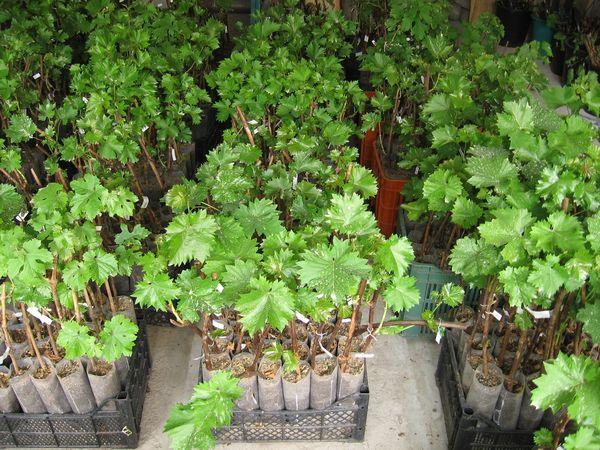
For planting, purchase two-year-old grape vines about 20 centimeters long, with a well-developed root system, and no damage or signs of disease. The roots are trimmed slightly and soaked in water for 24 hours, optionally with a growth enhancer.
 Important! Purchase seedlings from reputable growers or retailers.
Planting diagram
Grape bushes are planted as follows:
- dig a hole measuring 80×80×80 centimeters;
- if the soil is heavy, a 15-centimeter layer of drainage is placed on the bottom;
- pour a layer of soil;
- place a grape bush in the center, water it, and cover it with the remaining soil;
- lightly compact and cover with mulch.
When planting several grape bushes in a row, leave a distance of 3 meters between them.
Care instructions
Rumba grapes require some care, especially in the first year after planting. They need regular watering, fertilizing, tying, pruning of excess shoots and bunches, and protection from diseases and pests.
Watering
Immediately upon planting, add 2-3 buckets of water to the hole, and water the soil again after 3 weeks. After that, water the grapes only as needed, especially if there has been no rain for an extended period. Excess moisture around the root system can cause fungal diseases.
Top dressing
As an organic fertilizer, humus or bird droppings are added to the bushes every three years. In the spring, the grapes are fertilized with nitrogen, and in the summer, with a potassium-phosphorus compound. After fruiting, to prepare the bushes for winter, the plant is fed with potassium.
Mulching
Immediately after planting, Rumba grapes are mulched with peat, straw, and sawdust. Mulching helps retain moisture and prevents weed growth. Furthermore, mulch prevents crusting after watering or rain.
Garter
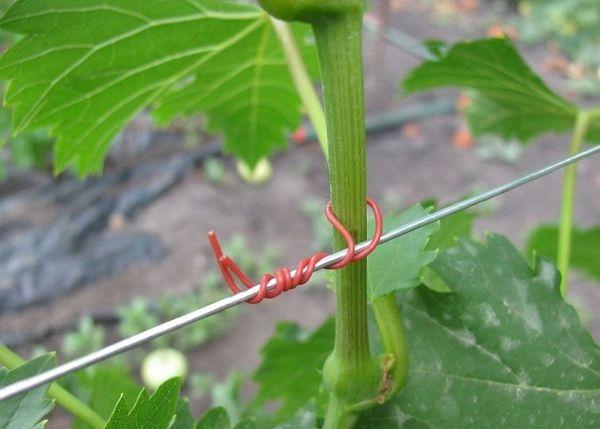
Immediately upon planting, or later, when the first shoots emerge, a stake is driven in near the vine. The branches are tied to it to prevent them from breaking in the wind. Then, as the new vines develop, they are also tied to the support, preventing them from breaking and also guiding their growth.
Disease prevention
To prevent grapevine diseases, preventative measures are necessary. To do this, remove fallen leaves from the tree trunks and remove any weeds growing nearby. Additionally, spray the grapevines with antifungal agents several times a season.
Bird protection
Feathered pests love to feast on sweet berries. To prevent them from ruining the appearance of grape clusters, they need to be controlled using various methods. For example, placing scarecrows near the bushes, hanging rustling film, or tape.
If you have a small number of grapes, you can wrap each bunch in fine-mesh netting. Also, place a jar of water near the plants; the birds may only want to drink and won't touch the berries.
Pest control methods
Besides birds, grapes are also attacked by other pests, causing damage through their activities.
Wasps
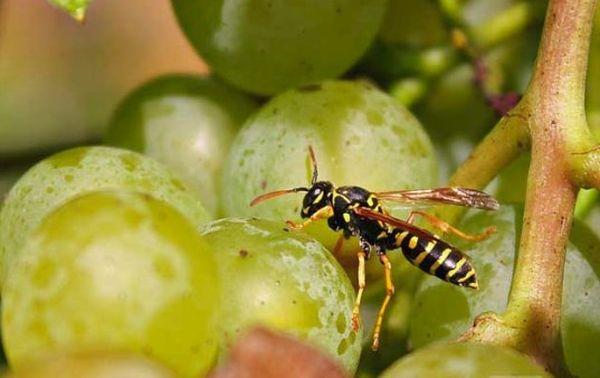
First, you need to find and destroy wasp nests. You can protect your crops from them in the same way as you would from birds, using fine-mesh netting. Smoke from a campfire or liquid smoke will repel pests.
Spider mite
If the leaves are covered in webbing, it means the grapevine is infested with spider mites. If there are only a few, folk remedies, such as spraying with horseradish leaf infusion, will help. If the pest appears in large numbers, spray it with an insecticide.
Leaf roller
Leaf roller caterpillars damage leaves, inflorescences, buds, and berries. Protecting grapes from this pest requires a comprehensive approach, including removing plant debris from the trunk circle, weeds, and applying bioinsecticides several times per season.
May beetle larvae
This pest can consume entire grape buds. Experienced gardeners recommend setting traps filled with kvass to control it. The larvae love to feed on roots. They are intolerant of nitrogen, so in the spring, the soil around the grapes is watered with a solution of 10-20 milliliters of ammonia and 10 liters of water.
Preparing for winter
During the first three years, grapevines are removed from their supports and covered. This procedure should not be rushed: it begins only after temperatures have remained at -3°C for several days. After removal, the branches are covered with soil and spruce branches.
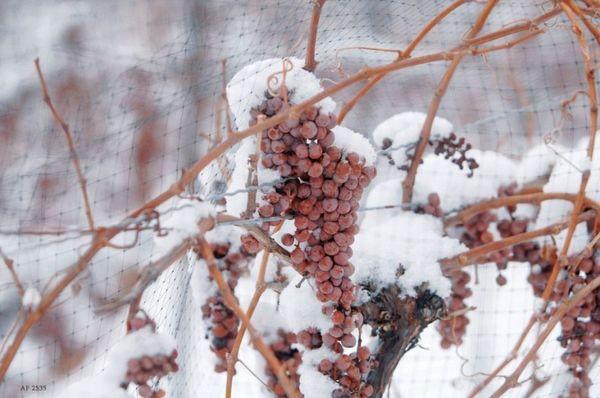 Important! To help grape vines withstand harsh cold weather, perform a moisture-replenishing irrigation in late autumn.
Pruning and shaping
Over the course of a season, grapevines develop a large number of vines, placing additional stress on the bush. This results in smaller berries, which, in turn, leads to a loss of marketability in the bunches.
Therefore, grapes are pruned several times during the spring-autumn period.
Spring
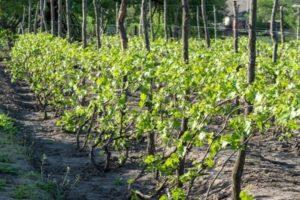
With the arrival of warm weather, begin the first pruning of the season. Remove any vines that haven't survived the winter. Use a sharp, disinfected tool for this.
Summer
Remove shoots, side shoots, and excess bunches that are crowding the crown. No more than two bunches are left on each branch. Young Rumba vines are left with 20 bunches, while mature vines are left with 40.
Autumn
Before the onset of frost, another pruning is carried out. This is primarily to make it easier to cover the vine. After pruning, treatments are carried out against diseases and pests.
Methods of reproduction
There are several ways to propagate Rumba grapes: cuttings, seedlings, grafting, and layering.
Cuttings
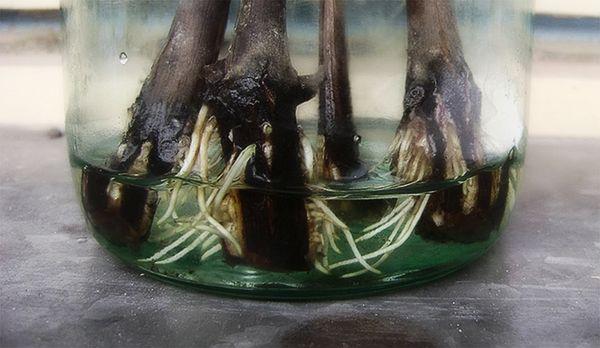
In the fall, cuttings with 4-5 buds are taken and soaked in a copper sulfate solution. They are then placed in plastic bags and taken to a cool room. In the spring, they are treated with a growth stimulant and rooted indoors.
seedlings
Two-year-old grape vines are planted outdoors in spring or fall. They are cared for throughout the season, including watering, mulching, and tying. For several years, young seedlings require winter shelter.
By grafting method
Healthy, hardy grape varieties are used as rootstocks. Scion cuttings are prepared in the fall and stored in the refrigerator until spring. The procedure is carried out in April or May, combining the scion with the rootstock.
Bends
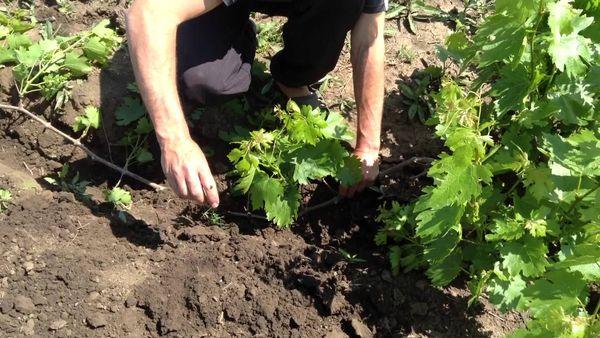
To propagate grapevines by layering, dig a shallow trench near the vines in late summer. Place the vines in the trench and secure them with bent wire. Water the planting site throughout the summer, and remove any weeds around it. Once shoots appear and develop well, separate them from the parent plant and replant.
Advantages and disadvantages of the variety
The advantages of Rumba grapes include the following qualities:
- early ripening;
- high yield;
- attractive appearance of berries;
- high taste qualities;
- unpretentiousness;
- frost resistance;
- good survival rate of cuttings;
- excellent transportability.
The disadvantages of the variety include a decrease in the size of the berries when there is an excess of clusters on one shoot.
Harvesting and storage
When the berries acquire a rich coral-pink color, harvesting begins. The key factor is dry weather, otherwise the grapes will not store well. By storing the grapes in a cool room, you can enjoy the delicious and nutritious fruits within 3-4 weeks.
Tips and advice from experienced gardeners
Winegrowers have extensive experience growing Rumba grapes, which they are willing to share with novice gardeners. Here are some tips and recommendations:
- Carefully select a location for planting grapes: it should be maximally illuminated by the sun throughout the day.
- Water the seedlings generously only in the first year after planting.
- Do not irrigate the bushes using the sprinkler method.
- Pruning is a mandatory procedure.
- In the first 2-3 years after planting, cover the plants for the winter.
Rumba grapes are easy to care for, have a strong immune system, and boast excellent marketability, flavor, and transportability. These qualities make this variety very popular among gardeners and consumers.
Related posts:
 Description of 30 grape varieties for Siberia, planting and care for beginners
 How to grow grapes in the Moscow region in open ground without a greenhouse
 Description of the Julian grape variety, planting and care instructions
 The ripening time of grape vines by variety, how to speed up the process, and what to treat the plant with
 Description of 30 varieties and types of Muscat grapes, planting, cultivation and care
 Description of the Krasotka grape variety, planting and care technology
 Beginner's Guide to Growing Grapes in Open Ground in Central Russia
 Description and characteristics of the Preobrazhenie grape variety, planting and care