
Among varieties of this delicacy, red corn stands out for its beneficial properties; its color comes from anthocyanins. Besides its nutritional benefits, some varieties of red corn are simply delicious, making them a popular addition to any garden.
General characteristics of the plant
Corn, or maize, is a tall plant. Its robust stalks reach heights of 2 meters or more, but shorter varieties also exist. Each stalk produces several ears of red kernels, which retain their color when cooked.
The root system is fibrous, consisting of numerous relatively thin rootlets. Almost all the roots are located at a shallow depth. Under normal conditions, red corn roots are quite capable of supporting the weight of the green mass and cobs. However, strong winds can uproot the plants from the loose soil.
It's best to plant corn in the garden in several rows, simulating field cultivation. This will not only prevent the plants from falling over but also facilitate pollination, increasing yield.
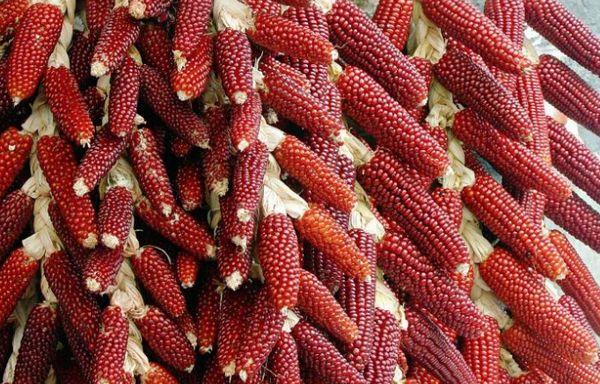
The number of cobs varies depending on the variety. Large cobs up to 30 cm long (Bloody Butcher, Ruby Garnet, etc.) produce only 2-4 cobs per plant. Small cobs about 10-13 cm long (Red Miracle Cone, Early Pink Radiance, etc.) are much more numerous. Each plant can yield 8-10 cobs.
Red corn is a heat-loving plant. However, it can be grown even in the Altai or Southern Siberian climates. The most important factor is the initial growth of the plant. The grain will not germinate in cold soil (below 13°C), but after germination, the above-ground part actively develops even in low heat. Air temperature has virtually no effect on cob formation and kernel growth, although in seasons with prolonged rainfall, yield may decrease due to the inability to pollinate the female flowers.
Take a look Also
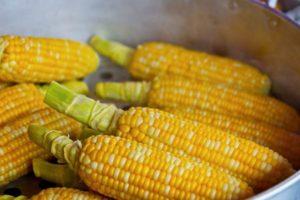
In some regions, it's difficult to obtain seeds for propagating the variety on your own plot. The cobs successfully reach the technical maturity (wax stage), when they're ready for consumption, but they may not fully mature (for seed storage and sowing the following year). To successfully grow red corn in a given region, you need to choose the right variety based on ripening time and the length of the growing season.
Consumer qualities of different varieties
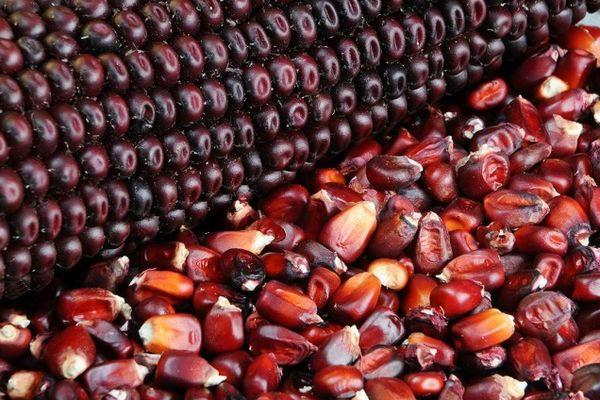
Among red corn varieties, there are those that taste best when boiled (waxy and dent) or can be used to make popcorn (only when ripe), but they can also be boiled. Ripe kernels are also used to make flour and grits, but red corn is not typically grown on a large scale in gardens.
For amateur gardeners, the following varieties can be recommended:
- Bloody Butcher (USA) is a mid-season variety (70-110 days) with large ears up to 30 cm long. The kernels are flat, tightly pressed together, and the ear is well-filled. Flavor is excellent; the kernels at the waxy stage have a sweet taste and are best suited for boiling young heads. Only 2-3 ears may grow on a single stalk.
- Ruby Garnet (Russia) – similar in appearance and ripening time to the previous corn. Suitable for boiling, and when ripe, for making groats.
- Red Wonder Cone (China) is a high-yielding bush variety with low stems (up to 1 m). The plant produces up to 10 ears, each about 15 cm long. The kernels are small, round, and the ears are well-filled. Ripening takes approximately 80 days from sowing. At waxy ripeness, the young heads can be boiled whole, and at biological maturity, the variety is used for popcorn.
- Red Arrow (China) is a variety suitable for boiled consumption and popcorn. The kernels are dented, elongated, and flat. The color is rich, burgundy with a black tint. A stalk can produce 4-5 ears up to 30 cm long.
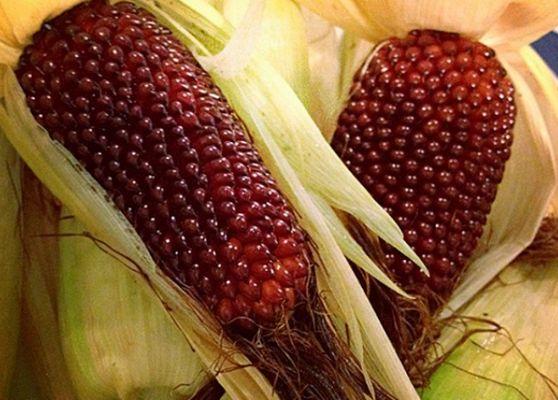
- Strawberry is the most famous red corn variety in Russia. In the milky-waxy stage, it's delicious when boiled; it's sweet, with round, slightly pointed kernels of a pleasant ruby hue. The cob grows up to 22 cm long and reaches commercial maturity 80-90 days after sowing.
- Oaxacan Red (USA) produces large ears up to 25 cm long. The kernels are sweet when waxy and ripe, making this variety ideal for boiling. When ripe, it is used to produce grits and flour.
- Mini-striped (China) - an unusually colored variety with striped red and white grains, bush, productive (up to 5 heads on 1 stem), the bush usually has 3 stems.
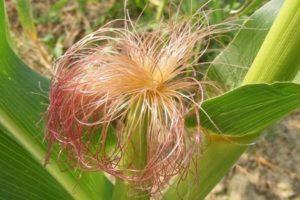
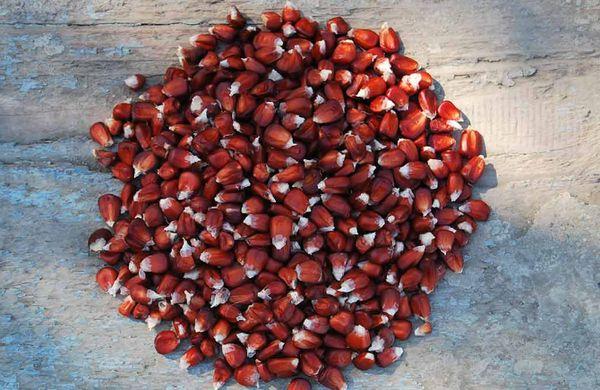
There are also other varieties of red corn with later maturation periods. In central Russia, they can only be grown in a greenhouse or from seedlings.
Red corn cultivation techniques
Once the soil has warmed up sufficiently, prepare the area for corn. Add at least one bucket of well-rotted compost per square meter to provide the plant with ample nitrogen. You can also use complex mineral fertilizers (ammonium nitrate, universal ammophoska, etc.) according to the product's instructions.
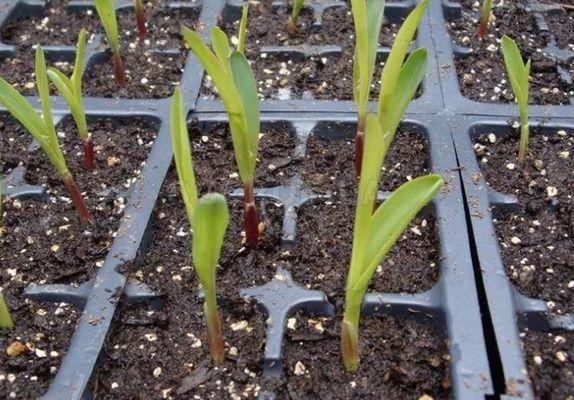
To save time on germination, you can soak the seeds in advance and then sow them while they're already sprouted. This will help you get seedlings 7-10 days earlier than when sowing dry seeds. Spread the seedlings in a single layer over a damp cloth, then cover with another damp cloth. Roll the cloth into a roll and wrap it in plastic wrap, leaving openings for air circulation.
Germinate in a warm place (+25°C) for 4-5 days, constantly monitoring the seeds. As soon as sprouts of 1-2 mm long roots appear, carefully transfer the seeds to prepared soil.
Sow corn using a 20x50 cm pattern. It can be planted in strips of 4-5 rows, but it's not recommended to plant just one long row. The plants are wind-pollinated, and most of the pollen will be carried away before reaching the cobs.
Related posts:
 Technology for growing corn in open ground and greenhouses, planting and care
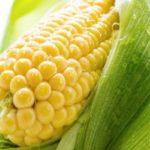 Description and characteristics of the most productive varieties and hybrids of corn
 Corn sowing rules and regulations, how to plant and prepare seeds
 Technological map for growing corn for silage, seeding rates and yield per 1 ha
 Rules for harvesting corn from fields for different purposes: for grain, for popcorn and for silage
 Why do you need to fertilize corn? Irrigation and watering after applying fertilizer.
 Corn diseases and pests, effective control measures and prevention
 Description and characteristics of the best varieties of sweet corn, cultivation technology
We've been planting Ruby Garnet for the last few years. It's excellent corn, tasty and juicy, but we only plant it to eat, a little at a time. I noticed that when we fertilized it last year, BioGrow, then the harvest was much higher.