
Onions are one of the easiest crops to grow in the garden. Even a novice gardener can handle this task. Growing onions in the Urals is similar to other regions. The plant is easy to care for, making it unpretentious. However, there are a number of specific considerations when growing and harvesting onions. Early and mid-season varieties are best suited for planting in this region.
The difference in cultivation is that harvesting largely depends on specific climatic conditions. Time to harvest onions in the Urals directly affects the shelf life of these vegetables.
Signs of maturity
There are a number of external signs by which one can roughly determine the degree of maturity of the bulbs.
Leaf color
The onion bulbs' appearance helps determine their maturity relatively accurately. The plant's stem turns yellowish and dries out, and the leaf tips also change color. This usually occurs by the end of the second month of growth.
The neck at the base of the head becomes soft, and the onion tops cannot stay upright.
False stem
As the onion matures, this part of the plant also dries out, but not completely. It retains its green color, although it becomes rather wilted.

Methods to speed up ripening
Experienced gardeners sometimes use artificial methods to accelerate the ripening of bulbs. In this case, the vegetables ripen faster, but the bulbs will be smaller than those ripened naturally.Such methods help to obtain a harvest that can be stored throughout the winter.
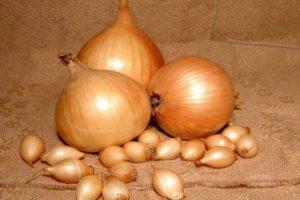
More sun for heads
Onions are a plant that normally thrives in light shade. However, in the Urals, they should be planted in a sunny location. This will speed up the ripening process.
For better ripening, experienced gardeners lightly remove the top layer of soil to partially expose the bulb. Sunlight promotes rapid ripening of the bulbs.
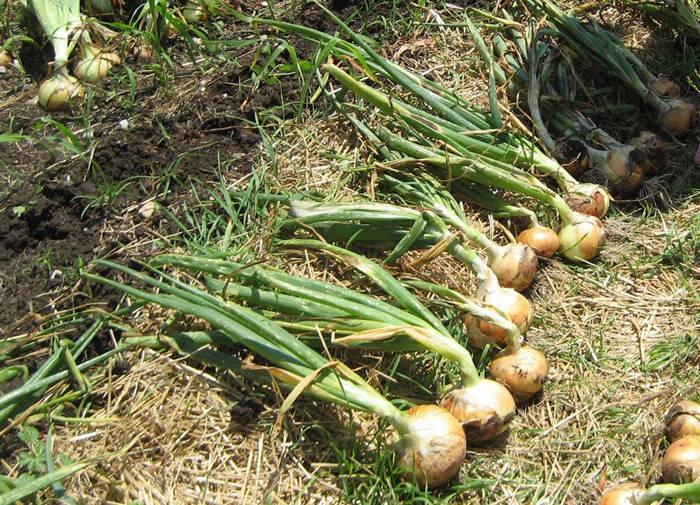
Trimming roots
This method forces the plant to direct nutrients from the tops to the maturing onion bulbs. Trim the bulbs with a knife 5 cm below the base. This procedure is best performed when the top layer of soil is dry.
Undermining the roots of bulbs
This is done by digging up the plant and slightly lifting the soil around it, cutting off some of the long roots. Another method is to bend the tops down to the ground. This artificially suppresses their growth, and the plant directs its energy toward the maturation of the bulb.
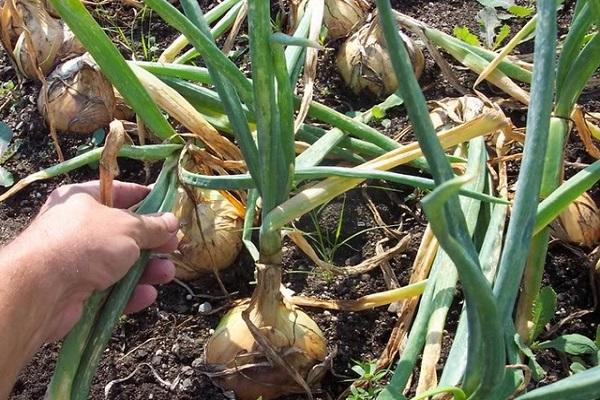
When they clean up in the Urals
If onions are planted in May, the harvest will begin on July 20th. Typically, the entire crop should be harvested by early August, as the rainy season may begin after that.
It's important to consider weather conditions. If the summer is rainy and cold, the bulb ripening time will be delayed.
Harvesting and storage of crops
Stop watering these vegetables a week before you plan to harvest them. Harvesting should be done on dry, sunny days. If the crop ripens unevenly, you can harvest it partially, as the heads ripen.
Large, ripe bulbs are removed from the soil along with the tops, but the sets should be carefully dug up. It's best to leave the pulled bulbs in the beds for a few hours to allow them to dry thoroughly. Leaving the harvest overnight is not recommended, as the bulbs may absorb excess moisture. Don't rush to cut the tops off the harvested onions immediately. As they dry, they will impart additional minerals to the bulbs.
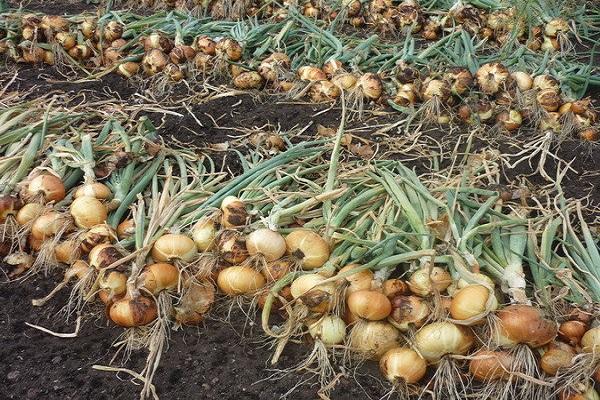
After harvesting, it's best to place the onions on racks in a well-ventilated area under cover. This will give them two weeks to dry and ripen. Only then should they be sorted and stored for long-term storage. Care should be taken to ensure that late-ripening onions are not exposed to the first frost. Onions should be stored dry and in a cool place.
The dangers of untimely harvesting of onions
Onions must be harvested on time. Bulbs that aren't harvested promptly may sprout. If an overripe bulb remains in the ground, water from the soil continues to seep into it, causing rotting. Such a vegetable should not only not be stored, but should not be eaten at all.
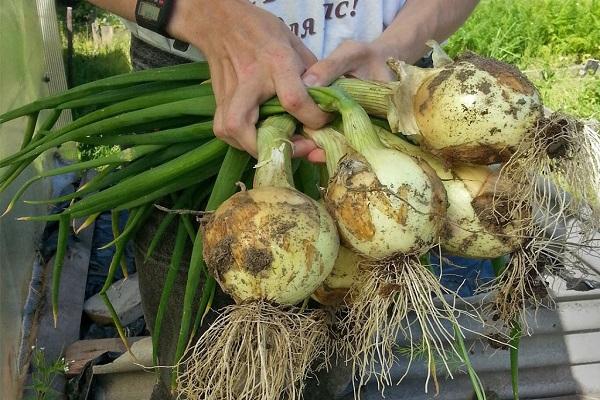
Unripe onions lack protective scales, meaning they won't store well. Therefore, it's important to know the proper onion harvesting conditions in the Urals.
Typical mistakes
Often, inexperienced gardeners rely only on external signs of ripening, which is why they make mistakes.
- It's necessary to use a combination of external indicators and a mathematical method for calculating harvest times. Changing weather conditions must also be taken into account.
- Sometimes gardeners wait until the onion tops turn completely yellow and dry out. This shouldn't be done, as it can lead to overripening of the onions.
- Sometimes, in an effort to harvest on time, gardeners dig up onions too early. To avoid this, pull one plant out of the ground and check whether the protective layer has formed sufficiently. The skins should be dry and rustle when crushed in your hand.
- Avoid over-watering the soil as this will slow down the ripening of the bulbs.
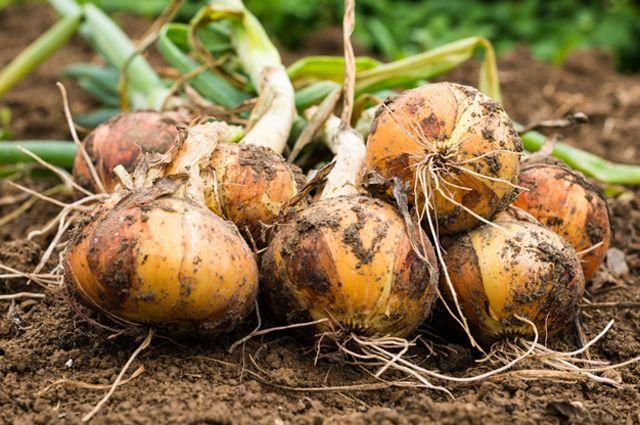
Overripe or underripe bulbs are not suitable for long-term storage. They should be processed immediately.
Mathematical method of counting
Seed packaging usually indicates the growing dates for vegetables, but it's important to understand that this region has unique climatic conditions, with cold weather arriving early. Therefore, a mathematical method is used to calculate the harvest date.
Gardeners in the Urals believe that it takes 70-75 days from planting to harvest. Once you've memorized or written down the day you planted your onions, add 70 days. This is your harvest time.
In the Urals, onions are sown in the late first ten days of May. Therefore, the harvest time will be around July 20th. However, this will only happen if the summer is moderately warm and rainfall is infrequent. By following these simple guidelines, the crop will reward the gardener with a bountiful harvest.
Related posts:
 50 types and varieties of perennial onions with descriptions, cultivation, and care
 When to harvest leeks from the garden for storage, ripening times
 How and when to plant onions to get large bulbs
 Description of the best varieties of onions, planting and care in open ground
 The beneficial properties of white onions, description of varieties, cultivation and care
 Description of the Exhibition onion variety, growing from seedlings, planting and care
 Description of varieties and cultivars of wild onions, the subtleties of cultivation
 When to harvest onions planted in autumn and spring from the garden for storage, how to determine the timing
The harvesting time also depends on the weather itself. For example, if it's "golden autumn," then I leave it for a long time. The onions end up being more ripe, I don't know what to call it, but the harvest is better.