
- History of selection
- The growing area of the Hercules raspberry
- Description and characteristics
- Bush
- Fruits and scope of application of the Hercules variety
- Immunity to diseases and insects
- Resistance to low temperatures and drought of the Hercules variety
- Advantages and disadvantages of the variety
- Planting and care
- Preparing the site and planting hole
- Schemes and timing for planting raspberry seedlings Hercules
- Regularity of watering and fertilizing
- Pruning and crown shaping
- Loosening and mulching
- Preparing the Hercules raspberry bush for winter
- Methods of reproduction
- Gardeners' reviews of the Hercules variety
The description of the raspberry variety "Hercules" highlights its many virtues. This variety is renowned for its abundant yields, allowing berries to be harvested twice during the growing season. Raspberries require little maintenance and adapt easily to new locations. To successfully plant seedlings and ensure proper care, it's important to familiarize yourself with the information below.
History of selection
The new raspberry variety, "Hercules," originates from the Bryansk region and was developed by breeders from the All-Russian Institute of Horticulture and Nursery. The parent variety is the "Ottom Bliss." Its "daughter," the "Hercules," was added to the state register in 2004.
The growing area of the Hercules raspberry
The domestic raspberry variety Hercules was created for cultivation in the Central regions, but it also thrives in the southern and even northern regions.
The variety is suitable for cultivation for personal use or sale.
Description and characteristics
The Hercules raspberry is a remontant variety, producing two harvests per season. The first harvest is in July, where the berries ripen on older branches. The second harvest is in August, on young shoots. In northern regions, the raspberry ripens only once during the growing season. When needed, the branch is cut, placed in water, and stored in a warm place. At temperatures of 20°C (68°F), the berries ripen in three days.

Bush
Hercules raspberry bushes grow from 150 to 200 cm in height, with 5-6 shoots. These shoots are strong and upright, not bending due to the growing berries. A single bush can yield up to 10 kg of fruit, with proper care. The fruiting area covers one-third of the stems. The shoots are heavily thorned, making harvesting the berries difficult. The foliage is wrinkled and bright green.
Fruits and scope of application of the Hercules variety
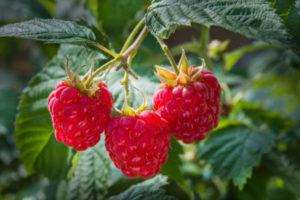
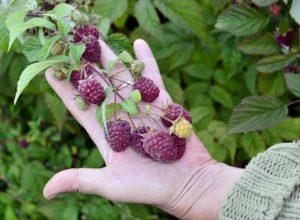
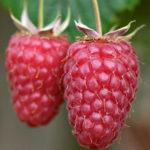
The everbearing Hercules raspberry is cone-shaped and richly red. Each fruit weighs 10-15 g. The flesh is plump, sweet, and slightly tart. It has a rich aroma and is highly transportable.
When stored properly in a cool place, they do not lose their marketable appearance for 1.5 weeks.

Immunity to diseases and insects
The Hercules raspberry has strong protective properties and is resistant to diseases and harmful bugs. Without proper care, it can be attacked by insects, pathogens, and fungi.
Resistance to low temperatures and drought of the Hercules variety
The Hercules raspberry variety is known for its moderate frost resistance. In areas with harsh, low-snow winters, cover is required. In central Russia, when fully pruning, covering the bushes is not necessary. If the above-ground part remains, mulch the soil with leaves and peat. Raspberries tolerate drought well, even without frequent watering, but yields decline.
Advantages and disadvantages of the variety
The Hercules raspberry variety is renowned for its many positive qualities, making it a worthy choice for cultivation. Some gardeners have found some drawbacks to the variety.
| Pros | Cons |
| High yield, in 2 waves | Abundance of thorns on shoots |
| Safe transportability | A small number of root suckers |
| In the first year after planting, the bushes bear fruit | By the time the cold weather sets in, some green fruits remain on the branches. |
| Low maintenance | |
| Resistance to diseases and bugs |
Planting and care
Hercules raspberry bushes should not be planted in areas previously occupied by other varieties of the plant, such as blackberries, strawberries, cabbage, or tomatoes. The seedlings thrive in almost any soil, but prefer sandy loam or loamy soils with a slightly acidic texture. It's best to locate the raspberry patch in a sunny, draft-free area facing south.
Preparing the site and planting hole
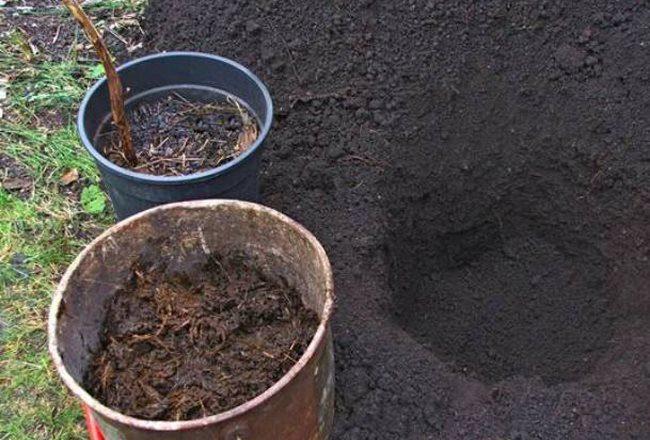
The area should be prepared two weeks before planting. Add two buckets of compost, 50 g of superphosphate, and 30 g of potassium nitrate per square meter. Once the fertilizer has been added, the soil is plowed.
Dig holes 60 cm wide and 50 cm deep, spaced 1 meter apart. If the soil is too acidic, add lime—600 g of lime per square meter. It's recommended to plant the Hercules raspberry using the trench method, spacing it 1.5 meters between rows and 70 cm between bushes.
Rows are placed north to south to ensure good light and sun exposure. Trenches are dug 50 cm wide and 45 cm deep. When planting, a 5 cm layer of rotted manure is added to the bottom, along with 200 g of superphosphate, 70 g of potassium salt, and 300 g of ash per square meter, mixed with the topsoil.
Schemes and timing for planting raspberry seedlings Hercules
Seedlings are planted in late April or early May, before the buds begin to open, or in September or October, when the growing season ends. The seedlings are placed in holes and covered with soil, compacting them by hand. It's important that the root collar is 3-5 cm above the soil surface. The bushes are watered and mulched with compost and peat.
Regularity of watering and fertilizing
Hercules raspberries are watered in late May, twice each in June and July, and again in early August. The final irrigation is done in October, with generous amounts of water to saturate the plant. This should last the entire winter. Experienced gardeners recommend digging irrigation furrows along both sides of the beds, spaced 40 cm apart. The optimal depth is 10 cm. The furrows are filled with 40 liters of water per plant.
Fertilizing is done according to a schedule. A total of three applications are required during the growing season:
- in May, after the fruits appear;
- in July, when fruiting begins;
- in August-September, when the buds for the subsequent harvest are laid.
 In spring, add a mullein solution (half a liter per bucket of water) or dry ammonium sulfate to the bush. In summer, spray the raspberries with a mixture of superphosphate, potassium sulfate, boric acid, and urea. In the fall, add compost and potassium salt.
Pruning and crown shaping
The Hercules raspberry is pruned in late October, removing last year's fruit-bearing branches at the roots. These will no longer produce berries, but will weaken the raspberry bush.
If winters are frosty, you can cut back all the above-ground parts. This way, the everbearing variety will produce one harvest on the branches that emerged in the spring, but the berries will be of the highest quality.
In March, sanitary pruning is performed, removing dried and damaged shoots. The crown is trimmed back to the first healthy bud.
Loosening and mulching
To ensure oxygen access to the root system, the soil is loosened to a depth of 10 cm, carefully so as not to disturb the roots. The first manipulation is carried out immediately after the snow melts. During the growing season, the soil is weeded after irrigation. Then, mulch with straw. This will help prevent the growth of couch grass and conserve moisture.

Preparing the Hercules raspberry bush for winter
When pruning has removed all of the above-ground portion of the bush, there's no need to cover it. The root system will survive winter frosts in the ground. If only dried, diseased shoots were removed, the bushes are wrapped in burlap, bent to the ground, covered with peat moss, and covered with pine needles. Once the snow melts, the cover is removed.
Methods of reproduction
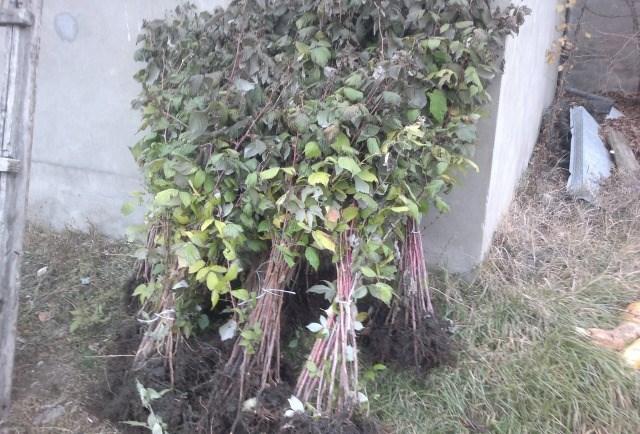
Raspberry Heracles is propagated by cuttings or root suckers.
- Cuttings. The Hercules raspberry is propagated by this method in spring or fall, carefully digging the soil 40 cm from the center of the plant. Adventitious roots are dug up carefully, preserving as many branches as possible. Healthy roots are cut into pieces, each with 1-2 buds, 10 cm long. Overgrown specimens should be saved. The prepared cuttings are planted in loose soil in the garden or greenhouse. Planting is done in furrows 5-10 cm deep. The cuttings are laid one by one, without gaps, covered with soil, and watered with 0.5 buckets of settled water.
- Root suckers. This method is used in the spring, when green adventitious buds reach 10-20 cm in height. Select specimens with the base 5 cm above the soil and bronze or reddish leaves. Dig up the shrub 40 cm away from the ground. Select the best root suckers with a clod of soil. These are planted in beds for further growth and used for planting in the fall.
 The first technique is suitable for diseased raspberries or those infested with beetles. The second method is best used on healthy plants.
Gardeners' reviews of the Hercules variety
Reviews from gardeners about the Hercules raspberry will help you make a choice and learn more.
Valentin Ivanov, 54 years old, Zhitomir
Hello! I've been growing the Hercules raspberry at my dacha for five years, and the berries are incredibly tasty and large. Before winter, I prune the entire above-ground portion of the bush. I fertilize twice during the growing season and water 4-5 times. It's a low-maintenance plant.
Oksana Kovalenko, 49 years old, Melitopol
Hi everyone! The Hercules raspberry is my favorite variety; I've been growing it for about 10 years. I have seven beds at my dacha, and the harvest is abundant. I make jam, compotes, and use them in baked goods.
Victor Sergeev, 59 years old, Kyiv
Greetings! I learned about the Gerakl raspberry from a coworker and bought some seedlings at the market. I planted them in 2017 and they're already bearing fruit abundantly. These raspberries are versatile and high-quality.
Related posts:
 Description and characteristics of the Hussar raspberry variety, care and cultivation
 Step-by-step instructions for planting and caring for raspberries in summer, tips from gardeners
 Description of the Polka raspberry variety, yield, planting and care
 The best raspberry varieties for the Moscow region with descriptions and characteristics
 Description of the remontant raspberry variety Orange Miracle, planting and care
 Description and characteristics of the Solnyshko raspberry variety, planting and care
 Description of the remontant raspberry variety Atlant, planting technology and care
 Description and varieties of the everbearing raspberry variety Penguin, planting and care