
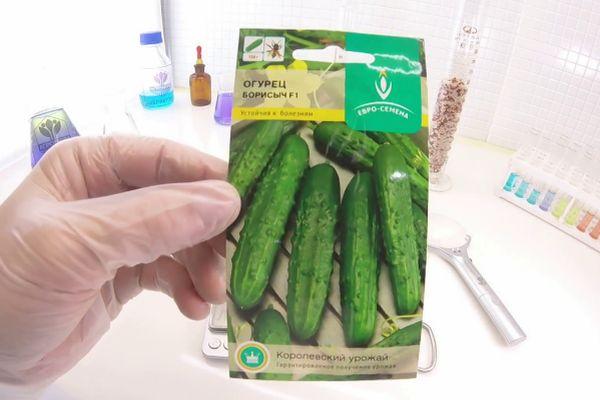
The Borisych F1 cucumber belongs to the group of early-ripening hybrids. This variety is recommended for spring cultivation in greenhouses and under plastic covers. Cucumbers are consumed fresh.
Technical data of the crop
The characteristics and description of the variety are as follows:
- From the moment the first shoots appear until the harvest is obtained, 35-37 days pass.
- The height of the bush ranges from 180 to 250 cm. The hybrid has a female type of flowering.
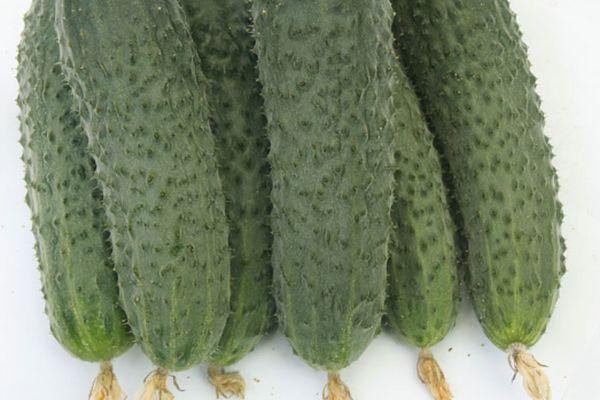
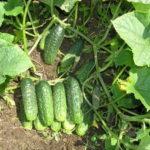
- The fruits are cylindrical. The entire surface of the cucumbers is covered with tubercles and white spines. Ripe fruits are green, with thin white lines running across the entire surface.
- 2-3 vegetables are formed on 1 node.
- Varieties of the described hybrid produce fruits weighing from 0.15 to 0.18 kg.
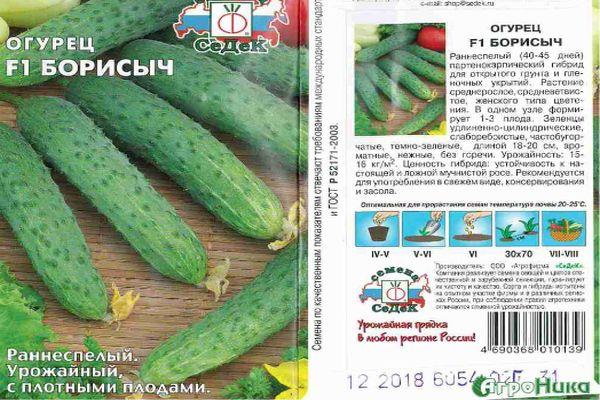
Reviews from farmers growing this variety indicate that the hybrid's yield when planted in a greenhouse is up to 19 kg per square meter. When grown outdoors, this yield drops to 15 kg per square meter. Gardeners note the hybrid's resistance to plant diseases such as powdery mildew.
In Russia, this plant is propagated by direct seeding only in the southern regions of the country. In the central and northern regions, the hybrid is grown in greenhouses and hotbeds. Cucumbers can be transported over any distance.
Sowing seeds and obtaining seedlings
If a farmer lives in southern Russia, the Borisych variety is grown by direct seeding. This process occurs in late April or early May. The soil temperature in the beds should be between 8 and 15⁰C. The soil should be enriched with mineral fertilizers, peat, or manure.
Dig holes in the soil and water them with warm water before planting the seeds. The seedlings are buried 15-20 mm deep. The seed bank is planted at a spacing of 0.5 x 0.5 m. After planting, the seeds are covered with plastic film, which is removed when the first shoots appear.

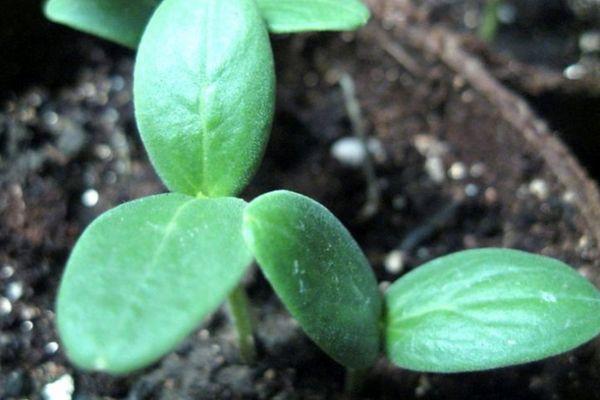
When growing from seedlings, the seeds are first treated with a weak solution of potassium permanganate or hydrogen peroxide. They are then treated with growth stimulants. The seedlings are planted in separate containers and watered with warm water.
The first sprouts appear in about a week. The seedling trays are moved to a well-lit area. The sprouts are watered once every 4-5 days and fed with organic fertilizer.
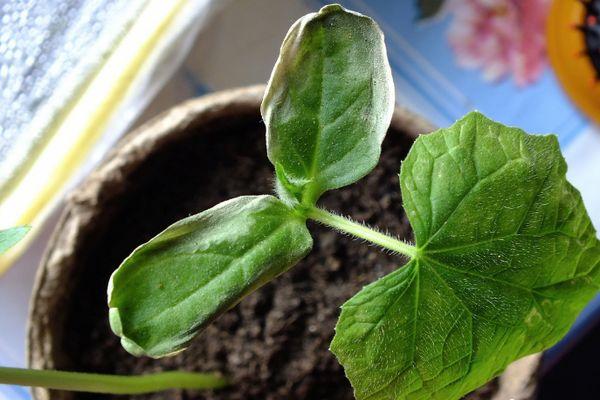
When the seedlings are 20-25 days old, they are transplanted into permanent beds. Each seedling should have 3-5 leaves. Transplanting is most often done in mid-May, when the risk of a sharp drop in nighttime temperatures has passed. The seedlings are planted in beds measuring 0.9 x 0.6 m. Before transplanting, loosen the soil and add fertilizer and wood ash. Water the young plants with warm water.
Caring for plants before fruiting begins
The bush is trained into 1-2 stems. Due to the hybrid's tall height, the vines are tied to trellises to prevent breakage. It is recommended to regularly remove leaves from the lower parts of the plants and remove side shoots until the first fruits appear.
The hybrid is fertilized once every 10 days. Nitrogen, potassium, and phosphorus mixtures are used. Borisych responds well to organic mixtures (manure, peat, etc.). Fertilizing is recommended after watering and loosening the soil.

Water the bushes moderately. Use warm water that has been left to stand in the sun. Avoid allowing puddles to form under the bushes or allowing moisture to get on the hybrid's leaves. Excessive humidity will cause root rot. Water splashing on the leaves on a sunny day can burn the bushes. If it rains, watering frequency can be reduced by half, and in hot or dry weather, daily watering is recommended.
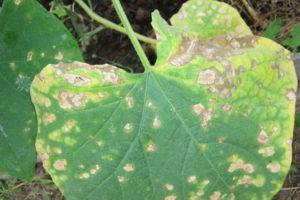
Loosening the soil is done immediately after watering. This is necessary to aerate the hybrid's root system. Instead, mulching the soil is recommended. These procedures reduce the risk of fungal and bacterial infections.
 At the same time, the flow of oxygen to the roots of cucumbers helps get rid of parasites living on the roots of plants.
Weeding prevents the spread of diseases from weeds to crops. It also eliminates garden pests that use weeds as a springboard to attack crops.
To protect cucumbers from various diseases, they are sprayed with medicinal preparations. For this purpose, you can use traditional methods to protect the hybrid from diseases. Bushes are treated with copper sulfate or a soap solution.
If garden pests, such as aphids or mites, are found in the area, it is recommended to destroy the insects with toxic chemicals.
Related posts:
 Description of the Krasotka grape variety, planting and care technology
 Description of the Julian grape variety, planting and care instructions
 The best eggplant varieties for growing in a polycarbonate greenhouse: planting and care
 Description and pruning group of clematis Ernest Markham, planting and care of the hybrid
 Methods for planting and propagating cherries at home
 Description of the Elematis Pink Fantasy variety and pruning group, planting and care
 35 Best Powdery Mildew-Resistant Cucumber Varieties with Descriptions
 Description and rules for growing Solaris grapes
Have you tried growing this cucumber variety with a plant growth bioactivator? It was recommended to me. BioGrowThey said that the result would be much better with it, the fruits would be bigger, but I doubt it.