
- Clematis Ernest Markham - characteristics of the hybrid
- Examples in landscape design
- Flower characteristics: advantages and disadvantages
- How to plant correctly
- Preparing the site and seedlings
- Disembarkation times and rules
- Further care
- Watering and fertilization
- Mulching and loosening
- Sanitary pruning
- Tying up
- Diseases and pests
- Preparing for the winter period
- Reproduction
- Cuttings
- Layering
- Dividing the bush
- Reviews of clematis Ernest Markham
Clematis holds a special place among garden flowers. Despite their beauty and exotic appearance, they are undemanding in terms of growing conditions and present little challenge to gardeners. This shrubby vine always attracts attention and becomes the focal point of any floral arrangement. Among clematis, gardeners often favor the Ernest Markham hybrid, which many consider a true king for its unusually vibrant and large blooms.
Clematis Ernest Markham - characteristics of the hybrid
The hybrid clematis Ernest Markham is named after its creator, the Englishman E. Markham, who introduced the new hybrid to gardeners in 1936. Despite the passage of many years since the plant's introduction, its popularity remains as strong as ever. This is all thanks to the plant's unique characteristics.
This hybrid is characterized by late but profuse flowering. Gardeners grow clematis not only in open ground flowerbeds but also in large containers placed on balconies and loggias. With proper care, this shrubby vine can reach 4 meters in length, and it easily clings and twines along supports such as fences, railings, and tree trunks. Direct sunlight is not a problem for this hybrid; unlike other varieties, its petals do not fade; in fact, they only become brighter.
Clematis 'Ernest Markham' belongs to the Jackmanii group and is a perennial plant. It has moderate resistance to diseases, pests, and cold, but requires careful cultivation. Flowering occurs from July to October, depending on the climate of the growing region. Since Ernest Markham belongs to Group 3, it will require drastic pruning in preparation for winter frosts.
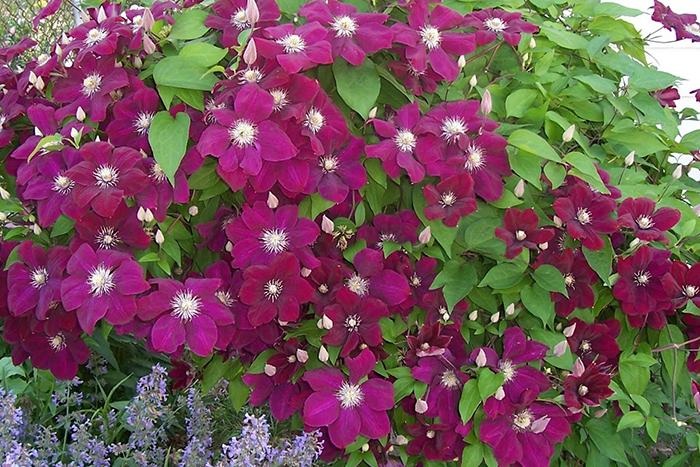
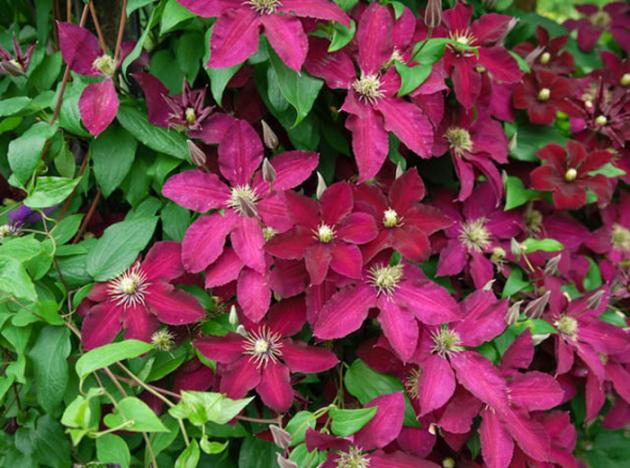
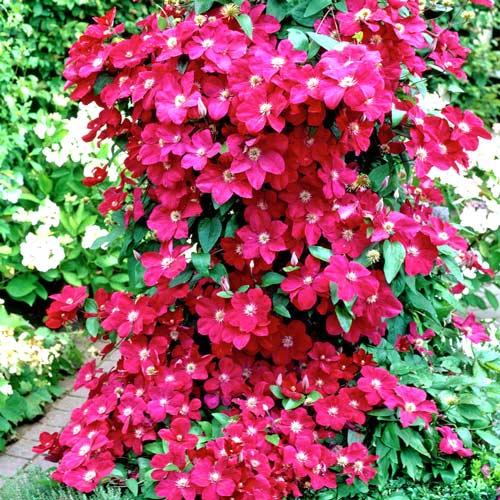
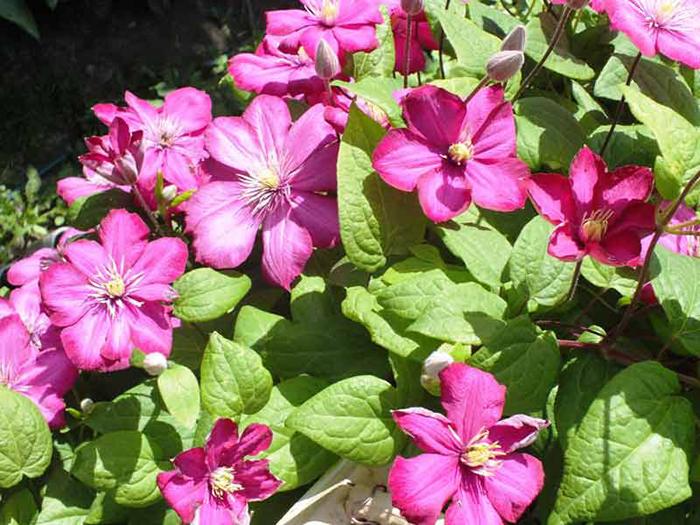
The hybrid's slightly velvety flowers are no more than 15 cm in diameter, with purple-red petals and brown-cream stamens. Flowers appear on the current year's shoots.
Examples in landscape design
Because this shrubby vine can reach heights of up to 4 meters, it's used to decorate the walls of buildings, unsightly structures, and fences. Gardeners also use this hybrid to create stunning arches and hedges. However, clematis is no less impressive when trained as a lush bush. The hybrid is also used in flowerbeds, both on its own and in combination with other plants.
Flower characteristics: advantages and disadvantages
Before purchasing hybrid seedlings, gardeners study all the advantages and disadvantages of the plant in order to assess their capabilities and provide the clematis with the necessary agricultural care.

Ernest Marham's undeniable merits include:
- Fast growth and length of the vine.
- Spectacular large buds.
- Resistance to sunlight.
- Ability to withstand frosts down to -35 WITH.
- A perfect addition to any flower arrangement.
The hybrid also has some disadvantages that are worth considering:
- Average tolerance to the effects of pathogens and pests.
- Intolerance to damp areas with poor drainage and stagnant water.
- Inability to grow and develop on acidic and heavy soils.
How to plant correctly
The growth rate and decorative appearance of the shrubby vine depend on proper planting procedures. Therefore, pay attention to the plant's requirements for the planting site, the quality of the seedlings, and follow the planting procedure.
Preparing the site and seedlings
Since this hybrid loves light, it requires a location that receives at least six hours of sunlight per day; otherwise, the plant will stunt growth. A south-facing site, protected from strong winds and drafts, is ideal. A growing spot in partial shade is also suitable.
Not all soils are suitable for this hybrid clematis—planting it in heavy or clayey soils is strongly discouraged, as the plant will not thrive there. Choose a site with fertile, light, well-drained soil. If you plan to use the hybrid for vertical gardening, immediately prepare and install supports; their height should be at least 2 meters.

Avoid placing clematis supports close to building walls. Otherwise, rainwater running off the roofs will flood the plants, resulting in their death. For planting, purchase seedlings from specialized nurseries. There's a risk of purchasing diseased or pest-infested clematis at the market. Furthermore, the seller must have a certificate of hybrid conformity.
Disembarkation times and rules
If the gardener lives in regions with a mild and warm climate, planting should be done in the fall, in late September or early October. In temperate climates, spring planting is preferable to allow the plant to establish itself and adapt to its new location before the cold weather sets in. This period lasts from late August to mid-September. If the planting material is grown in containers, planting should be carried out throughout the growing season. However, initially, the plants should be shaded to prevent the scorching sun from damaging the hybrid.
It is recommended to plant seedlings according to the following algorithm:
- They dig a hole with dimensions of 60 x 60 x 60 (depth, length, width).
- A drainage layer is placed at the bottom, and a mound of prepared soil is poured on top of it.
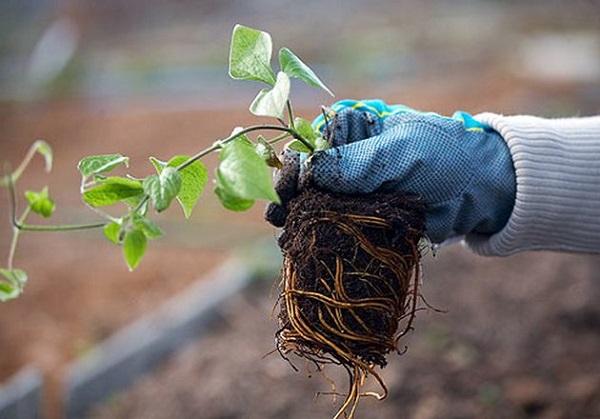
- Inspect the existing seedling—it should have at least five roots approximately 30 cm long. If the roots are dry, soak them for several hours in water with a few drops of growth stimulant added.
- Place the seedling on the mound of soil, spreading out all the roots. Ensure the root collar is completely covered with soil to prevent frost damage.
- Lightly press the soil around the clematis with your hands.
The trunk circle is watered, fertilized, and, if desired, covered with mulch. To protect the clematis roots from overheating during intense summer heat, low-growing annuals are placed around the hybrid. Gardeners have noted that annual seedlings take root best in their new location.
Further care
Next, provide the hybrid with comprehensive care, which includes watering and fertilizing, loosening and mulching, garter and sanitary pruning, disease and pest prevention, and preparation for winter.
Watering and fertilization
Large, richly colored buds appear on clematis only when adequately moistened. If the shrubby vine is planted on the south side of the plot, it will need to be watered once a day. Approximately one bucket of water is used per mature hybrid, but this amount can be adjusted depending on the weather. Care should be taken to avoid stagnant water, as this will lead to an outbreak of fungal diseases and root rot.
During the rooting period, the hybrid does not require additional nutrients. Once the plant has fully adapted to its new location, fertilize according to the following algorithm:
- Spring - use a vitamin complex, which necessarily contains nitrogen.
- During the period of bud formation, phosphorus and potassium are added and complex mineral fertilizers are used.

Mulching and loosening
After each watering, it's essential to loosen the soil. This will prevent a dry crust from forming and eliminate weeds that rob the clematis of its nutrients. With the onset of autumn, the soil around the hybrid is covered with a layer of mulch. Any organic material, such as compost or humus, can be used for this. The required layer is about 15 cm.
Sanitary pruning
During the first few years, the hybrid devotes all its energy to adapting to its new location, establishing roots, and building up its root system. This results in few or no flowers. Experienced gardeners recommend removing spent flower buds immediately, so the plant doesn't waste energy on them and instead begins producing new ones. During the first season, leave one central shoot, no more than 20 cm tall. This will allow the plant to better develop lateral shoots. All old, diseased, and dead branches are pruned.
Tying up
Because the vine grows so widely in both width and length, it cannot maintain its decorative appearance without staking. For this, special support trellises are used or the vine is allowed to climb trees or fences.

Diseases and pests
The hybrid has average disease immunity, most often affected by various types of rot. These are caused by improper agricultural management, such as inadequate winter protection or excessive watering with cold water. In these cases, repot the hybrid, remove all damaged parts, and return to normal plant care.
Nematodes are considered the most dangerous insect pests, and there is no treatment for them. They damage the root system, resulting in the death of the plant. Spider mites and thrips are also common on the hybrid. To eliminate these pests, use any insecticide, such as Actellic.
Preparing for the winter period
Proper preparation of the hybrid for winter determines how abundant its flowering and health will be. In the fall, the soil around the clematis is treated with a fungicide and covered with a layer of mulch. A small amount of wood ash is sprinkled on top of the mulch. When the soil freezes to -5°C (23°F), the hybrid is covered using wooden boxes, burlap, or roofing felt. If there is sufficient snowfall, it is raked down to the roots of the plant to insulate them.
Reproduction
Clematis is propagated by three simple methods: rhizome division, cuttings, and layering. Since it's a hybrid, seed propagation won't produce positive results indoors.
Cuttings
During the summer flowering period, cuttings 7-10 cm long are harvested. After treatment with a growth stimulant, the material is placed in a nutrient substrate for rooting.
Layering
This method is even simpler. To do this, select the lower shoots, place them in the furrows, and cover them with soil. Staples or pieces of wire are used to securely hold the shoots in place.
Dividing the bush
Hybrids over five years old can also be propagated by division. Dig up the plant and divide it into several pieces with a sharp shovel. Treat the cut areas with wood ash and plant them in prepared areas.
Reviews of clematis Ernest Markham
Darya Vasilyevna Skobtseva, 45, Mytishchi: "I've been growing this hybrid for several years now. I've had virtually no problems. We did have a spider mite attack once, but after treating it with Actellic, the pests disappeared."
Maria Evgenievna Marchuk, 57, Saratov: "On the advice of a neighbor, I planted several hybrid clematis bushes near the fence. Over the course of a few years, the clematis has completely covered the structure, and it looks wonderful."
Related posts:
 Description of the Krasotka grape variety, planting and care technology
 Description of the Elematis Pink Fantasy variety and pruning group, planting and care
 Description of the Julian grape variety, planting and care instructions
 Description and pruning group of clematis variety Arabella, planting and care rules
 35 Best Powdery Mildew-Resistant Cucumber Varieties with Descriptions
 TOP 30 best varieties of cold-resistant cucumbers with descriptions and characteristics
 Description and characteristics of the 30 best hazelnut varieties, cultivation
 Description of the best tomato varieties for greenhouses in the Kirov region