Crispin's cucumber is the work of the Dutch Agrobiologists have included this variety in the State Register of Breeding Achievements. It is suitable for cultivation in open ground, greenhouses, and hotbeds. The fruits are versatile and have excellent taste.
Advantages of a hybrid
Parthenocarpic (does not require pollination by bees), the Crispina f1 cucumber is resistant to adverse growing conditions, making it recommended for beginners. The variety does not require warmth during the early fruiting period.
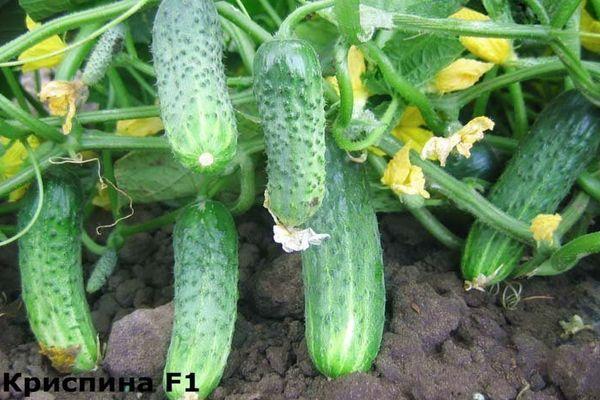
During the growing season, it easily adapts to higher temperatures. The Crispina hybrid begins to bear fruit 40-45 days after sprouting.
The variety's description is based on the characteristics of the indeterminate cultivar. The plants have a medium number of branches, are medium-sized, and produce exclusively female flowers with a well-developed root system.
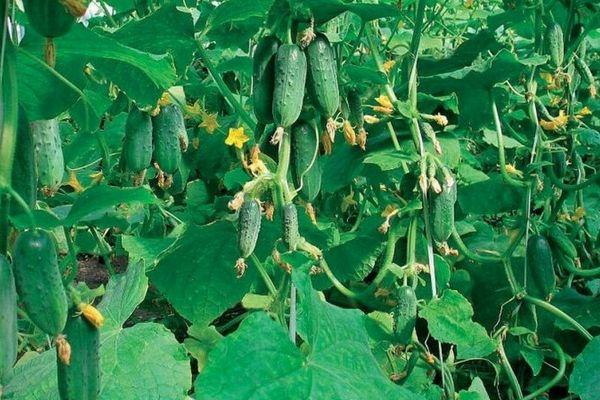
The leaf surface is slightly wrinkled. The foliage is a rich green. Four to five fruits are formed and ripen in a single leaf axil. The cucumbers are uniform in size, cylindrical in shape, and slightly ridged at the apex.
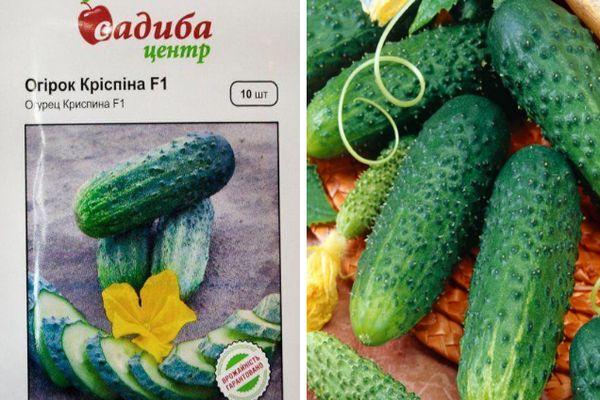
The flesh is firm, crisp, without bitterness, and has an excellent flavor, with a small number of seeds. The surface of the cucumbers is large and bumpy, while the skin is green and dark green with small round spots and white spines.
Light stripes extend up to two-thirds of the fruit. Cucumbers are 10-12 cm long, 4 cm in diameter, and weigh 100-120 g, yielding 6.3-10 kg per square meter. This variety is suitable for growing for pickles; fruits 3-5 cm long can be harvested from the bush.
Cucumbers are consumed fresh, preserved, pickled, and canned. The hybrid is resistant to powdery mildew, brown spot, and cucumber mosaic virus.
Growing methods
The Crispina variety is cultivated in open and protected ground, by directly planting seeds in a permanent growing location and by seedlings.
To ensure early harvest, use the seedling method. To do this, add a potting mix consisting of the following components to the pots:
- humus - 1 part;
- peat - 3 parts;
- turf soil - 1 part;
- mineral fertilizers.
Seeds are planted at a depth of 1-2 cm. Using peat containers helps preserve the root system. If cucumber seedlings have overgrown and their stems have become elongated, care must be taken to strengthen the plants.
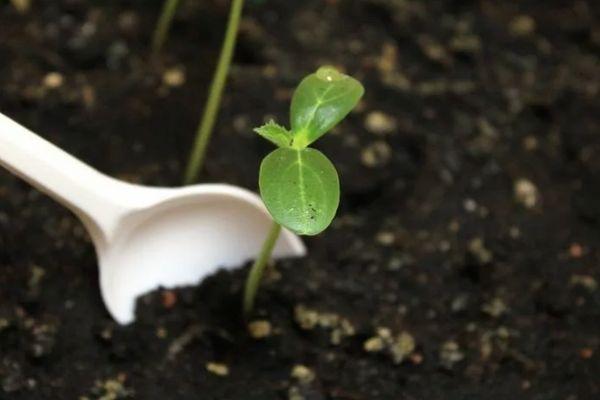
To do this, the seedlings are transferred to larger containers, and the humidity and lighting conditions are adjusted. They are not watered for a few days before planting, and slightly wilted plants are transferred to their permanent location. This allows them to adapt more easily to the new conditions.
After germination, the plants are transplanted to their permanent location 25-30 days later, usually in late May. Seeds are sown outdoors after the temperature stabilizes, reaching 10–15°C.
Plant in prepared soil containing the necessary fertilizer. The beds should be 15-20 cm high. Irrigation is essential for this variety, so the watering system should be positioned 10 cm from the plant.
Growing in open ground requires the correct cultivation method to ensure a high yield. With the trellis method, supports are installed 80-90 cm apart. The main stem, once it reaches the top trellis, is directed downward. This variety can be grown spread out or on a net.
When grown indoors, the bushes are trained into a single stem with side shoots. In the first 4-5 axils of the main stem, the ovaries and side shoots are removed, and only one ovary is left in each node.
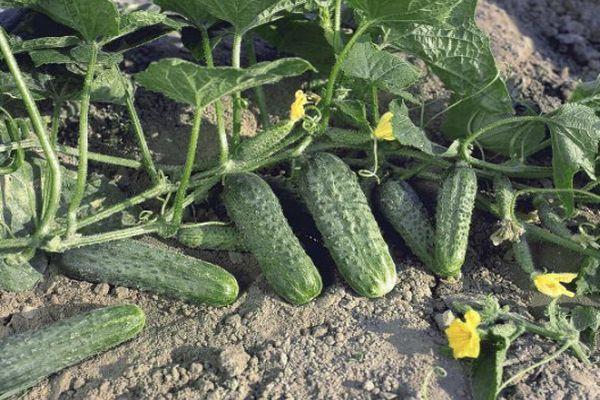
The growth of side shoots is stopped up the stem at intervals of 2-3 leaves. The pace of this process is adjusted depending on the planting density. Once the central stem reaches the horizontal crossbar of the trellis, it is wrapped around it and lowered down.
As the plant ages, remove the lower leaves, which improves air exchange and prevents the development of fungal diseases.
Caring for the crop
The agronomic management system for growing cucumbers includes timely watering with warm water after sunset. Regular loosening is performed to ensure moisture balance and air access to the root system.
Crop care includes stem shaping and weed removal. If biological pests are detected, the plants are treated with special agents.
The plant develops a robust above-ground growth habit, so it requires supplemental feeding with complex fertilizers containing beneficial components during the growing season. The root system responds favorably to nutrient application, especially localized through drip irrigation.
After 1-2 harvests, the crop is fertilized with nitrogen and potassium-containing fertilizers. A solution of manure or poultry manure in water can be used for this purpose. Fertilizers are applied every 10-14 days. A fungicide is used to prevent fungal diseases.
Opinions and recommendations from gardeners
Vegetable growers who cultivate the Crispin hybrid report the plant's resistance to temperature fluctuations and diseases common to pumpkins. Gardeners recommend shaping the stems to increase fruit yield.
Gardeners note that this variety is easy to grow and is ideal for beginning gardeners. Care instructions include timely harvesting and fertilizing at all stages of development.
Throughout the fruiting period, the cucumbers are uniform in size and even in shape. Vegetable growers' reviews point to the hybrid's positive characteristics and the fruit's versatility. The cucumbers store well for a long time and withstand long-distance transportation.
Related posts:
 Description of unusual methods for planting and growing cucumbers
 Description of the best varieties of Chinese cucumbers, planting, growing and care
 How to care for cucumbers in open ground from planting to harvesting
 How to properly plant cucumber seedlings in a greenhouse and care instructions
 Description of the best, most productive and new varieties of cucumbers for 2025
 How to properly plant cucumbers in open ground with seeds, and at what depth
 The best grape varieties for growing in the Urals, planting and care rules in summer
 How to make a cucumber trellis with your own hands from scrap materials