
- Breeding the Siberian Garland F1 hybrid
- Pros and cons of culture
- Description and characteristics of cucumbers
- Appearance of the bush and leaves
- All about flowering and fruiting
- Resistance to temperature fluctuations and drought
- What insects and diseases are cucumbers susceptible to?
- Recommended areas for planting
- Growing and caring for the variety in open ground and greenhouse conditions
- Timing and technology of sowing
- Rules for planting seedlings
- Watering and fertilizing
- Plant formation
- Preventive treatment
- Weeding and loosening the soil
- How to properly remove excess ovaries
- Rules for harvesting and storing crops
- Reviews from experienced gardeners
Every gardener dreams of harvesting crisp, firm gherkins. Choosing the right variety can be challenging due to the abundance of options. The Siberian Garland F1 cucumber variety is a new self-pollinating hybrid with a bouquet-type ovary. It tolerates cold weather, temperature fluctuations, and drought, boasting strong immunity and high yields.
Breeding the Siberian Garland F1 hybrid
The innovative cucumber variety, Siberian Garland, was developed by domestic breeders in Miass (Chelyabinsk Oblast). This hybrid is part of the premium "Magnificent Five" collection.
The variety is declared by the manufacturer to be high-yielding, capable of bearing fruit until the first frost.
Pros and cons of culture
Siberian Garland is an improved hybrid. Breeders have taken care to meet all vegetable growers' requirements for this crop. Key advantages:
- self-pollination – parthenocarpic hybrid;
- resistance to temperature changes and extreme weather conditions;
- formation of bouquet-type ovaries;
- the small size of cucumbers makes the fruit aesthetically attractive for canning and decorating dishes;
- excellent taste, fruits are firm and crispy;
- high yield (up to 20 kilograms from one bush);
- strong immunity;
- universal purpose: suitable for fresh consumption, pickling and canning;
- early maturity – capable of bearing fruit until late autumn.
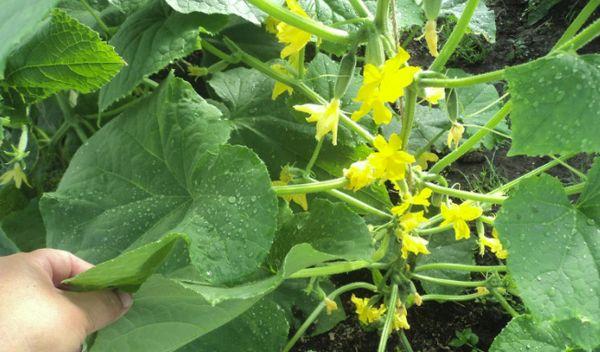
The variety has few drawbacks. The hybrid's negative qualities include:
- relative difficulty of care: the gardener must be able to properly shape the bushes, promptly remove excess shoots and tie up the vines;
- Cost of seeds: you need to buy seeds every season; you won't be able to get them from ripe fruits yourself.
This hybrid can only achieve high yields with comprehensive plant care. It requires specific soil conditions and the addition of mineral and organic fertilizers.
Description and characteristics of cucumbers
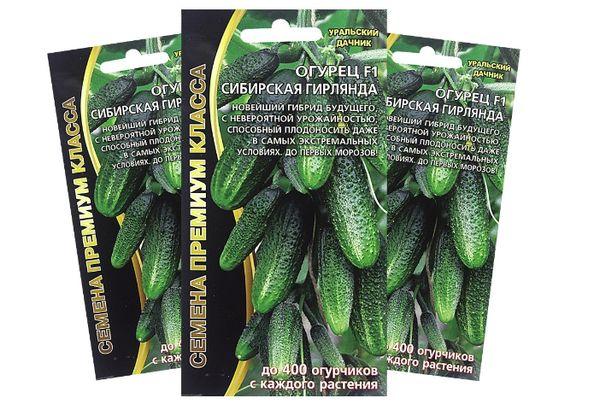
At first glance, Siberian gherkins are no different from classic cucumber hybrids, and the variety description is standard. Experienced gardeners note the variety's high bushiness and abundance of ovaries in the internodes. The garland is popularly called cucumbers-walkers.
Appearance of the bush and leaves
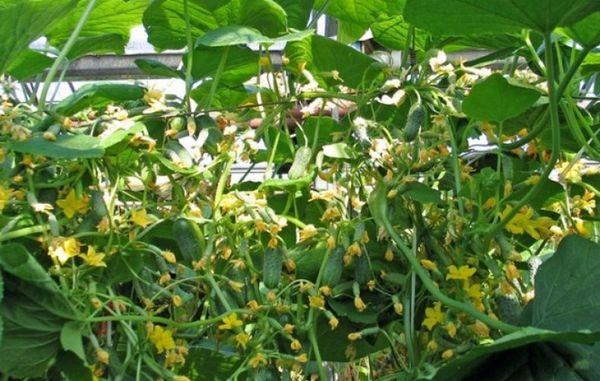
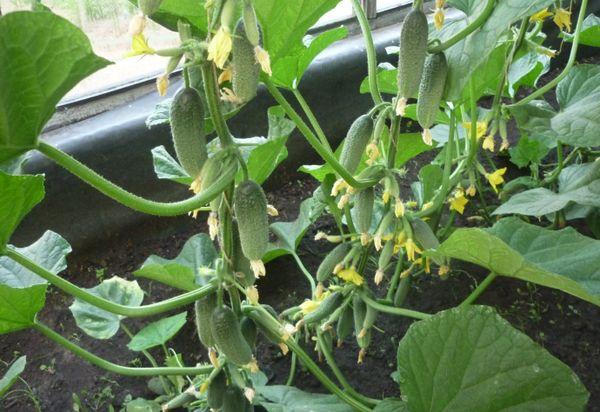
The Siberian Garland cucumber variety is attractive in appearance. Experienced gardeners immediately notice the numerous clustered ovaries. They resemble a bouquet or a fir tree branch: one gherkin "hides" beneath another.
The bush is vigorous, with a thick stem, short internodes, and leaves spaced 7 centimeters apart. Three to fifteen ovaries can form in a single node.
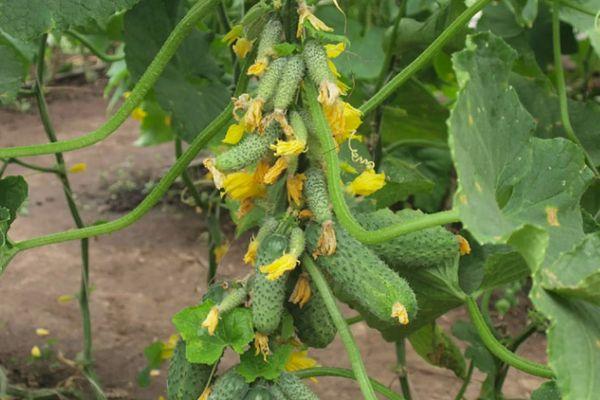
The Siberian Garland cucumber variety's small, five-pointed leaves, arranged on long petioles, act as umbrellas for the fruit, shielding them from the sun. The plant prefers partial shade and thrives in shady locations.

All about flowering and fruiting
Siberian Garland is a parthenocarpic hybrid with a female flowering type; it doesn't require insects for fruit formation. The flower is yellow, with six petals. The ovaries are set in clusters of five to six flowers.
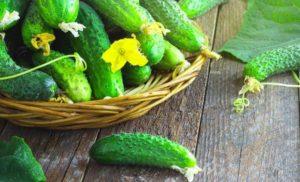
Siberian Garland begins to bear fruit, on average, 45 days after planting the seedlings in the ground. The gherkins are edible when they are still in the milky stage of ripeness—the ideal size is 5-9 centimeters. The gherkin harvest continues until late autumn.
Important! Fruit must be picked promptly. The sooner the gardener harvests, the sooner new fruit will develop.
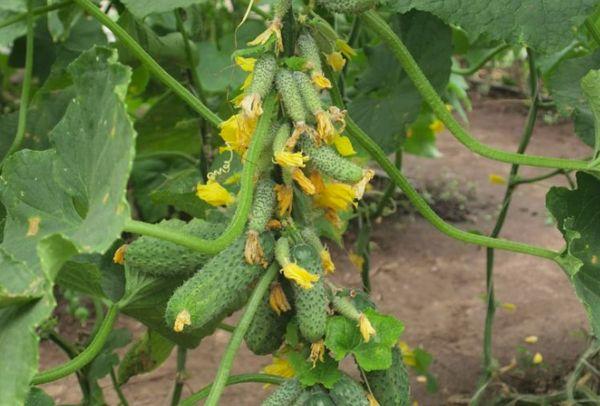
The Siberian hybrid has another unique feature: slow growth of the gherkin, the cucumber does not overgrow, no voids form, the taste does not deteriorate, and the cucumber does not taste bitter.
Resistance to temperature fluctuations and drought
Suitable for cultivation in risky farming zones, these cucumbers are resistant to the Siberian climate. The variety is genetically adapted to temperature fluctuations and extreme weather conditions, including prolonged droughts and heavy rains. Shade-tolerant, planting in shady areas is preferred.
What insects and diseases are cucumbers susceptible to?
Breeders have endowed Siberian cucumbers with strong immunity. The variety is resistant to fungal and infectious diseases:
- downy mildew;
- powdery mildew.
Siberian Garland F1 is tolerant to cucumber mosaic virus. Root rot poses a risk to the variety. The disease can occur due to excess moisture and overwatering.
Recommended areas for planting
The Siberian Garland hybrid was developed in Siberia, but cucumbers can be grown in the Volga region and other regions. Experienced gardeners say the variety's strengths include its hardiness and ability to withstand temperature fluctuations.
Growing and caring for the variety in open ground and greenhouse conditions
The Siberian variety can be grown both in greenhouses and hotbeds, as well as in the open ground. The choice depends on the regional climate. In the south, the variety will yield the promised yield in the open ground. In the northern regions, it is preferable to grow gherkins indoors.
Timing and technology of sowing
There are two ways to grow the Siberian Garland hybrid:
- Growing seedlings.
- The non-seedling method is by direct sowing of seeds into the soil.
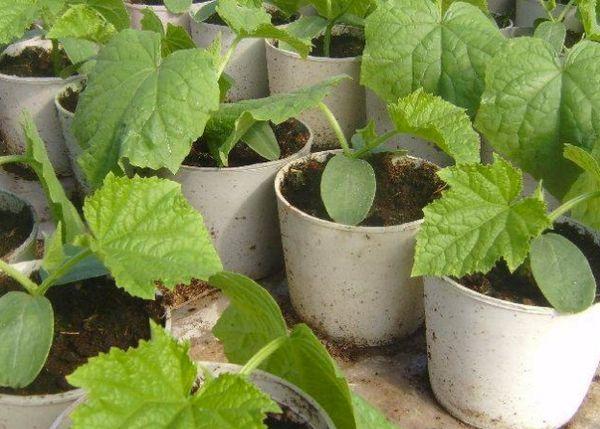
For seedlings, seeds are planted in individual cups with nutritious soil at the end of April. The seeds should be soaked in water or a weak solution of potassium permanganate beforehand. The future seedlings are buried in the prepared containers to a depth of two centimeters. Water them, then cover them with plastic wrap and place them in a warm, sunny spot. The first shoots appear within seven days.
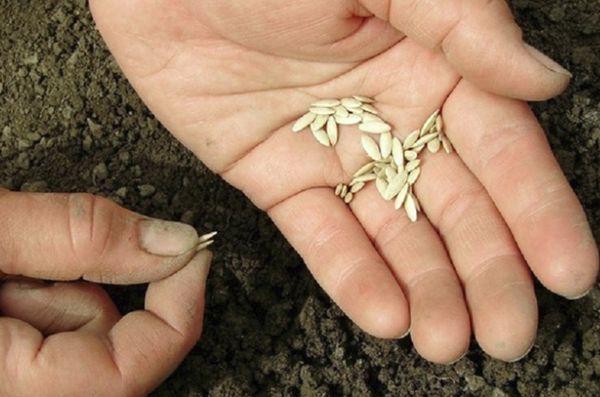
The direct-seeding method is recommended in warm climates. In this case, the seeds are planted directly in their permanent location in the second half of May. Seed treatment is the same as in the first method. It is essential to maintain the distance between plants from the start. A planting pattern of 50 x 60 centimeters is used.
Rules for planting seedlings
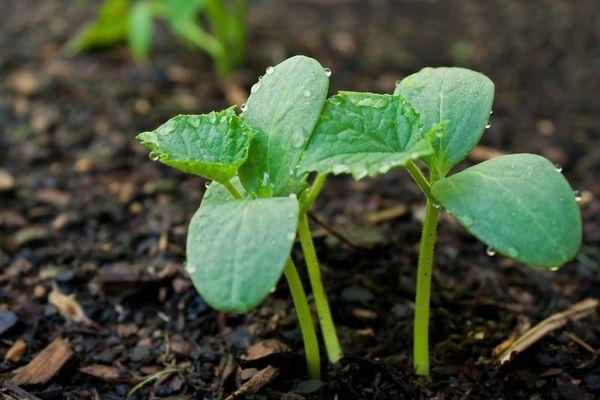
Young cucumbers can be planted in the ground when they have two or three true leaves. By this time, the plant will have developed a root system and will be strong enough to withstand the transplant. Early May is the optimal time for planting indoors. Late May to early June is the best time for planting outdoors.
In the garden bed, mark out the locations for the holes using a standard pattern – 50 by 60 centimeters. The holes are dug shallowly, and a mineral-organic mixture (comprising humus, wood ash, and sand) can be placed under the plant's roots. The plant is replanted with its root ball, being careful not to damage the root system. The roots are spread out and the plant is covered with soil, after which it is watered generously. During the first few days, the seedlings need to be protected from the sun using small covers.
Watering and fertilizing
Regular watering of plants should be done with caution. Excessive moisture is harmful to cucumbers. On sunny days, water droplets should not fall on the leaves, as this can cause sunburn.
The Siberian Garland variety responds well to feeding and fertilizing. Due to its high yield and rapid growth, cucumbers require additional nutrients. It is recommended to apply up to four applications per season.
Fertilizing with cow dung is a proven, reliable method. Dilute one part cow dung per 10 liters of water. Water the plants at the roots, avoiding contact with the leaves. Superphosphate is a mineral fertilizer; spray the leaves with an aqueous solution and water at a ratio of 25 grams of superphosphate per 5 liters of water.
Plant formation
Important! Bush shaping is a requirement for this Siberian hybrid. Without this procedure, cucumbers will lose half their yield.
The gardener's main goal is to form the bush into a single stem. Simply tying the vines together won't do the trick. The ovaries and side shoots are removed completely at the first four nodes. Then, the ovaries should be left in place, and the side shoots should also be removed.
It's also recommended to remove excess leaves. Thinning the canes allows for even distribution of light, ventilation, and proper weighting of the bush.
Preventive treatment
Vegetables need daily care. Fungal diseases can be prevented with folk remedies: wood ash or a solution of brilliant green and iodine. A solution of natural antiseptics is made with water: 10 drops of brilliant green and 5 drops of iodine per 10 liters of water. This solution is watered at the roots of cucumbers and sprayed on the leaves.
Weeding and loosening the soil
Regular loosening and weeding of cucumber plants are essential care procedures. This allows the root system to "breathe," preventing the cucumbers from having to share nutrients with weeds.
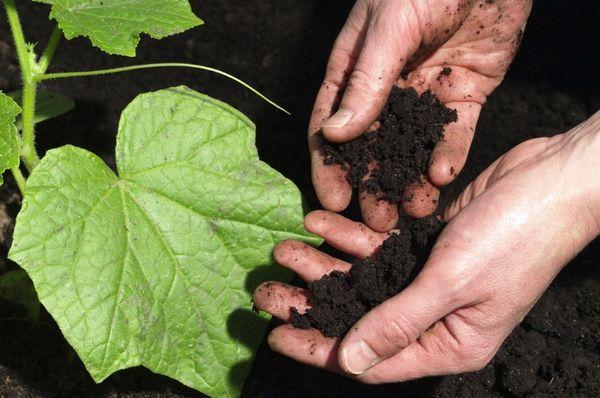
It is enough to weed and loosen the beds once a week, combining the procedure with trimming excess leaves and shoots.
How to properly remove excess ovaries
To increase the yield of Siberian Garland, remove excess ovaries and harvest ripe fruits promptly. Green fruits can form in every leaf axil—this is a characteristic of the variety. The plant will not be able to handle all the young fruits.
The correct way to remove excess ovaries is by pinching them off; it is better not to do this procedure by hand; you should use scissors.
Rules for harvesting and storing crops
Siberian Garland cucumbers should be harvested daily. The firmest gherkins can be picked in the morning or late evening. Store the harvested crop in wicker baskets in a dark, dry, cool place.
Cucumbers retain their marketable appearance for three days, after which they inevitably begin to wilt and become soft. Gherkins for pickling and salting should be preserved immediately after harvesting or within the first 24 hours.
Reviews from experienced gardeners
Milkov Vladislav Aleksandrovich, 45 years old, Kazan
"My love for pickled cucumbers began in childhood. Our family tradition was to pickle large cucumbers, but they didn't always turn out crispy, so my wife and I have been experimenting with different varieties of cucumber gherkins for several years. Last year, we planted a Siberian Garland in the open ground.
The variety surprised me after just a month and a half, producing a huge number of buds. I cut some off, just in case, because I was afraid the plant wouldn't survive. But it seems this variety isn't afraid of anything. The cucumbers grew bigger every day! The harvest was magnificent. And this winter, we opened the jars of gherkins! The taste is superb! Juicy, firm, and most importantly – crunchy. I'll definitely find a place for them in my garden this year."
Solovyova Tatyana Vasilievna, 51 years old, Magnitogorsk
"Siberian Garland is a very beautiful variety. At first, I didn't believe the yield claim on the seed package, but the cucumbers looked so beautiful in the picture. I decided to plant seedlings. I sowed 10 seeds in jars in early April. Four cucumbers sprouted within five days, and the rest followed within a couple of days. I planted them in a greenhouse in June, after the threat of frost had passed.
They transplanted easily; they didn't get sick, reaching for the sun, and quickly sprouted additional leaves. I watered them a couple of times with iodine solution and sprinkled the soil with ash. They produced a plethora of ovaries, as well as shoots. At first, the bed resembled a jungle, but I removed the excess, and the cucumbers started growing. They were small, but numerous, hanging in clusters. I picked them every day in August, and they grew massively. I used them for pickling. They were very tasty; my grandchildren especially loved them. I recommend them."
Related posts:
 Description and how to plant the Garland strawberry variety
 Description of the Garland cucumber and cultivation features of the variety
 The best grape varieties for growing in the Urals, planting and care rules in summer
 How to plant grapes step by step, with a description of the process and care
 How to properly plant peas in a greenhouse and open ground
 How to propagate and grow peas, cultivation technology, and care in open ground
 The best varieties and types of early and winter garlic with descriptions and names
 How to control onion flies using natural and chemical methods