
- Cedar habitat
- Factors Affecting the Start of the Harvest Season
- Terrain
- Soil composition
- Age
- Climate conditions
- Approximate ripening time
- How to prepare
- Basic collection methods
- Knocking down with a stick
- Collection from the ground
- Tree climbing
- Processing of collected cones
- Manually
- Using a device
- Purification of nucleoli
- How to properly store harvested crops
- Making a collection cleaver yourself
To successfully harvest cedar cones, preparation is essential. First, select the right equipment for removing the cones from the tree and choose the right time to harvest cedar pine nuts. Common collection methods include climbing trees, searching for fallen cones, and knocking them down with a stick. Environmental organizations do not prohibit removing cones from branches, but they do ensure that no irreparable damage is caused to the trees.
Cedar habitat
The Siberian cedar pine is an evergreen tree native to Siberia. Its main asset is its beneficial and nutritious seeds, known as pine nuts. In Russia, there are designated cedar planting zones—groves in the Vologda and Arkhangelsk regions, as well as near Veliky Ustyug.
Siberian pine is most common in the West Siberian forest belt, and is less common in Central Altai, Eastern Siberia, and the Timan Ridge. The tree also grows in Kazakhstan, China, and northern Mongolia.
Factors Affecting the Start of the Harvest Season
Cedar seeds mature between August and early September.
The yield and the time of full ripening are influenced by various factors:
- soil composition;
- geographic location;
- terrain conditions in the landing zone: mountains, slopes, lowlands, plains;
- age of the tree;
- general qualitative composition of the forest;
- climate in the region.
Of all the factors listed, climate has the strongest impact. When spring arrives early, trees begin blooming almost from the first days of June. If warm weather lingers, however, flowering doesn't occur until the end of the month, closer to July.
Terrain
The tree's polymorphic root system allows it to grow in any terrain. Fruit production declines only with a sharp increase in altitude, such as on slopes and foothills.
Soil composition
Pine tolerates extremely dry soil well, provided, however, that the growing area has very humid air. The properties of one biological environment are compensated by others. In its natural environment, Siberian pine grows well in neutral, slightly acidic, and gravelly soils. In very waterlogged soil, the pine develops adventitious roots.
In cold and damp climates, the tree's sensitivity to frozen soil increases significantly, and fruit production declines. Warm locations are also absolutely unsuitable.
Age
In a cedar plantation, the first fruits appear only 20-25 years after planting. Cedar trees bear fruit most actively at 50-70 years of age.
Often, the appearance of early cones is not a good sign – it indicates poor growing conditions. The intensity of fruiting depends on the tree's growing environment:
- blueberry cedar forest – 80-100 years;
- Rhododendron cedar – 120-140 years;
- trees in the Slyudyansky forestry enterprise are 140-150 years old.
There is a direct correlation between the onset of fruiting and its decline. The sooner a pine tree produces its first fruit, the sooner it will stop bearing fruit.
Climate conditions
Siberian cedar is resistant to severe frosts, but can easily grow and bear fruit in warmer regions, such as the European part of Russia. However, if planted further south, beyond the sixth zone, the tree becomes diseased and fails to bear fruit, making it virtually impossible to eradicate the parasites infesting it.
Approximate ripening time
Before you go collecting cones, you need to find out when flowering and fruiting begin. Siberian cedars are wind-pollinated and begin blooming in the warmer months—late May to early June. However, it takes 18 months from the emergence of shoots and buds to the formation of mature seeds.
Ripening periods:
- spring-autumn: buds are formed, flowering and pollination occur, seeds are formed;
- Within 12 months after pollination, the ovules become resinous and mature;
- intensive growth begins after winter and continues until July;
- The ripening process is completed in September.
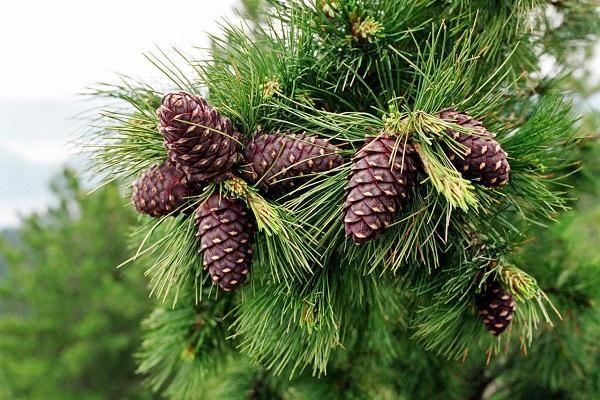
Mature cones are a rich brown color and often fly off the tree when gusts of wind or light taps on the trunk.

How to prepare
The first thing to do is choose a seed collection method. This could be collecting pine cones that have fallen to the ground or climbing trees. These methods are sufficient for small-scale harvesting.
You can also use the tapping method with a mallet, but in this case you need to act extremely carefully.
Basic collection methods
There are different ways to collect nuts:
- Pick up fallen fruit and do not harm trees.
- Climb a cedar tree and shake the pine cones off the branches.
- Knocking down with a stab.
Cedar is very brittle, and even the thickest branches can snap unexpectedly. When climbing a pine tree, be sure to use a safety rope tied around the trunk.
Knocking down with a stick
The fruit is picked with a special tool called a cleaver. This is a simple stick of the appropriate length. Fruit can only be picked from young trees, as they are low enough to be easily reached without damaging the trunk or branches.

The pine cone is lightly struck against the tree with a pick, causing the cones to fall to the ground. It's important to protect your head from the blows, and remember that pine is very fragile and can crack even with a slight impact.
Collection from the ground
The simplest and easiest way is to collect pine cones from the ground. The only problem is that they're quickly carried off by wild animals. You can choose a forest area with plenty of pine cones lying on the ground, eliminating the need to climb trees. To harvest, all you need is a few buckets or canvas bags.
Tree climbing
If there are no pine cones on the ground, or if you need them in large quantities, you'll have to climb a tree to collect them. However, this shouldn't be done without safety equipment and an understanding of the proper harvesting process.
Stages of collection when climbing a tree:
- a rope is tied around the trunk, and the person who climbs up must wear a safety belt;
- another person stands below and controls the entire process, making sure that the rope does not get tangled and the wood does not crack;
- For additional protection, you can use special hooks that cling to the bark and allow you to climb higher.
You need to act slowly and carefully, because the tree can break at any moment.
Processing of collected cones
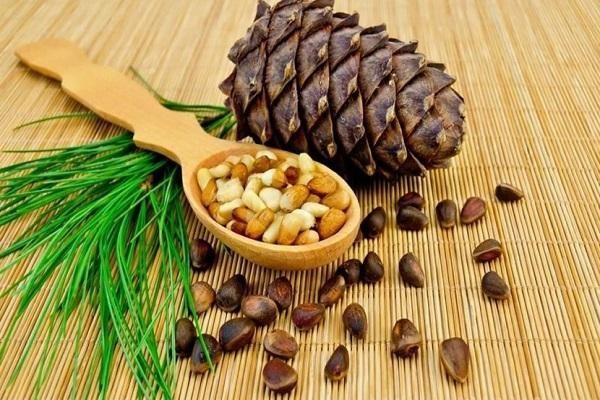
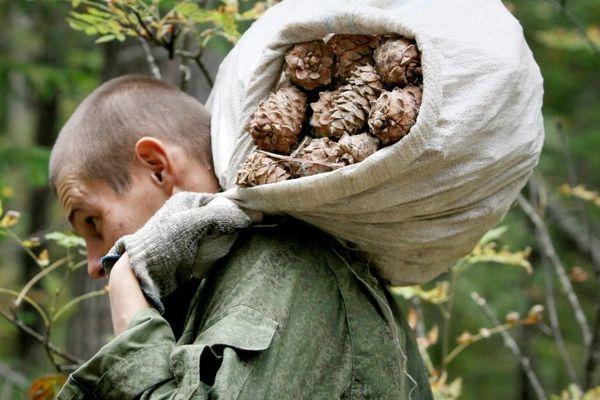
Once the nuts have been collected, they need to be processed and stored properly. Processing is done using a special device or by hand. The delicate nuts are very easy to damage, so care must be taken to ensure proper handling.
Manually
For small quantities of cones, the seeds can be extracted manually at home. However, it's not necessary to scoop out all the seeds one by one; you can spread the cones out on paper and lightly beat them. This will cause the cone itself to lose its shape or even crumble, and the contents will fly out.
Using a device
Using a special tool called a "grater," you can quickly extract seeds from pine cones. The principle is very simple: the pine cones are placed on the grater and rolled over with a roller. As the roller moves, the grater's teeth dig into the pine cones, extracting the nuts.
There are also mechanical threshing structures used in production.
Purification of nucleoli
Shelling pine nuts isn't as easy as shelling sunflower seeds. Before shelling, soak the nuts in water for 12 hours or a day. Alternatively, you can simply pour boiling water over them or, conversely, freeze them. Freezing nuts is not recommended for storage; they are consumed immediately after peeling.
You can also use a hammer or garlic press to peel pine nuts.
How to properly store harvested crops
Because the vegetable fats in the nuts quickly change their properties and impart an unpleasant taste to the pine nuts, it is not recommended to store them for a long time.

The ideal storage method is in a natural environment, such as in bags on the ground, in a cool, dark place. This way, the nuts retain their flavor and all their nutritional properties.
Preparation for storage takes place in several stages:
- The nuts are removed from the cone and laid out in a thin layer on paper or boards, where they are dried for 2-4 days. Exposing them to direct sunlight is strongly discouraged.
- During the drying process, the nuts are carefully monitored to ensure they don't dry out or spoil. All bad seeds are removed.
- After drying, the nuts are placed in bags or in the refrigerator and stored in a cool, dark place.
The maximum storage time is 6 months, provided there are no rodents or mold.
Making a collection cleaver yourself
To collect pine nuts, you can use a homemade tool called a nut pick. It's simple in design and made from a regular, thick birch branch.

Tips for making your own kolot:
- An important part of the tool is the handle. If the trees in the forest are large, the axe needs to be heavy. To reach tall cedars, the handle also needs to be longer.
- Larch will be an excellent replacement for birch – such wood will not rot for a long time.
- The base of the instrument is made of dried cedar, which makes the mallet easy to hold and prevents the blows from feeling too harsh.
- Most often, a regular piece of wood is attached to the board at a right angle, or at a slight angle.
There's a common belief among cedar cone collectors that a long cleaver increases the chances of knocking down more cones, but this is a misconception. In fact, the tree sways more, but the cones don't fall. To achieve a more precise strike with the cleaver, you should place pressure on the lower part of the tree, that is, its base.
To collect pine cones, you don't need any special skills or abilities; you just need to choose the right tool and familiarize yourself with the basic rules for collecting pine nuts.
Related posts:
 How to plant walnuts, care for them, and grow them at home
 Description and characteristics of the 30 best hazelnut varieties, cultivation
 10 Best Walnut Jam Recipes for Winter
 Descriptions of the 20 best cherry varieties for the Moscow region, their planting and care
 Description and cultivation of the 15 best cherry plum varieties for the Moscow region, planting and care rules
 Growing and caring for hazelnuts in open ground, rules for planting hazelnuts
 Description and characteristics of the 27 best plum varieties for the Urals, planting and care
 Peach tree care and agricultural secrets, pest control