
A planted Siberian pine will become the centerpiece of any garden or yard. The tree will be admired not only by its current owners but also by future generations. To ensure the Siberian pine maintains its decorative appearance and prevents premature death, proper care is essential. Preventative measures are used to avoid cedar diseases and attacks by parasitic insects. If the cedar does become infested with fungal spores or attacked by pests, treatment is required.
Methods of combating diseases
An adult cedar has a strong immune system that resists adverse external factors, including diseases.
Things are different with a young, recently planted tree. The plant devotes all its energy to rooting and acclimating to its new environment, making it vulnerable to common conifer diseases such as rhizomes and rust.
Seryanka
Other names for the disease caused by rust fungi include blister rust and pitch canker. For feeding and reproduction, the fungi often prefer young, immature trees or the tops of mature Siberian pine trees. During fruiting, yellow, blister-like aecidia form on the trunk and branches, emerging through bark wounds.
The mycelium destroys the wood, resulting in resin leakage and the formation of cankers. The wood stops growing, and the top or crown of the cedar dries out, depending on the progression of the fungus. Cankers disrupt metabolic processes and photosynthesis. The weakened tree is attacked by stem-dwelling insects.
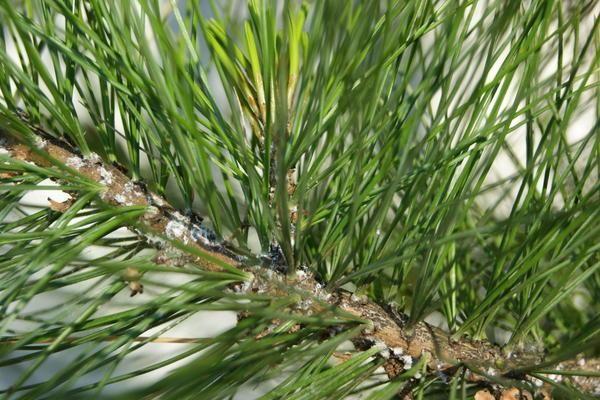
If cedar is significantly damaged by pitch canker, the tree is cut down and burned to prevent infection of neighboring plants. In the early stages of pitch canker, treatment involves the following measures:
- cleaning out ulcers on the trunk down to healthy tissue;
- processing of cuts with copper sulfate, painting with oil paint;
- pruning, disposal of diseased branches with disinfection of cuts, as on the trunk;
- removal of plant debris under a cedar pine tree;
- irrigation of the cedar tree trunk circle with solutions of Fitosporin, Gamair, Bayleton;
- spraying the crown and trunk with Rovral, Tilt, Vectra.
It is also recommended to combat bark beetles. Treatments with Taran and Clipper, carried out twice at weekly intervals, are effective.
Pine rust
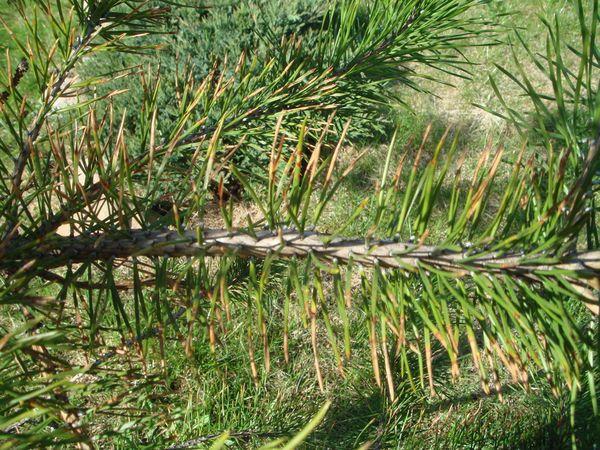
In spring, the Coleosporium fungus forms orange pads on cedar needles, which later burst. These pads release a rust-like powder (fungal spores) that spreads throughout the crown.
During their life cycle, pathogenic microorganisms attack the needles of young shoots, causing them to turn yellow and fall off. The disease reduces the cedar's ornamental value and inhibits the growth of new shoots.
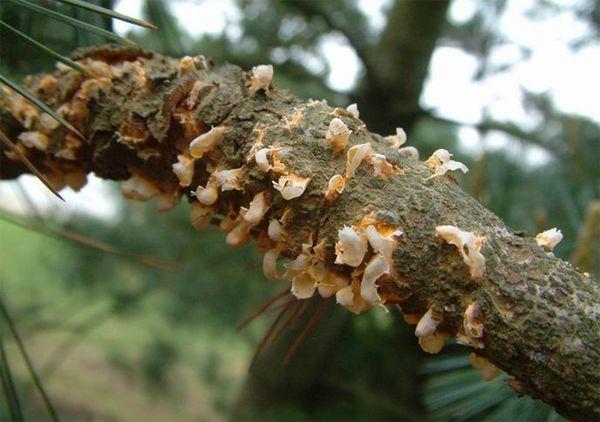
Branches damaged by rust are broken off and disposed of. Treatment with Abiga-Peak, Topaz, Strobi, and HOM is recommended. Treatments are performed twice.
How to control cedar pests
The scent of pine needles attracts insects, and pests are no exception. If the cedar is healthy, growing in favorable conditions, and receiving preventative treatments, it is immune to insect attacks.

Most often, pests attack young, fragile trees or pines that have sustained mechanical injuries or are weakened by disease.
Pine Hermes
The insect arrived in Russia from North America. When the brown aphid larvae, covered in long hairs, breed on cedar trees, the tree appears coated in a white film. Pine aphid moths feed on the cedar's cell sap, inhibiting vegetation and weakening the immune system. They quickly reproduce and migrate to neighboring trees.
Cedar trees are treated with insecticides monthly throughout the season, alternating between Karbofos, Decis, and Fufanon. In late fall or early spring, the soil around the tree trunk is watered with a solution of Actellic or Aktara.
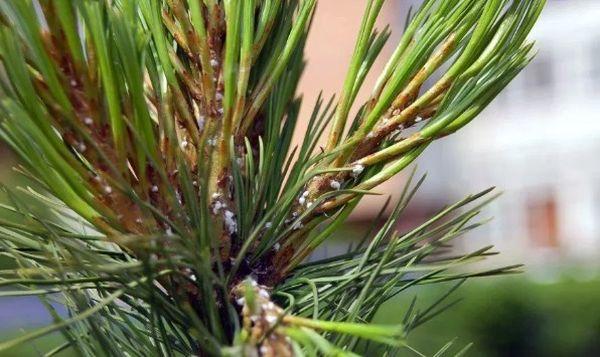
If the pests haven't had time to breed en masse, spray the cedar pine with a soap solution, or infusions of tobacco, garlic, onion, and pepper. The white coating on the needles doesn't disappear, but the larvae die.
Pine aphid
During their growth and reproduction, pine or Sitka aphids release toxins that have a detrimental effect on the pine needles. As a result of these insects' activity, cedar needles dry out and fall off. If the tree's crown thins and the bark develops a dirty purple coating, it means the cedar pine is infested with pests.
The peculiarity of pine brown aphids is that the insects settle on young branches in the spring, and in the summer they feed on the sap of the needles of old branches and the trunk of the cedar.
To get rid of aphids in the early stages of infestation, use Karbofos, repeating treatments every 10 days, paying particular attention to the trunk. When the pest population increases significantly, use Karate, Iskra, Tanrek, and Aktara.
Scale insect
Scale insects are common in gardens. These insects favor vegetable crops and fruit trees. The numerous species of scale insects are united by the presence of waxy shields on their bodies.
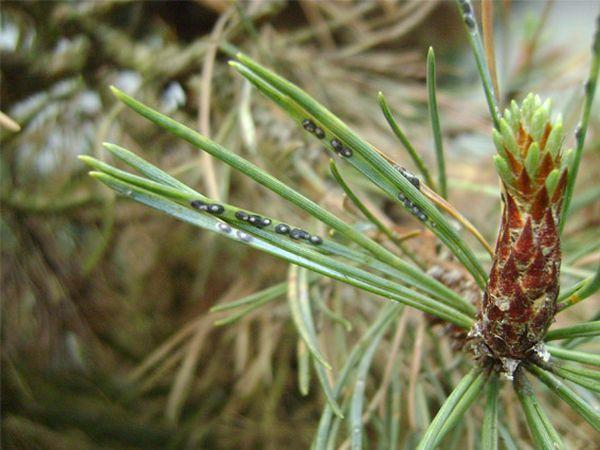
Damage to cedar trees growing in garden plots is caused by both adult pine scale insects and larvae, which pierce the needles with their proboscis, drink plant sap, and leave behind sticky honeydew.
The presence of a shield on insects eliminates the use of contact insecticides and necessitates the use of systemic drugs whose toxins penetrate into the cell sap.
Such products include Mospilan, Confidor, and Aktara. For best results, it is recommended to apply these products under the tree. At the same time, spray the needles with Operkot and Korsar.
Treatments with Decis, Fitoverm, and Fufanon are effective during the migration of larvae, when the infestation by pine scale insects is not widespread.
owl
The pine moth, with a 3-cm wingspan and flying at dusk and at night, is colored like pine bark. However, it's not the moths that harm the cedar, but the green caterpillars with red heads, up to 4 cm long, which begin their destructive activity in May.
Within 25-40 days, insects can cause serious damage to a cedar tree, gnawing off young shoots, buds, and needles. As a result, the cedar pine's immunity weakens, and its branches dry out. The tree becomes more vulnerable to attack by stem pests.
When fighting pine cutworm caterpillars in early spring, treating cedar with Lepidocide and Decis shows good results.
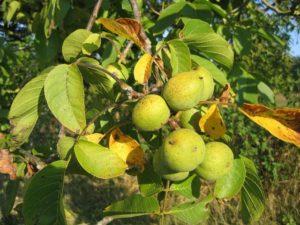
Silkworm
The caterpillars of the Siberian silkworm, a large, inconspicuous butterfly with a wingspan of up to 8 cm, are hardy and incredibly voracious. These insects can destroy vast areas of coniferous forests. Starting to feed on the needles from the lower branches of the tree, the caterpillars move upward, leaving bare branches in their wake. Bark beetles then finish the job, and the tree dies.
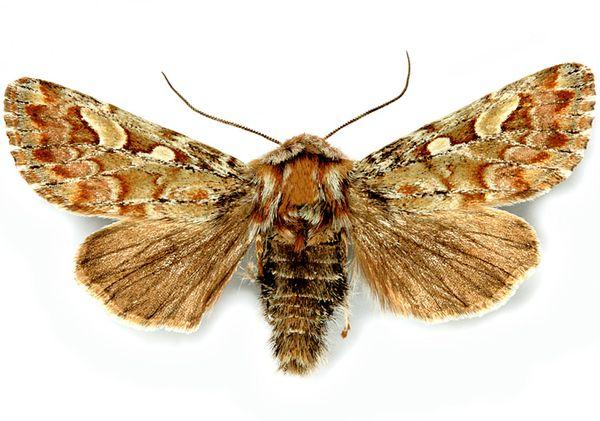
Silkworm caterpillars are eaten by cuckoos, woodpeckers, and wasps. To eradicate overwintered pests, treat cedar trees with insecticides in the spring, and to kill newly emerged caterpillars this year, spray in August.
The drug Lepidocide poisons caterpillars and repels Siberian silkworms.
Geometrid moth
The pine looper is a brown moth with a wingspan of up to 4 cm, featuring light and dark spots. Its yellow-green caterpillars with a brown head are harmful to cedar trees. The insects feed on pine needles at night, preferring older branches.
From July until the onset of cold weather, one caterpillar can eat more than 3 kg of needles.
To prevent geometer moth attacks next year, clear the tree trunk area in the fall of plant debris and grass litter, where the pupae overwinter. Dig up the soil around the tree trunk. In the spring, hang bird feeders and birdhouses to attract birds to the garden, and treat the cedar with insecticides.
Common engraver
This small beetle, about 2 mm long, belongs to the subfamily Bark Beetles. Its black-brown, cylindrical body is covered with sparse hairs. The pest gets its name from the engraving-like pattern it leaves on the trunk.
Engravers reproduce under the bark, where white larvae hatch from eggs located individually in separate chambers. The insects, feeding on the phloem, bore tunnels under the bark, creating wormholes.
During the season, engravers lay eggs twice, in the south - three times.
To prevent the appearance of the common cedar beetle on young cedars, seedlings are treated with Lepidocid. After flowering, all above-ground parts of mature trees are sprayed with Decis, Aktara, or Bi-58. Another, less harmful method is to hang anti-pheromone traps in the crown to repel bark beetles.
Rules for caring for cedar pine
A solitary cedar forms a spreading crown and a powerful root system. When planting, keep at least 3 meters away from fences and buildings. Cedar prefers fertile soil and good lighting.
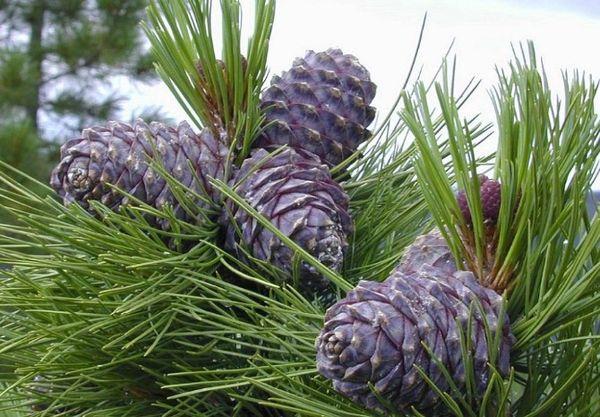
Siberian pine trees require moderate watering and misting during the first year of life. Mature Siberian pine trees receive sufficient natural precipitation.
To maintain the health of the root system and the formation of new root shoots, young trees are mulched with peat, increasing the mulch layer each year before the onset of winter and in the spring.
The tree's trunk area is kept clean. Plant debris and weeds are removed. Compost can be added to the cedar if desired. Fertilizer is incorporated into the soil during shallow loosening of the trunk area (up to 10 cm). Once a year, the Siberian pine is fertilized with a mineral complex.
Preventive measures
To prevent weakened immunity or death of the cedar, a range of protective measures against diseases and parasitic insects is carried out. This includes periodic inspections of the trunk and crown, sanitary pruning, treatments, and injections.
Hot fog
When generated by a gas generator, fine droplets at 60°C evaporate, turning into a hot mist. The dense cloud, consisting of tiny particles of the active ingredient, kills insects parasitizing cedar trees within 10 hours.
Unlike spraying, hot fog treatment envelops the entire tree, penetrating into hard-to-reach areas.
Due to the fact that the cloud of steam travels long distances when gusts of wind occur, this method is not recommended for use in private farmsteads and small summer cottages.
Spraying
Before sap flow begins, in early spring when temperatures are no lower than 6°C, after sanitary pruning, it is recommended to treat the cedar with antifungal agents such as Bordeaux mixture or copper sulfate. Repeat the treatment after two weeks. Spray methodically, directing the stream to all parts of the tree, not missing a single branch.
To prevent pest attacks, cedar pine is treated with acaricides (against mites), insecticides, or biological agents that are safe for humans and animals - Fitoverm, Fitosporin, Aktara, Actellik, Karate.
Protective measures are carried out every 2 weeks, alternating drugs.
Regular inspections of cedar for pests and diseases help take timely measures to get rid of pathogenic microorganisms and insects and maintain the health of the cedar.
Injections
The advantage of injections over spraying is that the active substance enters the tree's water-carrying vessels and begins to act immediately, without polluting the environment with chemicals.
This innovative method was developed by Soviet scientists and implemented by foreign scientists. The product is injected into the tree trunk under pressure, with the inlet hermetically sealed to prevent leakage. This method of preventing and treating bark beetles is particularly popular.
Improving conditions
Cedar growing conditions are created during planting. The tree thrives in open, sunny, and well-ventilated locations. Water accumulation in the trunk circle and shade are avoided. Healthy cedar pines, with a strong immune system that protects against diseases and parasitic insects, grow in a soil mixture consisting of equal parts black soil, peat, and sand.
Related posts:
 Causes and treatment of eggplant pests and diseases, how to combat them at home
 When and how to properly collect pine nuts, and how to process the collected cones
 The best eggplant varieties for growing in a polycarbonate greenhouse: planting and care
 Causes and treatment of cherry diseases, methods of pest control
 Methods for planting and propagating cherries at home
 Symptoms of diseases and pest attacks on hazelnuts, control measures
 Why plum tree leaves turn yellow and fall off, and the best control measures
 The best grape varieties for growing in the Urals, planting and care rules in summer